Spring Potential Energy PhysicsHooke's Law & Quadratic Energy Storage
Introduction
Spring potential energy is the elastic energy stored in a deformed spring, given by U = ½kx², where k is the spring constant in N/m and x is the displacement from equilibrium in metres. Unlike kinetic energy, which belongs to a moving mass, this energy resides in the spring itself: compress or stretch it, and the coils hold the energy until released. The spring constant k sets the stiffness, a stiffer spring stores more energy at the same displacement.
Engineers rely on this relationship wherever controlled energy storage matters: suspension springs absorb road-bump energy without allowing excessive travel, watch mainsprings meter out energy over hours, and valve springs in engines must store and release precise amounts of energy thousands of times per minute. In each case the design question reduces to choosing k and the operating displacement x so that ½kx² lands in the right range. The U-vs-x parabola is not a theoretical curiosity but a working design chart.
The quadratic dependence on x is the feature most people underestimate. With k = 80 N/m and x = 0.20 m, the Potential Energy readout shows 1.60 J. Sliding the displacement to x = 0.40 m, twice as far, pushes the readout to 6.40 J, four times higher, not twice. Most expect stretching twice as far to store twice the energy; the readout contradicts that expectation immediately.
The Physics Explained


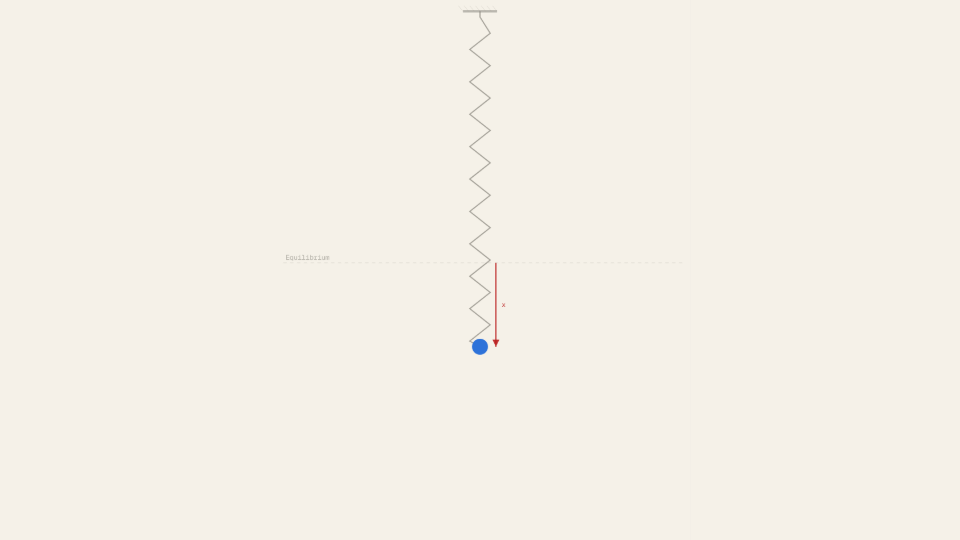
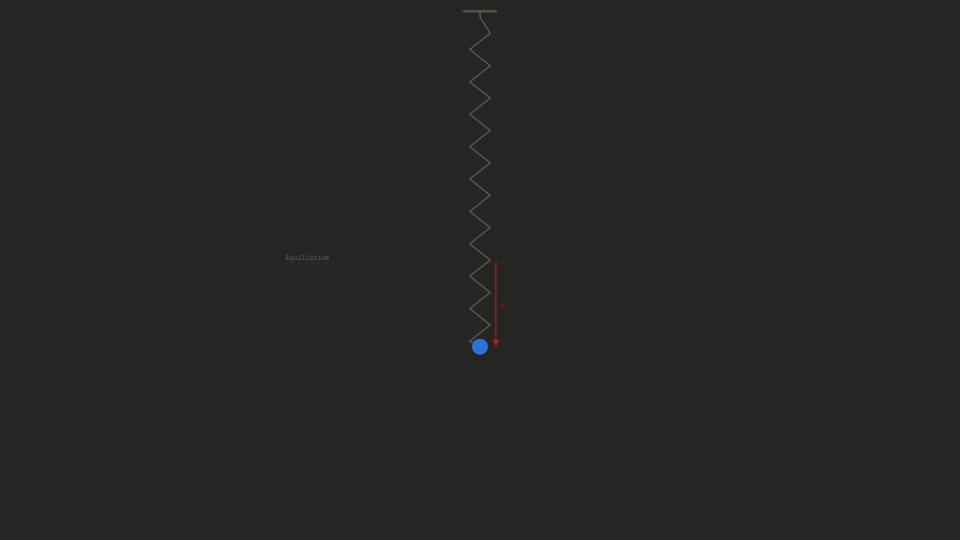
Hooke's law states that the restoring force a spring exerts is proportional to its displacement from equilibrium: F = −kx. The negative sign means the force always points back toward equilibrium, compress the spring and it pushes outward; stretch it and it pulls inward. This linear force law is what generates the quadratic energy formula. To move the spring's end from equilibrium to displacement x, work must be done against this restoring force; integrating F over that path from 0 to x gives ½kx², which is exactly the energy stored.
The simulator keeps this connection visible. With k = 80 N/m and x = 0.20 m, the Spring Force readout shows −16.00 N (the spring pushes back with 16 N) and the Potential Energy readout shows 1.60 J. Changing the displacement to x = 0.50 m raises the force magnitude to 40.00 N and the stored energy to 10.00 J. The force readout scales linearly with x; the energy readout scales as x².
The U-vs-x graph on the right panel of the simulator makes the parabolic shape explicit. As the displacement slider moves, the amber dot traces the curve U = ½kx² in real time, and crosshair guides project the current (x, U) pair onto both axes. The parabola is symmetric about x = 0 because squaring removes the sign: compressing by 0.20 m stores exactly as much energy as stretching by 0.20 m. Setting k = 200 N/m and x = 0.50 m places the dot at the parabola's upper edge, with the Potential Energy readout at 25.00 J, the simulator's worst-case storage value.
Changing k rescales the entire parabola without moving its vertex. With x fixed at 0.20 m, increasing k from 80 N/m to 200 N/m raises the Potential Energy readout from 1.60 J to 4.00 J, a 2.5× increase matching the ratio of the two spring constants. The parabola becomes steeper, meaning the same displacement now stores proportionally more energy, exactly the trade-off a designer makes when selecting between a soft and a stiff spring.
Key Equations
This is the central result. With k = 80 N/m and x = 0.20 m: U = ½ · 80 · 0.20² = ½ · 80 · 0.04 = 1.60 J. The Potential Energy readout in the simulator reports 1.600 J under those slider settings, confirming the formula to three decimal places. The ½ factor arises from integrating the linearly increasing force over the displacement path; it cannot be dropped.
The restoring force is linear in displacement and always opposes it. With k = 80 N/m and x = 0.20 m: F = −80 · 0.20 = −16.0 N. The Spring Force readout shows −16.00 N under those settings. At x = 0.50 m with k = 200 N/m, F = −200 · 0.50 = −100 N, the maximum restoring force the simulator's slider range can produce.
Doubling the displacement always quadruples the stored energy, regardless of k. With k = 80 N/m at x = 0.20 m the readout is 1.60 J; at x = 0.40 m it is 6.40 J, a ratio of exactly 4. This is not an approximation: it follows directly from (2x)² = 4x² inside the ½kx² formula. The same rule applies to compressions: x = −0.40 m also yields 6.40 J because squaring removes the sign.
At the slider extremes of k = 200 N/m and x = 0.50 m: Umax = ½ · 200 · 0.50² = ½ · 200 · 0.25 = 25.0 J. The Potential Energy readout confirms 25.000 J at those settings, and the amber dot sits at the top of the parabola on the U-vs-x graph. This value sets the upper boundary of the graph's U-axis at 26 J.
Key Variables
| Symbol | Name | Unit | Meaning |
|---|---|---|---|
| U | Elastic potential energy | J | Energy stored in the spring at displacement x |
| k | Spring constant | N/m | Stiffness; higher k means more force and more energy per unit displacement |
| x | Displacement | m | Distance from equilibrium; positive = stretched, negative = compressed |
| F | Restoring force | N | Force the spring exerts; always directed back toward equilibrium |
| xeq | Equilibrium position | m | The natural length position where F = 0 and U = 0 |
Real World Examples
Why do car suspension springs use stiff springs rather than soft ones?
A car suspension must absorb road-bump energy without allowing the chassis to bottom out. Because elastic PE scales as the square of displacement, a stiffer spring (larger k) stores the same energy at a smaller displacement. With k = 200 N/m and x = 0.25 m, the spring stores U = ½ · 200 · 0.25² = 6.25 J; achieving that same 6.25 J with k = 80 N/m would require x ≈ 0.395 m of travel, nearly 60% more compression.
Suspension designers therefore choose k large enough to keep wheel travel within the physical limits of the chassis geometry while still absorbing typical bump energy. The quadratic law also means that very large hits, which compress the spring far beyond the typical operating point, store disproportionately more energy, which is why bump stops (secondary stiff elements that engage at the travel limits) are always paired with the primary spring.
The relationship is verifiable in the simulator by comparing the Potential Energy readout at x = 0.25 m across two k settings. At k = 80 N/m the readout shows 2.500 J; at k = 200 N/m the same x = 0.25 m yields 6.250 J, confirming that doubling-plus k raises stored energy proportionally while the displacement stays fixed.
How does an archery bow store and release energy?
When an archer draws a bow, the limbs act as a distributed elastic element obeying Hooke's law across most of the draw range. The energy stored in the bent limbs is the integral of F·dx, which for a linear spring gives ½kx². A bow with an effective spring constant near 100 N/m drawn to x = 0.70 m stores approximately ½ · 100 · 0.70² = 24.5 J. On release, nearly all that elastic PE converts to the kinetic energy of the arrow.
The quadratic dependence means that a deeper draw delivers far more energy than a shallow one, and not in a linear proportion. Going from x = 0.35 m to x = 0.70 m doubles the draw length but quadruples the stored energy. Archers who maximise draw length gain a large energy advantage per the x² rule, which is why draw length is a regulated parameter in competitive archery.
The simulator reproduces this scaling directly. Setting k = 80 N/m and comparing x = 0.25 m (Potential Energy readout: 2.500 J) against x = 0.50 m (readout: 10.000 J) shows a 4× energy increase for a 2× displacement increase, matching ½ · 80 · 0.50² = 10.00 J and illustrating exactly the deeper-draw advantage an archer exploits.
Why must pogo-stick riders stay near the centre of the spring's travel to bounce efficiently?
A pogo stick converts elastic PE to gravitational PE and back on each bounce. Maximum height is reached when all the spring's stored energy has transferred to the rider's gravitational PE (mgh). Because spring PE grows as x², the energy available per bounce scales with the square of compression depth. A rider who compresses only half as far stores only one-quarter of the energy and rises to one-quarter of the height, not one-half.
This sensitivity means small reductions in compression depth lead to large efficiency losses. Experienced riders actively push down at the bottom of each cycle to maintain deep compression, keeping the system on the steep part of the U-vs-x parabola where small changes in x produce large changes in stored energy.
The simulator illustrates this directly: with k = 80 N/m, the Potential Energy readout reports 1.60 J at x = 0.20 m and 6.40 J at x = 0.40 m, a 4× increase for a 2× increase in displacement, matching the ½ · 80 · 0.40² = 6.40 J prediction exactly. The steepening slope of the U-vs-x parabola at larger x values is the same geometric fact that makes deep compression so much more valuable than shallow compression on a pogo stick.
Further Reading
- Damped spring: how energy stored in a spring dissipates over successive oscillations when friction or viscous damping is present.
- Spring-mass system: extending the spring force law into full oscillatory motion, connecting elastic PE to kinetic energy through conservation of energy.
- Pendulum energy bars: a side-by-side comparison of kinetic and potential energy across a swing cycle, showing the same PE-to-KE exchange that governs spring oscillation.
- Work by a variable force: the integral derivation that turns F = −kx into U = ½kx², connecting Hooke's law to the work-energy theorem.