Spring-Mass System PhysicsPeriod Formula & Harmonic Motion
Introduction
A mass attached to an ideal spring traces the cleanest oscillation in classical mechanics. Pull the mass away from equilibrium, release it, and the spring delivers a restoring force proportional to how far it was displaced, which produces a perfectly sinusoidal swing repeating at a single, well-defined frequency. The motion is called simple harmonic motion, and the spring-mass pair is the canonical example used to define every other oscillator that comes after it.
This system anchors the oscillations curriculum because almost any physical vibration, when looked at near equilibrium, behaves like a spring-mass pair. Atoms in a crystal lattice, molecules in a chemical bond, the mass on a car suspension, and the diaphragm of a loudspeaker all obey the same restoring-force-times-acceleration relationship. Once the period formula T = 2π√(m/k) is in hand, those advanced systems become variants of one foundational equation.
It seems reasonable that pulling the mass back farther, to a larger amplitude, should make each cycle take longer; there is more distance to cover. The Period T readout stays put regardless: with k = 10 N/m and m = 1.0 kg, it holds at about 1.99 s whether the Amplitude slider sits at 1.0 m or 2.0 m, because the larger swing also runs at a proportionally higher peak speed.
The Physics Explained
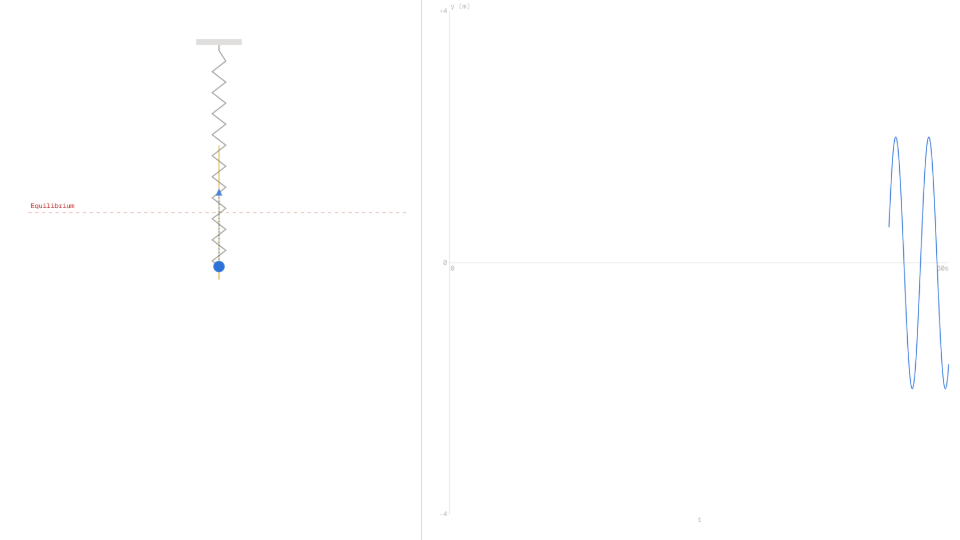
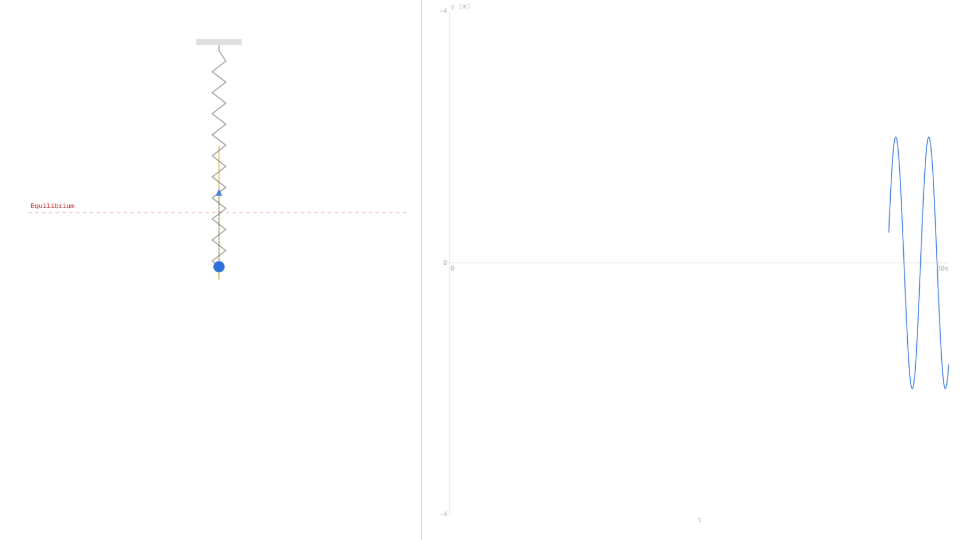
Hooke's law states that an ideal spring exerts a restoring force F = −k·x, where x is the displacement from equilibrium and k is the spring constant in N/m. The minus sign is the whole story: the force always points back toward x = 0, so a mass pulled below the rest line is yanked upward, and a mass compressed above it is pushed downward. Combine that with Newton's second law F = m·a and the equation of motion is m·ẍ = −k·x, whose solution is x(t) = A·cos(ωt + φ) with angular frequency ω = √(k/m).
At the slider defaults of k = 10 N/m, m = 1.0 kg, A = 2.0 m, and v₀ = 0, the angular frequency works out to ω = √(10/1) ≈ 3.162 rad/s and the period T = 2π/√10 ≈ 1.987 s. The Period T readout displays exactly this value before the run starts, computed live from the slider settings. Releasing the mass from rest at x = 2.0 m means the phase φ = 0, so the predicted trajectory is the pure cosine x(t) = 2.0·cos(3.162·t), and the Displacement readout begins at 2.000 m and falls smoothly through zero.
Energy conservation gives the swing its symmetry. At maximum displacement the mass is momentarily at rest, so all the energy is stored as elastic potential energy ½·k·x². At equilibrium the spring is unstretched, so all the energy is kinetic ½·m·v². With A = 2.0 m and k = 10 N/m the total is E = ½·10·4 = 20.0 J, and that 20 J shuttles back and forth between the two reservoirs forever in the absence of damping. The peak speed at x = 0 is therefore vmax = √(2E/m) = √40 ≈ 6.325 m/s.
Because period depends only on the ratio m/k, neither the amplitude nor the initial velocity changes the frequency of a Hookean spring. This property, called isochronism, is the reason mechanical clocks were built around mainsprings rather than pendulums for portable timekeeping. A direct check: stepping the Amplitude slider from 1.0 m to 2.0 m at fixed k and m leaves the Period T readout pinned at ≈ 1.99 s, while the peak Velocity reading scales linearly with A.
Key Equations
For the default amplitude x = 2.0 m and k = 10 N/m at the moment of release: F = −10 · 2.0 = −20 N. The minus sign means the 20-newton force points back toward equilibrium, accelerating the 1.0-kg mass at a = F/m = −20 m/s², the largest acceleration anywhere in the cycle.
With k = 10 N/m and m = 1.0 kg: ω = √(10/1) ≈ 3.162 rad/s. This is the rate at which the cosine argument advances, and it appears in both the displacement and velocity solutions below.
For the defaults: T = 2π · √(1.0/10) = 2π/√10 ≈ 1.987 s. The Period T readout shows ≈ 1.99 s on the same configuration, and the timed return of the mass to its starting position confirms the prediction within numerical drift over several cycles.
Plugging in A = 2.0 m and ω = 3.162 rad/s: x(t) = 2.0 · cos(3.162·t). At t = T/4 ≈ 0.497 s the cosine hits zero, so the Displacement readout passes through ≈ 0 m at that instant, matching the analytical prediction within rounding.
For the same defaults: vmax = A · ω = 2.0 · 3.162 ≈ 6.325 m/s, reached at x = 0. The Velocity readout peaks near −6.325 m/s at t ≈ 0.497 s and near +6.325 m/s at t ≈ 1.490 s, matching the sine prediction sign and magnitude.
For the defaults at the release instant: E = ½ · 10 · 2.0² + 0 = 20.0 J. At the equilibrium crossing: E = 0 + ½ · 1.0 · 6.325² ≈ 20.0 J. The two readouts sampled at any other instant (say x ≈ 1.414 m, v ≈ ±4.472 m/s) give 10.0 + 10.0 = 20.0 J, confirming conservation.
Key Variables
| Symbol | Name | Unit | Meaning |
|---|---|---|---|
| x | Displacement | m | Position of the mass relative to equilibrium |
| v | Velocity | m/s | Rate of change of displacement |
| k | Spring constant | N/m | Stiffness: restoring force per unit stretch |
| m | Mass | kg | Inertia of the object attached to the spring |
| A | Amplitude | m | Maximum displacement reached during the swing |
| ω | Angular frequency | rad/s | Rate of phase advance, ω = √(k/m) |
| T | Period | s | Time for one complete oscillation |
| E | Total mechanical energy | J | Constant sum of elastic and kinetic energy |
Real World Examples
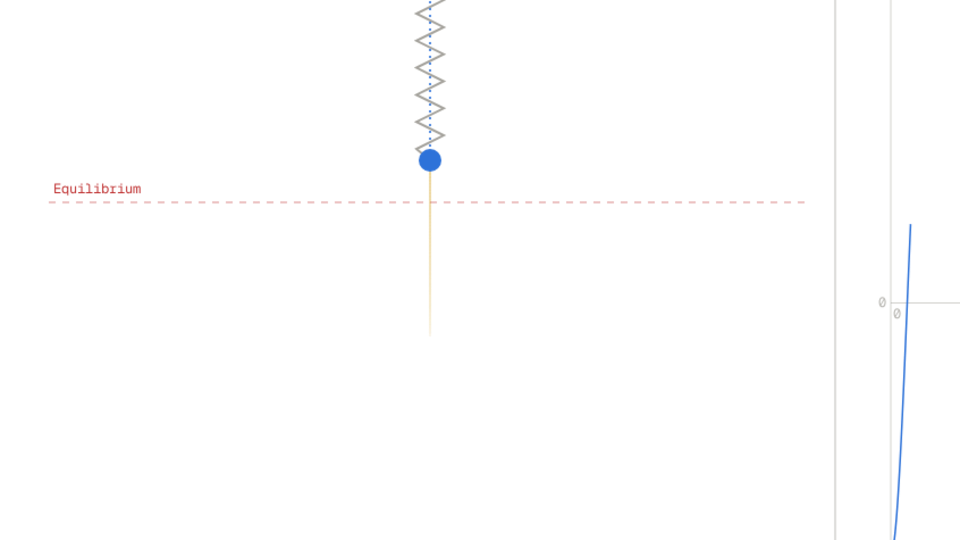
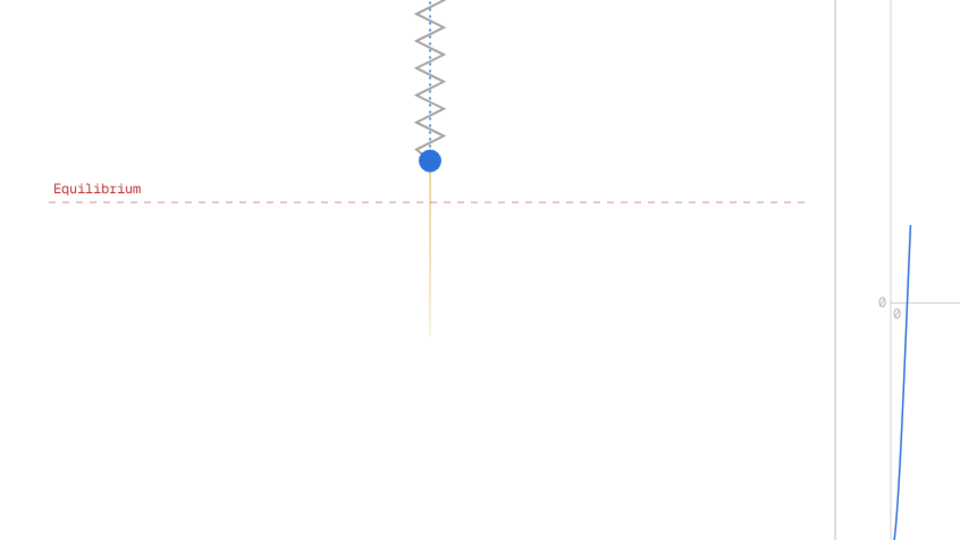
Why does a heavier car sit lower on the same suspension springs?
A typical sedan suspension spring has a stiffness near k = 25 000 N/m, and each spring carries roughly a quarter of the vehicle's weight. A 1 200 kg car loads each spring with 300 kg · 9.81 m/s² = 2 943 N, compressing it by x = F/k = 2 943/25 000 ≈ 0.118 m, or about 12 cm. Adding 200 kg of passengers and cargo raises the load to 3 434 N and the static compression to 0.137 m; the back of the car visibly sinks by a couple of centimetres until the spring force balances the added weight.
The same load-versus-stretch relationship plays out at small scale on screen. With k = 10 N/m and m = 1.0 kg, releasing from rest at the natural compression x = m·g/k = 0.98 m produces a Period T readout near 1.99 s, while doubling Mass to 2.0 kg both increases the static compression to 1.96 m and stretches the period to T = 2π·√(2/10) ≈ 2.81 s. Suspension engineers exploit exactly this trade-off: a stiffer spring sags less under load but transmits more road harshness into the cabin.
How does a mechanical wristwatch keep accurate time?
The hairspring inside a balance wheel is a tiny torsional spring-mass system that ticks at a fixed rate set by its own k and m, almost completely independent of how hard the mainspring drives it. A typical hairspring oscillates at 4 Hz, so the period is T = 0.25 s, set by 2π·√(I/κ) where κ is the torsional stiffness and I is the wheel's moment of inertia. The watchmaker's job is to tune κ and I so the product matches the desired period to within a few parts per million.
Isochronism is what makes this work. Because T depends on the m/k ratio and not on amplitude, the watch keeps the same period whether the mainspring is fully wound or nearly run down. The simulator shows this directly: with k = 10 N/m and m = 1.0 kg, sweeping the Amplitude slider from 0.5 m to 2.0 m leaves the Period T readout fixed at ≈ 1.99 s, while the peak Velocity reading scales linearly from ≈ 1.58 m/s to ≈ 6.32 m/s.
Why do tall buildings need tuned mass dampers?
A 300-metre skyscraper has a fundamental sway period near T = 6 s, set by its effective stiffness and distributed mass via the same T = 2π·√(m/k) relationship that governs a single spring. When wind gusts contain energy at that 0.17 Hz frequency the building resonates, and unchecked sway can reach amplitudes that make occupants seasick. A tuned mass damper, a several-hundred-tonne steel pendulum hung high in the structure, is engineered to oscillate at the same frequency but in opposite phase, draining energy from the building's swing.
The simulator illustrates the underlying period-tuning step. With m = 1.0 kg, raising k from 10 N/m to 40 N/m drops the Period T readout from ≈ 1.99 s to ≈ 0.99 s, a factor of two as predicted by T ∝ 1/√k. To match a target frequency, designers solve k = (2π/T)²·m for the required spring stiffness, exactly as a watchmaker would for a balance wheel; only the units change.
Further Reading
- Damped spring oscillations: what happens when friction is added to the same spring-mass pair, and how the amplitude decays exponentially while the period barely shifts.
- Simple pendulum motion: gravity replaces the spring as the restoring force, and the period formula T = 2π·√(L/g) follows the same √(inertia/stiffness) pattern.
- Double pendulum dynamics: two coupled oscillators whose linearised normal modes reduce to two independent spring-mass systems near equilibrium.