Simple Pendulum PhysicsWhy Period Depends on Length, Not Mass
Introduction
A simple pendulum is a point-mass bob hung from a frictionless pivot by a massless rigid rod, free to swing in a vertical plane under gravity. The simulator runs the full nonlinear equation θ'' = −(g/L) · sin(θ), so the bob obeys real swing physics rather than the textbook small-angle shortcut. Length, initial angle, and damping are the three sliders, and the readouts expose Time, Angle, Period, and angular velocity ω.
Pendulums anchor the chapter on oscillations because the same restoring-force structure appears in clock escapements, seismograph beams, building dampers, and walking gait. Understanding why a one-metre pendulum has a period near two seconds (and why that number stops being right past about 20°) is the gateway to every richer oscillator that follows.
Intuition suggests that pulling the bob back farther should shorten each swing, since the bob moves faster. The measured times say no: with L = 1.0 m and a 10° release the swing returns to its starting angle near 2.01 s, but releasing from 60° at the same length stretches the round trip to about 2.15 s. The wider arc is geometrically longer, and the restoring force is weaker than the linear formula assumes, so the period grows even as peak speed grows too.
The Physics Explained
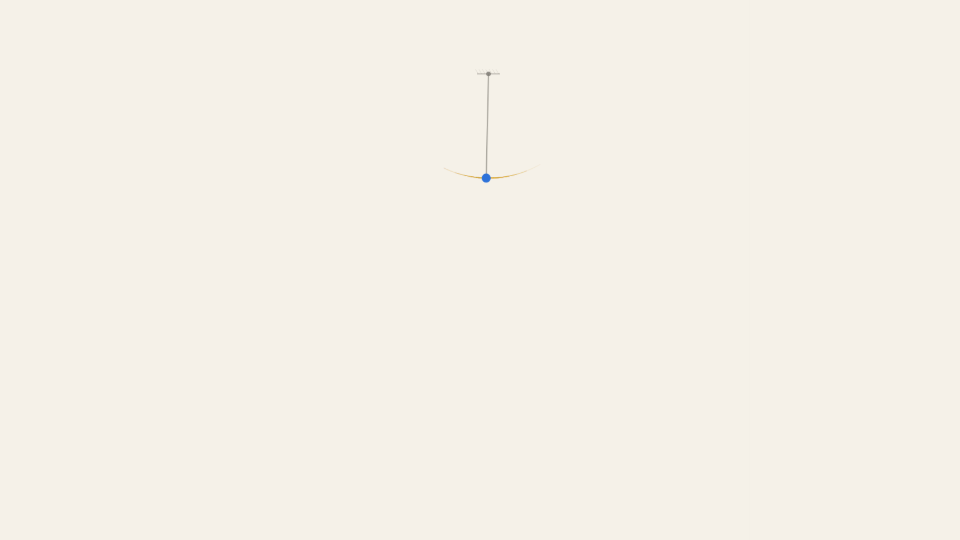
Two forces act on the bob: rod tension along the string, which only redirects motion, and gravity straight down. Project gravity onto the arc and the tangential component is −g · sin(θ). Because the bob's distance from the pivot is fixed at L, the tangential acceleration becomes L · θ'', and the equation of motion is θ'' = −(g/L) · sin(θ). The negative sign is the restoring character: whenever θ leaves zero, the bob is pulled back toward zero. The simulator integrates this equation directly, sin(θ) rather than its linear stand-in, at a 1/240 s substep, which is why the on-canvas swing matches reality even at large amplitudes.
For small angles, sin(θ) ≈ θ in radians, so the equation collapses to θ'' = −(g/L) · θ. That is the defining shape of simple harmonic motion, and its solution oscillates at constant frequency with amplitude-independent period T = 2π · sqrt(L/g). Plugging the default L = 1.0 m gives T ≈ 2.006 s, which is what the Period readout displays. With Initial Angle 10° and Damping 0, the actual time between successive returns to +10° lands near 2.01 s; the small-angle prediction holds to within a few tenths of a percent.
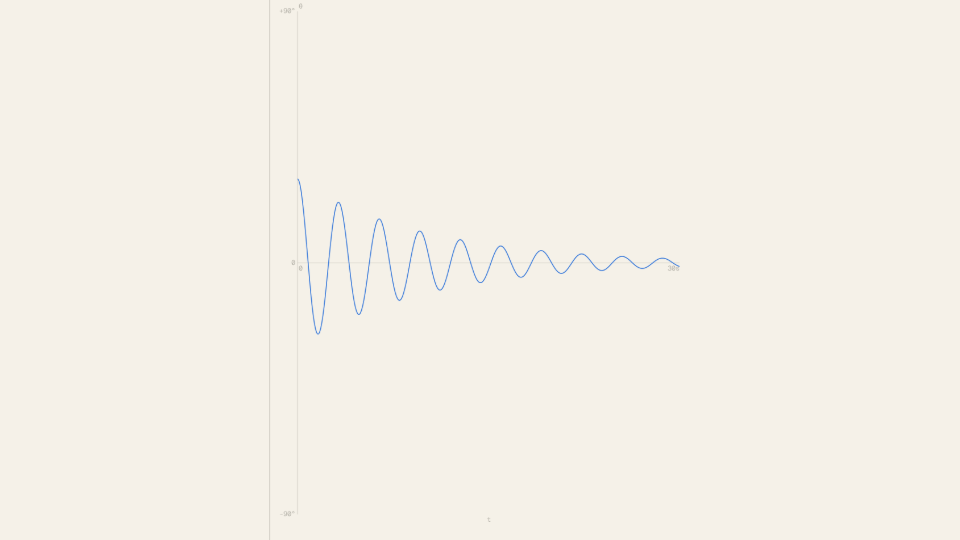
Push the angle larger and the linear formula starts to lie. The Period readout still reports 2.006 s for L = 1.0 m because that number is computed straight from the formula, but the bob takes longer to actually return. At Initial Angle 60° the measured swing time is about 2.15 s, roughly 7% above the displayed Period. At 85° the gap widens to almost 18%. This is not a numerical bug; it is the genuine signature of the sin(θ) curve sitting below its tangent line. Larger swings dwell longer near the turnaround points where the restoring force is weakest.
Length and gravity are the only knobs that move the small-angle period: the bob's mass cancels out of θ'' = −(g/L) · sin(θ) entirely. Quadrupling the rod length doubles the period because of the square root: at L = 4.0 m the prediction becomes 2π · sqrt(4.0/9.81) ≈ 4.012 s, exactly twice the L = 1.0 m value. Adding damping does not change the period much at the small-angle limit, but it bleeds amplitude every cycle. With Damping 0.20 and Initial Angle 30° the bob's swing visibly shrinks while the zero-crossing intervals stay close to constant.
Key Equations
This is what the simulator integrates. With g = 9.81 m/s² and L = 1.0 m, releasing from θ₀ = 10° = 0.1745 rad gives an initial angular acceleration of −9.81 · sin(0.1745) ≈ −1.703 rad/s². The bob never leaves this rule for the duration of the run.
Replacing sin(θ) with θ is accurate to about 0.5% at 10° and to about 5% at 30°. At the default L = 1.0 m and θ₀ = 10° the linearised acceleration is −9.81 · 0.1745 ≈ −1.712 rad/s², within 0.6% of the exact value above.
For L = 1.0 m: T = 2π · sqrt(1.0 / 9.81) = 2π · 0.3193 ≈ 2.006 s. The simulator's Period readout shows exactly 2.006 s on the default configuration, and a stopwatch on the Time readout between successive returns to +10° agrees within a fraction of a percent.
For L = 1.0 m: ω₀ = sqrt(9.81) ≈ 3.132 rad/s. The peak |ω| readout at the bottom of the swing for a 10° release is ω₀ · sin(10°) ≈ 3.132 · 0.1736 ≈ 0.544 rad/s, which is what the angular-velocity display reaches as the bob crosses θ = 0.
Take m = 1 kg as a reference. At θmax = 10° = 0.1745 rad, E = 1 · 9.81 · 1.0 · (1 − 0.9848) ≈ 0.149 J. With Damping 0 this energy is conserved exactly; with Damping 0.20 the simulator's amplitude shrinks and the equivalent E decays toward zero.
Key Variables
| Symbol | Name | Unit | Meaning |
|---|---|---|---|
| θ | Angle | rad (or °) | Angular displacement from vertical equilibrium |
| θmax | Amplitude | rad (or °) | Maximum angle reached during the swing |
| L | Length | m | Pivot-to-bob distance along the rigid rod |
| g | Gravitational acceleration | m/s² | 9.81 m/s² downward near Earth's surface |
| m | Mass | kg | Mass of the point bob; cancels in the period formula |
| T | Period | s | Time for one full back-and-forth swing |
| ω | Angular velocity | rad/s | Rate at which the angle θ changes |
| b | Damping | kg/s | Velocity-proportional drag coefficient |
Real World Examples
Why does a one-metre pendulum clock tick almost exactly once per second?
The grandfather clock industry settled on a roughly one-metre pendulum because the small-angle period for L = 1.0 m and g = 9.81 m/s² is T = 2π · sqrt(1.0 / 9.81) ≈ 2.006 s. Half of that round trip, the time between left-extreme and right-extreme, is just over one second, which is precisely the cadence of the second hand. The choice was not aesthetic. It came directly out of T = 2π · sqrt(L/g) and the constraint of building a clock that beats seconds.
The simulator reproduces this number on its default configuration. Set Length to 1.0 m, Initial Angle to 10°, and Damping to 0, and the Period readout reads 2.006 s. Time successive returns of the Angle readout to +10° using the Time readout and the interval lands inside 2.01 s. A clock escapement keeps the swing amplitude tiny (usually a couple of degrees) precisely so that the small-angle formula stays accurate to the tenth of a percent its accuracy claims demand.
If a horologist needs a half-second beat instead of a one-second beat, the same equation forces the rod length down. Solving 1.0 = 2π · sqrt(L/9.81) gives L ≈ 0.248 m, and the simulator at L = 0.25 m reports a Period of 1.003 s on its readout: half the one-metre value, exactly as the square root of one-quarter predicts.
How long should a Foucault pendulum be to swing slowly enough to read the Earth's rotation?
A Foucault pendulum demonstrates the rotation of the Earth by tracing a slowly precessing line of swing across the floor of a museum atrium. For the precession to be visible to a casual observer, each individual swing must be long enough that the eye can follow it: museum installations usually choose rod lengths between 15 m and 30 m. Plugging L = 25 m into T = 2π · sqrt(L/g) gives a period of about 10.03 s, slow enough to watch the bob arc across the room without strain.
The square-root scaling is what forces the rod to be so long. Doubling the period from 2 s to 4 s requires quadrupling the length, from 1.0 m to 4.0 m. Reaching 10 s requires a length 25 times the one-metre baseline. The simulator confirms the trend at the lower end: setting Length to 4.0 m and Initial Angle to 10° gives a Period readout of 4.012 s, exactly twice the L = 1.0 m baseline of 2.006 s, with the measured time on the Time readout matching to within rounding.
Real Foucault installations also keep the release angle small, typically under 5°, for the same reason clock pendulums do. Larger angles introduce the sin(θ) period growth that the simulator exposes at 60° and 85°, which would muddy the precession signature the demonstration is meant to highlight.
Why are seismograph pendulums tuned to long periods?
A seismograph pendulum needs to stay still while the ground beneath the pivot moves. That separation works only when the natural period of the pendulum is much longer than the period of the ground motion being recorded. Typical earthquake surface waves run from 1 s to 30 s, so seismograph designs target natural periods well above 30 s. Solving T = 2π · sqrt(L/g) for that target gives a required length of about 224 m on a vertical pendulum, which is why real seismographs use lever and spring tricks rather than a single long rod.
The simulator illustrates the trend without requiring the full seismograph length. At Length 4.0 m and Initial Angle 10°, the Period readout shows 4.012 s and the bob takes its time across the screen. Cut Length back to 0.25 m and the Period readout drops to 1.003 s; the swing becomes too quick to dissociate from rapid pivot motion. The longer the pendulum, the more sluggishly the bob responds: exactly the inertia-versus-pivot separation the seismograph engineer needs.
Further Reading
- Spring-mass oscillator: the same restoring-force structure with a Hooke's-law spring instead of gravity, and the cleanest setting in which to see simple harmonic motion stripped of nonlinearity.
- Damped spring: what happens when a velocity-proportional drag term is added to the oscillator, and how underdamped, critically damped, and overdamped regimes look on a swing-time graph.
- Double pendulum: attach a second pendulum to the bob of the first and the system's behaviour leaves the small-angle window entirely, becoming famously chaotic for almost any release configuration.