Damped Spring PhysicsDamping Ratio & Decay Regimes
Introduction
A damped spring describes a mass attached to a spring while a velocity-proportional resistive force bleeds energy out of the motion. Without that resistance the mass would oscillate forever at a fixed amplitude; with it, the motion either decays as a shrinking oscillation, slides smoothly back to rest, or creeps toward equilibrium without ever crossing it. A single dimensionless number, the damping ratio ζ = c / (2·sqrt(m·k)), selects between those three regimes from the same underlying equation of motion.
The model is the workhorse of every vibration problem in mechanical and civil engineering. Car suspensions, door closers, vibrating circuit elements, seismograph pickups, and the shock mounts inside a hard drive all reduce to a mass, a spring, and a dashpot. Once a designer fixes m and k for the structural job at hand, the choice of damping coefficient c is what decides whether the system rings, settles cleanly, or sluggishly recovers.
Intuition insists that any nonzero damping should kill the oscillation outright. Yet with k = 10 N/m, m = 1.0 kg, and c = 3.00 N·s/m, the Damping ratio readout sits at 0.474 and the trail still swings through several visible peaks before flattening, because ζ has to reach 1.0 before oscillation actually stops.
The Physics Explained
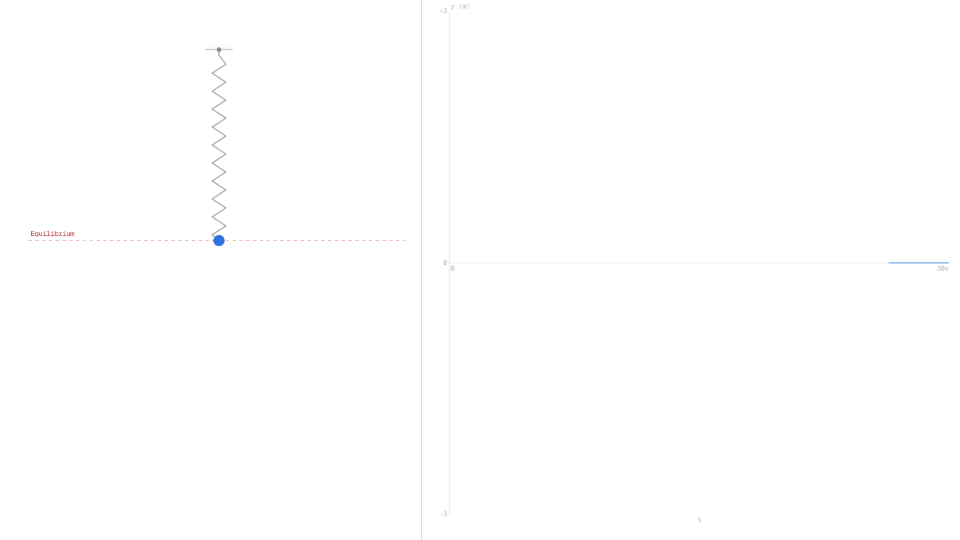
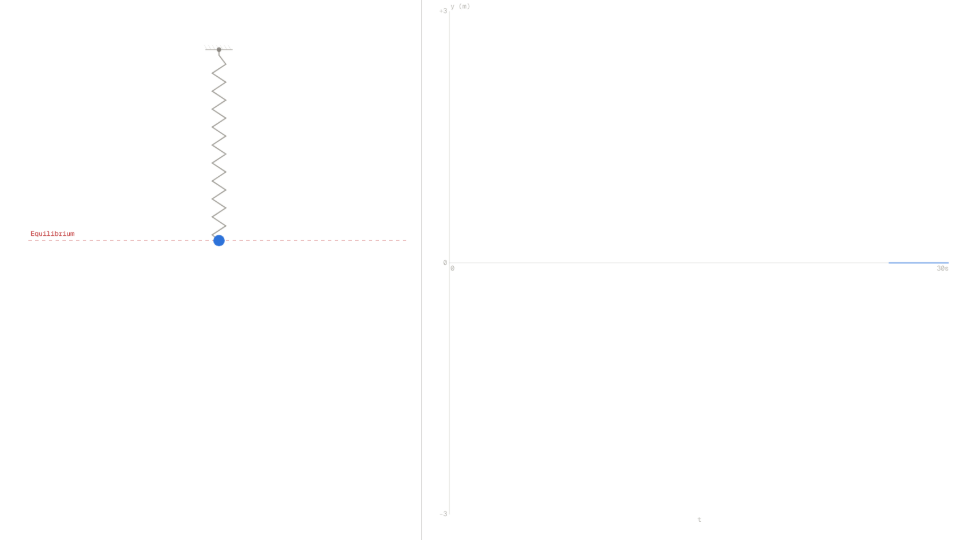
The mass on the spring carries two forces in this model. The spring contributes a restoring force −k·x that always points back toward the equilibrium line at x = 0 with magnitude proportional to displacement, the linear Hooke's-law form. The dashpot contributes a viscous drag −c·ẋ that opposes whichever way the mass is moving, with magnitude proportional to speed. Newton's second law combines them into a single second-order linear differential equation, m·ẍ + c·ẋ + k·x = 0, which the simulation integrates step by step from the initial conditions set by the sliders.
With the default Spring Constant 10 N/m, Mass 1.0 kg, and Damping 3.00 N·s/m, the natural angular frequency is ω₀ = sqrt(k/m) = sqrt(10) ≈ 3.162 rad/s, the decay rate is γ = c/(2m) = 1.5 s⁻¹, and the damping ratio is ζ = c / (2·sqrt(m·k)) ≈ 0.474. Because ζ < 1 the simulator reports an under-damped run: the mass starts at the Initial Displacement of 1.0 m, swings through the equilibrium line at the predicted t ≈ 0.741 s, and reaches its first negative peak near t ≈ 1.13 s at roughly x ≈ −0.18 m on the Displacement (m) readout.
Each successive peak shrinks by the same exponential factor e^(−γ·Td), where Td = 2π/ωd ≈ 2.257 s is the damped period and ωd = sqrt(ω₀² − γ²) ≈ 2.784 rad/s. That ratio works out to about 0.034 for the default settings, so the second positive peak is roughly 30 times smaller than the first and the trail visibly flattens onto the equilibrium line within a few cycles. The shrinking envelope is independent of the starting amplitude, which is why doubling the Initial Displacement slider changes the height of every peak proportionally without altering the timing.
Nudging the Damping slider upward keeps shifting the readout. The Damping ratio crosses 1.0 exactly at c = 6.32 N·s/m for k = 10 N/m and m = 1 kg, and at that value the trail stops crossing the equilibrium line and instead glides straight back to zero: the critically damped regime. Beyond it, at c = 20 N·s/m, ζ ≈ 3.16 and the same release from 1.0 m creeps slowly toward equilibrium without overshoot, the over-damped regime. The transition is sharp because ωd is a square-root branch that vanishes at the boundary.
Key Equations
Substituting the defaults k = 10 N/m, m = 1.0 kg, c = 3.00 N·s/m gives ẍ + 3·ẋ + 10·x = 0. The simulator integrates this same ODE numerically; every readout the user sees comes from forward-stepping it from the initial state x = 1.0 m, ẋ = 0.
For the defaults: ω₀ = sqrt(10 / 1) ≈ 3.162 rad/s. This is the frequency the system would hold forever if the Damping slider were set to 0 N·s/m, and it is the upper bound on the oscillation rate at any nonzero damping.
For the defaults: ζ = 3 / (2·sqrt(10)) ≈ 0.474. The simulator's Damping ratio readout displays this exact value to three decimals because it computes ζ from the same definition. Any setting with ζ < 1 oscillates, ζ = 1 returns straight to rest, ζ > 1 creeps.
For the defaults: γ = 3 / 2 = 1.5 s⁻¹, so ωd = sqrt(10 − 2.25) = sqrt(7.75) ≈ 2.784 rad/s. The damped period is Td = 2π / ωd ≈ 2.257 s, which the user can confirm by timing the gap between two consecutive zero crossings on the trail.
Released from rest at x₀ = 1.0 m the constants are A ≈ 1.137 m and φ ≈ −0.494 rad, giving x(t) ≈ 1.137·e^(−1.5·t)·cos(2.784·t − 0.494). At t ≈ 1.13 s this evaluates to x ≈ −0.18 m, matching the first negative-peak value on the Displacement (m) readout.
For k = 10 N/m and m = 1 kg: cc = 2·sqrt(10) ≈ 6.32 N·s/m. Setting the Damping slider to that value drives the Damping ratio readout to 1.000 and produces the fastest non-oscillating return, a single smooth glide from x = 1.0 m to the equilibrium line.
Key Variables
| Symbol | Name | Unit | Meaning |
|---|---|---|---|
| x | Displacement | m | Distance from equilibrium |
| m | Mass | kg | Inertia of the moving body |
| k | Spring constant | N/m | Stiffness of the spring |
| c | Damping coefficient | N·s/m | Strength of viscous drag |
| ω₀ | Natural angular frequency | rad/s | Undamped oscillation rate |
| ωd | Damped angular frequency | rad/s | Actual rate when ζ < 1 |
| ζ | Damping ratio | dimensionless | Selects regime; 1.0 is critical |
| γ | Decay rate | 1/s | Envelope shrink rate c/(2m) |
Real World Examples
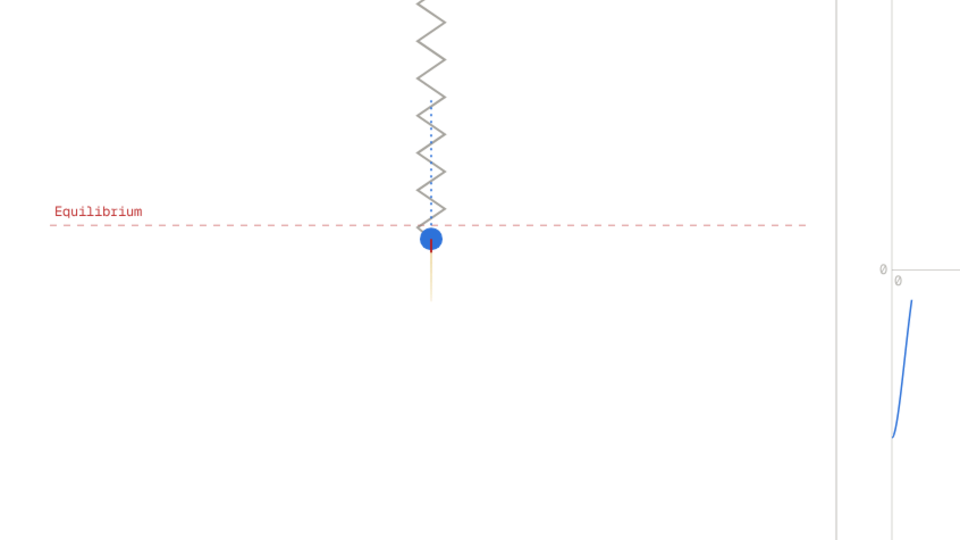
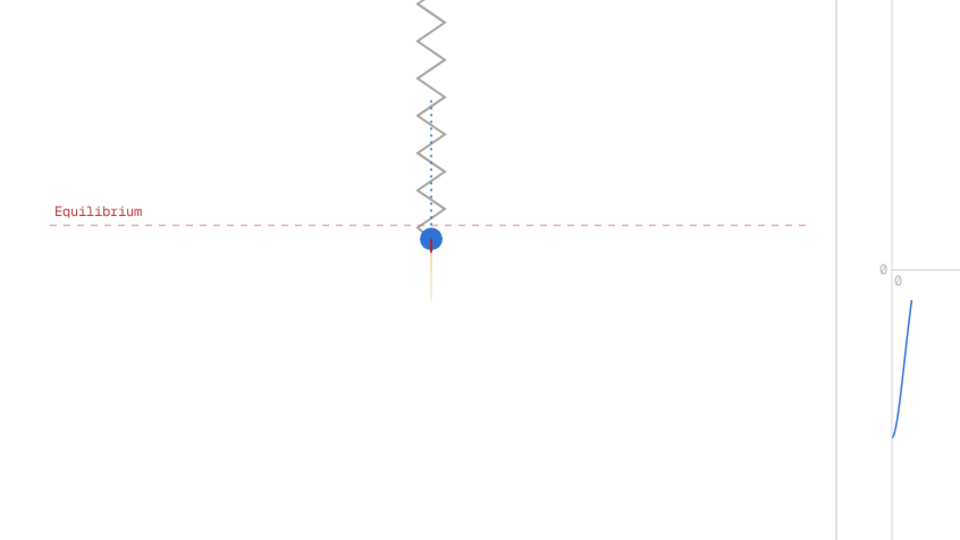
Why are car shock absorbers tuned just below critical damping?
A passenger car suspension is engineered with a damping ratio in the neighbourhood of 0.2 to 0.4 for the comfort of the cabin and closer to 0.7 for the handling response of the wheel-and-tyre subsystem. The choice is deliberate: a fully critically-damped suspension would feel harsh because the spring deflection cannot overshoot at all, while a lightly damped one would let the chassis float and bob after a single bump. Sitting just below critical gives the body a small, quickly-extinguished overshoot that masks high-frequency road noise without surrendering control.
The simulator reproduces the trade-off across the same ζ range used in real chassis tuning. With k = 10 N/m and m = 1.0 kg, setting Damping to 3.00 N·s/m yields ζ = 0.474 on the readout and a visible decaying oscillation that flattens within a few cycles, mimicking a comfortable family car. Pushing the Damping slider to 6.32 N·s/m drives ζ to 1.000 and the trail returns straight to equilibrium without overshoot, the boundary between sport-firm and floaty that suspension engineers spend their working hours dialling in.
How do tuned mass dampers stop tall buildings from swaying?
A skyscraper is, dynamically, a tall vertical spring with a small inherent damping ratio of perhaps 0.01 to 0.02, so light that wind gusts at the building's natural frequency can pump enough energy in to make occupants seasick. Engineers add a tuned mass damper, a multi-tonne pendulum or sliding block coupled to the structure through a stiff spring and a heavy dashpot. The damper's parameters are chosen so the combined system behaves like a single damper with ζ near 0.1 to 0.2, dropping the peak sway by a factor of three or four during a typhoon.
The simulator illustrates the mechanism with a single-mass version of the same physics. Holding k = 10 N/m and m = 1.0 kg fixed and stepping the Damping slider from 0.50 N·s/m up through 3.00 N·s/m, the Displacement (m) readout shows the first negative peak shrinking from roughly −0.78 m to −0.18 m. The damper inside Taipei 101 does the same job at a vastly larger scale, converting the building's sway energy into heat in the dashpot's hydraulic fluid before the next gust can resonate with it.
What sets the response time of an analogue ammeter needle?
A pivoted ammeter needle behaves as a torsional spring-mass-damper system. The torsional spring sets ω₀, the rotational inertia of the needle and coil sets m, and a thin film of viscous oil or a copper damping vane sets c. Instrument designers tune c so the meter sits at ζ ≈ 1.0, the critically damped regime, because that gives the fastest possible reading without the needle overshooting and swinging past the true value. Underdamped meters waste the operator's time waiting for oscillations to die; overdamped ones lag.
The simulator quantifies the time penalty for missing critical damping. With k = 10 N/m and m = 1.0 kg, setting the Damping slider to 6.32 N·s/m gives ζ = 1.000 on the readout and the Displacement (m) trace decays to within 1% of equilibrium in roughly 4.6 s. Cutting the Damping slider in half to 3.00 N·s/m drops ζ to 0.474 and the same 1% settling target slips out beyond 6 s once the residual oscillation envelope is included: exactly the design penalty meter manufacturers calibrate around.
Further Reading
- Simple harmonic motion: the undamped spring-mass baseline that this article specialises by adding a velocity-proportional drag term to the equation of motion.
- Projectile motion: a non-oscillating Newtonian system that shares the linear ODE machinery used to derive the damped-spring solution.