Damped Spring · SimulatorUnder-, Critical & Overdamping
A spring-mass system with adjustable damping showing underdamped, critical, and overdamped motion.
Published: April 29, 2026 · Updated: May 28, 2026
Objective
Verify that a mass-spring-damper system obeys m·ẍ + c·ẋ + k·x = 0 and that the dimensionless damping ratio ζ = c/(2·√(m·k)) alone selects which of three regimes the motion follows: under-damped (ζ < 1, decaying oscillation), critically-damped (ζ = 1, fastest non-oscillating return), and over-damped (ζ > 1, slow non-oscillating return). Confirm that the under-damped angular frequency is ω_d = √(ω₀² − γ²) with γ = c/(2m) and ω₀ = √(k/m), shifted below the natural frequency by the damping.
Setup
- Set the Spring Constant slider to 10 N/m and the Mass slider to 1.0 kg, so the natural angular frequency is ω₀ = √(k/m) = √10 ≈ 3.162 rad/s.
- Set the Damping slider to 3.00 N·s/m and the Initial Displacement slider to 1.0 m. The Damping ratio ζ readout should display 0.474, placing the system in the under-damped regime.
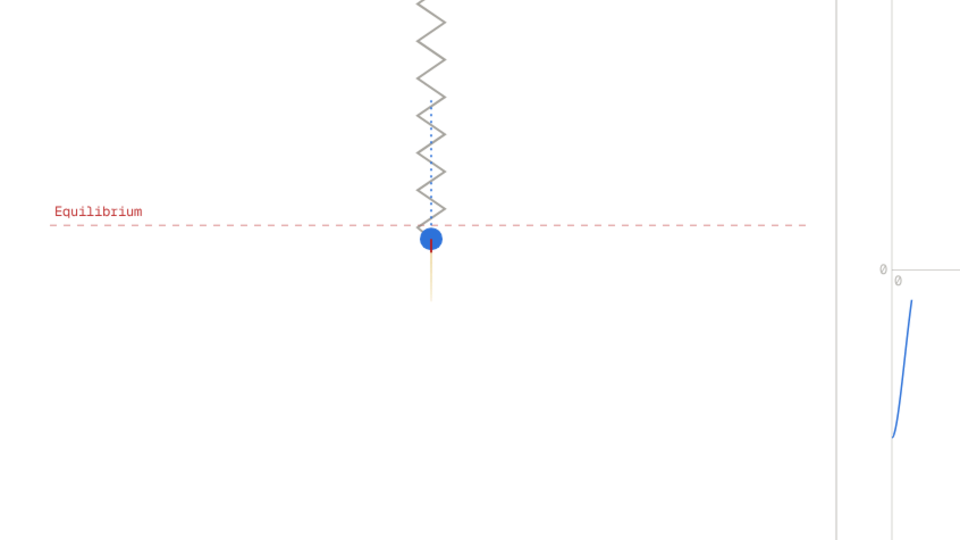
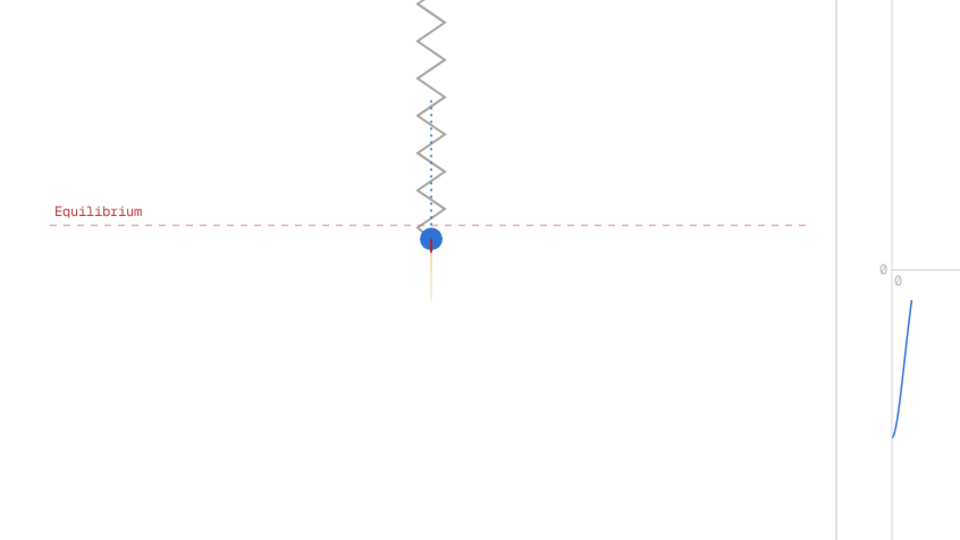
- Press Start. The mass is released from rest at x = +1.0 m and oscillates about the equilibrium line with shrinking amplitude. The dotted blue arrow shows velocity; the solid red arrow shows the spring restoring force.
- Watch the Displacement (m) and Velocity (m/s) readouts and the trail. Note the time of the first zero crossing and the magnitude of the first negative peak.
- Press Reset, then move the Damping slider to 6.32 N·s/m, the value of c that gives ζ = 1 for k = 10 N/m and m = 1 kg. Press Start and observe a single non-oscillating return to equilibrium.
- Press Reset, set the Damping slider to 20.0 N·s/m (ζ ≈ 3.16), press Start, and observe the slow asymptotic creep back to equilibrium with no overshoot.
Analytical Prediction
With k = 10 N/m, m = 1 kg, and c = 3 N·s/m, the natural angular frequency, decay rate, and damping ratio are:
Because ζ < 1 the motion is under-damped and follows x(t) = A·e^(−γ·t)·cos(ω_d·t + φ) with ω_d = √(ω₀² − γ²) = √(10 − 2.25) = √7.75 ≈ 2.784 rad/s. From rest at x₀ = 1 m the constants are A ≈ 1.137 m and φ ≈ −0.494 rad, so x(t) ≈ 1.137·e^(−1.5·t)·cos(2.784·t − 0.494). The damped period is T_d = 2π/ω_d ≈ 2.257 s, the first zero crossing falls near t ≈ 0.741 s, and the first negative peak near t ≈ 1.870 s reaches roughly x ≈ −0.430 m. After one full period the envelope has shrunk by e^(−γ·T_d) ≈ e^(−3.385) ≈ 0.034. Setting c = 6.32 N·s/m gives ζ = 1 and a non-oscillating return; c = 20 N·s/m gives ζ ≈ 3.16 and an over-damped creep.
Results Analysis
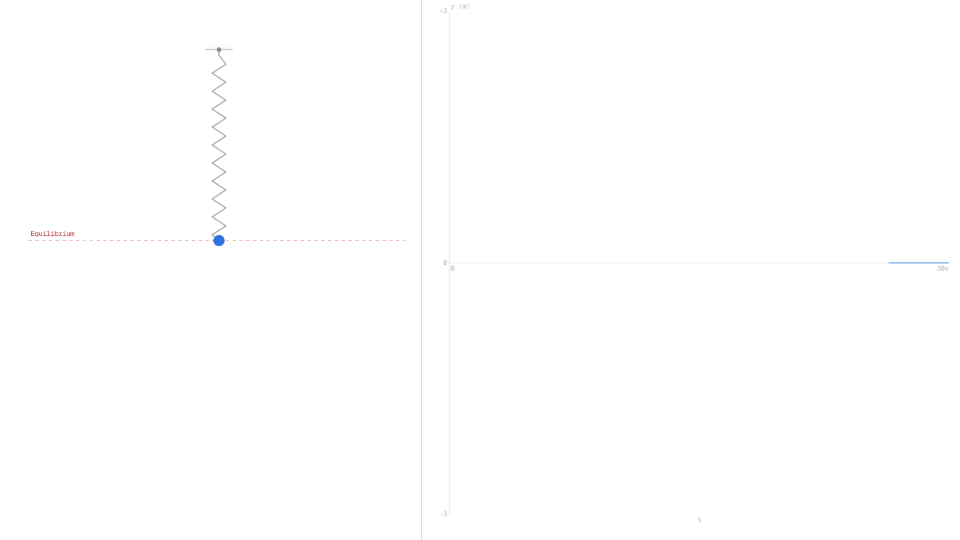
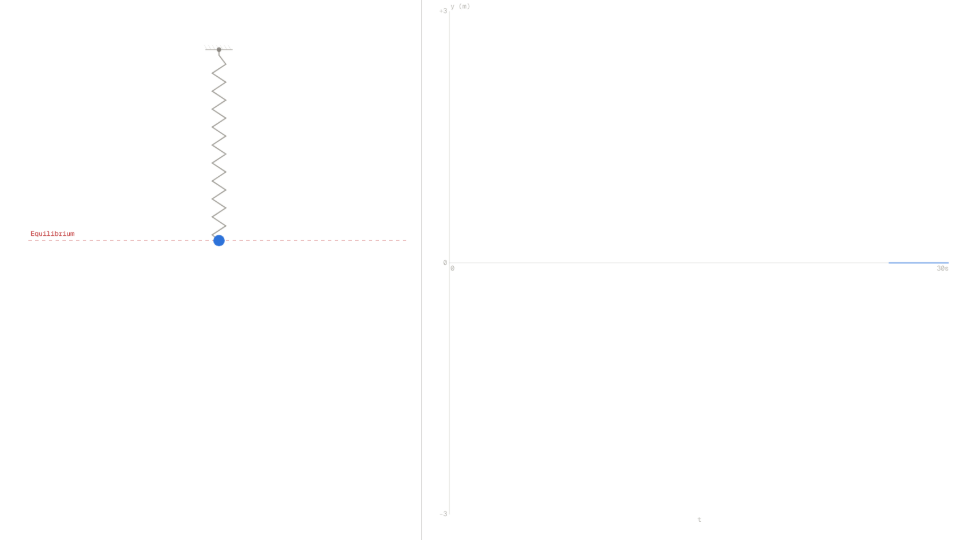
Compare the simulation behaviour against the closed-form prediction for the c = 3 N·s/m run. The Damping ratio ζ readout should match 0.474 to three decimals, since the simulation computes ζ from the same definition. Time the first zero crossing using the Time (s) readout when Displacement (m) flips sign; the value should sit close to 0.741 s. Pause near the first minimum and read the Displacement value; it should be close to −0.430 m, with the next positive peak roughly 0.18 m and the second negative peak roughly −0.07 m. The successive ratio of consecutive same-side peaks should be e^(−γ·T_d) ≈ 0.034 in magnitude, confirming exponential envelope decay at rate γ = 1.5 s⁻¹. Increase the Damping slider in steps and watch the Damping ratio ζ readout cross 1.0 at c ≈ 6.32 N·s/m: oscillation disappears precisely there. Above that threshold the trail no longer crosses the equilibrium line; below it the trail always overshoots at least once. The qualitative regime change is sharp because it is a square-root branch in ω_d.
Source of Error
What this sim does NOT model: the spring's own mass and inertia, mass distribution along the coil, non-Hookean stiffening at large amplitudes, finite spring travel limits, or temperature effects on the spring constant. The mass is a point hanging from an ideal Hookean spring with linear viscous damping. The closed forms ω₀ = √(k/m), ζ = c/(2·√(k·m)), and the second-order ODE m·x'' + c·x' + k·x = 0 assume the same idealizations, so they cancel rather than contributing to the residual amplitude or period. The remaining gap is therefore purely numerical, not physical.
Further Exploration
- Hold k = 10 N/m and m = 1 kg fixed and find by experiment the smallest Damping value (to the slider step of 0.5 N·s/m) for which no negative-displacement overshoot is visible. Compare with the analytical critical value c_c = 2·√(m·k) ≈ 6.32 N·s/m.
- Quadruple the spring constant from 10 N/m to 40 N/m at fixed m = 1 kg and c = 3 N·s/m. Predict the new ζ and ω_d, then verify against the readouts. Why does stiffening the spring move the system further into the under-damped regime?
- Set k = 10 N/m, c = 3 N·s/m and sweep the Mass slider from 0.1 kg up to 5 kg. At what mass does the system cross from over-damped through critical to under-damped? Reconcile the crossing mass with the condition ζ = 1.
- With ζ ≈ 0.474, measure the ratio of the first negative peak to the first positive peak. The logarithmic decrement δ = γ·T_d should equal ln(|x₁|/|x₂|) for consecutive same-side peaks. Does the measured δ match π·c/(m·ω_d)?
- Set the Damping slider to 0 N·s/m and press Start. The Damping ratio ζ readout reads 0.000 and the motion is undamped. By how much does the measured period differ from T_d at c = 3 N·s/m, and is the difference consistent with ω_d = √(ω₀² − γ²)?
- Double the Initial Displacement from 1.0 m to 2.0 m at the default k, m, c. Does the damped period T_d change? Does the decay rate γ change? Use the readouts to argue that for a linear oscillator both quantities are amplitude-independent.