Pendulum Energy Bars PhysicsEnergy Conservation & Damping Decay
Introduction
A pendulum bob released from an angle converts gravitational potential energy into kinetic energy as it descends, then returns that kinetic energy to potential energy as it climbs: a continuous, lossless exchange when no dissipative forces act. The simulator tracks this exchange in real time through three bar heights: KE, PE, and Total E, all normalized to the initial total energy E₀. Without damping the Total E bar holds perfectly still while KE and PE oscillate in opposition, rising and falling as mirror images of each other.
Conservation-of-energy units lean on the pendulum because it makes the exchange visible at human timescales. Engineers apply the same framework to clock escapements, seismograph suspensions, and building dampers: systems where controlling how energy moves between kinetic and potential forms, and how quickly it bleeds away, is the central design problem. The damping coefficient b is the sole parameter that governs energy bleed rate; the simulator isolates its effect by keeping KE and PE otherwise in their undistorted mirror-image relationship.
Most people expect a heavier bob or a longer rod to change how fast the energy decays. The bar chart says no: with θ₀ = 30°, b = 0, and m increased from 1 kg to 2 kg, the Total E bar rises (the system starts with more energy), but the KE and PE readouts still reach exactly zero and exactly E₀ in alternation, and the Total E bar stays flat. Mass and length scale the energy budget without altering the ratio dynamics or introducing any decay.
The Physics Explained
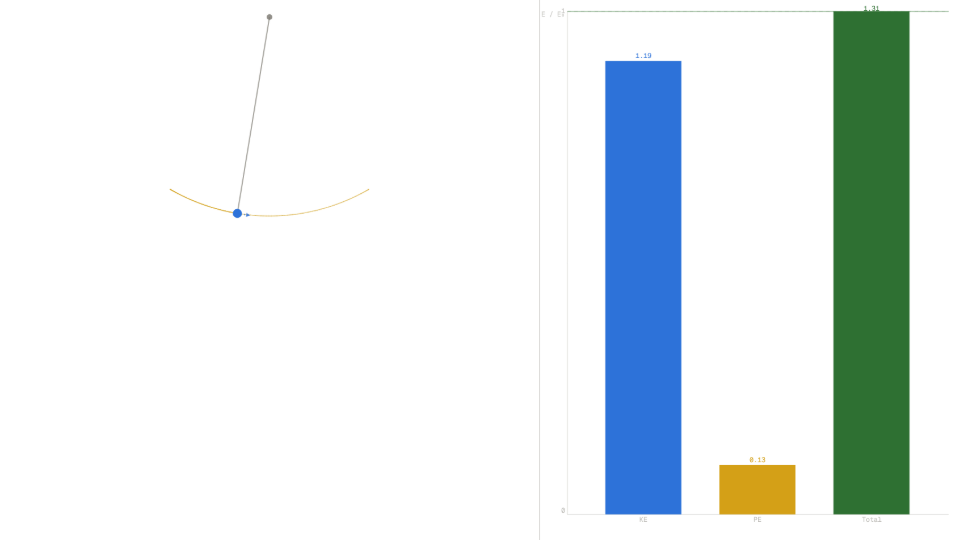
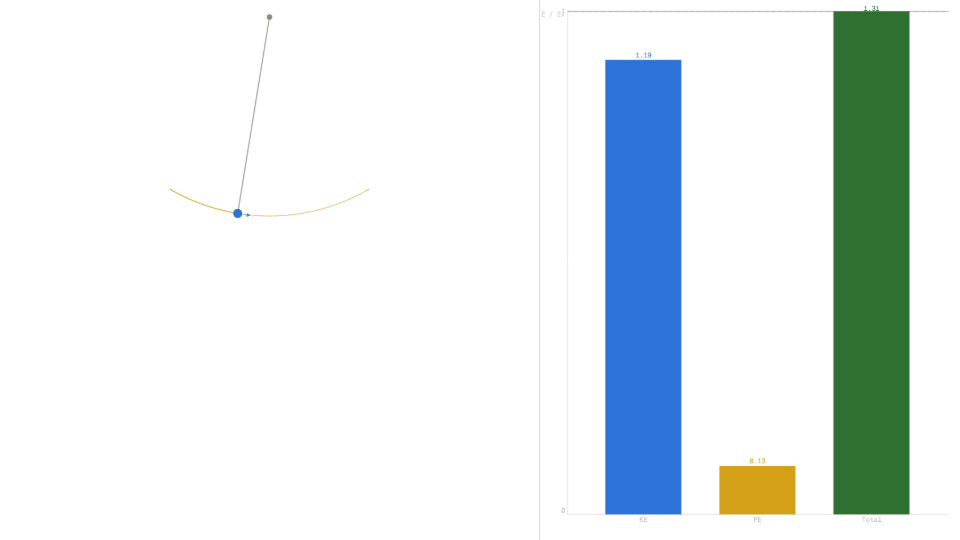
The pendulum's angular acceleration obeys α = −(g/L)·sinθ − (b/mL²)·ω. The first term is the restoring torque from gravity; the second is the damping torque, proportional to angular velocity ω and the damping coefficient b. When b = 0 the equation is conservative: the only force doing work on the bob is gravity, which is a conservative force. Conservative forces have the defining property that the work they do depends only on the start and end positions, never on the path taken. This means the work gravity does as the bob descends from angle θ₀ to angle 0 is exactly recovered as the bob climbs back to θ₀; no energy leaks, so total mechanical energy is constant.
The simulator makes this conservation concrete. With θ₀ = 30°, m = 1 kg, L = 1 m, and b = 0, the PE readout opens at 1.314 J and the KE readout opens at 0.000 J, since the bob starts from rest at maximum displacement. As the bob swings through the lowest point roughly one half-period later (T/2 ≈ 1.003 s for the small-angle approximation; the actual half-period at 30° is slightly longer), the KE readout climbs to approximately 1.314 J and PE falls to approximately 0.000 J. The Total E readout stays at 1.314 J throughout. The two energy bars are exact complements: KE + PE = E₀ at every instant.
Adding damping breaks the conservative condition. The damping force −b·ω does negative work on the bob every time it moves (it always opposes motion), so mechanical energy is steadily converted to heat. The decay follows an exponential envelope: E(t) = E₀·e^(−2γt), where γ = b/(2mL²) is the decay rate. Crucially, the KE↔PE mirror-image exchange shape is preserved inside the decaying envelope. With b = 0.5 N·m·s/rad, m = 1 kg, L = 1 m, γ = 0.25 s⁻¹. After 4 seconds the envelope factor is e^(−2) ≈ 0.135, so total energy has fallen to roughly 0.178 J, about 13.5% of E₀. The KE and PE bars still cross at their respective zero and envelope-peak values, but their peaks shrink with each swing.
Mass and length together set the initial energy through E₀ = m·g·L·(1 − cosθ₀) and through the moment of inertia term in KE = ½·m·L²·ω². Changing m or L rescales all three bar heights proportionally, leaving the ratio KE/E₀ and PE/E₀ unchanged at every phase of the swing. This is why sweeping the mass slider from 1 kg to 2 kg with b = 0 doubles the KE, PE, and Total E readouts but leaves the bar chart's normalized shape identical; the physics of energy exchange is governed entirely by θ and ω, not by the scale of the energy pool.
Key Equations
This is the rotational form of kinetic energy, with moment of inertia I = m·L² for a point mass on a massless rod. With the default settings at the lowest point of the swing, m = 1 kg, L = 1 m, and ω ≈ 1.621 rad/s (the value at which all initial PE has converted to KE), KE = ½·1·1·1.621² ≈ 1.314 J, equal to E₀ exactly: in a conservative pendulum, energy conservation holds at every amplitude, large or small (the large release angle changes the period, never the energy budget). The exact bottom-speed satisfies ½·m·L²·ω² = m·g·L·(1 − cosθ₀). The simulator's KE readout matches this formula to three decimal places throughout the run.
Gravitational PE is measured relative to the lowest point of the arc (θ = 0), so PE = 0 at the bottom and PE = m·g·L·(1 − cosθ₀) at the release angle. With θ₀ = 30°, m = 1 kg, L = 1 m, g = 9.81 m/s²: PE₀ = 9.81·(1 − cos30°) = 9.81·(1 − 0.86603) = 9.81·0.13397 ≈ 1.314 J. This is the value the PE readout shows at t = 0, before the sim advances. The PE readout confirms the formula at every angle during the swing, including the non-small-angle regime where cosθ departs significantly from the parabolic approximation.
With b = 0, the sum KE + PE equals the fixed initial value E₀ at every instant. The Total E readout remains at 1.314 J from t = 0 to the natural stop at t = 30 s, never drifting by more than numerical integration error. This equation is the direct result of the work-energy theorem applied to a conservative force: the net work done by gravity over any complete return trip is zero, so no energy enters or leaves the mechanical budget.
With b = 0.5 N·m·s/rad, m = 1 kg, L = 1 m: γ = 0.5 / (2·1·1) = 0.25 s⁻¹. At t = 4 s, E(4) = 1.314·e^(−0.5·4) = 1.314·e^(−2) ≈ 1.314·0.1353 ≈ 0.178 J. The Total E readout in the simulator descends along this curve while the KE and PE bars continue their mirror-image exchange inside the shrinking envelope. The formula predicts t₁/₂ = ln(2)/(2γ) ≈ 1.386 s for the energy to halve; at roughly t = 1.4 s the Total E bar crosses 0.657 J, consistent with this prediction.
Key Variables
| Symbol | Name | Unit | Meaning |
|---|---|---|---|
| θ | Angular displacement | rad | Angle of the rod from vertical; θ = 0 at the lowest point |
| ω | Angular velocity | rad/s | Rate of change of θ; zero at the turning points, maximum at the bottom |
| m | Bob mass | kg | Inertial and gravitational mass of the pendulum bob |
| L | Rod length | m | Distance from pivot to center of bob; sets the moment of inertia and PE scale |
| b | Damping coefficient | N·m·s/rad | Viscous damping constant; zero gives undamped oscillation |
| γ | Decay rate | s⁻¹ | γ = b/(2mL²); controls how quickly the energy envelope shrinks |
| E₀ | Initial total energy | J | m·g·L·(1 − cosθ₀); the normalization reference for the bar chart |
Real World Examples
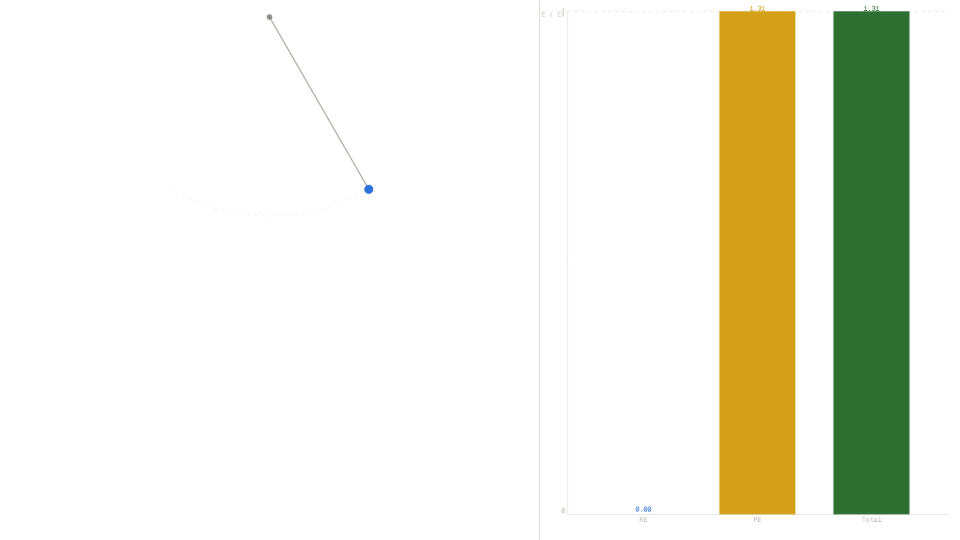
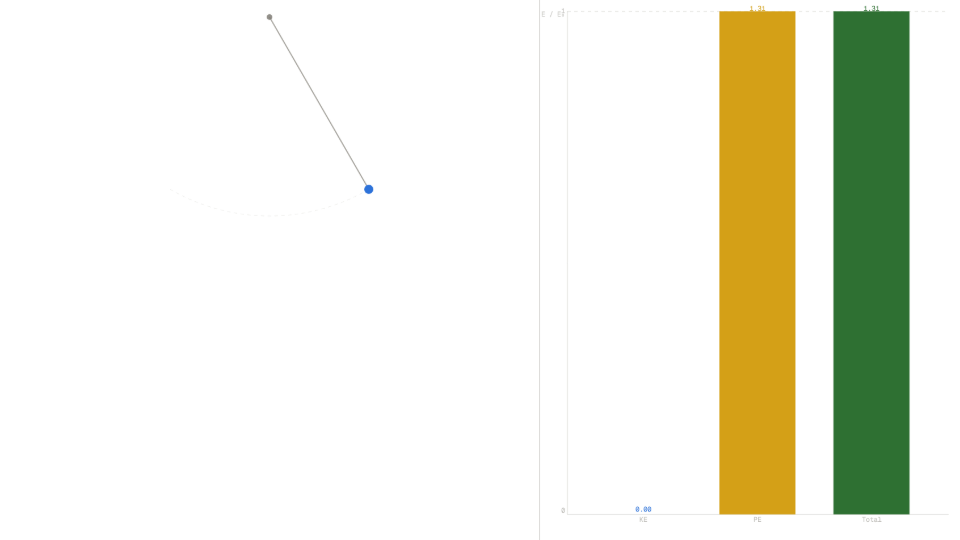
Why do grandfather clock pendulums need a weekly winding?
A real grandfather clock pendulum loses energy to air drag on the bob and to friction at the pivot, both dissipative forces that do negative work on the system each swing. The governing equation is α = −(g/L)sinθ − (b/mL²)ω, where the second term drains angular velocity at every instant. Without an energy input, the amplitude shrinks exponentially according to E(t) = E₀·e^(−2γt), with γ = b/(2mL²). The escapement mechanism, driven by a wound spring or hanging weights, delivers a precisely timed impulse once per swing to replace exactly the energy lost to damping, keeping amplitude and period stable.
The simulator shows this decay directly. With default settings θ₀ = 30°, m = 1 kg, L = 1 m and damping b = 0.5 N·m·s/rad, the Total E bar decays from 1.314 J toward zero with a decay rate γ = 0.25 s⁻¹. The amount of energy a clock mechanism must inject each swing to maintain constant amplitude equals the deficit the Total E bar accumulates per half-period, a quantity the exponential envelope makes precise.
Practical clock makers tune b (through pivot lubrication, bob shape, and case ventilation) to minimize the energy draw on the driving spring or weights. A lower b means a longer winding interval. The KE and PE bars in the simulator remain mirror images regardless of b; only their shared scale changes. This confirms that reducing damping does not distort the energy exchange, it simply extends how long the system sustains it.
How do seismograph engineers exploit pendulum energy exchange to detect earthquakes?
A seismograph suspends a heavy mass on a long pendulum whose pivot is fixed to the bedrock. When the ground accelerates during a seismic event, the mass, by inertia, lags behind, and that relative displacement is recorded as the signal. The sensitivity depends on the natural period T = 2π·√(L/g): longer rods give longer periods, which respond to lower-frequency seismic waves. The KE↔PE exchange is central here because the undamped resonance frequency sets the instrument's peak response band.
Engineers add controlled damping (b > 0) to broaden the response without eliminating resonance entirely, exactly the exponential envelope the damping slider produces on screen. With b = 0 the Total E bar stays perfectly flat and the instrument rings indefinitely, making it useless after the first tremor. With b set to near-critical damping, the instrument settles quickly between events while still responding to new arrivals.
The simulator reveals this trade-off. With θ₀ = 30°, m = 1 kg, L = 1 m, and b = 1.5 N·m·s/rad, γ = 0.75 s⁻¹ and the Total E bar reaches less than 5% of E₀ within roughly 2 seconds, showing how aggressively a heavily damped pendulum forgets its history. Seismograph designers select b to balance ringdown speed against sensitivity: the same dial the simulator exposes as the damping slider.
Why do tall buildings use tuned mass dampers shaped like pendulums?
A tuned mass damper is a massive pendulum, often hundreds of tonnes, suspended near the top of a skyscraper. Its natural period is set by T = 2π·√(L/g) to match the building's fundamental sway frequency. When the structure oscillates in wind or an earthquake, the pendulum bob swings out of phase, and the reaction force it exerts on the building's frame subtracts from the sway amplitude. The energy the building would have accumulated as mechanical energy is instead transferred into the damper's KE↔PE exchange, then bled away by the damper's own viscous elements.
The simulator captures the core trade-off. With b = 0, the Total E bar stays flat: a pendulum without damping redistributes energy but never removes it from the mechanical budget, which would make a useless building damper. Adding b > 0 introduces the exponential decay; the damper steadily converts the transferred mechanical energy to heat. The Taipei 101 damper has a period of roughly 7 seconds, corresponding to a cable length near 12 m at standard gravity, and its damping is tuned to dissipate energy quickly enough to limit sway to safe levels in typhoon conditions.
In the simulator, setting L = 1 m, m = 1 kg, b = 1.0 N·m·s/rad gives γ = 0.5 s⁻¹ and an energy half-life of ln(2)/(2·0.5) ≈ 0.693 s. A real tuned mass damper with a 7-second period and similar damping ratio would have an energy half-life on the order of several seconds: long enough to absorb the building's energy over many sway cycles while short enough to clear the stored energy before the next gust arrives.
Further Reading
- Simple pendulum: the undamped single-degree-of-freedom oscillator in detail, including the small-angle approximation, the exact period integral, and isochronism across amplitudes.
- Damped spring: the same exponential energy decay applied to a mass-spring system, with the underdamped, critically damped, and overdamped regimes shown side by side.
- Spring-mass oscillator: KE and PE exchange in a horizontal spring system where potential energy is elastic rather than gravitational, completing the comparison between the two canonical conservative oscillators.