Impulse from a Force Pulse PhysicsImpulse-Momentum Theorem & Force-Time Area
Introduction
Impulse quantifies the mechanical action a force delivers over time. For a constant force, J = F·Δt in newton-seconds (N·s), and the impulse-momentum theorem states J = Δp = m·vf − m·vi. What determines the outcome is the area enclosed by the force-time curve, not the peak force or the duration in isolation.
A short, sharp pulse and a long, gentle push can produce identical impulse and leave a cart at identical speed, provided their force-time areas match. Many students expect that doubling the force must always yield a faster result. The J readout in the simulator contradicts that expectation: at F = 80 N with Δt = 0.25 s and at F = 40 N with Δt = 0.5 s, both the J readout and the v readout settle at the same values, because equal rectangle area means equal impulse and equal final speed.
The Physics Explained
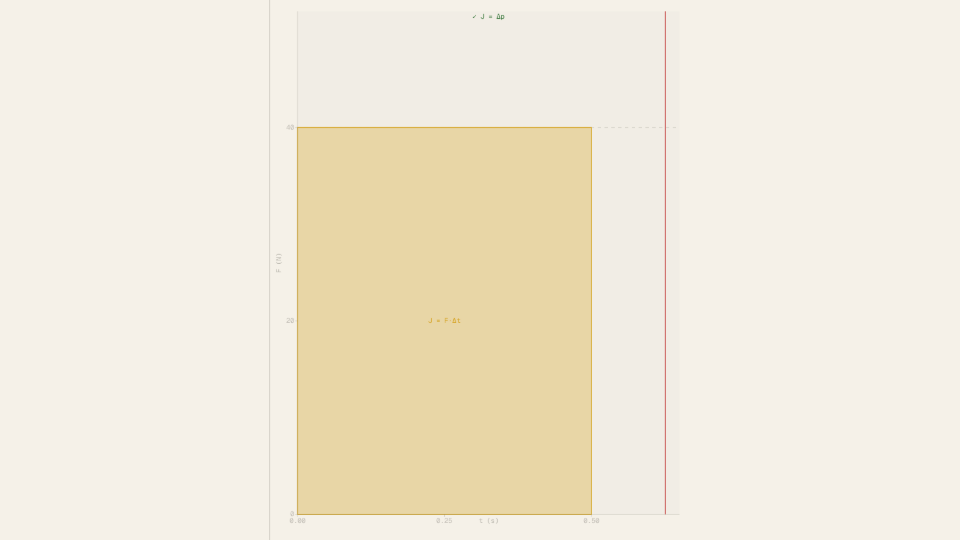
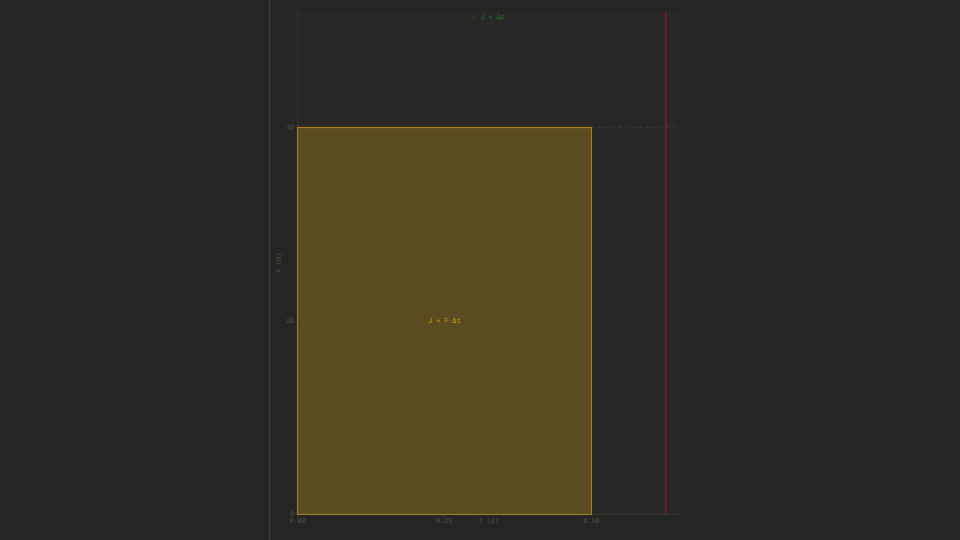
Newton's second law in its time-integrated form is the foundation. Integrating F = m·a over the pulse duration gives ∫F dt = m·Δv, which for a constant force collapses to F·Δt = m·(vf − vi). With vi = 0 on a frictionless track this simplifies further to J = F·Δt = m·vf, the impulse-momentum theorem. The simulator's F-t graph draws this as a filled rectangle: width equal to Δt on the horizontal axis and height equal to F on the vertical axis, with the shaded area numerically equal to the impulse J reported by the J readout.
At the default slider settings of F = 40 N, Δt = 0.5 s, and m = 1.0 kg, the rectangle has area 40 × 0.5 = 20.0 N·s. The J readout confirms 20.00 N·s and the v readout settles at 20.00 m/s once the pulse ends, satisfying vf = J / m = 20.0 / 1.0. The Δp readout independently computes m·vf = 1.0 × 20.0 = 20.00 kg·m/s, matching J to the displayed precision and confirming the theorem holds in the simulation.
The mass slider reveals how impulse distributes differently depending on the object's inertia. Keeping F = 40 N and Δt = 0.5 s fixed while raising mass to m = 2.0 kg leaves J unchanged at 20.00 N·s but halves the final speed to 10.00 m/s, because vf = J / m = 20.0 / 2.0. The rectangle on the graph does not change shape, but the cart accelerates more slowly during the pulse and exits at lower speed. This separation between impulse (a property of the force history) and the resulting velocity (which depends on mass) is what the Δp readout makes visible: Δp still equals J regardless of m, while v changes with it.
A subtlety worth noting concerns the equal-area insight when comparing runs. Setting F = 80 N and Δt = 0.25 s produces a taller, narrower rectangle on the graph whose area is still 80 × 0.25 = 20.0 N·s. After the run, the J readout reads 20.00 N·s and v reads 20.00 m/s for m = 1.0 kg, identical to the default run. The graph's x-axis rescales to fit the new Δt, so the two rectangles appear differently proportioned on screen even though their areas are equal, a feature that rewards careful reading of the tick labels rather than visual comparison of apparent rectangle sizes.
Key Equations
At F = 40 N and Δt = 0.5 s: J = 40 × 0.5 = 20.0 N·s. This is the area of the shaded rectangle on the simulator's F-t graph. The J readout reports 20.00 N·s, matching the analytical product. Increasing F to 80 N while halving Δt to 0.25 s gives J = 80 × 0.25 = 20.0 N·s, the same value, confirming that the area is the only quantity that determines the impulse.
With vi = 0 for the cart at rest, Δp = m·vf. At F = 40 N, Δt = 0.5 s, m = 1.0 kg: Δp = 1.0 × 20.0 = 20.0 kg·m/s, equal to J = 20.0 N·s. The simulator's Δp readout shows 20.00 kg·m/s after the pulse ends, and the "✓ J = Δp" badge appears on the graph confirming the theorem. Raising mass to m = 2.0 kg with the same pulse yields Δp = 2.0 × 10.0 = 20.0 kg·m/s, still equal to J because the impulse is set by the force profile alone.
At F = 40 N, Δt = 0.5 s, m = 1.0 kg: vf = 20.0 / 1.0 = 20.0 m/s. The v readout confirms 20.00 m/s once the cart exits the pulse. At m = 2.0 kg with the same pulse: vf = 20.0 / 2.0 = 10.0 m/s, and the v readout settles at 10.00 m/s. At the extreme slider values of F = 100 N, Δt = 2.0 s, m = 5.0 kg: vf = 200.0 / 5.0 = 40.0 m/s, which the readout reproduces to two decimal places.
Key Variables
| Symbol | Name | Unit | Meaning |
|---|---|---|---|
| J | Impulse | N·s | Area under the force-time curve; equals the momentum change delivered to the cart |
| F | Force magnitude | N | Constant force applied to the cart during the pulse interval |
| Δt | Pulse duration | s | Length of the time interval over which the force acts |
| m | Cart mass | kg | Inertial mass of the cart; governs how much velocity a given impulse produces |
| Δp | Momentum change | kg·m/s | Change in the cart's momentum; equal to J by the impulse-momentum theorem |
| vf | Final velocity | m/s | Cart speed after the pulse ends; equal to J / m |
Real World Examples


Why does a karate chop break a board even though the hand barely moves?
The physics centres on impulse, not on distance. During a strike, the hand decelerates from roughly 10 m/s to 0 m/s in a contact time of about 3 ms. The impulse delivered to the board is J = F·Δt, and because Δt is so brief the average force F must be enormous to produce the same change in momentum. Estimates place peak contact forces above 3000 N on a properly conditioned hand, far above the fracture threshold of a pine board. The board does not care how far the hand travelled: it responds only to the impulse, which is the area of a very narrow, very tall force-time spike.
The simulator captures the same trade-off. Setting F = 100 N and Δt = 0.05 s yields J = 5.0 N·s and a final cart speed of 5.0 m/s for m = 1.0 kg. Setting F = 5 N and Δt = 1.0 s yields the same J = 5.0 N·s and the same final speed, even though the force is twenty times smaller. The breaking action requires the short, high-force shape of the pulse, but the cart's resulting momentum is set entirely by the area, not by the force magnitude alone.
How do crumple zones in cars reduce injury forces?
In a collision, a car must bring its occupants from highway speed to rest, and the total impulse J = Δp required to do so is fixed by the initial momentum. The crumple zone cannot change J; it changes Δt. By extending the crush duration from perhaps 80 ms in a rigid structure to 150 ms or more in a well-designed crumple zone, the structure spreads the same impulse over a longer time interval and thereby reduces the peak force the occupant experiences. The impulse-momentum theorem J = F·Δt = Δp makes this explicit: for a fixed Δp, a larger Δt means a smaller average F.
The simulator makes the trade-off concrete. With m = 2.0 kg and a target momentum change of 40 N·s, delivering that via F = 200 N over Δt = 0.2 s produces the same cart speed as F = 40 N over Δt = 1.0 s, with the J readout sitting at 40.00 N·s in both cases. The crumple zone is an engineering application of choosing the second rectangle: same area under the force-time curve, lower force, longer time, and a survivable deceleration for the occupant.
Why do batters follow through on a swing to hit the ball farther?
Follow-through extends the duration of contact between the bat and ball, increasing Δt and therefore the impulse J = F·Δt delivered to the ball. The bat-ball contact during a major-league pitch lasts only about 1 ms, but even a small increase in that window while the bat is still accelerating adds meaningfully to the area under the force-time curve and to the ball's final momentum. A truncated swing where the batter decelerates early shortens the effective pulse duration, producing a narrower rectangle on the force-time graph and a lower J even if the peak force is identical.
The simulator demonstrates the area principle directly. Holding m = 0.5 kg and comparing F = 80 N with Δt = 0.25 s against F = 40 N with Δt = 0.5 s shows both configurations report J = 20.0 N·s on the readout and arrive at vf = 40.0 m/s, illustrating that the same final speed follows from equal areas regardless of the force-time shape. A batter who follows through is effectively shifting the pulse toward the second rectangle: somewhat lower peak force, somewhat longer contact, same or greater impulse transferred to the ball.
Further Reading
- Inelastic collisions: how momentum is conserved but kinetic energy is not during a contact, and where the impulse transmitted between colliding bodies ultimately goes.
- Elastic collisions: the special case where both momentum and kinetic energy survive the impact, with closed-form velocity formulas derived from the same impulse skeleton.
- Momentum vector on a cart: visualising momentum as a directed quantity and seeing how impulse changes both its magnitude and direction in two dimensions.
- Foot-on-ball collision: the impulse-momentum theorem applied to a sports impact with a large mass ratio between the striking foot and the ball.