Foot–Ball Collision PhysicsImpulse, Mass & Launch Speed
Introduction
A foot–ball collision is the brief one-dimensional impact in which a swinging leg transfers momentum to a stationary match ball. The contact lasts roughly eight to twelve milliseconds, during which the ball deforms, stores elastic energy in its pressurised bladder, and rebounds away. A closed-form expression (built from the foot's effective mass, its speed at contact, and a single coefficient of restitution) predicts the ball's exit speed accurately enough that it forms the basis of every penalty, free kick, and goal-bound drive in the modern game.
The collision sits at the centre of football biomechanics because it is the one moment in the sport where the player has full control over the input variables and the ball obeys a clean Newtonian law. Coaches use the same impulse–momentum framework to compare striker techniques, shoe designers tune cleat stiffness against the coefficient of restitution, and sports scientists model career hip and knee load by integrating contact force across thousands of recorded strikes. Once the impulse phase is understood, spin, drag, and Magnus deflection sit on top of it as separate corrections.
Players tend to assume the ball can exit no faster than the swinging foot itself. The Ball Speed readout contradicts that: with mfoot = 5.0 kg, vfoot = 18.0 m/s, and e = 0.55 it settles at 25.69 m/s, and the ball ends up moving roughly 43 % faster than the foot that struck it, because a partially elastic rebound can amplify exit speed beyond the swing speed when the foot is much heavier than the ball.
The Physics Explained
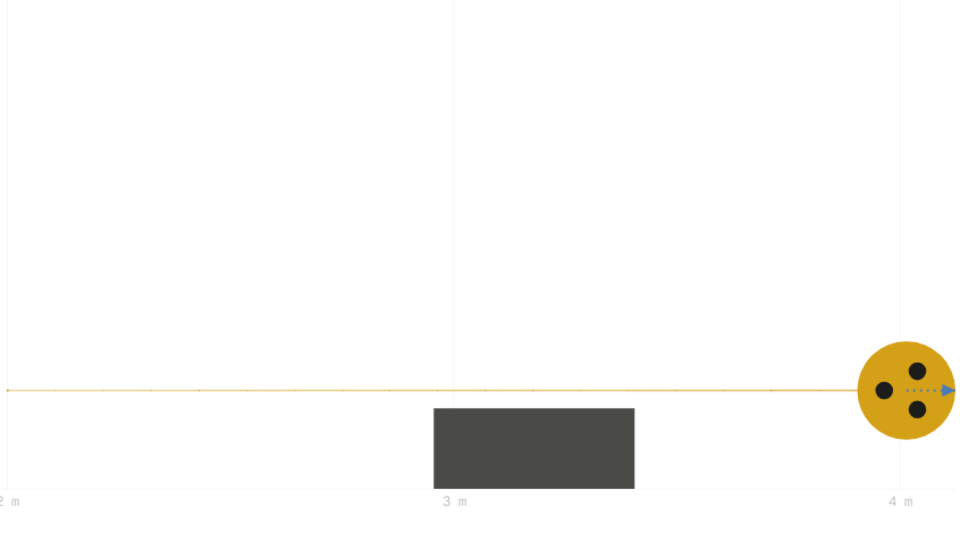
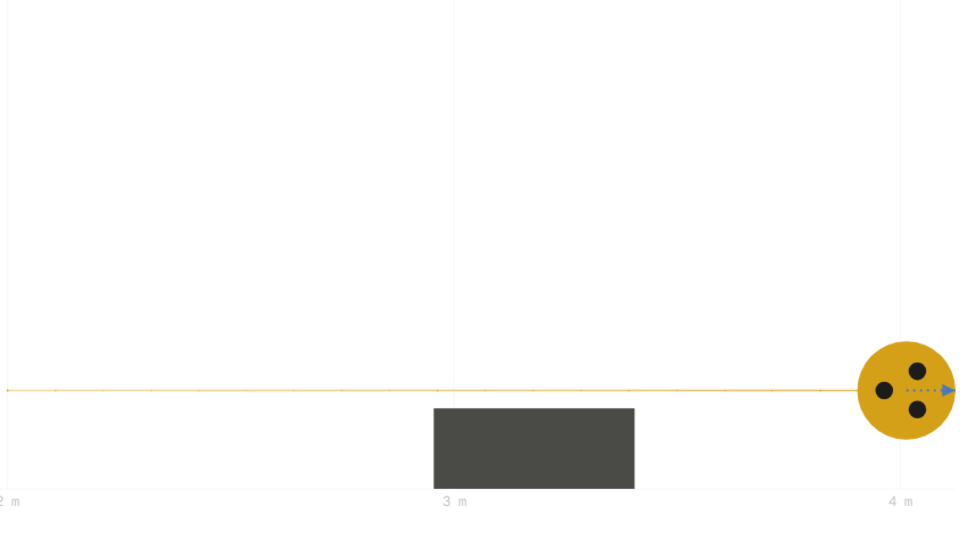
The collision is treated as a one-dimensional impact between a foot of effective mass mfoot moving at vfoot and a match ball of mass mball ≈ 0.43 kg starting at rest. Two conservation statements pin the post-impact velocities. The first is conservation of linear momentum: mfoot · vfoot equals mfoot · vfoot' + mball · vball', where the primed symbols are post-impact velocities. The second is the kinematic definition of the coefficient of restitution: e equals the ratio of the relative speed of separation to the relative speed of approach, which for a stationary ball reduces to e = (vball' − vfoot') / vfoot.
Solving the two-equation system yields the closed-form expression vball = (1 + e) · mfoot · vfoot / (mfoot + mball). Three behaviours follow directly. A heavier swinging leg pushes vball toward the upper limit (1 + e) · vfoot, because the denominator mfoot + mball approaches mfoot itself. A higher coefficient of restitution scales vball linearly through the (1 + e) factor. And a stationary ball always exits faster than the foot that struck it whenever mfoot ≫ mball, since the (1 + e) numerator beats the small mass-ratio penalty from the denominator.
Plugging in the simulator defaults (mfoot = 5.0 kg, vfoot = 18.0 m/s, e = 0.55) gives vball = 1.55 · 5.0 · 18.0 / 5.43 ≈ 25.69 m/s, which is exactly the value the Ball Speed readout reports after launch. The Impulse readout shows 11.05 N·s, equal to mball · vball ≈ 0.43 · 25.69, which is the cleanest visible confirmation that momentum is being conserved end to end. A quick sanity check on the heavy-foot limit: setting Foot Mass to 10 kg with the same speed and restitution pushes the predicted vball to 26.75 m/s, closing about 48 % of the remaining gap to the ceiling (1 + 0.55) · 18.0 = 27.9 m/s.
The Energy Transfer readout closes the loop. The foot carries ½ · mfoot · vfoot² = 810 J of kinetic energy into the contact, while the ball carries away ½ · mball · vball² ≈ 141.9 J, so η ≈ 17.5 %, the value the readout reports for the default settings. The foot itself retains roughly 623 J at its post-impact speed of 15.79 m/s, and the missing ≈ 45 J is the inelastic loss the e < 1 coefficient bookkeeps. Counter-intuitively, η falls when foot mass rises past the ball's: pushing Foot Mass from 5 to 10 kg drops the readout from 17.5 % to 9.5 %, and 12 kg drops it further to 8.0 %. The closed form η = (1 + e)² · mfoot · mball / (mfoot + mball)² peaks where mfoot equals mball, at (1 + e)² / 4 ≈ 60 % for e = 0.55, and decays as either side becomes the heavier party. η is independent of foot speed at fixed mass ratio, since both numerator and denominator scale as v².
Key Equations
For the default ball at rest, the impulse delivered by the foot equals the ball's full outgoing momentum. With mball = 0.43 kg and vball = 25.69 m/s, J = 0.43 · 25.69 ≈ 11.05 N·s, exactly the value the Impulse readout reports for the default run.
For the defaults, the foot's residual speed after impact is vfoot,after = (mfoot − e · mball) · vfoot / (mfoot + mball) ≈ 15.79 m/s, so e = (25.69 − 15.79) / 18.0 ≈ 0.55, recovering the slider value.
With mfoot = 5.0 kg, vfoot = 18.0 m/s, mball = 0.43 kg, and e = 0.55: vball = 1.55 · 5.0 · 18.0 / 5.43 ≈ 25.69 m/s. The Ball Speed readout settles at the same 25.69 m/s once the ball clears the viewport.
This is the impulse–momentum theorem specialised to a stationary target. For the defaults, J = 0.43 · 25.69 ≈ 11.05 N·s, which matches the Impulse readout to two decimal places and confirms momentum conservation at the integer-decimal level.
The simulator collapses the contact to a single substep, so Δt is not displayed. Assuming a representative Δt = 10 ms, the default impulse 11.05 N·s gives F̄ ≈ 1105 N, squarely inside the 1–2 kN range cited for hard professional strikes.
For the defaults: η = (0.43 · 25.69²) / (5.0 · 18.0²) = 283.78 / 1620 ≈ 0.175. The Energy Transfer readout reports 17.5 %, matching the closed-form prediction to one decimal place.
Key Variables
| Symbol | Name | Unit | Meaning |
|---|---|---|---|
| mfoot | Effective foot mass | kg | Portion of the leg that decelerates during contact (1–12 kg) |
| mball | Ball mass | kg | FIFA Law 2: 0.41–0.45 kg, fixed at 0.43 kg in the sim |
| vfoot | Foot speed at impact | m/s | 5 m/s for a soft pass, up to 30 m/s for a record strike |
| vball | Ball exit speed | m/s | Reported by the Ball Speed readout after launch |
| e | Coefficient of restitution | dimensionless | Between 0 (sticks) and 1 (perfectly elastic); ~0.55 typical |
| J | Impulse | N·s | Time-integral of contact force; equals ball's momentum change |
| η | Energy transfer ratio | dimensionless | Ball kinetic energy divided by foot kinetic energy at contact |
Real World Examples
Why does a kicked ball travel faster than the foot that struck it?
The intuition that exit speed is capped by swing speed comes from everyday experience with hand throws, where the ball leaves the hand at roughly the hand's release speed. Football breaks that intuition because the leg is around twelve times heavier than the ball, so the closed-form factor (1 + e) · mfoot / (mfoot + mball) climbs to about 1.43 at e = 0.55 and the simulator defaults, meaning the ball flies away 43 % faster than the foot's contact speed.
The simulator demonstrates the amplification numerically. With mfoot = 5.0 kg, vfoot = 18.0 m/s, and e = 0.55, the Ball Speed readout shows 25.69 m/s, well above the 18 m/s swing speed. Reducing Foot Mass to its 1.0 kg minimum at the same swing speed and restitution drops Ball Speed to about 19.5 m/s, only 8 % faster than the foot, because the ball's mass is no longer negligible compared to the leg's.
Goalkeepers exploit the same amplification on long goal kicks. A heavily-locked ankle and trunk-driven swing can effectively recruit eight to ten kilograms of leg mass behind a 20 m/s contact, pushing exit speeds toward 30 m/s without the swing itself being unusually fast. The biomechanics are not about leg speed alone; they are about getting the highest mfoot / mball ratio that the joint chain will allow.
How hard does the foot have to push during contact?
Average contact force is impulse divided by contact time, F̄ = J / Δt. For a hard professional strike, contact lasts roughly 10 ms while the impulse runs around 10–12 N·s, so the leg must transmit on the order of 1 to 1.5 kN through the boot: about one and a half times the player's body weight, applied for one hundredth of a second. Over a single match a striker may absorb this peak load forty or fifty times, which is why ankle stiffness and forefoot strength dominate kick-specific training programmes.
The simulator's Impulse readout makes the calculation concrete. With mfoot = 5.0 kg, vfoot = 18.0 m/s, and e = 0.55, the readout shows 11.05 N·s. Dividing by an assumed Δt = 10 ms gives F̄ ≈ 1105 N, sitting inside the 1–2 kN window measured by force-plate studies of senior professionals. Push the Coefficient of Restitution slider to its 0.70 maximum at the same mass and speed and the impulse rises to about 12.13 N·s, lifting F̄ toward 1.2 kN.
Where does the rest of the foot's kinetic energy go?
Only a fraction of the leg's kinetic energy ends up in the ball. For the simulator defaults, ½ · mfoot · vfoot² = 810 J enters the contact and ½ · mball · vball² ≈ 141.9 J leaves with the ball; the Energy Transfer readout reports 17.5 %. The foot retains the rest: at vfoot,after ≈ 15.79 m/s and mfoot = 5.0 kg, ½ · 5.0 · 15.79² ≈ 623 J stays with the leg, and the missing ≈ 45 J is the inelastic deformation captured by the e < 1 coefficient.
The mass-ratio dependence is counter-intuitive. Raising Foot Mass beyond the ball's mass makes the ball faster (vball asymptotes at the (1 + e) · vfoot ceiling), but pushes the Energy Transfer readout down, not up. Holding e and vfoot fixed and moving Foot Mass from 5 to 10 kg drops the readout from 17.5 % to 9.5 %, and the 12 kg cap drops it further to 8.0 %. The closed form η = (1 + e)² · mfoot · mball / (mfoot + mball)² peaks where mfoot equals mball, at (1 + e)² / 4 ≈ 60 % for e = 0.55. A heavier leg wins more ball speed in absolute terms but loses on the energy-fraction lever: the cost of a partially elastic collision that must dissipate energy in boot leather, ball bladder, or skin no matter how cleanly the leg is locked.
Further Reading
- Elastic collisions: the same one-dimensional impact framework with e = 1, where no kinetic energy is lost.
- Magnus free kick: what happens after the impact when spin is added to the linear impulse modelled here.
- Penalty kick vs keeper: the impulse phase set in the context of a 12-yard duel against a diving goalkeeper.
- Ball bounce on grass and turf: the same coefficient-of-restitution framework applied to ball–surface rather than foot–ball contact.