Penalty Kick: Speed vs. Keeper Reaction PhysicsBall Speed vs Reaction Time
Introduction
A penalty kick is one of the few moments in football where the physics is almost transparent: a stationary ball, a known distance of 11 metres, two athletes with no help, and the clock running in tenths of a second. The shooter has roughly half a second to put the ball past the keeper before the keeper can reach it; the keeper has the same half-second to read the shot, decide a direction, and dive across the goal mouth.
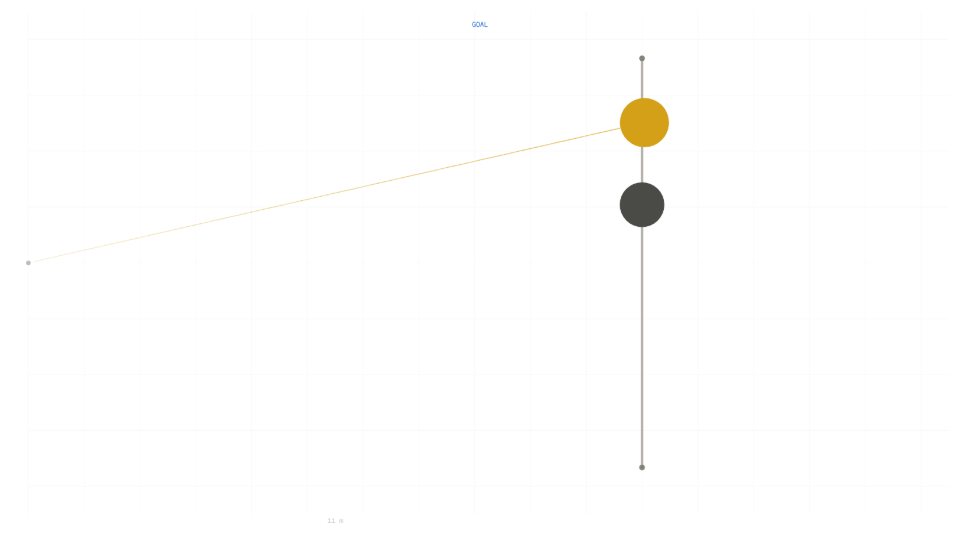
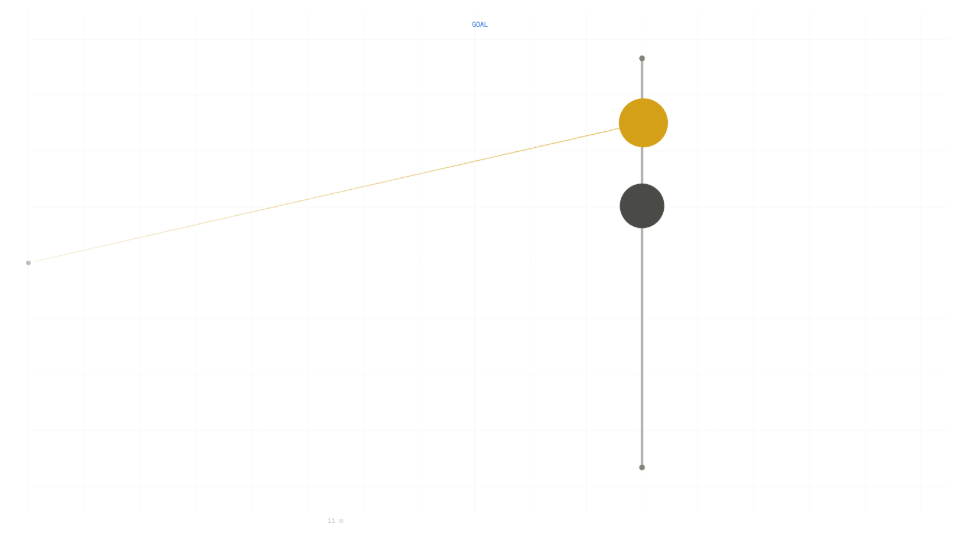
The exercise reduces to a race between two clocks. One clock measures how long the ball takes to cover the 11-metre flight at its launch speed. The other measures how long the keeper takes to react and then dive laterally to the ball's projected line. Whichever clock runs out first decides the outcome. The accompanying simulation lets you scrub the four critical variables (Ball Speed, Placement, Keeper Reaction, and Keeper Dive Speed) and see the verdict update in real time.
Fans tend to assume that a hard, well-placed shot can always be saved by a fast enough goalkeeper. The two clocks say no: with Ball Speed = 28 m/s, Placement = 2.5 m, Keeper Reaction = 0.20 s, and Keeper Dive Speed = 5 m/s, the Ball Travel readout displays 0.39 s while the Keeper Reach readout displays 0.70 s, so the verdict latches GOAL by a margin of more than three tenths of a second.
The Physics Explained
The ball's flight from the penalty spot to the goal line is treated as a constant-velocity straight line. The penalty mark is fixed at d = 11 m by FIFA Law 14, and even the hardest professional shots take less than half a second to cover that distance. Air drag at this scale, over a flight that brief, removes only a few percent of speed; the model ignores it without losing meaningful accuracy. The ball travel time is therefore the goal distance divided by the kick speed, tball = d / vball, and the simulator's Ball Travel readout displays exactly this quotient before launch.
The keeper's response is the sum of two parts. The first is a pure reaction delay during which the keeper is still parsing the shot; the second is a dive across the goal mouth at a roughly constant lateral speed. With Keeper Reaction = 0.20 s and Keeper Dive Speed = 5 m/s sent toward Placement = 2.5 m, the reach time is tkp = 0.20 + 2.5 / 5 = 0.70 s, and the Keeper Reach readout displays 0.70 s before the shot is launched. Reaction times for trained goalkeepers cluster between 0.10 and 0.30 s; dive speeds top out around 5 to 7 m/s.
The verdict is decided by comparing the two clocks against a simple geometric gate. If tball < tkp and the ball is inside the post at |ytarget| ≤ 3.66 m, the verdict latches GOAL. If tkp ≤ tball and the placement stays inside the post, the verdict latches SAVE. If |ytarget| exceeds 3.66 m, the placement is past the post and the verdict latches WIDE regardless of either clock. With the default Ball Speed = 28 m/s and Placement = 2.5 m, the ball arrives 0.31 s before the keeper does, comfortably inside the 3.66 m post limit, so the simulator displays GOAL.
Sweeping Ball Speed downward shows where the verdict flips. Holding everything else at the defaults, the two clocks meet when vball = d / tkp = 11 / 0.70 ≈ 15.7 m/s. Anything slower at the same target turns the verdict to SAVE; anything faster keeps it at GOAL. The same algebra explains why nudging Placement outward to 3.5 m grows the keeper's reach time to 0.90 s and widens the GOAL margin at fixed speed, while nudging Placement past 3.66 m skips the keeper entirely and forces WIDE.
Key Equations
For the default Ball Speed = 28 m/s over the fixed d = 11 m: tball = 11 / 28 ≈ 0.393 s. The simulator's Ball Travel readout displays 0.39 s on the same configuration, and the on-screen Time counter ticks from 0 to about 0.39 s before the ball crosses the goal line.
For Keeper Reaction = 0.20 s, Placement = 2.5 m, and Keeper Dive Speed = 5 m/s: tkp = 0.20 + 2.5 / 5 = 0.20 + 0.50 = 0.70 s. The Keeper Reach readout displays 0.70 s on this configuration, and changes live as any of the three sliders moves.
At Ball Speed = 28 m/s the inequality fails (tball ≈ 0.39 s is well below tkp = 0.70 s), so the verdict latches GOAL. Sweeping Ball Speed downward to 15.7 m/s makes the two clocks meet, and the verdict flips to SAVE.
The defaults satisfy both conditions: tkp = 0.70 s exceeds tball ≈ 0.39 s, and the lateral target of 2.5 m sits inside the 3.66 m post. The simulator latches GOAL with a 0.31 s margin between the two clocks.
Pushing Placement past ypost = 3.66 m forces WIDE no matter what the keeper does. At Placement = 3.7 m the simulator latches WIDE even with the keeper held at extreme reaction and dive values, because the ball never crosses the goal line inside the frame.
Key Variables
| Symbol | Name | Unit | Meaning |
|---|---|---|---|
| d | Spot-to-goal distance | m | 11 m by FIFA Law 14 |
| ypost | Goal half-width | m | 3.66 m (full width 7.32 m) |
| vball | Ball speed at impact | m/s | 15–40 m/s in this simulation |
| ytarget | Lateral aim point | m | 0 = centre; ±3.66 m = at the post |
| treact | Keeper reaction time | s | Slider 0.10–0.50 s; trained keepers cluster in 0.10–0.30 s |
| vdive | Keeper dive speed | m/s | Slider 3–7 m/s; lateral dive speed |
| tball | Ball travel time | s | d / vball |
| tkp | Keeper reach time | s | Reaction plus dive interval |
Real World Examples
Why does the “hit it hard, hit it high” rule actually work?
The conventional advice for penalty takers is to strike the ball hard and aim near a corner, and the two-clock model explains exactly why. A 36 m/s shot covers the 11-metre flight in tball = 11 / 36 ≈ 0.31 s. Even an elite reaction of 0.10 s leaves the keeper just 0.21 s to dive laterally to the placement, so a target as close-in as 1.5 m demands a dive speed of 1.5 / 0.21 ≈ 7.1 m/s, at the absolute upper limit of human capability. Anything closer to the post is geometrically out of reach.
The simulator confirms this directly. Setting Ball Speed = 36 m/s with Placement = 2.5 m, Keeper Reaction = 0.20 s, and Keeper Dive Speed = 5 m/s drops the Ball Travel readout to 0.31 s while the Keeper Reach readout still displays 0.70 s, so the verdict latches GOAL with a 0.39 s margin. The asymmetry between attacker and defender is built into the kinematics: at the upper end of professional shot speed, the keeper's reaction alone consumes most of the available flight time, leaving no budget for the dive.
How does the Panenka chip exploit the keeper’s commitment?
A chipped penalty rolled down the centre travels at perhaps 13 m/s, which gives tball = 11 / 13 ≈ 0.85 s, more than double the budget of a hard shot. In principle the keeper has plenty of time to react; in practice the chip works because the keeper has already committed to a side. Once the dive is launched, the lateral momentum carries the keeper past the central line, and there is no realistic recovery within the remaining flight time.
The simulator brackets the strategy. Setting Ball Speed = 13 m/s with Placement = 0 m, Keeper Reaction = 0.20 s, and Keeper Dive Speed = 5 m/s gives a Ball Travel readout of 0.85 s and a Keeper Reach readout of 0.20 s: the verdict latches SAVE because the keeper at the centre never has to move. Push Placement to 1 m at the same chip speed and the keeper still saves comfortably with tkp = 0.40 s. The chip is not a physics trick; it is a game-theory bet that the keeper will dive before the ball is in the air, taking themselves out of the play.
Where is the break-even speed for a given placement and reaction?
Setting the two clocks equal gives the speed at which any combination of placement and reaction tips from save to goal: vbreak = d / (treact + |ytarget| / vdive). With the default Keeper Reaction = 0.20 s, Placement = 2.5 m, and Keeper Dive Speed = 5 m/s, the keeper reach time is 0.70 s, so vbreak = 11 / 0.70 ≈ 15.7 m/s. Any kick faster than this is a goal at that target; any kick slower is a save.
The slider sweep exposes the boundary cleanly. Holding Placement = 2.5 m and Keeper Reaction = 0.20 s and Keeper Dive Speed = 5 m/s, sweeping Ball Speed in 2 m/s steps from 28 m/s downward keeps the verdict at GOAL until vball drops near 16 m/s, at which point the verdict label flips to SAVE. Move Placement outward to 3.5 m and the keeper reach time grows to 0.90 s, lifting vbreak to about 12.2 m/s; a wider band of slower shots still beats the keeper. The closed-form prediction matches the slider sweep within rounding.
Further Reading
- Corner kick into the box: how delivery angle and speed set the same kind of time budget for a striker meeting a cross.
- Magnus effect on a free kick: what changes when the shot is curled instead of struck on a straight line.
- Foot–ball collision: the impact phase that decides the launch speed feeding into the penalty's two-clock race.
- Ball bounce on grass and turf: why low driven shots behave differently on wet pitches and synthetic surfaces.