Foot–Ball Collision · SimulatorBoot Meets Ball
Watch the foot strike the ball: a closed-form impulse model from foot mass, foot speed, and the coefficient of restitution.
Published: May 3, 2026 · Updated: June 2, 2026
Objective
Confirm that the post-kick ball velocity for a 1D foot–ball impact follows v_ball = (1+e)·m_foot·v_foot / (m_foot + m_ball), where e is the coefficient of restitution, m_foot is the effective swinging-leg mass, and m_ball ≈ 0.43 kg per FIFA Law 2. Verify that exit speed grows with both foot mass and e, that impulse on the ball equals m_ball·v_ball, and that the energy-transfer ratio η = (m_ball·v_ball²)/(m_foot·v_foot²) stays below 1 for any partially elastic contact.
Setup
- Set the Foot Mass slider to 5.0 kg, a typical effective swinging-leg mass for an instep strike with a moderately locked ankle.
- Set the Foot Speed slider to 18.0 m/s, a brisk amateur-to-semi-pro contact speed, well below the ~30 m/s record range.
- Set the Coefficient of Restitution slider to 0.55, the central foot–ball value cited in the article and the simulation default.
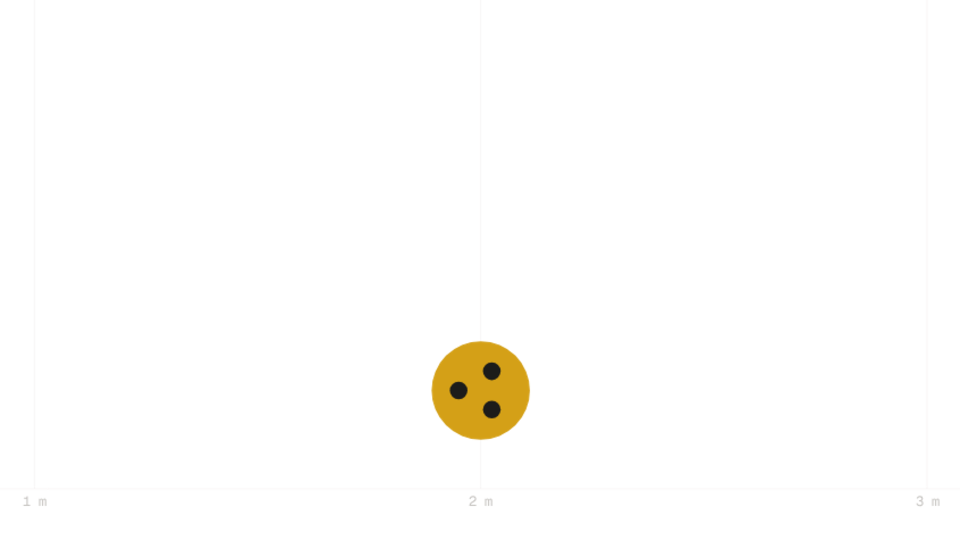
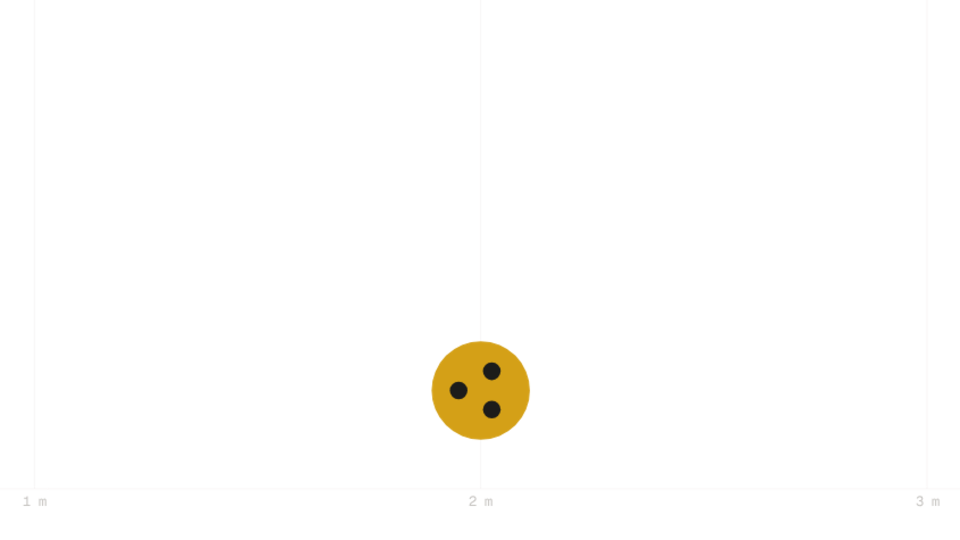
- Confirm that the readouts read Time 0.00 s, Ball Speed 0.00 m/s, Impulse 0.00 N·s, and Energy Transfer 0.0 % before launch.
- Press Start. The foot accelerates from the left at the chosen speed and contacts the stationary ball at x = 2 m.
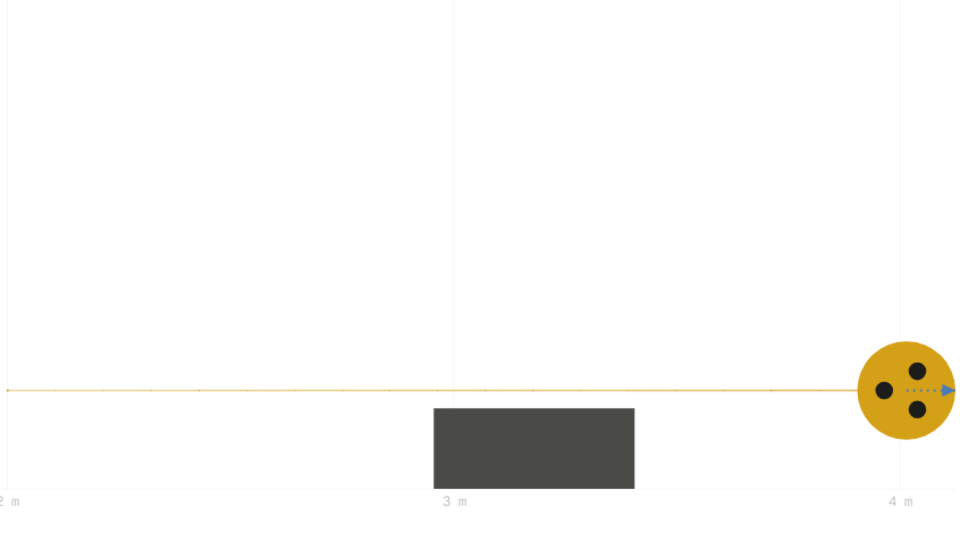
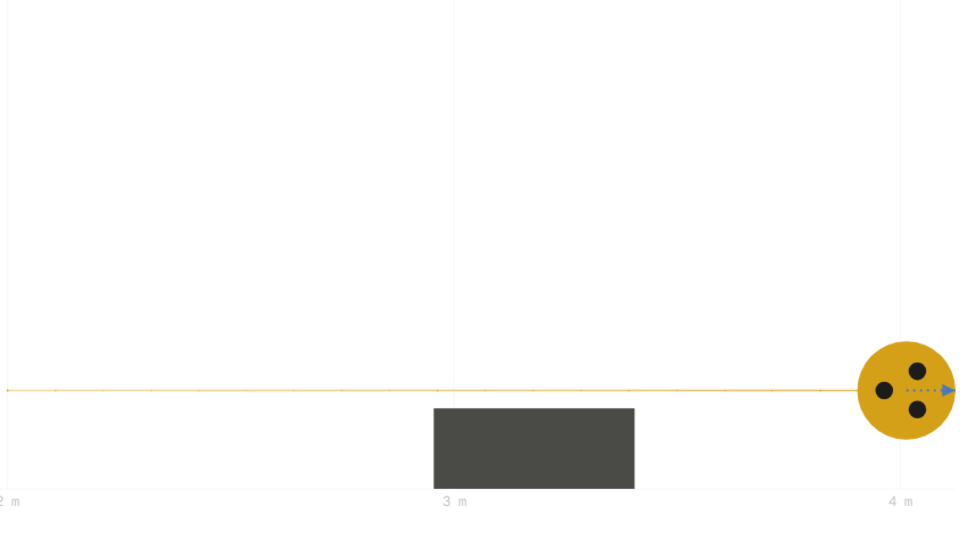
- Read Ball Speed, Impulse, and Energy Transfer once the ball clears the viewport, and compare them to the predicted values below.
Analytical Prediction
With m_foot = 5.0 kg, v_foot = 18.0 m/s, m_ball = 0.43 kg, e = 0.55, the closed-form expression for the ball's exit speed is:
The foot's kinetic energy before impact is ½·5.0·18.0² = 810 J, while the ball carries away ½·0.43·25.69² ≈ 141.9 J:
So the energy-transfer ratio is about 17.5 %. The mass mismatch is the main bottleneck: because m_foot ≫ m_ball, the limit (1 + e)·v_foot ≈ 27.9 m/s is the largest exit speed an infinitely heavy 18 m/s leg could produce at e = 0.55, and the 5 kg leg already gets within 8 % of that ceiling.
Results Analysis
Compare the simulation readouts to the three predicted numbers: Ball Speed ≈ 25.69 m/s, Impulse ≈ 11.05 N·s, and Energy Transfer ≈ 17.5 %. Agreement to two decimal places confirms that the sim uses the same closed-form expression and the same FIFA-spec ball mass as the prediction. Now sweep one slider at a time. Raising Foot Mass from 5 to 10 kg with the other settings unchanged pushes v_ball toward (1 + 0.55)·v_foot ≈ 27.9 m/s, demonstrating the heavy-foot limit. Raising the coefficient of restitution from 0.55 to 0.70 at fixed mass and speed scales v_ball by (1 + 0.70)/(1 + 0.55) ≈ 1.097, a ~10 % increase that the readout should reflect almost exactly. Notice that η rises with m_foot but is independent of v_foot at fixed mass ratio and e, since both numerator and denominator scale as v². The impulse readout always equals 0.43 · v_ball within rounding, which is the cleanest check that momentum conservation is being applied correctly.
Source of Error
What this sim does NOT model: air drag during contact, energy loss to deformation beyond what the coefficient of restitution captures, rotational kinetic energy of either body, foot-shoe stiffness coupling, or non-rigid leg geometry. The contact is instantaneous and the swinging-leg mass is treated as a single effective lumped mass. The closed form v_ball = (1+e)·m_foot·v_foot/(m_foot + m_ball) assumes the same idealizations, so they cancel rather than contributing to the residual ball exit speed or impulse. The remaining gap is therefore purely numerical, not physical.
Further Exploration
- Set Foot Mass to its 1.0 kg minimum at Foot Speed 18 m/s and e = 0.55. Compute v_ball from the formula, then run the sim. Why does the exit speed barely exceed the foot speed, and what does this say about the m_foot ≫ m_ball assumption?
- Hold Foot Mass at 5 kg and Foot Speed at 18 m/s, then sweep e from 0.40 to 0.70 in 0.05 steps. Plot the predicted v_ball against e and confirm the relationship is linear with slope m_foot·v_foot/(m_foot + m_ball).
- Find the slider combination that maximizes Energy Transfer. Is η bounded above by a value below 1, and what mass ratio m_foot/m_ball gives the theoretical maximum at fixed e?
- At Foot Mass 10 kg, Foot Speed 25 m/s, and e = 0.70, what ball speed does the formula predict? How does this compare to the ≈37 m/s record speeds quoted in the article?
- Compute the average contact force F̄ = J / Δt assuming a 10 ms contact for the default settings. Does the resulting force lie in the 1–2 kN range cited in the article for hard strikes?
- If the swinging leg's effective mass were doubled but its kinetic energy held constant (so v_foot drops by √2), would the ball gain or lose exit speed? Verify with the sim.