Elastic Collision PhysicsMomentum, Energy & Velocity Exchange
Introduction
An elastic collision is an impact in which two objects bounce apart while preserving both the total momentum of the system and its total kinetic energy. Momentum is preserved by Newton's third law in any collision, but kinetic energy survives only when the contact is perfectly springy and no energy leaks into heat, sound, or permanent deformation. The simulator resolves every contact between two balls on a frictionless track using the closed-form elastic update, with the p total and KE total readouts exposing both invariants on the HUD.
Collision chapters open with this case because it is the cleanest setting where both conservation laws hold simultaneously. Engineers borrow the same equations to design Newton's-cradle-style overload arresters, model neutron moderation in reactors, predict billiard trajectories, and analyse scattering of subatomic particles. Inelastic, two-dimensional, and relativistic generalisations sit on top of the same conservation skeleton rather than replacing it.
Before pressing Start, most people picture the heavier ball always shoving the lighter one forward and barely changing its own motion. The equal-mass case upends that picture: with m₁ = 2 kg, m₂ = 2 kg, and v₁ = 8 m/s into a stationary ball 2, the v₁ readout drops to roughly 0 m/s while v₂ climbs to roughly 8 m/s. The moving ball stops dead and hands its entire velocity across.
The Physics Explained
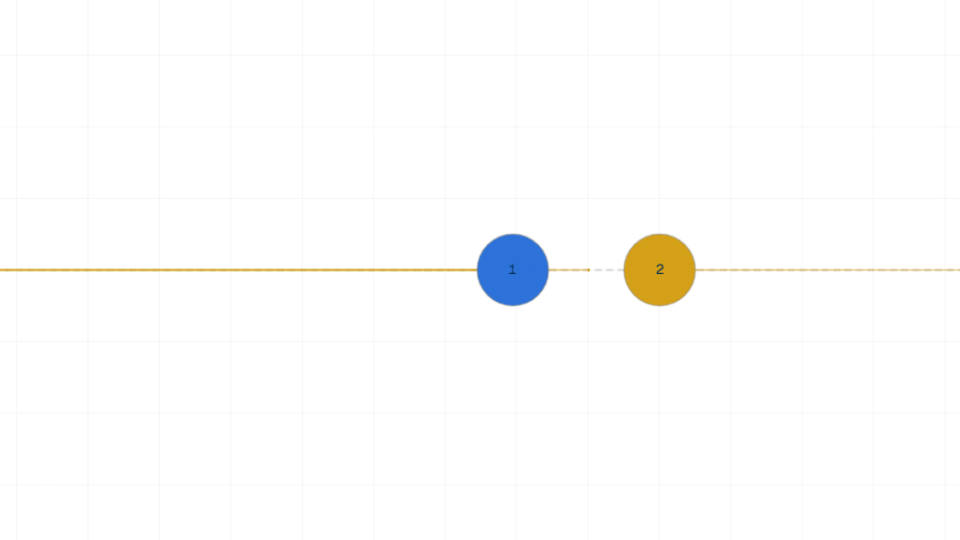
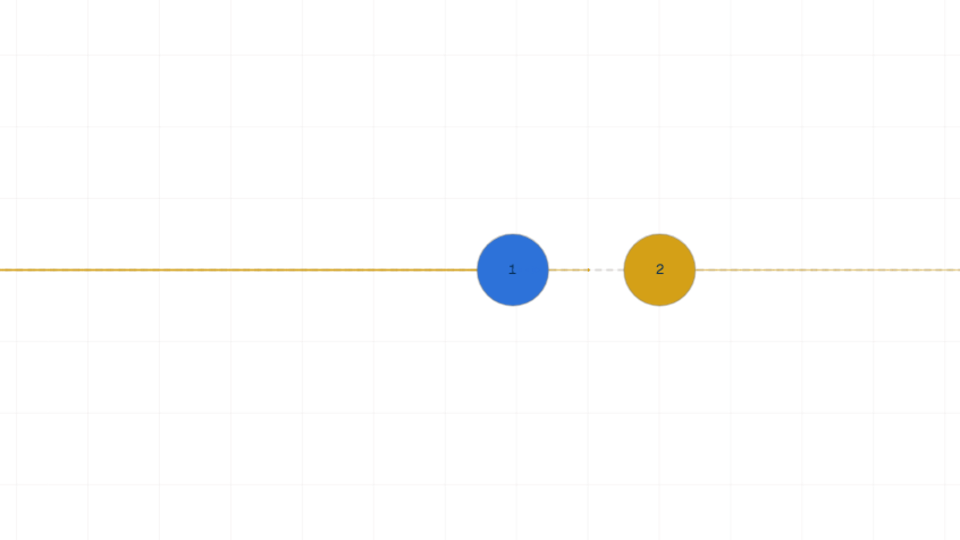
Every collision conserves momentum, because the contact forces between the two balls form a Newton-third-law pair: ball 1 pushes ball 2 with the same magnitude that ball 2 pushes back on ball 1, so the two impulses cancel inside the isolated system. With the default configuration of m₁ = 2 kg, m₂ = 2 kg, v₁ = 8 m/s, v₂ = 0, the simulator reports p total = 16.000 kg·m/s before contact, and the same 16.000 kg·m/s after; the readout does not move across the discontinuity. This conservation is what defines an isolated system regardless of whether the collision is elastic, inelastic, or anything in between.
Elastic collisions add the second constraint that kinetic energy is also preserved. Solving the momentum equation and the energy equation simultaneously for the two unknown post-collision velocities yields the closed-form result v₁' = ((m₁−m₂)·v₁ + 2·m₂·v₂) / (m₁+m₂) and v₂' = ((m₂−m₁)·v₂ + 2·m₁·v₁) / (m₁+m₂). For the default sliders these formulas predict v₁' = 0 m/s and v₂' = 8 m/s, exactly matching the post-collision readouts. The KE total readout, locked at 64.00 J before and after, confirms that the second conservation law also holds to the displayed precision.
The mass ratio governs every interesting limit of the formulas. Equal masses produce the velocity swap described above. A heavy projectile hitting a light stationary target keeps almost all of its initial velocity while the target shoots forward at nearly twice that speed: setting m₁ = 10 kg, m₂ = 0.5 kg, v₁ = 8 m/s in the simulator yields v₁' ≈ 7.24 m/s and v₂' ≈ 15.24 m/s, both predicted by the closed-form. A light projectile hitting a heavy stationary target bounces backward at nearly its original speed while the target barely moves, mirroring how a ping-pong ball rebounds off a bowling ball.
Wall reflections in the simulator are modelled as a second elastic event in which the wall acts as an effectively infinite mass: the ball's velocity flips sign while its speed is preserved, so kinetic energy stays put and momentum changes by exactly the impulse the wall delivers. This is why the KE total readout never drifts across the full 20-second run, but p total can shift each time a ball hits a wall because the wall is not part of the isolated two-ball system. Between wall hits, every ball-ball collision is a clean velocity swap or its mass-weighted generalisation.
Key Equations
For the default run with m₁ = 2 kg, m₂ = 2 kg, v₁ = 8 m/s, v₂ = 0: the left side evaluates to 2·8 + 2·0 = 16 kg·m/s, and the simulator's p total readout reports 16.000 kg·m/s before contact, matching exactly.
For the same defaults: ½·2·8² + ½·2·0² = 64 + 0 = 64 J, and the simulator's KE total readout sits at 64.00 J before and after contact. The two sides of this equation are what an inelastic collision would fail to satisfy.
Substituting m₁ = 2 kg, m₂ = 2 kg, v₁ = 8 m/s, v₂ = 0: v₁' = ((2−2)·8 + 2·2·0) / (2+2) = 0 / 4 = 0 m/s. The simulator's v₁ readout drops from 8.00 m/s to 0.00 m/s the instant the gap closes to 2·R, confirming the formula at readout precision.
Same substitution: v₂' = ((2−2)·0 + 2·2·8) / 4 = 32 / 4 = 8 m/s. The simulator's v₂ readout climbs from 0.00 m/s to 8.00 m/s in the same physics substep, completing the velocity swap that the equal-mass elastic case predicts analytically.
Key Variables
| Symbol | Name | Unit | Meaning |
|---|---|---|---|
| m₁ | Mass of ball 1 | kg | Inertial mass of the moving projectile |
| m₂ | Mass of ball 2 | kg | Inertial mass of the initially stationary target |
| v₁, v₁' | Velocity of ball 1 | m/s | Signed velocity of ball 1 before and after contact |
| v₂, v₂' | Velocity of ball 2 | m/s | Signed velocity of ball 2 before and after contact |
| p total | Total momentum | kg·m/s | Sum m₁·v₁ + m₂·v₂; conserved across every ball-ball collision |
| KE total | Total kinetic energy | J | Sum ½m₁v₁² + ½m₂v₂²; conserved only when the collision is elastic |
Real World Examples
Why does Newton's cradle pass exactly one ball through?
The desk-toy version uses five identical steel spheres suspended in a row. Lift one ball and release it, and exactly one ball at the far end swings out at the same height: never two, never half a ball. The behaviour is a direct consequence of the equal-mass elastic rule: when two equal masses collide, the velocities swap. The chain of contacts passes the incoming velocity along the line until it reaches the unsupported ball at the end.
Two balls swinging out at half speed would satisfy momentum but violate the kinetic-energy budget; they carry the same total momentum m·v but only half the energy of one ball at v, since KE scales as v². Only one configuration satisfies both laws at once, and that is the one nature picks.
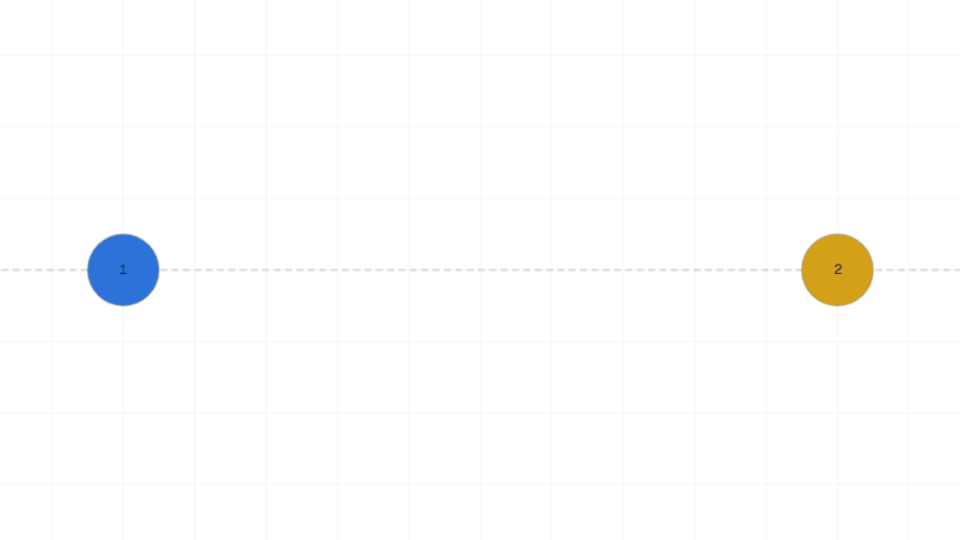
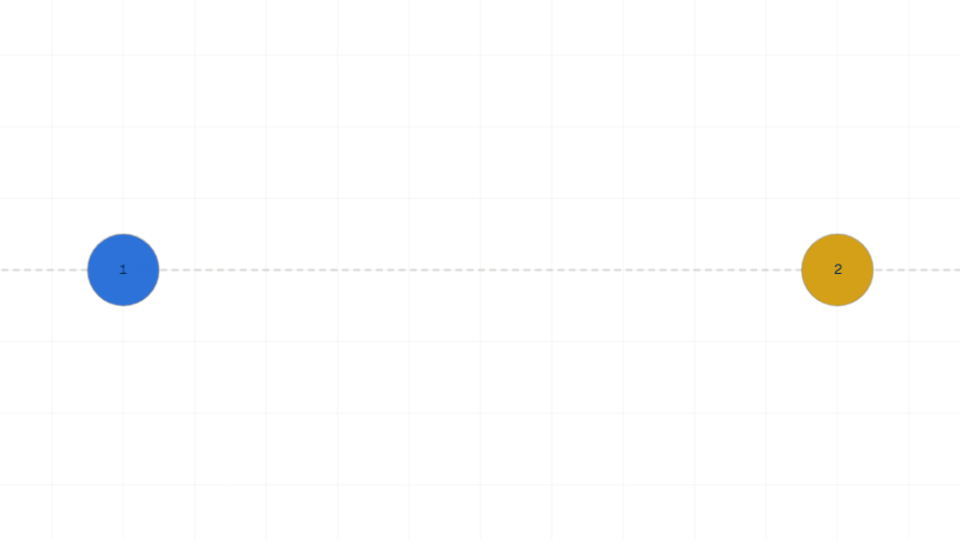
The simulator reproduces the underlying contact rule. Setting m₁ = 2 kg, m₂ = 2 kg, v₁ = 8 m/s drops the v₁ readout to 0 m/s and raises v₂ to 8 m/s in a single substep, while p total stays at 16.000 kg·m/s and KE total at 64.00 J across the discontinuity. The cradle is this same rule chained five times in series.
How do reactor designers use elastic collisions to slow neutrons?
Fission neutrons leave a uranium nucleus at roughly 2 MeV, far too fast to trigger further fission, which favours thermal neutrons near 0.025 eV. Reactor designers introduce a moderator whose nuclei elastically scatter the neutrons until most of the kinetic energy is lost. The choice of moderator nucleus is dictated directly by the elastic-collision formulas applied across a range of mass ratios.
Hydrogen in light water is the most efficient per collision because mneutron ≈ mproton, so the equal-mass swap rule transfers nearly all the neutron's energy to the proton in a head-on event. Heavier moderators like graphite need many more collisions to thermalise a neutron, but they absorb fewer of those neutrons, a trade-off that decides whether a reactor needs enriched fuel.
The simulator illustrates the transfer law. Holding v₁ = 8 m/s and m₁ = 2 kg as a stand-in for the neutron, sweeping m₂ from 0.5 kg to 10 kg traces the energy-transfer curve directly. Equal masses (m₂ = 2 kg) produce the perfect velocity swap; heavy targets (m₂ = 10 kg) leave the projectile with most of its original kinetic energy, just as a carbon nucleus removes only a small fraction per collision.
Why does a billiards break shot scatter the rack so violently?
The cue ball weighs essentially the same as each of the fifteen object balls in a standard rack. When the cue strikes the apex ball at break speeds of 7 to 9 m/s, the equal-mass rule transfers nearly all of the cue's velocity to the apex ball, which immediately collides with its neighbours, and so on. The energy fans out through the rack via a cascade of equal-mass swaps, each modelled by the one-dimensional formulas projected onto the line of centres.
Real billiard balls are not perfectly elastic: coefficients of restitution near 0.92 to 0.98 mean each contact loses a few percent to sound and deformation. Skilled players also use cue-ball spin, which the elastic formulas do not capture because they treat the balls as point particles. The scatter pattern is therefore an elastic phenomenon with small inelastic and rotational corrections layered on top.
The simulator confirms the per-contact rule. With m₁ = 2 kg, m₂ = 2 kg, v₁ = 8 m/s, the v₁ readout falls to 0 m/s while v₂ climbs to 8 m/s, the cue-stops-and-target-departs pattern every break shot exhibits at first contact. Each subsequent rack-internal collision repeats the same swap rule, distributing the cue-ball energy across the fifteen balls within a few hundred milliseconds.
Further Reading
- Inelastic collisions: what happens when momentum is conserved but kinetic energy is not, and where the missing energy goes inside the colliding bodies.
- Two-dimensional collisions: extending the same conservation laws to off-axis impacts that produce angular scattering between the two bodies.
- Foot-on-ball collision: the same conservation framework applied to a sports impact with a much larger mass ratio between projectile and target.