Inelastic Collision PhysicsMomentum Conservation & Energy Loss
Introduction
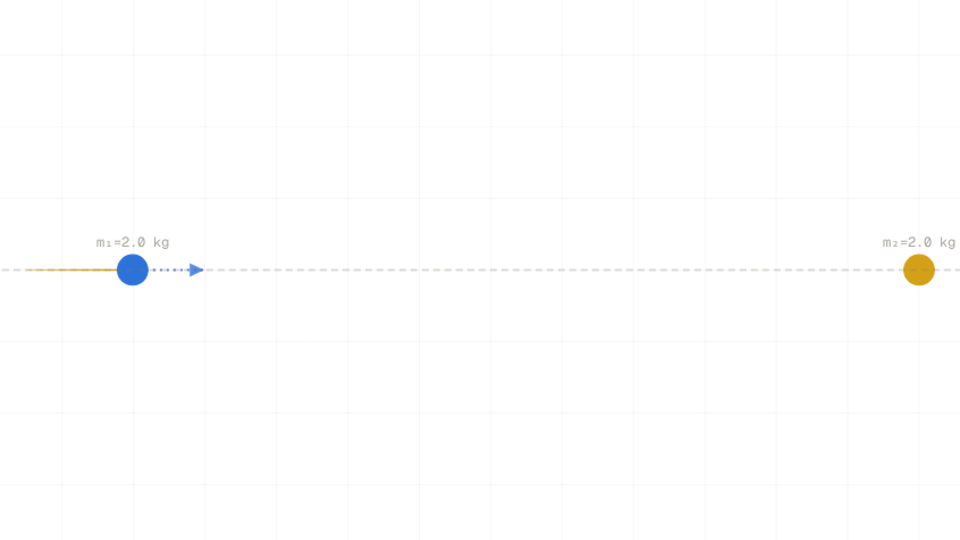
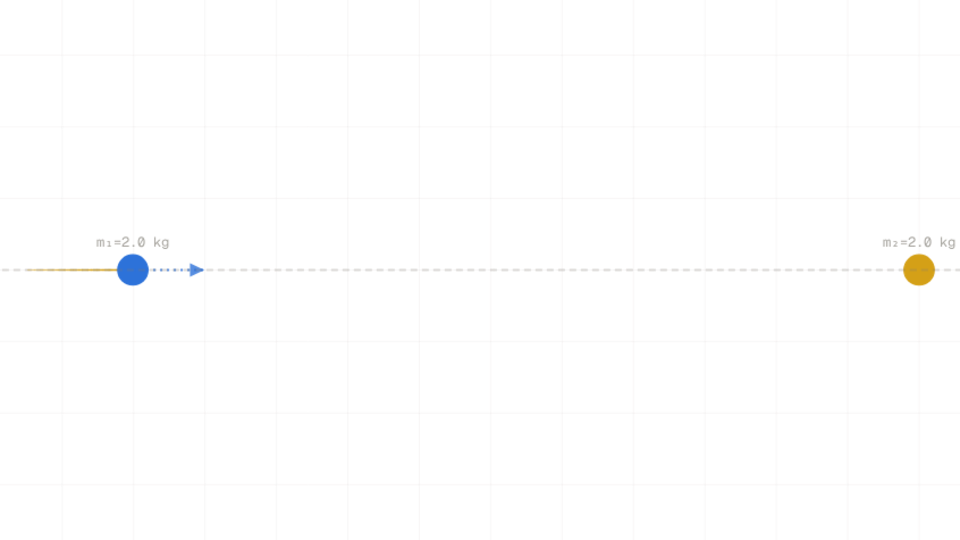
A perfectly inelastic collision is one in which two objects make contact and emerge stuck together as a single body. The shared post-impact velocity is fixed by the masses and incoming speeds through momentum conservation alone, while a definite fraction of the incoming kinetic energy vanishes into deformation, heat, and sound. The simulator stages the scenario on a frictionless 1D track: object 1 slides into a stationary object 2, the two merge, and readouts capture momentum and kinetic energy on both sides of impact.
This collision class is the workhorse model behind crash safety, ballistic measurements, coupling rail cars, and asteroid accretion. It is also the cleanest demonstration that momentum and kinetic energy are independent ledgers: one is conserved exactly while the other is not, and the inelastic case makes that distinction most visible.
Many students reason that if the two objects move more slowly after the collision, momentum must have been lost too. The momentum readout disagrees: with m₁ = m₂ = 2.0 kg and v₁ = 5.0 m/s, the merged pair leaves the impact at 2.50 m/s, half the original speed, yet pf still reads 10.00 kg·m/s, identical to p₀. Speed dropped because mass doubled; the product stayed fixed.
The Physics Explained
Newton's third law guarantees that the force object 1 exerts on object 2 during contact is equal and opposite to the force object 2 exerts on object 1. Because the two impulses share the same duration, they cancel exactly when the system is summed, so the total momentum p = m₁v₁ + m₂v₂ cannot change across the collision. This holds whether the bodies bounce, deform, or fuse. The simulator confirms it directly: with m₁ = m₂ = 2.0 kg and v₁ = 5.0 m/s, the p₀ and pf readouts both display 10.00 kg·m/s after the merge completes.
Kinetic energy obeys no such law. The deformation that locks the two bodies together is irreversible at the macroscopic scale: bonds rearrange, structure heats up, sound radiates outward, and a portion of the original ½mv² ends up as internal energy that cannot be recovered as bulk motion. With the same defaults, the KE₀ readout shows 25.00 J and the KEf readout settles at 12.50 J, a clean 50 % loss for the equal-mass case.
The lost energy has a compact closed form. Working in the centre-of-mass frame, all kinetic energy of relative motion is removed by the perfectly inelastic merger; only the bulk drift remains. The result is ΔKE = ½ μ vrel², where μ = m₁m₂/(m₁+m₂) is the reduced mass and vrel = v₁ − v₂ is the approach speed. With the defaults μ = 1.00 kg and vrel = 5.0 m/s, the formula predicts ΔKE = 12.50 J, exactly what the simulator reports.
Mass ratio drives how much energy survives. Equal masses always lose 50 %. A light object hitting a much heavier one loses almost everything because the merged body barely moves; a heavy object hitting a much lighter one loses almost nothing because the merger barely changes the dominant body's speed. With m₁ = 2.0 kg, m₂ = 6.0 kg, v₁ = 5.0 m/s, the ΔKE readout reaches 18.75 J (three quarters of the initial 25.00 J) while pf still equals p₀ to the precision displayed.
Key Equations
For object 1 at the default settings: p₁ = 2.0 · 5.0 = 10.00 kg·m/s. Object 2 starts at rest, so p₂ = 0 and the system's initial momentum p₀ = 10.00 kg·m/s. The simulator's p₀ readout populates with this value the moment the sliders settle.
Solving for the post-collision velocity at the defaults: v′ = (2.0 · 5.0 + 2.0 · 0) / (2.0 + 2.0) = 10/4 = 2.50 m/s. The merged pair carries pf = 4.0 · 2.50 = 10.00 kg·m/s, exactly matching p₀ on the simulator's readout grid.
For the equal-mass default: μ = (2.0 · 2.0) / (2.0 + 2.0) = 4.0 / 4.0 = 1.00 kg. The reduced mass is the effective inertia of the relative-motion coordinate, and it is the only mass that matters for the energy bookkeeping below.
With μ = 1.00 kg and vrel = v₁ − v₂ = 5.0 m/s: ΔKE = 0.5 · 1.00 · 25 = 12.50 J. The simulator's ΔKE readout displays 12.50 J after the merge passes x = 45 m, matching this prediction to two decimals.
KE₀ = ½ · 2.0 · 5.0² = 25.00 J at the defaults, so KEf = 25.00 − 12.50 = 12.50 J. The simulator reports KE₀ = 25.00 J and KEf = 12.50 J: an exact 50 % loss, the signature of any equal-mass perfectly inelastic collision.
Key Variables
| Symbol | Name | Unit | Meaning |
|---|---|---|---|
| m₁, m₂ | Object masses | kg | Inertias of the two colliding bodies |
| v₁, v₂ | Initial velocities | m/s | Speeds before contact (v₂ = 0 in this sim) |
| v′ | Final velocity | m/s | Shared speed of the merged pair |
| p | Momentum | kg·m/s | Conserved across the collision |
| KE | Kinetic energy | J | Initial and final values bracket the loss |
| ΔKE | Energy lost | J | Converted to deformation, heat, and sound |
| μ | Reduced mass | kg | m₁m₂ / (m₁ + m₂); sets ΔKE |
| vrel | Approach speed | m/s | v₁ − v₂ at the moment of contact |
Real World Examples
Why do crumple zones make modern cars safer in head-on crashes?
The crash itself is a near-perfect inelastic event: two vehicles collide and either deform together or come to rest as one mass. Because momentum is conserved no matter what the bodywork does, the engineering target is not momentum but energy. A frontal crumple zone is engineered to absorb a calibrated fraction of the initial kinetic energy by folding metal at controlled stress, which lengthens the deceleration distance and lowers the peak force the cabin transmits to its occupants.
The reduced-mass formula explains why two-vehicle crashes hurt more than single-vehicle barrier strikes at the same speed. Two equal-mass cars approaching head-on at v each have vrel = 2v, so ΔKE scales with (2v)² rather than v², quadrupling the energy the structure must absorb. The simulator stages the equal-mass version cleanly: with m₁ = m₂ = 2.0 kg and v₁ = 5.0 m/s, the KEf readout drops from 25.00 J to 12.50 J, the 50 % loss that crumple zones are sized to dissipate.
How does a ballistic pendulum measure bullet speed without a chronograph?
A bullet fired into a hanging block embeds completely, making the impact a textbook perfectly inelastic collision. Momentum conservation pins the post-impact speed of the block-plus-bullet system to (mbullet · vbullet) / (mbullet + mblock). The block then swings upward as a pendulum, converting that bulk kinetic energy into gravitational potential energy at its peak height. Measuring the peak height and inverting the energy equation gives the muzzle speed, no high-speed timing electronics required.
The simulator strips the experiment to its core. Setting m₁ = 0.5 kg and m₂ = 10.0 kg with v₁ = 5.0 m/s (a small projectile striking a heavy block) produces a v′ of (0.5 · 5.0) / 10.5 ≈ 0.238 m/s on the readout. The pf readout shows 2.50 kg·m/s, matching p₀ exactly, while the KEf readout collapses to about 0.30 J of the original 6.25 J. Roughly 95 % of the kinetic energy vanishes into the block's deformation, the same signature any real ballistic pendulum will record.
How fast did asteroid material accrete in the early solar system?
Planetesimals in the protoplanetary disk grew by sticking. When two icy or rocky grains drifted into contact at low relative velocity, electrostatic forces and surface chemistry locked them as one body: a perfectly inelastic merger writ small. The mass-weighted velocity formula v′ = (m₁v₁ + m₂v₂) / (m₁+m₂) governs every such union, and the cumulative bookkeeping over millions of mergers determines the final orbital trajectory of the growing body.
The energy budget of the merger sets a hard upper limit on collision speed. Once vrel grows large enough that ΔKE = ½ μ vrel² exceeds the bonding energy of the contact, the bodies fragment instead of fusing. The simulator's reduced-mass scaling captures the principle exactly: with m₁ = 2.0 kg, m₂ = 6.0 kg, v₁ = 5.0 m/s, the ΔKE readout reaches 18.75 J, a three-quarters loss that, in a real planetesimal, would shatter both bodies rather than glue them.
Further Reading
- Elastic collisions: the opposite limit, where the two objects rebound from contact without losing any kinetic energy at all and the closed-form solution involves both masses, not just the reduced mass.
- Projectile motion: vector decomposition that reappears whenever a single body obeys two independent motion rules at once.