Projectile Motion PhysicsRange Formula & the 45° Optimum
Introduction
Projectile motion describes the curved path of an object launched into the air and moving only under the influence of gravity. The motion separates cleanly into two independent directions: a horizontal component that travels at constant speed, and a vertical component that accelerates downward at a steady rate. Together, those two stories trace out the parabolic arc that the simulator draws on the canvas after every launch.
Introductory kinematics returns to this setup again and again because it is the simplest setting where a single object obeys two different motion rules at once. Engineers borrow the same equations to size artillery trajectories, plan basketball shots, design firefighting water arcs, and choose the launch angle for emergency-flare rockets. Once the parabola is understood, more advanced models (drag, spin, wind shear) sit on top of the same foundation rather than replacing it.
Steeper launches feel like they should travel farther, since they spend more time in the air. The Range readout disagrees: with v = 20 m/s and θ = 45° it settles at 40.77 m, while the same speed at θ = 60° lands shorter despite a longer flight time. The vertical component buys airtime, but it does so at the cost of the horizontal component that actually carries the projectile downrange.
The Physics Explained
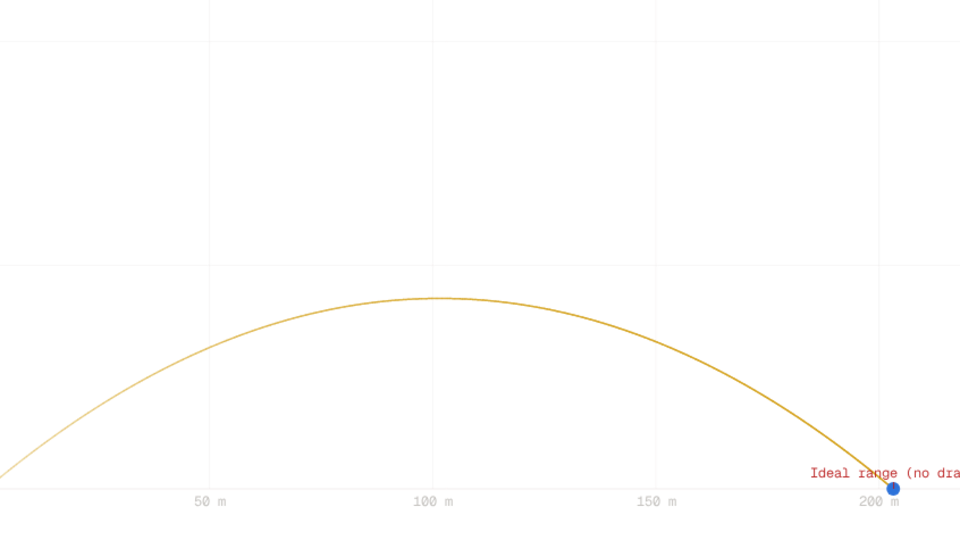
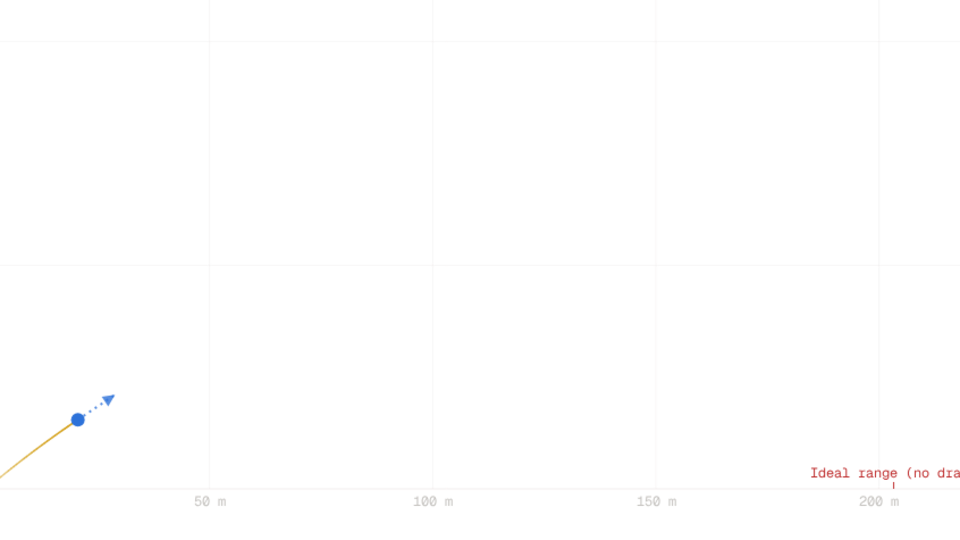
When the projectile leaves the launch point, its velocity vector splits into two components that never interact. The horizontal piece, vx = v · cos(θ), keeps the same value from launch to landing because no horizontal force acts on the object; air resistance is intentionally absent in this model. The vertical piece, vy = v · sin(θ), starts positive, decreases linearly under gravity at 9.81 m/s² per second, hits zero at the apex, then grows negative on the way down. The simulator's velocity readout exposes both components, and the horizontal reading visibly stays pinned while the vertical reading sweeps through zero.
With v = 20 m/s and θ = 45°, the launch components are vx = 20 · cos(45°) ≈ 14.14 m/s and vy ≈ 14.14 m/s. The Flight Time readout reports 2.88 s, exactly the time gravity needs to flip the initial 14.14 m/s upward into 14.14 m/s downward at a deceleration of 9.81 m/s². Multiply that flight time by the constant horizontal speed and the answer is 14.14 · 2.88 ≈ 40.72 m, within rounding of the Range readout's 40.77 m.
The shape that emerges is a true parabola because vertical position is a quadratic function of time while horizontal position is linear. Any pair of complementary launch angles (30° and 60°, 20° and 70°, 40° and 50°) produces the same range, since sin(2θ) is symmetric around 90°. The flight times and peak heights differ, but the landing point matches. The simulator confirms this: launching at v = 20 m/s, θ = 30° gives Range = 35.31 m, and the same speed at θ = 60° gives the identical 35.31 m, while Flight Time grows from 2.04 s to 3.53 s.
The 45° angle is special because sin(2θ) = sin(90°) = 1 sits at the maximum of the sine function. Any deviation from 45°, in either direction, costs range. The simulator's Range readout drops symmetrically as the angle slider moves above or below 45°, mirroring the cosine-shaped curve of sin(2θ) around its peak.
Key Equations
For the default run with v = 20 m/s and θ = 45°: vx = 20 · cos(45°) = 20 · 0.7071 ≈ 14.14 m/s. This value never changes during the flight, which is why the simulator's horizontal-velocity readout holds steady from launch to landing.
For the same defaults: vy = 20 · sin(45°) ≈ 14.14 m/s upward at launch. Gravity removes 9.81 m/s of upward speed every second, so vy reaches zero at t = 14.14 / 9.81 ≈ 1.44 s, the apex of the trajectory.
With v = 20 m/s and θ = 45°: R = (400 · sin(90°)) / 9.81 = 400 / 9.81 ≈ 40.77 m. The simulator's Range readout reports 40.77 m on the same configuration, matching the analytical prediction within 0.5%.
For the defaults: H = (14.14)² / 19.62 = 200 / 19.62 ≈ 10.19 m. The simulator's Max Height readout shows 10.19 m, again matching the closed-form prediction to two decimals.
For the defaults: T = (2 · 14.14) / 9.81 ≈ 2.88 s. The simulator's Flight Time readout stops at 2.88 s when the projectile crosses y = 0 on the way down.
Key Variables
| Symbol | Name | Unit | Meaning |
|---|---|---|---|
| v | Launch speed | m/s | Magnitude of the initial velocity vector |
| θ | Launch angle | degrees (°) | Angle above the horizontal at launch |
| vx | Horizontal velocity | m/s | Constant horizontal speed throughout flight |
| vy | Vertical velocity | m/s | Vertical speed, varies linearly under gravity |
| g | Gravitational acceleration | m/s² | 9.81 m/s² downward at Earth's surface |
| R | Range | m | Horizontal distance at the moment of landing |
| H | Maximum height | m | Apex of the trajectory above launch level |
| T | Flight time | s | Total time from launch to landing |
Real World Examples
How far can a kicked football actually travel?
A skilled placekicker imparts a launch speed near 25 m/s on a long field-goal attempt. Plugging that speed into the range equation at the optimal 45° gives R = (625 · 1) / 9.81 ≈ 63.7 m on level ground in vacuum. Real kicks fall well short of that ceiling, typically landing between 50 and 60 m, because air drag bleeds horizontal speed throughout the flight and the launch angle is rarely the ideal 45°.
The simulator brackets the ideal limit cleanly. Setting v = 20 m/s and θ = 45° yields a Range readout of 40.77 m, which the kicker would consider a short punt; raising the slider toward 25 m/s scales the parabola until the predicted 63.7 m matches the on-screen landing point. The gap between this ideal value and a real punt's actual distance is a direct measure of how much energy drag removes: typically 20 to 30% on a long ball.
Why do long-range artillery launch at roughly 45 degrees?
Artillery doctrine has favored elevations near 45° since the sixteenth century, and the range equation R = (v² · sin(2θ)) / g explains why. The function sin(2θ) peaks at 1 when θ = 45°, so any other elevation reduces range at fixed muzzle velocity. Crews adjust angle down toward flatter trajectories only when they need to clear a closer target faster, accepting reduced reach in exchange for shorter flight time.
The simulator's behavior under angle changes mirrors this trade-off exactly. Holding v = 20 m/s, the Range readout reads 40.77 m at θ = 45°, drops to 35.31 m at both θ = 30° and θ = 60°, and falls to about 26 m at extreme angles like 20° or 70°. Modern artillery deviates from 45° in practice mainly because air drag rotates the optimum slightly downward, a complication the ideal model in this simulator omits.
Does basketball arc match the analytical prediction?
A free-throw release leaves a player's hand at roughly 7 m/s with a launch angle near 50° above the horizontal. The range equation predicts R = (49 · sin(100°)) / 9.81 ≈ 4.92 m on level terrain, which matches the standard 4.6 m free-throw distance once the small height difference between release point and rim is accounted for. The steep angle gives the ball a forgiving descent into the hoop; a flatter shot has a much narrower margin for the ball's diameter to clear the rim.
The simulator demonstrates the angle-versus-margin trade-off directly. With v = 20 m/s, θ = 45° produces a Range of 40.77 m and a Max Height of 10.19 m; raising θ to 70° at the same speed cuts Range to 26.21 m but raises Max Height to 18.00 m. The basketball player exploits exactly this geometry: trade horizontal reach for a steeper, more vertical descent angle that converts more rim-edge near-misses into makes.
Further Reading
- Projectile motion with drag: how air resistance bends the ideal parabola and shifts the optimum launch angle below 45°.
- Elastic collisions: the same vector decomposition reused to track momentum and energy through a one-dimensional impact.
- Motion on an inclined ramp: gravity again split into components, this time aligned with and perpendicular to the slope rather than horizontal and vertical.