Projectile with Drag PhysicsWhy Drag Drops the Best Angle Below 45°
Introduction
Projectile motion with drag describes the curved path of an object launched into the air when air resistance is no longer ignored. The drag-free model treats the trajectory as a clean parabola governed only by gravity, but as soon as the surrounding air pushes back, that symmetric arc deforms into a shorter, lower, asymmetric flight whose descent is steeper than its ascent. The simulator builds a quadratic-drag projectile on top of the drag-free model so the two regimes can be compared side by side.
The topic matters because almost every real launch happens in air, not vacuum. Artillery, golf, baseball, javelin, and model rockets all live in the regime where drag rewrites the textbook formulas. Once the parabola is gone, the equations of motion become coupled and nonlinear, no closed-form trajectory exists, and a numerical integrator is the only honest way to predict where the projectile lands.
It is tempting to assume that drag mostly slows the horizontal component and leaves the peak height roughly unchanged. The readouts contradict that picture: with Launch Speed = 45 m/s, Launch Angle = 40°, and Drag Coefficient = 0.0050 kg/m, both the landing X and the peak Y fall well below the drag-free values of 203.3 m and 42.6 m, because the speed-squared drag bleeds energy from the climb just as aggressively as from the cruise.
The Physics Explained
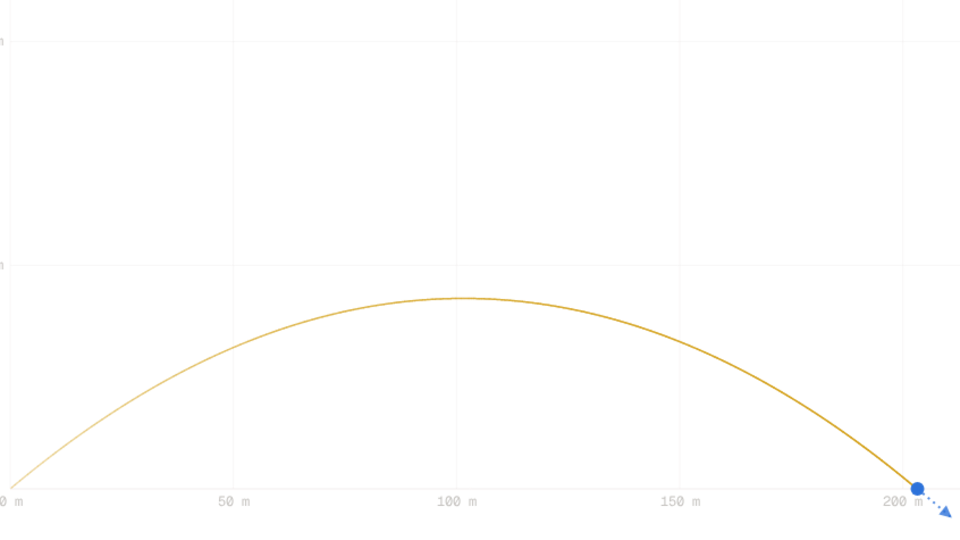
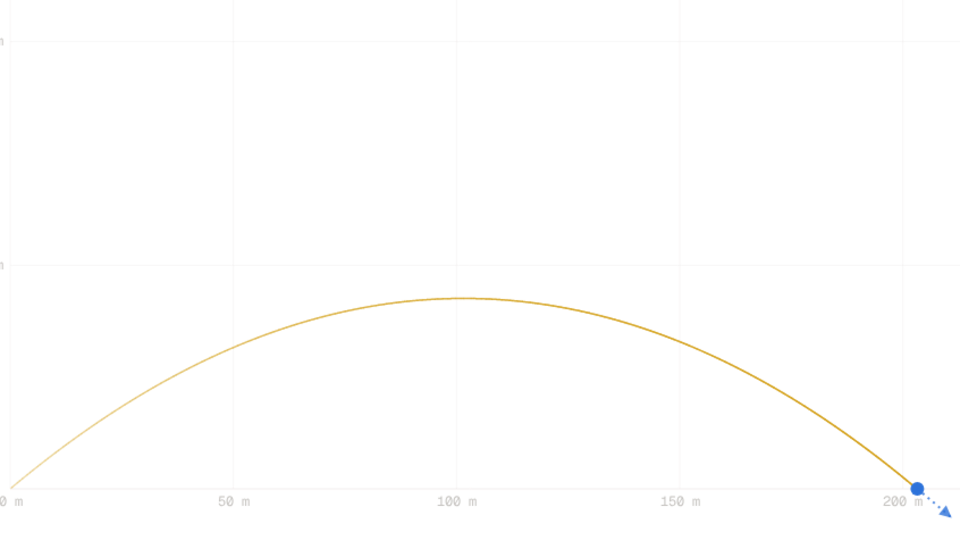
Drag is a force that opposes motion through a fluid, and at the speeds reached by sports balls, artillery shells, and the simulator's projectile, the dominant contribution scales with the square of speed. The simulator collapses air density, drag coefficient, and cross-sectional area into a single slider value k = ½·ρ·Cd·A with units of kg/m, then computes drag as k·v² acting opposite to the velocity vector. With Drag Coefficient = 0 the slider display reads off and the simulator reduces to ideal projectile motion; any non-zero k turns the motion into a coupled nonlinear system.
Because drag points opposite to velocity, it splits into a horizontal piece −(k/m)·vx·|v| and a vertical piece −(k/m)·vy·|v|. The vertical equation of motion is ay = −g − (k/m)·vy·|v| while ascending, which means drag and gravity cooperate to slow the climb, and ay = −g + (k/m)·|vy|·|v| while descending, which means drag now opposes gravity. The result is an asymmetric arc: with Launch Speed = 45 m/s, Launch Angle = 40°, and Drag Coefficient = 0.0050 kg/m, the simulator's trail visibly shows a steeper descent that covers less horizontal distance than the climb.
Energy is lost continuously throughout the flight, not just at the apex. The Speed readout starts at the launch value of 45 m/s, falls below 28 m/s near the peak (less than the 28.93 m/s vertical-zero crossing of the drag-free case), and at landing is markedly lower than the launch speed. That energy went into stirring the surrounding air. The Time, X, and Y readouts together pin down the deformation: range collapses well below the drag-free 203.3 m, peak Y drops below 42.6 m, and the drop half of the flight takes longer than the climb half rather than mirroring it.
One consequence is that the range-maximising launch angle is no longer 45°. Holding Launch Speed at 45 m/s and Drag Coefficient at 0.0050 kg/m, sweeping the Launch Angle slider through 30°, 35°, 40°, 45°, and 50° reveals that the X readout peaks somewhere below 45°. The harder drag bites (push Drag Coefficient toward 0.0100 kg/m), the further below 45° the optimum slides, because steep launches spend more time fighting drag in the vertical direction without converting it into horizontal range.
Key Equations
The simulator collapses ½·ρ·Cd·A into the single slider value k. With Drag Coefficient = 0.0050 kg/m and the speed of 45 m/s at launch, Fdrag = 0.0050 · 45² = 0.0050 · 2025 = 10.125 N at the instant of launch, comfortably above the projectile's 9.81 N weight (m·g with m = 1 kg).
For Launch Speed = 45 m/s and Launch Angle = 40°, vx at launch is 45·cos(40°) ≈ 34.47 m/s, |v| = 45 m/s, and ax = −0.0050·34.47·45 ≈ −7.76 m/s². The horizontal component decelerates immediately, unlike the drag-free case where it stays at 34.47 m/s for the entire flight.
At launch vy = 45·sin(40°) ≈ 28.93 m/s, so ay = −9.81 − 0.0050·28.93·45 ≈ −9.81 − 6.51 ≈ −16.32 m/s². Drag and gravity work together while ascending; on the way down vy flips sign and the second term reverses, leaving ay closer to −g once descent is established.
With v = 45 m/s and θ = 40°: R₀ = 2025·sin(80°)/9.81 ≈ 2025·0.9848/9.81 ≈ 203.3 m. The simulator confirms this when Drag Coefficient is set to off; the X readout halts near 203 m. Switching drag back to 0.0050 kg/m pulls the landing X well below this baseline.
With m = 1 kg and Drag Coefficient = 0.0100 kg/m, vterm = sqrt(9.81 / 0.0100) ≈ 31.3 m/s. A near-vertical launch at Launch Angle = 85° and Launch Speed = 45 m/s spends long enough falling that the Speed readout late in the descent levels off near this value.
Key Variables
| Symbol | Name | Unit | Meaning |
|---|---|---|---|
| v | Launch speed | m/s | Magnitude of the initial velocity vector |
| θ | Launch angle | degrees (°) | Angle above the horizontal at launch |
| k | Drag coefficient (lumped) | kg/m | Combined ½·ρ·Cd·A used by the simulator |
| m | Mass | kg | Hard-coded at 1 kg in the simulator |
| g | Gravitational acceleration | m/s² | 9.81 m/s² downward |
| vterm | Terminal speed | m/s | Vertical speed at which drag balances gravity |
Real World Examples
Why do long-range artillery shells launch below 45 degrees?
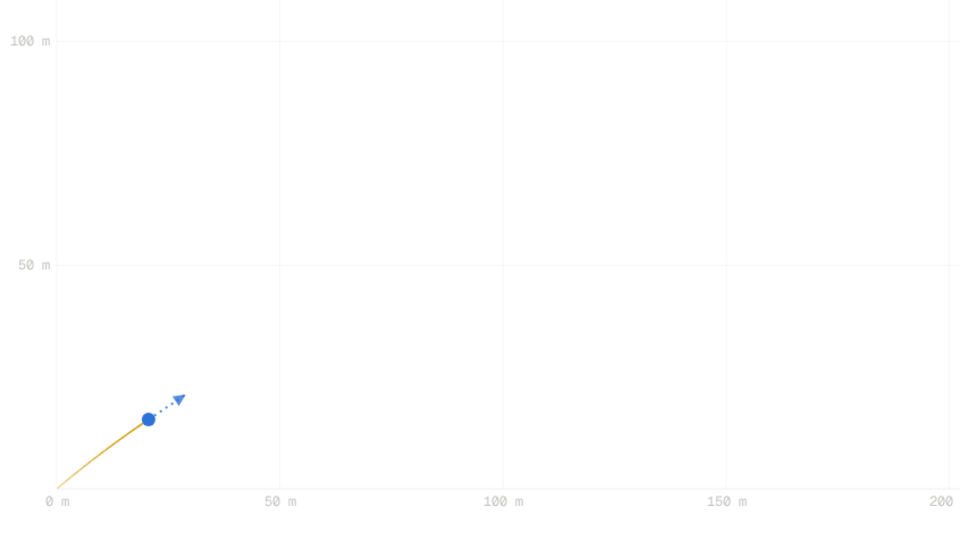
Drag-free physics predicts that a projectile launched on level ground reaches its maximum range when the launch angle is exactly 45°, because R = v²·sin(2θ)/g peaks where sin(2θ) = 1. Field artillery has known since the late nineteenth century that the real optimum sits well below this value, somewhere between 30° and 40° depending on muzzle velocity and shell shape. The reason is the same one the simulator demonstrates: drag scales with speed squared, so the steep climb of a 45° launch loses more energy per metre of altitude gained than a shallower trajectory does per metre downrange.
Modern range tables for tube artillery account for drag, lift, spin, and atmospheric density at each altitude reached during flight. At launch speeds typical of a 155 mm howitzer (around 800 m/s), the drag-corrected optimum elevation drops to roughly 40°, giving up several percent of the vacuum-predicted range in exchange for hitting a real target. The same effect appears in a much smaller setting: with Launch Speed held at 45 m/s and Drag Coefficient at 0.0050 kg/m, sweeping the Launch Angle slider through 30°, 35°, 40°, 45°, and 50° puts the maximum landing X somewhere below 45° on the simulator readout.
How fast does a skydiver actually fall?
A human in a belly-to-earth freefall position reaches a terminal speed of roughly 55 m/s, while a head-down dive position cuts cross-sectional area enough to push that figure past 90 m/s. Both numbers come straight from the same balance the simulator's terminal-speed equation expresses: the drag force k·v² grows until it equals the weight m·g, after which the net force is zero and acceleration stops. A larger area increases k, a larger mass increases m·g, and the terminal speed responds as vterm = sqrt(g·m/k).
The simulator captures the qualitative behaviour even though it locks mass at 1 kg. With Drag Coefficient = 0.0100 kg/m, the predicted terminal speed is sqrt(9.81/0.0100) ≈ 31.3 m/s. Setting Launch Angle = 85° and Launch Speed = 45 m/s produces a near-vertical climb followed by a long descent, and the Speed readout late in that descent levels off near the predicted terminal value rather than continuing to grow as it would in vacuum. A parachute multiplies the lumped k by the area ratio and slashes the terminal speed to a survivable few metres per second.
Do golf-ball dimples really help the ball travel farther?
A smooth sphere of golf-ball size and mass driven at 70 m/s would travel only about half as far as a real dimpled ball under the same launch conditions. The dimples trip the boundary layer into turbulence early; the turbulent layer stays attached around more of the ball's surface, narrowing the low-pressure wake behind it and lowering the effective drag coefficient Cd roughly from 0.5 (smooth sphere) to 0.25. That reduction feeds straight into k = ½·ρ·Cd·A, halving the drag force at any given speed.
The simulator does not model surface texture, but it makes the cost of a higher k visible. With Launch Speed = 45 m/s and Launch Angle = 40°, switching Drag Coefficient from 0.0050 kg/m to 0.0100 kg/m noticeably shortens the landing X readout and lowers the peak Y, the same kind of penalty a smooth golf ball would pay against its dimpled cousin. Engineering a lower Cd, whether through dimples, fairings, streamlined nose cones, or polished surfaces, is one of the cheapest ways to extend the range of any drag-limited projectile.
Further Reading
- Projectile motion: the drag-free parabolic baseline whose closed-form predictions this article repeatedly uses as a reference point.
- Free fall and terminal velocity: the simpler one-dimensional case where drag and gravity balance to give a single constant fall speed.
- The Magnus effect: how spin generates a sideways aerodynamic force that adds another complication on top of pure quadratic drag.