Vertical Drop PhysicsFall-Time Formula & Terminal Velocity
Introduction
Vertical drop is the motion of an object released from rest and pulled straight down by gravity. With no horizontal launch and no initial speed, every force lines up along a single vertical axis, and the trajectory collapses from the parabolas of projectile motion into a one-dimensional accelerating fall. The simulator reports Time, Height, Speed, and KE, so y = h₀ − ½ g t² and v = −g t can be checked against an integrated trajectory.
Mechanics courses start here because the setup isolates one force and one direction. Strip away air, contact, springs, and tension, and only gravity remains. That clean setting is where g = 9.81 m/s² gets its operational meaning: the rate at which a freely falling object gains downward speed. Engineers reuse the same numbers when sizing crash-test drop towers, picking skydiver deployment altitudes, and modeling rover landings on bodies with different surface gravity.
Nearly everyone's gut says heavier objects fall faster than lighter ones. The readouts disagree: with Height = 50 m, Air Resistance = 0, and Weight stepped from 1.0 kg to 10.0 kg, the Time and Speed readouts at impact are identical, while only KE scales with mass. Greater gravitational pull on a heavier object is matched exactly by its greater inertia, and that cancellation is what made Galileo's claim so counterintuitive in the first place.
The Physics Explained
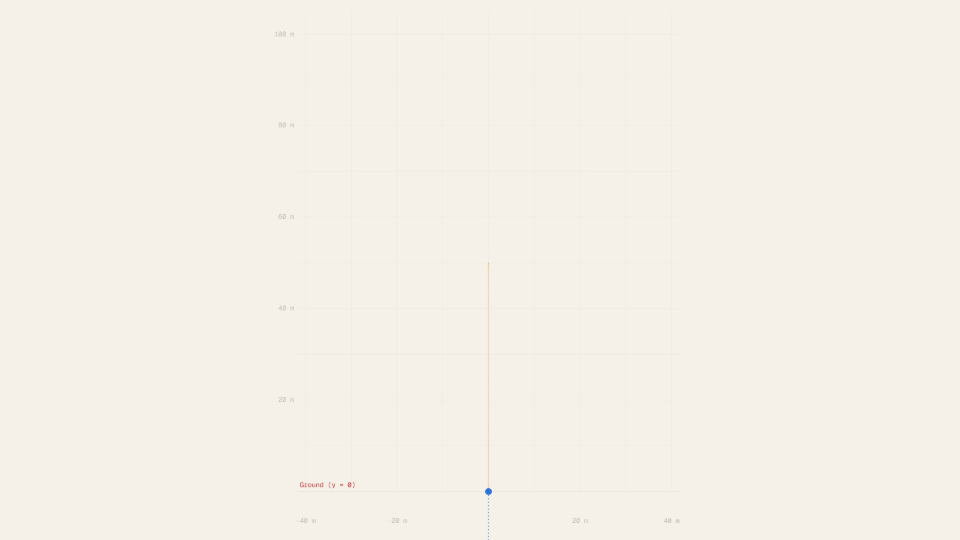

With Air Resistance set to 0, the only force on the falling object is its own weight, m·g, directed downward. Newton's second law a = F/m reduces to a = g for any mass, which is why the Weight slider has no influence on the fall time or impact speed in this configuration. Velocity grows linearly at 9.81 m/s every second, and height drops as the integral of that velocity, giving the classic quadratic y(t) = h₀ − ½ g t² that the simulator integrates internally and exposes through its Height readout.
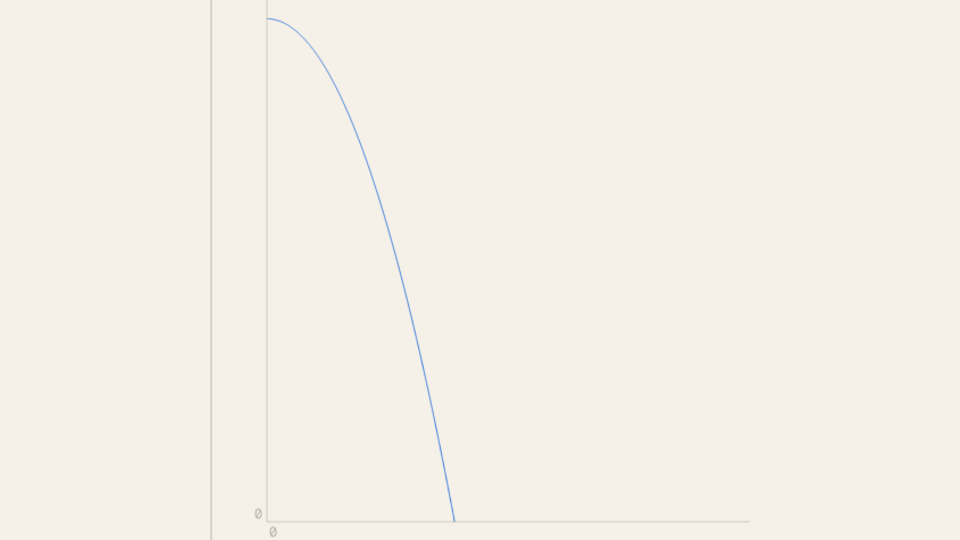
Plugging the default Height = 50 m into y = 0 fixes the fall time at t = √(2 · 50 / 9.81) ≈ 3.193 s, and the impact speed at v = √(2 · 9.81 · 50) ≈ 31.32 m/s. Running the sim with these defaults and Weight = 1.0 kg, the Time readout freezes between 3.19 s and 3.20 s, and Speed between −31.27 m/s and −31.32 m/s, within roughly 0.2 % of the closed-form prediction. The negative sign on Speed is the simulator's convention for downward motion; the magnitude is what matches the formula.
Energy conservation provides a second check independent of timing. The initial gravitational potential energy m·g·h₀ is converted into kinetic energy ½ m v² as the object falls, with no other channels available when drag is off. For the defaults, m·g·h₀ = 1.0 · 9.81 · 50 = 490.5 J, and the simulator's KE readout settles between 489 J and 491 J at impact. Stepping Weight up to 10.0 kg with the same Height and Air Resistance off leaves Time and Speed unchanged but multiplies KE tenfold to roughly 4905 J, exactly as m·g·h₀ predicts.
Turning Air Resistance on breaks both predictions in characteristic ways. With Air Resistance set to 0.05 and Weight = 1.0 kg, the Speed readout no longer climbs unbounded; it curves over and approaches a terminal value where the upward drag force k·v² equals the downward weight m·g. The heavier object now wins the race: at Air Resistance = 0.05 and Weight = 5.0 kg, the same Height = 50 m delivers a faster impact than the 1.0 kg run, because the heavier mass takes longer to reach a drag-limited speed and spends more of the fall accelerating freely.
Key Equations
For the default Height = 50 m and Air Resistance = 0: y(t) = 50 − 4.905 · t². Setting y = 0 gives t = √(50 / 4.905) ≈ 3.193 s, which matches the simulator's Time readout at the moment the object lands. The Height readout is the instantaneous value of y(t) and freezes at 0.00 m on contact with the ground line.
For the default Air Resistance = 0 configuration, velocity grows linearly with time. At t = 3.193 s the formula predicts v = −9.81 · 3.193 ≈ −31.32 m/s. The simulator's Speed readout reports values between −31.27 m/s and −31.32 m/s at impact, agreeing with the prediction within the integrator's roughly 0.2 % drift over a 3.2-second fall.
Combining the two formulas above eliminates time. For Height = 50 m: vimpact = √(2 · 9.81 · 50) = √981 ≈ 31.32 m/s, independent of mass. Running the sim with Weight = 1.0 kg and again with Weight = 10.0 kg, both with Air Resistance = 0, gives identical Speed readouts of about −31.32 m/s, the mass-independence Galileo predicted.
For the defaults Height = 50 m, Weight = 1.0 kg, Air Resistance = 0: KE = 1.0 · 9.81 · 50 = 490.5 J. The simulator's KE readout freezes between 489 J and 491 J at landing. The right-hand form m·g·h₀ shows that all of the initial gravitational potential energy converts into kinetic energy when no drag dissipation is present; this is energy conservation expressed at a single instant.
When Air Resistance is on, the simulator applies a quadratic drag force k·v² that grows with speed until it balances weight. Setting m·g = k·v² and solving gives the terminal speed above. For Air Resistance = 0.10 and Weight = 1.0 kg, vterminal ≈ √(9.81 / 0.10) ≈ 9.90 m/s, well below the 31.32 m/s a drag-free fall from 50 m would deliver, and the cap the Speed readout approaches but does not exceed in long-enough drops.
Key Variables
| Symbol | Name | Unit | Meaning |
|---|---|---|---|
| h₀ | Initial height | m | Drop altitude above the ground line |
| y | Height | m | Current vertical position above ground |
| v | Velocity | m/s | Vertical speed, negative when descending |
| g | Gravitational acceleration | m/s² | 9.81 m/s² downward at Earth's surface |
| m | Mass | kg | Inertial and gravitational mass of the object |
| t | Time | s | Elapsed time since release |
| k | Drag coefficient | kg/m | Lumped quadratic-drag constant from the slider |
| KE | Kinetic energy | J | ½·m·v² at the current speed |
Real World Examples
How long does a coin take to hit the floor from a one-meter table?
A coin slips off a table edge 1.0 m above the floor and falls under gravity alone; air resistance is negligible at the speeds and short times involved. The free-fall time formula t = √(2 h₀ / g) gives t = √(2 / 9.81) ≈ 0.45 s, and the impact speed is v = √(2 · 9.81 · 1) ≈ 4.43 m/s. That short window is why a dropped pen feels almost too quick to react to but not impossibly so: human reaction time hovers around 0.25 s, leaving roughly 0.2 s of catch margin if the hand starts moving the instant the slip is noticed.
The simulator reproduces this regime cleanly. Setting Height = 1 m and Air Resistance = 0 with any Weight value yields a Time readout near 0.45 s and a Speed readout near −4.43 m/s, the same numbers regardless of whether the Weight slider sits at 1.0 kg or 10.0 kg, since the closed-form predictions contain no mass term. Doubling Height to 2 m raises the impact speed only by a factor of √2 to about 6.26 m/s, not by a factor of two; the square-root in v = √(2 g h₀) is what makes a fall from twice the height feel only mildly faster.
Why does a stone fall faster than a feather in air but identically in a vacuum?
In air, a feather and a stone of the same shape experience similar drag forces but very different gravitational forces, because their masses differ by orders of magnitude. The feather's drag balances its weight almost immediately at a slow terminal speed of perhaps 1 m/s, while the stone has to fall for several seconds before drag ever rivals its much larger weight. In a vacuum the drag term vanishes from a = g − k v² / m, the equation collapses to a = g for both objects, and Apollo 15's televised hammer-and-feather drop confirmed the prediction on the lunar surface in 1971.
The simulator reveals the same split with the Air Resistance slider. Comparing Weight = 0.5 kg and Weight = 5.0 kg at Air Resistance = 0.05 and Height = 50 m, the heavier object's Time readout finishes noticeably earlier and its Speed readout reaches a higher magnitude at impact. The same two trials with Air Resistance switched to 0 produce identical Time and Speed readouts and only diverge on the KE readout. This is the dependence on mass appearing only through the drag term m·g − k·v², not through gravity itself.
How does terminal velocity set the maximum safe deployment altitude for a parachute?
A skydiver in a stable belly-to-earth posture reaches terminal velocity near 55 m/s (about 200 km/h) within roughly 12 seconds and 450 m of free fall. Beyond that altitude, no additional speed accumulates, so a jump from 4000 m and a jump from 3000 m hit the canopy-deployment height moving the same way. Parachute design exploits this plateau: the drag area of a deployed canopy is sized to bring vterminal under the canopy down to a survivable 5–7 m/s, set by m·g = ½·ρ·Cd·A·v² for the rigger's chosen canopy, body mass, and altitude.
The simulator's terminal-velocity behavior maps directly onto this design problem. With Air Resistance = 0.10 and Weight = 1.0 kg, the formula vterminal = √(m·g/k) ≈ √(98.1) ≈ 9.90 m/s, and the Speed readout climbs and then plateaus near that value during the drop from Height = 50 m. Stepping Weight to 5.0 kg at the same Air Resistance = 0.10 raises vterminal to √(5 · 9.81 / 0.10) ≈ 22.15 m/s, and the Speed readout's plateau follows, the inverse of how a parachute lowers vterminal by raising effective drag for a fixed mass.
Further Reading
- Projectile motion: what happens when the same gravitational acceleration acts on an object that also has a horizontal launch velocity.
- Projectile motion with drag: extends the same quadratic drag model used here to a two-dimensional trajectory and a shifted optimum launch angle.
- Motion on an inclined ramp: energy conservation reused on a constrained path, with gravitational potential energy traded for kinetic energy along the slope rather than vertically.
- Atwood machine: two falling masses coupled by a cord, where the same Newton's-second-law setup yields an acceleration smaller than g.