Curved Ramp PhysicsWhy Bottom Speed Ignores the Path
Introduction
A frictionless ball sliding down a curved ramp is one of the cleanest demonstrations of mechanical-energy conservation in classical physics. The simulator releases a point bead from a fixed start point A, follows it along a smooth curve to an end point B, and reports the speed, time, local slope, and arc length the bead has traversed at every moment along the way.
The setup matters because it isolates a single principle: gravitational potential energy at the top converts entirely into kinetic energy at the bottom when nothing dissipates along the way. Galileo used a straight inclined plane to make the same point in the early seventeenth century. Curving the ramp turns the same demonstration into a stronger claim: the path's shape is irrelevant to the speed at the bottom. That claim is the foundation of every energy-budget calculation that engineers do today.
A deeper, more curved ramp looks like it should deliver a faster ball at the bottom, since the slope steepens midway and the bead spends more time accelerating. The bottom speed never budges: with Inclination at 20.0° and Curvature at 1.00, the Speed readout at point B settles near 11.95 m/s, and dropping Curvature to 0.01 (a nearly straight ramp) produces the same 11.95 m/s on a shorter, faster descent.
The Physics Explained
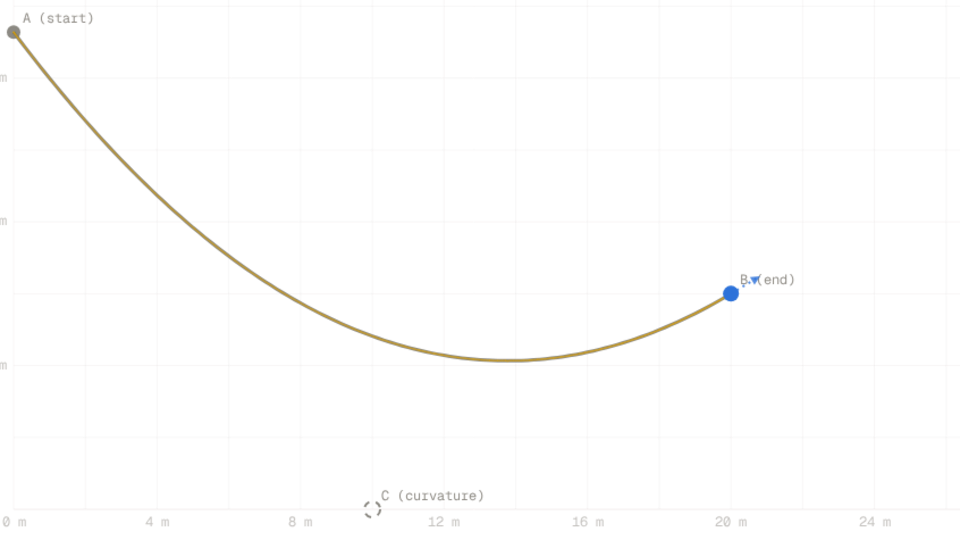
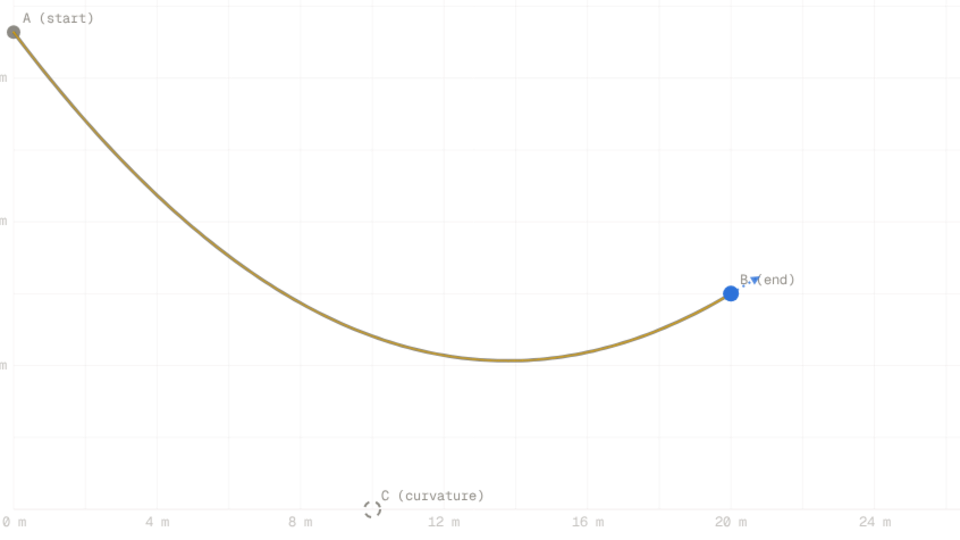
The simulator models a point bead constrained to a smooth curve between A and B. Two forces act on the bead: gravity, pulling straight down with magnitude m · g, and a normal force from the track, pointing perpendicular to the local tangent. Because the normal force is always perpendicular to the velocity, it does zero work; it bends the path without changing the bead's speed. Only the component of gravity that lies along the tangent accelerates the bead, and that component is g · sin θ, where θ is the local slope angle. The Slope θ readout reports exactly this angle as the bead moves.
Energy conservation collapses the per-instant force picture into a single statement about endpoints. At the start, the bead has potential energy m · g · H and zero kinetic energy. At the bottom, it has zero potential energy and kinetic energy ½ · m · v². Setting them equal and cancelling the mass gives v = √(2 · g · H). The mass falls out, the path's shape falls out, and only the vertical drop H survives. With Inclination at 20.0° the geometry fixes H = L · tan θ = 20 · tan 20° ≈ 7.28 m, and the prediction is v = √(2 · 9.81 · 7.28) ≈ 11.95 m/s.
What the path's shape does control is how long the descent takes and how far the bead travels along the arc. With Inclination at 20.0° and Curvature at 1.00, the curve bows deep below the chord, the Distance s readout grows beyond the straight-line length L / cos 20° ≈ 21.28 m, and the Time readout records a longer descent. Drop Curvature to 0.01 and the path is nearly straight: Distance s shrinks toward 21.28 m and Time falls noticeably, but the Speed readout at point B still lands near 11.95 m/s. The energy budget is fixed; only the journey changes.
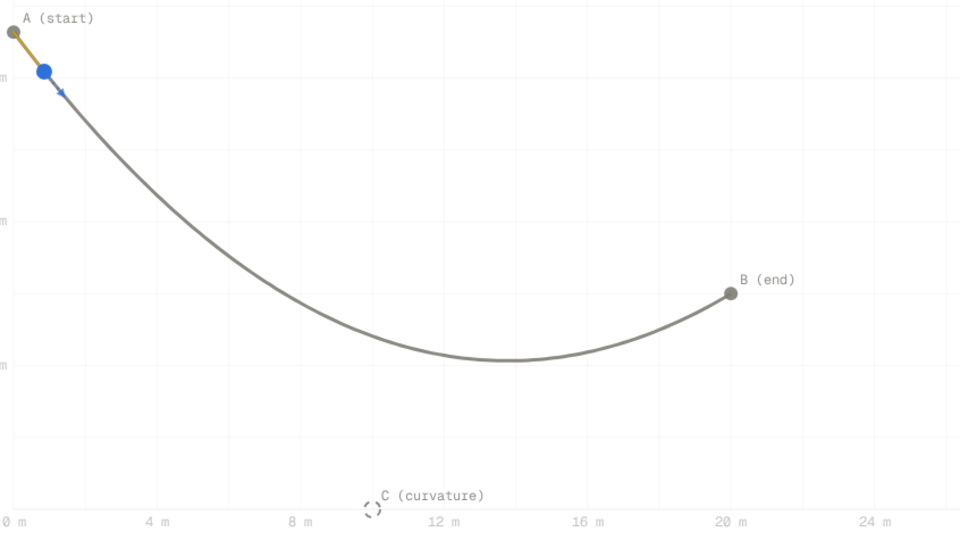
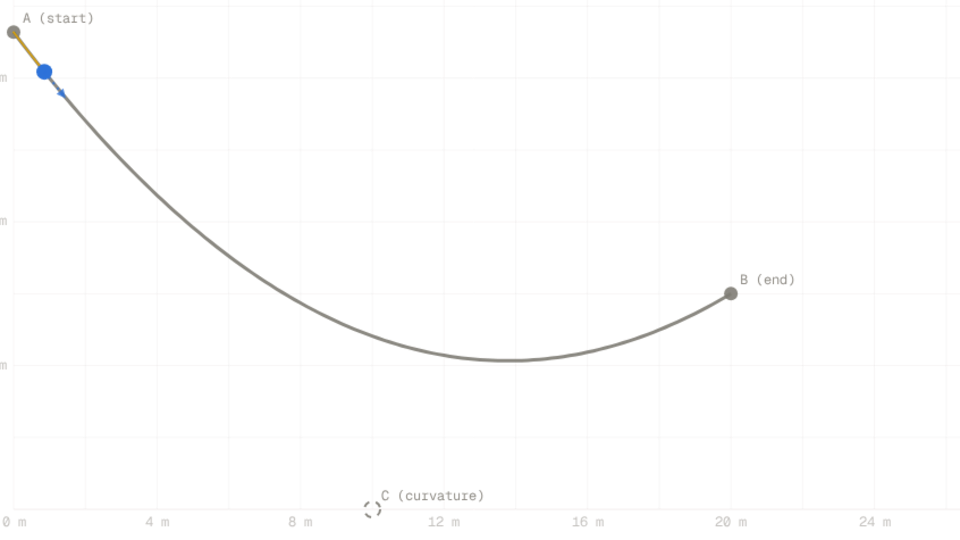
The Slope θ readout makes the local picture concrete. At the very top of a deeply curved ramp, the tangent is nearly horizontal, so g · sin θ is small and the bead barely accelerates. Near the middle, the tangent is at its steepest, sin θ is largest, and the bead picks up speed fastest. Near point B, the path levels out again, the tangent angle returns toward 0°, and the acceleration tapers to zero. The bead has its maximum speed but is no longer gaining any.
Key Equations
For Inclination at 20.0° the geometry fixes H = L · tan θ = 20 · tan 20° ≈ 7.28 m, so a 1 kg bead at point A holds PE = 1 · 9.81 · 7.28 ≈ 71.4 J. The bead's actual mass cancels in the next step, so the simulator does not need to expose it as a slider.
If the Speed readout at point B is 11.95 m/s, the same 1 kg bead arrives with KE = 0.5 · 1 · 11.95² ≈ 71.4 J. The number is identical to the starting PE within rounding, which is exactly the conservation statement you expect on a frictionless track.
Substituting H ≈ 7.28 m and g = 9.81 m/s² gives v = √(2 · 9.81 · 7.28) = √142.8 ≈ 11.95 m/s. This is the prediction the Speed readout reproduces at point B with Inclination at 20.0° and Curvature at 1.00. The Curvature slider does not appear anywhere in this expression.
With L = 20 m fixed, raising the Inclination slider to 45.0° lifts H to 20 · tan 45° = 20 m. Plugging that into the speed formula predicts v = √(2 · 9.81 · 20) ≈ 19.81 m/s at point B, which the Speed readout reproduces at any Curvature setting between 0.01 and 1.00.
This is the per-instant acceleration the simulator integrates; θlocal is the Slope θ readout, not the slider Inclination. At the start of a Curvature 1.00 ramp the tangent is nearly flat, so atangent is tiny; near the middle it peaks, then it tapers to zero as the path levels at B.
Key Variables
| Symbol | Name | Unit | Meaning |
|---|---|---|---|
| L | Horizontal span | m | Fixed 20 m distance from point A to point B |
| θ | Inclination | degrees (°) | Slider angle that fixes the chord drop |
| H | Vertical drop | m | Height difference between A and B, equal to L · tan θ |
| g | Gravitational acceleration | m/s² | 9.81 m/s² downward at Earth's surface |
| v | Speed at B | m/s | Bead speed when it reaches the end of the curve |
| s | Arc length | m | Distance the bead has traveled along the curve |
| θlocal | Slope angle | degrees (°) | Local tangent angle at the bead's current position |
Real World Examples
How do roller-coaster engineers set the height of every hill after the lift?
The first lift hill on a coaster does the work of charging the energy budget for the rest of the ride; every subsequent hill draws from that budget. On an idealised frictionless track the formula v = √(2 · g · H) says the cars would reach the same speed at the bottom of any later valley as long as it sits at the same height as the lift's release point. Real tracks burn 10 to 25 % of the budget to friction, air drag, and wheel deflection per kilometer of track, so engineers must lower each successive hill to keep the cars moving over its crest.
The simulator demonstrates the ideal version of the same calculation. With Inclination at 20.0° the Speed readout at point B settles near 11.95 m/s independent of the Curvature setting, exactly because the energy budget depends only on the H = 7.28 m drop. A coaster designer who knew the cumulative friction loss between the lift and a target hill would subtract that loss from the lift height, then use v = √(2 · g · Hremaining) to verify the cars still clear it.
Why does the brachistochrone curve beat a straight ramp on descent time, even though the bottom speed is identical?
Johann Bernoulli's 1696 brachistochrone problem asked which curve carries a bead from one point to another in the shortest time under gravity alone. The answer is a cycloid, not a straight line, even though the straight line is the shortest path. The reason is that a cycloid is steeper at the start, so the bead accelerates earlier and spends most of the descent moving fast, so the longer arc is more than compensated for by the higher average speed.
The Curvature slider scans through a one-parameter family of paths between A and B. With Inclination at 20.0° the Speed readout at point B lands near 11.95 m/s for both Curvature 1.00 and Curvature 0.01, exactly as energy conservation requires. The Time readout, however, is shorter at Curvature 0.01 only because the straight path is also short; deeply curved variants cost more time even though the bottom speed is fixed. The brachistochrone wins on time only when the family includes curves steeper than a chord at the start, which is the geometric ingredient the cycloid supplies.
How does a ski jumper's in-run convert tower height into take-off speed?
A modern large-hill ski jump tower stands roughly 60 m above the take-off table, so the in-run drop is around 50 m once the gentle initial section is accounted for. The frictionless prediction v = √(2 · 9.81 · 50) ≈ 31.3 m/s sets an upper bound on the speed at the table edge. Real jumpers leave the table at 26 to 28 m/s, the gap being the energy lost to ski-snow friction and aerodynamic drag through the tucked descent. International rules cap the in-run length precisely so this take-off speed cannot grow beyond what the landing slope can absorb safely.
The simulator brackets the same calculation. Setting Inclination to 45.0° lifts H to 20 m and the Speed readout at point B to √(2 · 9.81 · 20) ≈ 19.81 m/s; raising H by changing the geometry to a larger drop scales the predicted bottom speed exactly as the square root of the drop, which is the relationship a ski-jump designer uses to size the tower for a target take-off speed. The Curvature slider has no effect on the predicted speed, mirroring the rule that the precise profile of the in-run only affects the body posture and the time spent in the tuck, not the energetics.
Further Reading
- Spring-mass oscillator: energy conservation between elastic potential energy in the spring and kinetic energy in the mass, with the same path-independence trick at the turning points.
- Projectile motion: gravity again as the only force, but with the constraint surface removed so the energy budget plays out across a parabola in free space.