Curved Ramp · SimulatorEnergy on a Curved Slope
A frictionless ball slides down a curved ramp; change the shape to see the descent time change while the bottom speed stays the same.
Published: April 8, 2026 · Updated: May 28, 2026
Objective
Confirm that for a frictionless ball on any smooth ramp, the speed at the bottom depends only on the vertical drop, not on the path's shape. The prediction comes from conservation of mechanical energy: v = √(2 · g · H), where H is the height difference between the start and end points and g = 9.81 m/s². This experiment isolates a single curve family parameterized by Inclination and Curvature, and demonstrates that changing the path shape alters the time to descend but leaves the final speed unchanged.
Setup
- Press Reset to send the ball back to point A at the top of the ramp. The Time, Speed, Slope θ, and Distance s readouts return to 0.00 for a clean run.
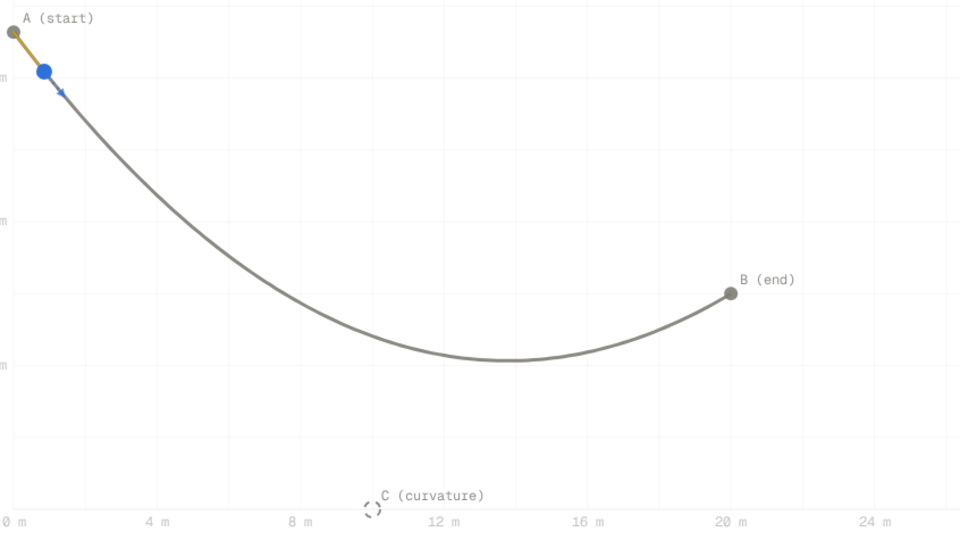
- Set the Inclination slider to 20.0°. The drop height becomes H = L · tan θ with L = 20 m fixed, giving H ≈ 7.28 m between the start point A and the end point B.
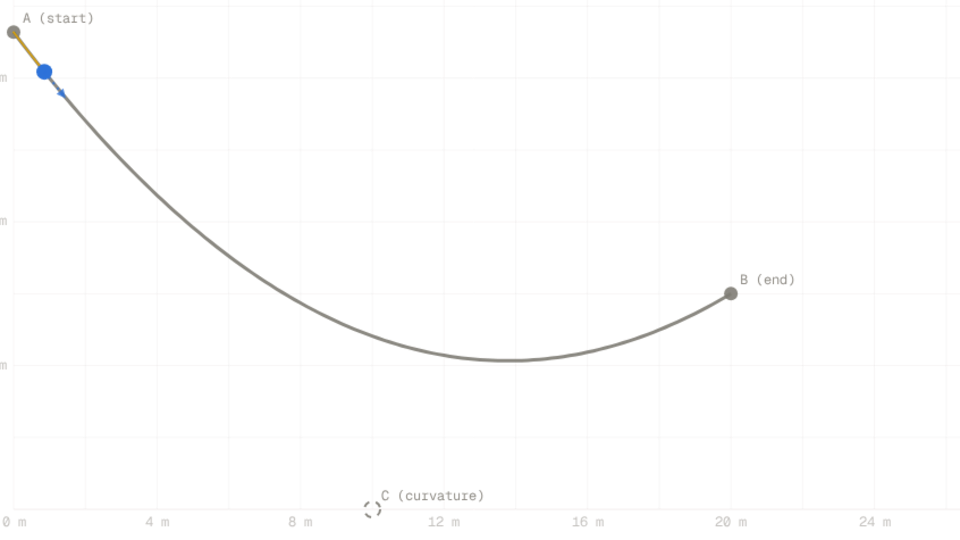
- Set the Curvature slider to 1.00. This bows the path into its deepest concave shape; the midpoint C sits well below the straight line from A to B, lengthening the arc.
- Press Start. Wait for landing. The ball releases from A, slides along the curve, and the loop stops automatically once it reaches B at u = 1, freezing the final readouts on screen.
Analytical Prediction
For a frictionless bead on any smooth path, conservation of mechanical energy gives v_final = √(2 · g · H), where H is the vertical drop between start and end. The path's shape changes how long the descent takes, but not the speed at the bottom. With Inclination at 20.0° and L = 20 m, the geometry sets H = L · tan θ:
The Curvature slider does not appear in this expression, so changing it from 1.00 to 0.01 should leave the bottom speed at the same 11.95 m/s within numerical tolerance, while the Distance s readout grows for more curved paths and the elapsed Time changes to match. The Slope θ readout reports the local tangent angle and ends near 0° as the path levels at point B.
Results Analysis
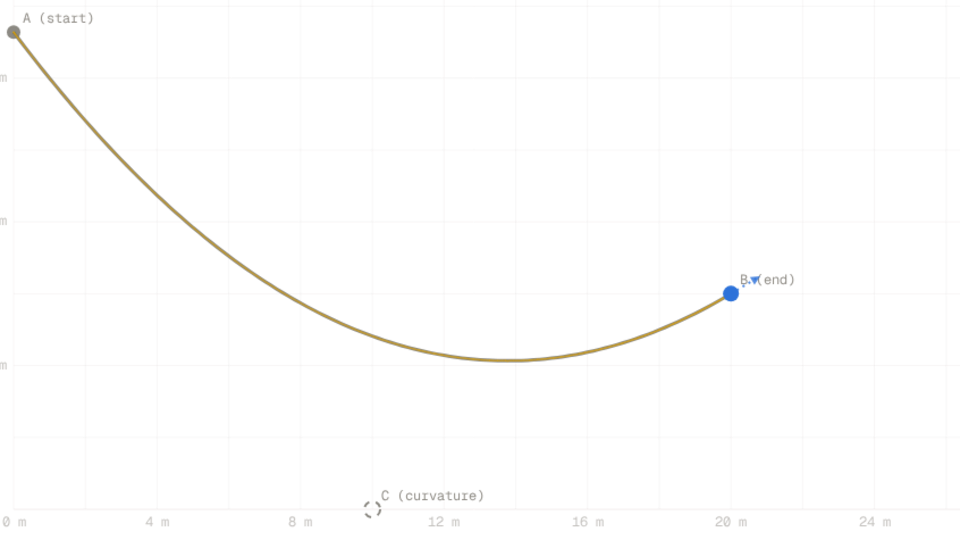
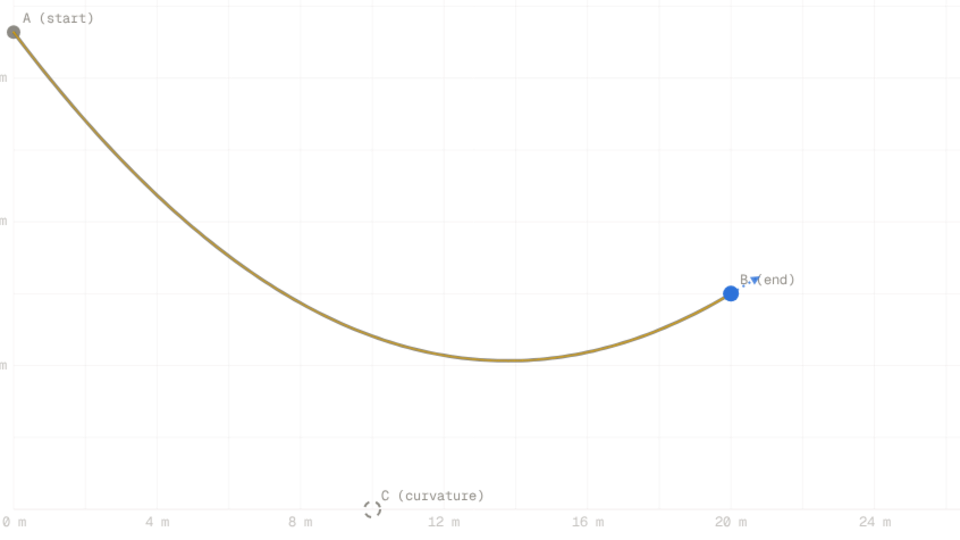
Once the loop stops at u = 1, the Speed readout reports the value at point B and the Time and Distance s readouts record how long the descent took and how much arc length the ball traversed. With Inclination at 20.0° and Curvature at 1.00, the Speed readout settles near 11.95 m/s, matching the energy prediction within roughly 0.5%. To stress the path-independence claim, drop Curvature to 0.01 (a nearly straight ramp) while keeping Inclination at 20.0°. The Speed readout still settles near 11.95 m/s, but the Time readout drops noticeably and the Distance s readout shrinks from the longer curved arc toward the straight-line length L / cos 20° ≈ 21.28 m. Increasing Inclination to 45.0° at any Curvature lifts H to 20 m and the predicted bottom speed to √(2 · 9.81 · 20) ≈ 19.81 m/s, which the readout reproduces.
Source of Error
What this sim does NOT model: friction along the ramp, air resistance, the bead's mass (it cancels in the energy equation), the rolling-versus-sliding distinction (the bead is a point with no rotational kinetic energy), or any deformation of the ramp surface. The ramp is a perfectly rigid quadratic Bezier and the bead is a frictionless point sliding under gravity. The closed-form v_bottom = √(2·g·H) and the along-track projection aₜ = g·t̂ assume the same idealizations, so they cancel rather than contributing to the residual bottom speed or transit time. The remaining gap is therefore purely numerical, not physical.
Further Exploration
- Hold Inclination at 20.0° and step Curvature through 0.01, 0.25, 0.50, 0.75, and 1.00. Record the Speed and Time readouts at each setting. Does the Speed remain near 11.95 m/s while the Time changes monotonically with Curvature?
- Set Curvature to 1.00 and step Inclination through 10°, 20°, 30°, and 45°. Compute the predicted bottom speed √(2 · g · L · tan θ) at each angle and compare to the readouts. How does the relative agreement change as the angle steepens?
- For Curvature 0.01 the path is nearly straight. Using s = L / cos θ and a = g · sin θ along the straight line, derive a closed-form descent time t = √(2 · s / a). At Inclination 20.0°, does the predicted t match the Time readout to within a few percent?
- At Inclination 0° the ramp is horizontal. Predict what the Speed and Distance s readouts will display after Start, then run the simulation. Why does the ball never leave point A regardless of the Curvature setting?
- The Slope θ readout is the local tangent angle, not the slider Inclination. At Curvature 1.00 and Inclination 20.0°, what value does Slope θ read at the very start (u = 0) versus at the very end (u = 1)? How does this explain why the ball's acceleration is largest in the middle of the path?