Vertical Drop · SimulatorFall Time, Speed & Drag
Drop an object and see how height, air resistance, and mass affect the fall.
Published: April 8, 2026 · Updated: May 28, 2026
Objective
Confirm that an object in free-fall, dropped from rest with no air resistance, lands in time t = √(2h/g) and arrives with speed v = √(2gh), independent of mass. Verify that the kinetic energy at impact equals the initial gravitational potential energy mgh, demonstrating energy conservation. The experiment also reveals what changes when quadratic drag is introduced, namely, that the fall is no longer mass-independent, and that sufficiently long falls approach a terminal speed.
Setup
- Press Reset to return the object to its starting altitude. The Time readout shows 0.00 s, and Height, Speed, and KE populate from the current slider positions.
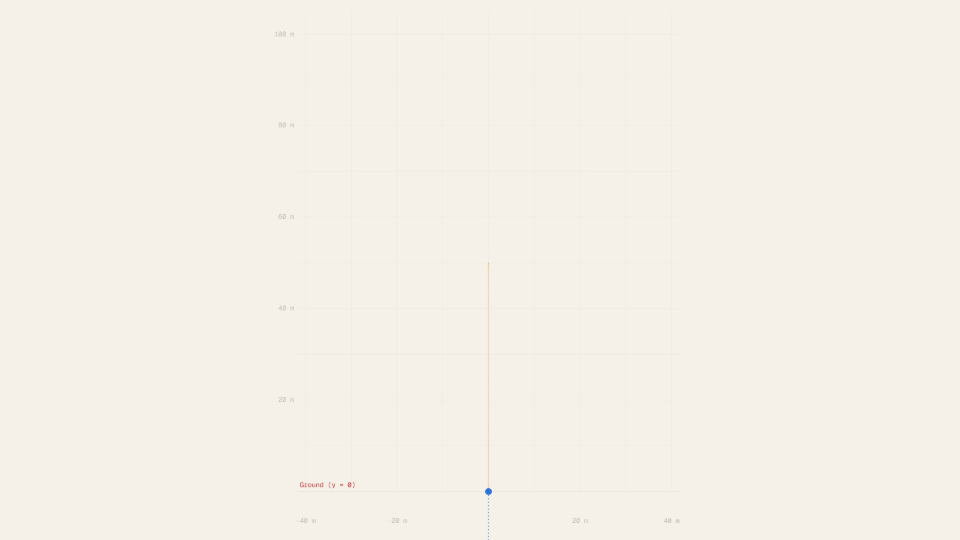
- Set the Height slider to 50 m. This is the default value and gives a fall short enough to fit cleanly in the canvas while producing a clear several-second descent.
- Set the Air Resistance slider to off (value 0). With drag disabled the motion is pure free-fall, which matches the closed-form prediction in the next section.
- Set the Weight slider to 1.0 kg. The numerical kinetic energy depends on mass, but for drag-free fall the time and impact speed do not: any value works; 1.0 kg keeps the KE arithmetic simple.
- Press Start. Wait for landing. The object stops at the Ground line (y = 0) and the Time, Height, Speed, and KE readouts freeze on their final values.



Analytical Prediction
For an object released from rest at height h₀ with no air resistance, the kinematic equations give y(t) = h₀ − ½ g t² and v(t) = −g t, with g = 9.81 m/s². Setting y = 0 yields the fall time, and v = √(2 g h₀) gives the impact speed; neither expression contains mass, so a feather and a hammer fall identically in vacuum. The kinetic energy at impact equals the initial gravitational potential energy: KE = ½ m v² = m g h₀, exactly. With the defaults h₀ = 50 m and m = 1.0 kg:
These three numbers (3.19 s, 31.32 m/s, and 490.5 J) are the targets for comparison with the simulation's readouts.
Results Analysis
After landing, the simulation reports the four readouts Time, Height, Speed, and KE. Height freezes at 0.00 m, confirming the integrator stopped at the ground. With h₀ = 50 m, drag off, and mass 1.0 kg, Time typically reads between 3.19 and 3.20 s, Speed between −31.27 and −31.32 m/s (the negative sign indicates downward motion), and KE between 489 and 491 J, all within roughly 0.2% of the analytical predictions of 3.193 s, 31.32 m/s, and 490.5 J. The mass-independence of free-fall can be cross-checked by changing the Weight slider to 10.0 kg and re-running with drag still off: Time and Speed should be identical to the 1.0 kg run, while KE scales by a factor of ten to about 4905 J. Increasing Air Resistance breaks both predictions: Time grows, Speed plateaus below 31.32 m/s, and the heavier object now falls noticeably faster than the lighter one.
Source of Error
What this sim does NOT model in the drag-off configuration: air resistance, buoyancy, variations in g with altitude, or any shape or aerodynamic effects beyond a point mass under uniform gravity. With the drag slider raised, the model adds a quadratic drag term a = −(k/m)·v·|v| but still treats the falling object as a point with no spin and no surface texture. The closed-form equations of motion match those same idealizations, so they cancel rather than contributing to the residual. The remaining gap between prediction and readouts is therefore purely numerical, not physical.
Further Exploration
- Energy conservation across heights. Run the sim at h₀ = 25 m, 50 m, and 100 m with drag off and mass 1.0 kg. The KE readout should equal m·g·h₀ in each case. Plot KE versus h₀. What does the slope tell you about g?
- Mass independence in vacuum, mass dependence with drag. Set Air Resistance to about 0.05 and run two trials at the same height: mass 0.5 kg and mass 5.0 kg. Why does the heavier object now reach the ground faster, and what would happen in the limit of infinite mass?
- Estimate terminal velocity. With Air Resistance set to 0.10 and mass 1.0 kg, derive the terminal speed from the condition g = (k/m)·v² and predict its numerical value. From what minimum drop height could the object actually reach that speed?
- Galileo's Pisa thought experiment. If the simulation could be configured so two objects of different masses are released simultaneously, what would the screen show with drag off versus drag on? Why did Aristotle and his followers reach the opposite conclusion for centuries?