Atwood Machine PhysicsAcceleration from the Mass Difference
Introduction
The Atwood machine consists of two masses hanging from opposite ends of a string that drapes over a single pulley at the top of the frame. When the masses differ, the heavier side falls and the lighter side rises at the same rate, traced by a faint gold trail behind Mass 1 in the simulator. The motion is uniformly accelerated from rest until the heavier block touches the ground.
English mathematician George Atwood built the original device in 1784 to slow gravitational motion enough that hand-timed measurements could resolve it. The same trick still pays off in classrooms: by tuning two slider masses, the simulator dials the system's acceleration anywhere between zero and roughly nine point eight one meters per second squared without ever changing g, isolating Newton's second law as the only variable in play.
Newcomers tend to reason that piling more mass onto the heavy side makes the system accelerate without limit. The Accel readout argues back: with Mass 1 = 3.0 kg and Mass 2 = 1.0 kg it settles at 4.91 m/s², and doubling both masses to 6.0 kg and 2.0 kg leaves it pinned at 4.91 m/s²; the ratio drives acceleration, not the totals.
The Physics Explained
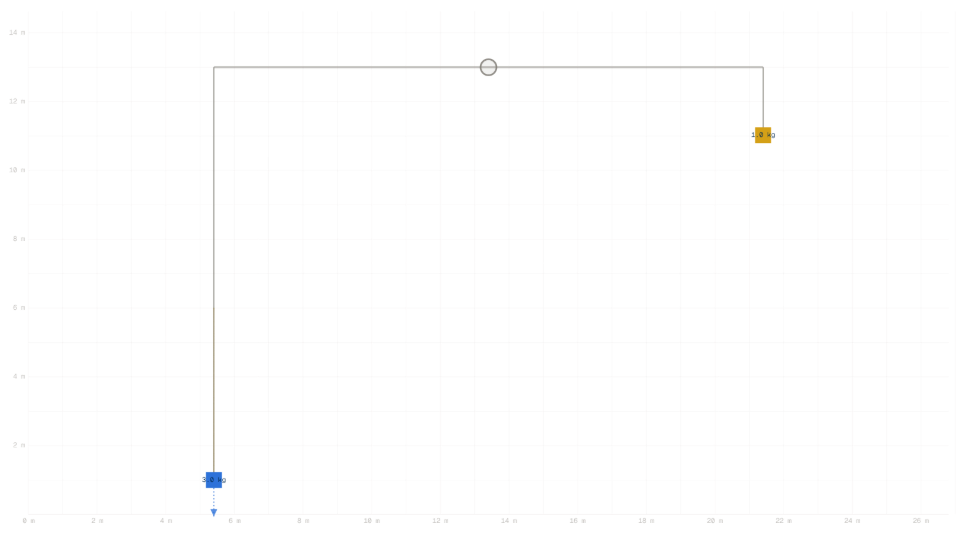
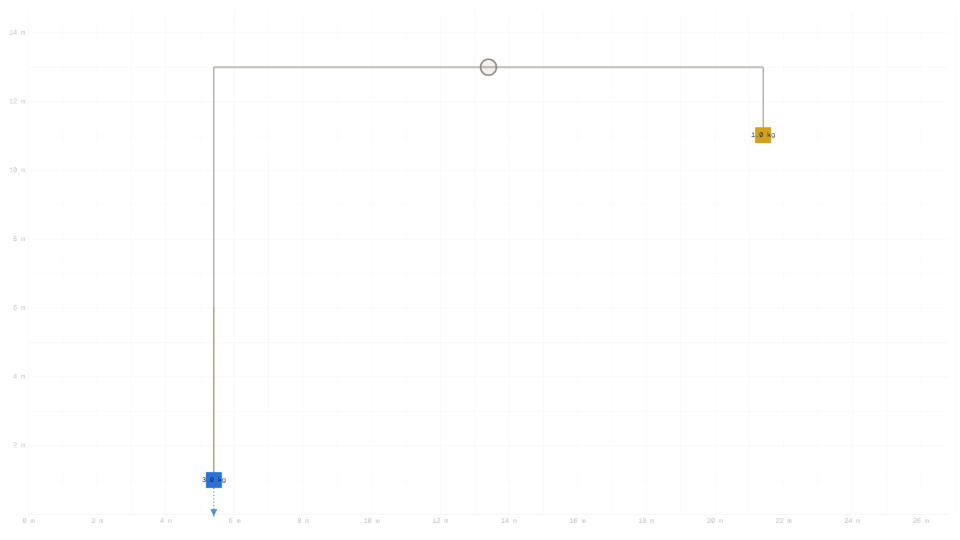
Each mass feels two forces: gravity pulling down at m·g, and rope tension pulling up at T. Because the rope is inextensible and the pulley frictionless, both blocks share the same magnitude of acceleration (heavier moving down, lighter moving up), and the tension is uniform along the entire rope. The simulator's Accel readout shows a single value because both blocks must move together; you never see independent accelerations on the two sides.
Newton's second law applied to each mass yields two equations. For Mass 1: m₁·g − T = m₁·a, with the heavier block accelerating downward. For Mass 2: T − m₂·g = m₂·a, with the lighter block accelerating upward. Adding the two equations cancels the tension and leaves a = g·(m₁ − m₂) / (m₁ + m₂). The simulator's default sliders, m₁ = 3.0 kg and m₂ = 1.0 kg, plug into this expression to give a = 9.81 · 2 / 4 = 4.905 m/s², which the Accel readout shows as 4.91 m/s² before any motion occurs.
Two limits make the formula's structure clear. When the masses are equal, the difference is zero and the system stays at rest: setting both sliders to 5.0 kg drives the Accel readout to 0.00 m/s² and keeps Velocity locked at zero until the 30 s safety cap halts the loop. When one mass dwarfs the other, the difference approaches the sum and the formula approaches g, which is unbounded free fall in disguise. Real slider settings keep the system safely between the two extremes.
Tension follows from substituting the acceleration back into either of the original equations. The closed form is T = 2·g·m₁·m₂ / (m₁ + m₂), which always falls between m₂·g and m₁·g. With the default 3.0 kg and 1.0 kg sliders, T = 2 · 9.81 · 3 · 1 / 4 = 14.715 N, comfortably above the 1.0 kg block's 9.81 N weight and below the 3.0 kg block's 29.43 N weight. The rope holds each block back from free fall without ever fully cancelling gravity.
Key Equations
With Mass 1 = 3.0 kg and Mass 2 = 1.0 kg, the formula gives a = 9.81 · (3.0 − 1.0) / (3.0 + 1.0) = 19.62 / 4.0 = 4.905 m/s². The simulator's Accel readout displays 4.91 m/s² before the system is released, confirming that the closed-form prediction sits at exactly half of free fall for a 3 : 1 mass ratio.
For the same default slider values, T = 2 · 9.81 · 3.0 · 1.0 / (3.0 + 1.0) = 58.86 / 4.0 = 14.715 N. The simulator does not display tension directly, but the value can be sanity-checked: 14.715 N must lie between the 1.0 kg block's weight of 9.81 N and the 3.0 kg block's weight of 29.43 N, and it does.
Both blocks start at rest at y = 5 m, so when Mass 1 reaches the ground after falling d = 5 m at constant acceleration a = 4.905 m/s², its impact speed follows from v² = 2·a·d. Numerically: v = sqrt(2 · 4.905 · 5) = sqrt(49.05) ≈ 7.00 m/s. The simulator's Velocity readout halts within 0.5 % of this value when Mass 1 touches down.
The same fall solved for time gives t = sqrt(2·d / a) = sqrt(10 / 4.905) ≈ 1.43 s for the default sliders. The simulator's Time readout typically stops between 1.42 and 1.44 s; the small spread comes from the fixed 1/240 s integration substep registering ground contact at a slightly overshot displacement of 5 m, and from the two-decimal display rounding the underlying value.
Key Variables
| Symbol | Name | Unit | Meaning |
|---|---|---|---|
| m₁ | Heavier mass | kg | Block on the side that descends |
| m₂ | Lighter mass | kg | Block on the side that rises |
| g | Gravitational acceleration | m/s² | Set to 9.81 m/s² in the simulator |
| a | System acceleration | m/s² | Magnitude shared by both blocks |
| T | Rope tension | N | Force the rope exerts on each block |
| v | Block speed | m/s | Magnitude of either block's velocity |
| t | Elapsed time | s | Seconds since release from rest |
| d | Displacement | m | Distance Mass 1 has fallen from its starting height |
Real World Examples
Why do passenger elevators always carry a counterweight?
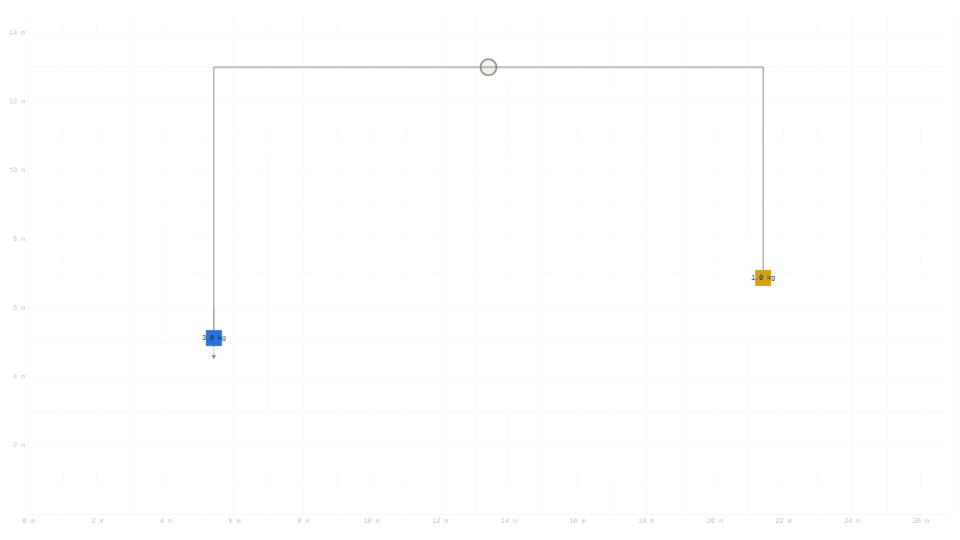
A passenger elevator hangs from a cable that loops over a sheave at the top of the shaft and connects on the other side to a counterweight. The arrangement is an Atwood machine in disguise: the cab is m₁ on one side and the counterweight is m₂ on the other. Designers typically size the counterweight to roughly match the cab plus 40 % of its rated load, so when the cab is half-full the system is nearly balanced and the motor barely has to fight gravity at all.
The Atwood formula a = g·(m₁ − m₂) / (m₁ + m₂) explains the energy savings precisely. Using the simulator as a model, a 5.0 kg block paired with a 5.0 kg block produces an Accel readout of 0.00 m/s²: no motion, no work against gravity. A 3.0 kg block paired with 1.0 kg accelerates at 4.905 m/s² and demands the full output of whatever raises it. Real elevators land near the first regime, which is why a hoist motor sized for a half-empty cab can move it efficiently.
How does a piano mover's pulley turn a heavy lift into a light pull?
A single fixed pulley with a counterweight on the back side is the same Atwood geometry a stagehand uses to fly a piano up to a balcony window. The mover hangs a sandbag heavier than the helper but lighter than the piano on the rope's far end. The Atwood acceleration a = g·(m₁ − m₂) / (m₁ + m₂) collapses toward zero as the two side weights converge, so the helper only needs to overcome a small residual force to lift the piano against gravity.
The simulator demonstrates the principle without any furniture at risk. Setting Mass 1 = 3.0 kg and Mass 2 = 1.0 kg gives Accel = 4.91 m/s², the same value a 6.0 kg / 2.0 kg pair produces because the ratio is identical. The mover working a 200 kg piano against a 180 kg counterweight faces an effective net pull of only 20 kg, even though the two sides together weigh 380 kg. Mass ratio governs the lift; absolute mass governs the fatigue in the pulley bearings.
How accurately can a classroom Atwood setup measure g?
Reverse the formula and a measured acceleration becomes a measurement of gravity: g = a · (m₁ + m₂) / (m₁ − m₂). A high school lab typically times one mass falling a known distance, computes a from kinematics, and back-solves for g. Careful trials with light pulleys and low-mass strings reach roughly 1 % of the textbook 9.81 m/s². The residual error comes from the rotational inertia of the pulley and the small mass of the string, both of which the ideal model treats as zero.
The simulator embraces the same idealizations exactly, so its readouts match the closed form rather than a real lab. With Mass 1 = 3.0 kg and Mass 2 = 1.0 kg the recorded Time of 1.43 s and final Velocity of 7.00 m/s feed back through v = a·t and v² = 2·a·d to recover Accel = 4.90 m/s² and g = 4.90 · 4 / 2 = 9.80 m/s², which is the 9.81 m/s² input returned to within the two-decimal readout rounding. The agreement isolates which corrections a real lab would need to apply.
Further Reading
- Inclined plane motion: gravity decomposed along and perpendicular to a slope, the same force-balance reasoning the Atwood derivation uses on a vertical rope.
- Friction block on a surface: Newton's second law applied to one body, with a velocity-dependent resistive force replacing the second mass.
- Torque and the lever: mechanical advantage from geometry rather than from a counterweight, the partner concept to pulley-based balance.
- Spring-mass oscillator: what happens when the restoring force depends on displacement instead of being constant, generalizing the Atwood setup to oscillatory dynamics.