Atwood Machine · SimulatorTwo Masses, One Pulley
Two masses connected by a string over a pulley demonstrating Newton's second law; adjust the masses to see how the weight difference drives acceleration.
Published: April 22, 2026 · Updated: May 28, 2026
Objective
Confirm that an ideal Atwood machine obeys the closed-form acceleration equation a = g·(m₁ − m₂) / (m₁ + m₂), where m₁ is the heavier mass, m₂ is the lighter mass, and g = 9.81 m/s². Verify that the heavier mass descends and the lighter rises with equal speed magnitudes, that the system stalls when m₁ = m₂, and that acceleration scales with the mass difference rather than the mass sum. The simulation assumes a massless inextensible rope and a massless frictionless pulley.
Setup
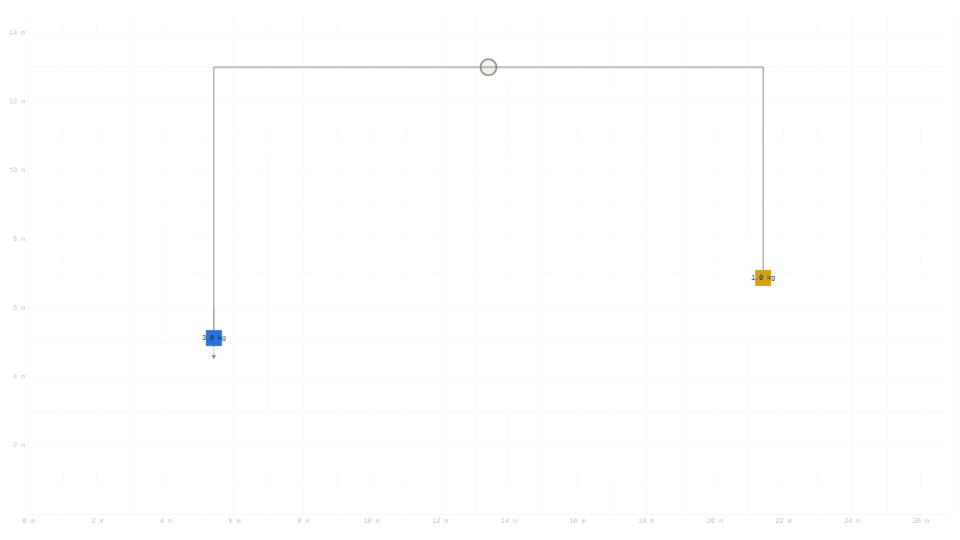
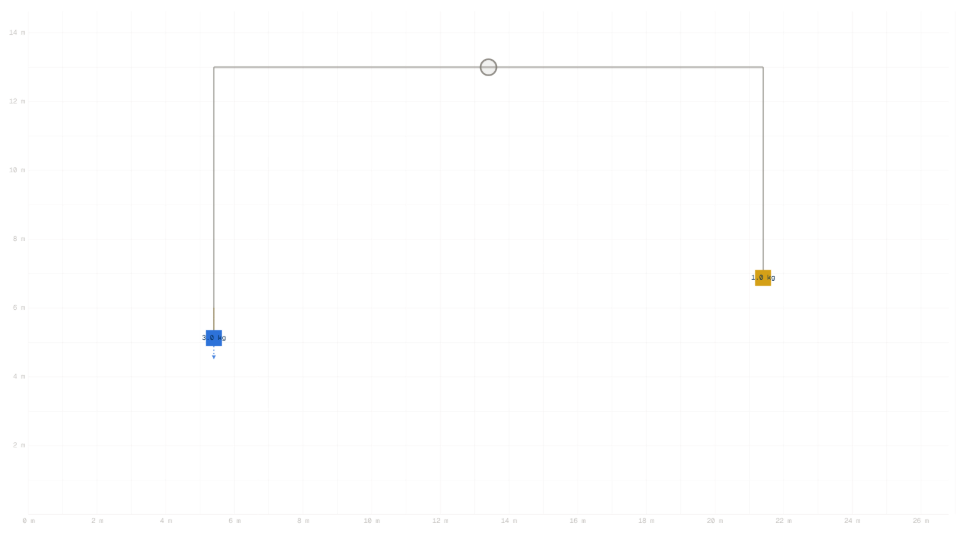
- Press Reset to return both mass blocks to their starting height of 5 m. The Time, Velocity, and Displacement readouts should show 0.00, and the Accel readout should display the current theoretical value.
- Set the Mass 1 slider to 3.0 kg. This is the heavier mass on the left string and will descend once the system is released from rest.
- Set the Mass 2 slider to 1.0 kg. This is the lighter mass on the right string and will rise at the same speed that Mass 1 falls.
- Confirm the Accel readout displays 4.90 m/s² before launching. This is the theoretical acceleration computed from the current slider values, independent of motion.
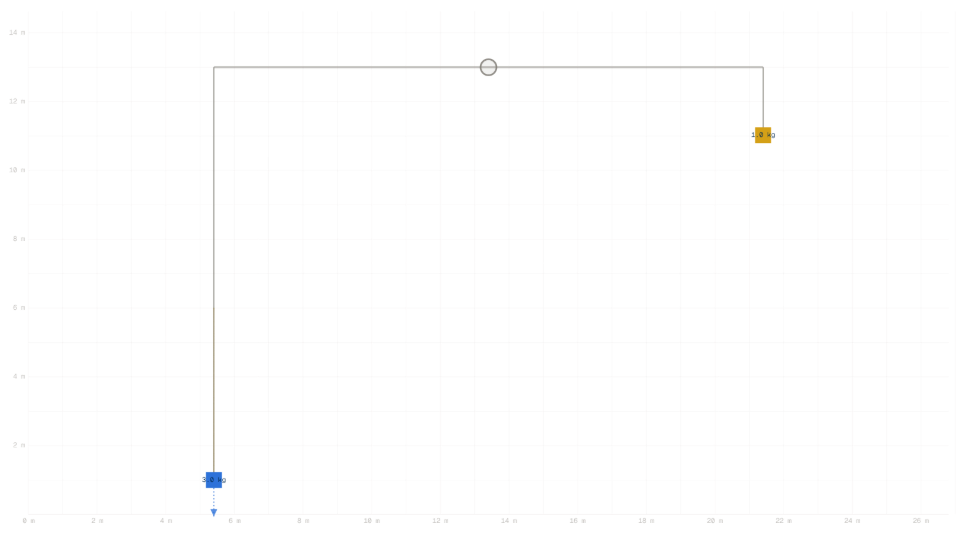
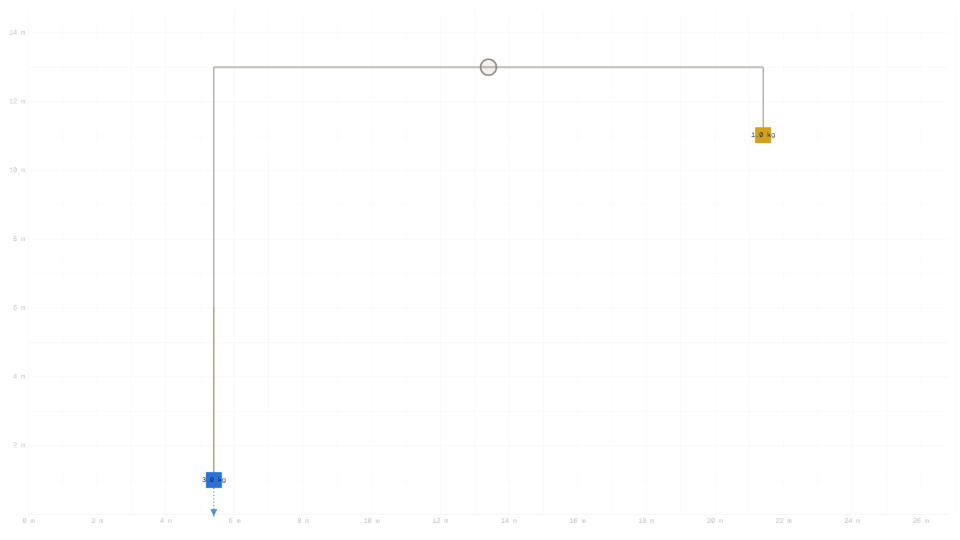
- Press Start. The 3.0 kg block descends from y = 5 m toward the ground while the 1.0 kg block rises toward the pulley; a faint gold trail records the path of Mass 1.
- Wait until Mass 1 reaches y = 0 and the loop halts. Record the final Time, Velocity, and Displacement readouts for comparison with the prediction.
Analytical Prediction
For an ideal Atwood machine the closed-form acceleration is a = g·(m₁ − m₂) / (m₁ + m₂) and the rope tension is T = 2·g·m₁·m₂ / (m₁ + m₂). With m₁ = 3.0 kg and m₂ = 1.0 kg, g = 9.81 m/s²:
Mass 1 starts at rest at y = 5 m and must fall 5 m to reach the ground. Kinematics gives the fall time and impact speed:
The three values to verify against the readouts: Accel = 4.90 m/s², final Velocity ≈ 7.00 m/s, final Time ≈ 1.43 s, with Displacement of Mass 1 reaching 5.00 m at the moment the loop stops.
Results Analysis
After Mass 1 reaches the ground, the readout grid reports the final Time, Velocity, Accel, and Displacement of Mass 1. Compare each to the predicted values for m₁ = 3.0 kg and m₂ = 1.0 kg: Accel = 4.90 m/s², final Velocity ≈ 7.00 m/s, Time ≈ 1.43 s, Displacement = 5.00 m. The simulation typically agrees within 0.5 %: Velocity may read 6.97 to 7.02 m/s and Time between 1.42 and 1.44 s. Agreement confirms that the constant-acceleration formula correctly describes the simulated dynamics. A more demanding check: press Reset, set Mass 1 = 5.0 kg and Mass 2 = 5.0 kg, and press Start. The Accel readout should fall to 0.00 m/s²; both blocks remain stationary and the loop runs until the 30 s safety cap. Now set Mass 1 = 6.0 kg and Mass 2 = 2.0 kg: the mass ratio is unchanged from the default 3 : 1, so Accel stays at 4.90 m/s² and the impact speed stays near 7.00 m/s, even though the total weight has doubled. This empirically demonstrates that acceleration depends on the mass ratio, not the total inertia.
Source of Error
What this sim does NOT model: pulley mass and moment of inertia, string mass and stretch, friction at the pulley axis, or air resistance on the hanging masses. The pulley is treated as a massless frictionless redirector and the string as inextensible and massless. The closed forms a = (m₁ − m₂)·g/(m₁ + m₂) and T = 2·m₁·m₂·g/(m₁ + m₂) assume the same four idealizations, so they cancel rather than contributing to the residual acceleration or tension. The remaining gap between prediction and readouts is therefore purely numerical, not physical.
Further Exploration
- Hold Mass 2 fixed at 1.0 kg and step Mass 1 through 1.0, 2.0, 4.0, 6.0, 8.0, and 10.0 kg. Record the Accel readout at each setting and plot a versus the mass difference (m₁ − m₂). Is the relationship linear, and what slope do you predict?
- Set Mass 1 = Mass 2 = 5.0 kg and press Start. Why does the Accel readout show 0.00 m/s² and the Velocity stay at zero? Use the closed-form acceleration formula to explain the result without referring to the simulation.
- Find a pair of slider settings that produce exactly half the default acceleration of 4.90 m/s². Solve algebraically using a = g·(m₁ − m₂) / (m₁ + m₂) = 2.45 m/s², then verify by entering the values and reading the Accel field.
- Compare two runs with the same mass ratio but different totals, for example Mass 1 = 3.0 kg, Mass 2 = 1.0 kg versus Mass 1 = 9.0 kg, Mass 2 = 3.0 kg. Do the Accel and final Velocity readouts agree? What does this say about the role of total inertia versus mass difference?
- Predict the rope tension T = 2·g·m₁·m₂ / (m₁ + m₂) for Mass 1 = 4.0 kg and Mass 2 = 2.0 kg. The tension is not displayed directly, but you can sanity-check it by noting that T must lie between the lighter and heavier weights. Does your computed value of T ≈ 26.13 N satisfy 1.0·g < T < 4.0·g?
- Estimate the fall time analytically for Mass 1 = 10.0 kg and Mass 2 = 0.5 kg using t = √(2·d / a) with d = 5 m. Run the sim and compare the Time readout to your prediction. Does the larger acceleration shrink the fall time as expected?