Circular Motion · SimulatorCentripetal Force & Acceleration
An object moving in a circle showing centripetal force and velocity vectors; adjust radius, speed, and mass to explore the relationships.
Published: April 9, 2026 · Updated: May 28, 2026
Objective
Confirm that uniform circular motion follows the closed-form relations a_c = v²/r = ω²·r and F_c = m·v²/r, where v is tangential speed, r is orbit radius, ω is angular velocity, and m is the orbiting mass. Identify how centripetal acceleration scales with the square of speed and inversely with radius, and verify that doubling the mass doubles the required inward force at fixed v and r. The simulation assumes a point mass moving on a perfect circle at constant speed under an idealized inward force.
Setup
- Press Reset to clear any previous orbit trail. The Time, ω, a_c, and F_c readouts return to their initial values, and the centripetal-force and velocity arrows redraw at the starting angle θ = 0.
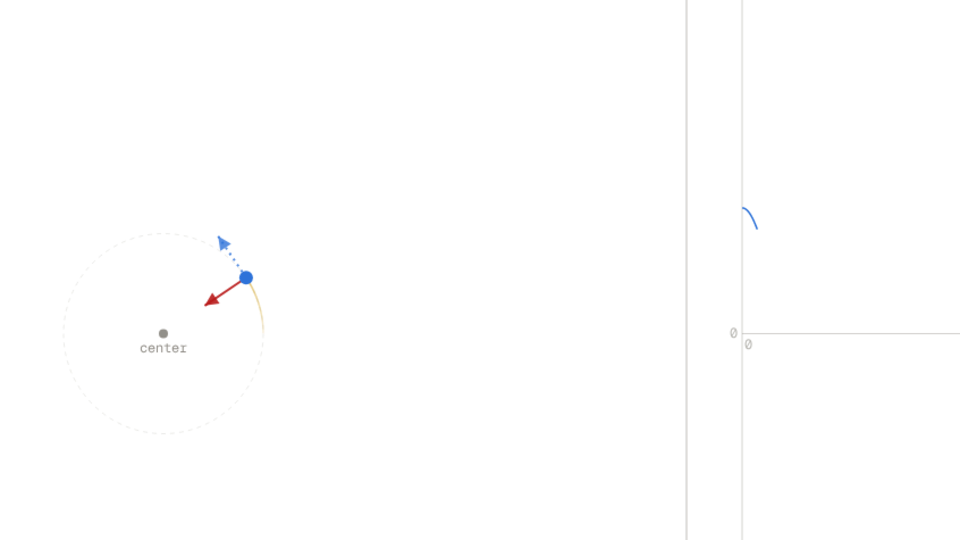
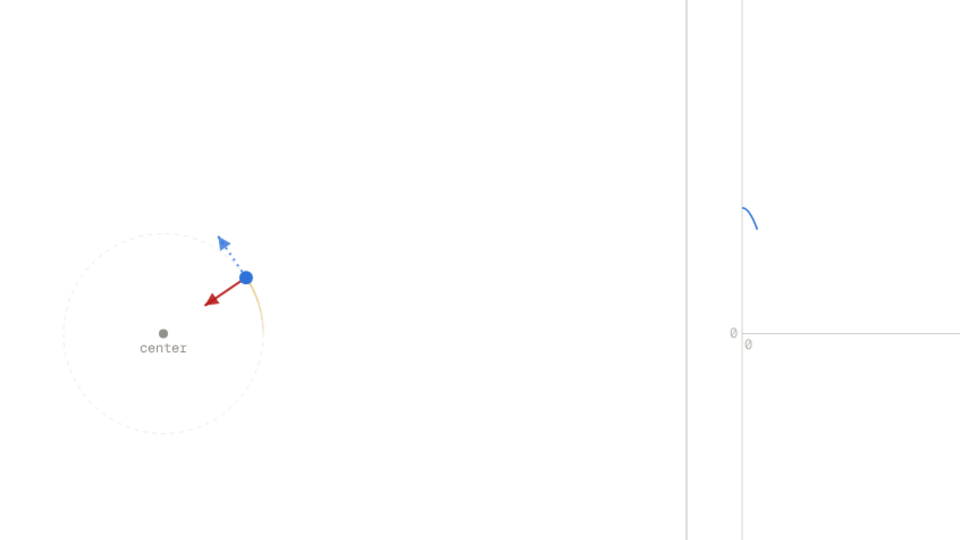
- Set the Radius slider to 5.0 m. The dashed orbit ring on the canvas shrinks or grows to match, and the marker at the world origin labels the center of the circle.
- Set the Speed slider to 5.0 m/s. This is the tangential speed of the orbiting object; the dotted blue arrow length scales with the chosen radius, not the speed.
- Set the Mass slider to 1.0 kg. Mass does not change the geometry of the orbit, but it scales the centripetal force F_c reported in the readout grid.
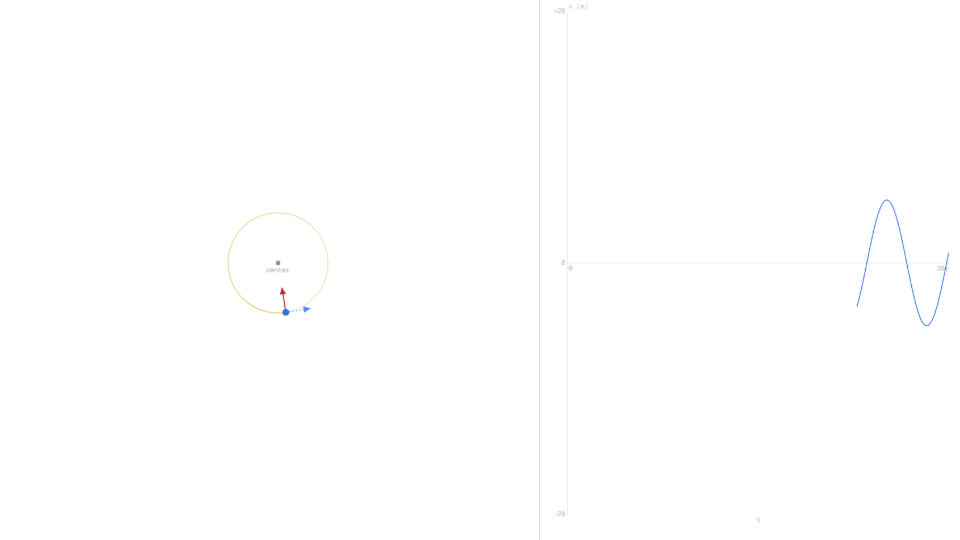
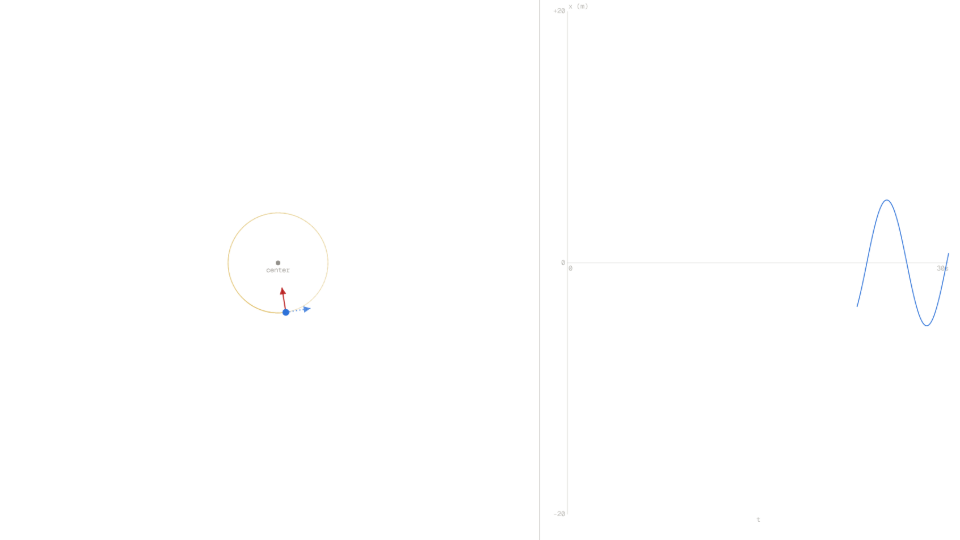
- Press Start. The yellow object begins tracing the dashed ring, the red centripetal-force arrow stays pinned toward the center, and the dotted blue velocity arrow stays tangent to the path.
- Allow the run to continue until the readouts stabilize. The simulation auto-stops at t = 30 s, by which point the object has completed several full revolutions.
Analytical Prediction
For uniform circular motion, the angular velocity is ω = v/r, the centripetal acceleration is a_c = v²/r = ω²·r, and the centripetal force required to keep mass m on the circle is F_c = m·v²/r. The orbital period is T = 2π·r/v = 2π/ω. These follow directly from differentiating the position vector r·(cos θ, sin θ) twice and applying Newton's second law. With Radius r = 5.0 m, Speed v = 5.0 m/s, and Mass m = 1.0 kg:
The object should complete roughly 30 / 6.28 ≈ 4.77 revolutions before the 30-second auto-stop. These four numbers (1.00 rad/s, 5.00 m/s², 5.00 N, and a 6.28-second period) are the values to verify against the simulation's HUD and visual orbit.
Results Analysis
Once the run is underway, the readouts report ω, a_c, and F_c continuously. With Radius = 5.0 m, Speed = 5.0 m/s, and Mass = 1.0 kg, the HUD should display ω = 1.00 rad/s, a_c = 5.00 m/s², and F_c = 5.00 N, matching the predicted values to two decimal places. Because speed and radius are held constant by the sim, these readouts do not drift over the run; they remain locked at the predicted values for all 30 seconds. A more revealing check is to vary one parameter while watching the others. Double the Speed slider to 10 m/s at fixed r = 5 m: a_c jumps from 5.00 to 20.00 m/s² (a factor of 4, since v² doubles squared), and F_c follows. Now double Radius to 10 m at v = 10 m/s: a_c drops back to 10.00 m/s². Sliding Mass from 1.0 to 2.0 kg leaves ω and a_c unchanged but doubles F_c, confirming the linear-in-mass dependence.
Source of Error
What this sim does NOT model: friction along the orbit, air resistance, the finite size or rotational kinetic energy of the orbiting object, finite track stiffness, or any radial speed component (the speed is held constant by construction). The mass is a point particle moving along a perfectly circular ideal track. The closed forms a = v²/r, F = m·v²/r, and ω = v/r assume the same idealizations, so they cancel rather than contributing to the residual centripetal acceleration or force. The remaining gap between prediction and readouts is therefore purely numerical, not physical.
Further Exploration
- Verify the v² scaling of centripetal acceleration. Hold Radius at 5.0 m and step Speed through 2, 4, 6, 8, and 10 m/s. Record a_c at each. Does the ratio a_c / v² stay constant near 1/r = 0.20 1/m across all five readings?
- Verify the inverse-radius scaling. Hold Speed at 10 m/s and step Radius through 2, 5, 10, 15, and 20 m. Record a_c at each setting and check whether the product a_c · r stays constant near v² = 100 m²/s² across the full range.
- Confirm that mass does not affect a_c or ω. Fix Radius at 8 m and Speed at 6 m/s, then sweep Mass from 0.2 kg to 10 kg. Watch the F_c readout scale linearly while a_c and ω stay locked. Why does mass cancel from the acceleration relation but survive in the force relation?
- Estimate the orbital period directly from the canvas. Set r = 10 m and v = 5 m/s, predict T = 2π·r/v ≈ 12.57 s, then start the sim and time one full lap of the trail visually against the Time readout. How close is your measurement to the prediction?
- Find the radius and speed combination that produces a_c = g = 9.81 m/s². There are infinitely many solutions: pick three pairs that satisfy v²/r = 9.81 and verify each on the sim. What does this say about the centrifuge condition for simulating Earth gravity?