Friction and Forces · SimulatorStatic vs Kinetic Friction
A ramped push builds until it defeats static friction, releases the block at 8 m/s, and kinetic friction slides it to rest; adjustable static and kinetic coefficients set the breakaway and the stopping distance.
Published: April 20, 2026 · Updated: May 28, 2026
Objective
Watch static friction balance a growing push up to its ceiling f_s ≤ μs·N, then confirm that the released block decelerates uniformly under kinetic friction and verify the closed-form stopping-distance relation d = v₀² / (2·μk·g), where v₀ = 8 m/s is the release speed, μk is the coefficient of kinetic friction, and g = 9.81 m/s². Read the friction force directly as f_k = μk·m·g, and observe how halving or doubling μk transforms both the stopping time and the stopping distance. The surface is uniform and the block is rigid: friction is the only horizontal force at play.
Setup
- Press Reset to return the block to its starting position at the left of the track. The Time, Speed, Friction, and Slide distance readouts all return to 0.00, and the trail clears.
- Set the Static Friction (μs) slider to its default value of 0.50. The ramped push must exceed the static ceiling f_s,max = μs·m·g ≈ 24.5 N before the block breaks away, so a higher μs delays the release.
- Set the Kinetic Friction (μk) slider to its default value of 0.30. This is the coefficient that will decelerate the block; it sets both the friction force and the rate of slowing.
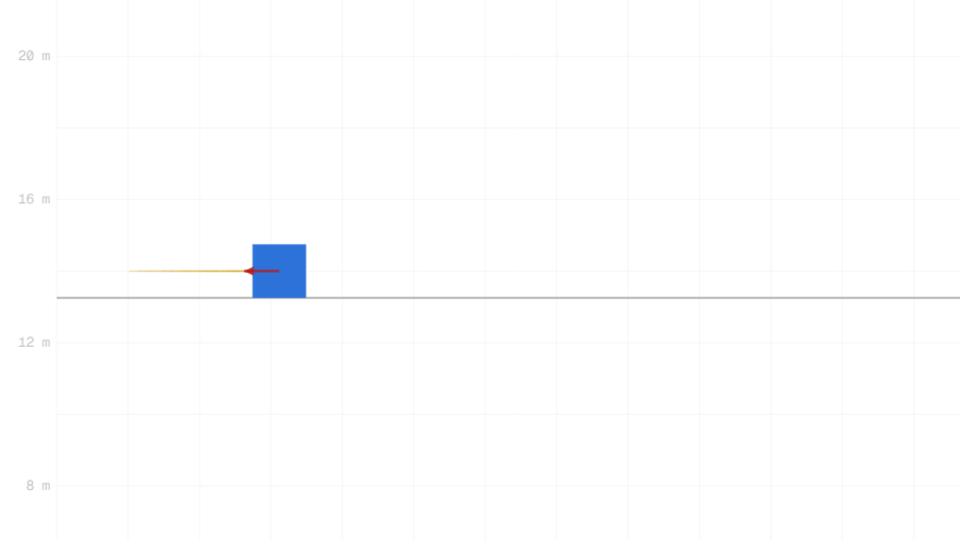
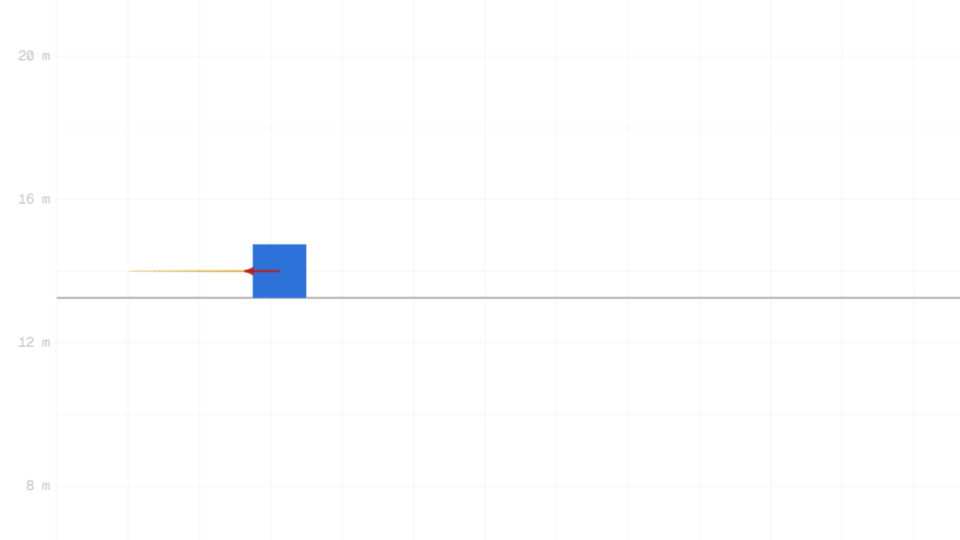
- Press Start. A growing applied-force arrow pushes on the block while static friction balances it; at breakaway the block accelerates, is released at 8 m/s, and slides rightward with the friction arrow pointing backward, opposite to motion.
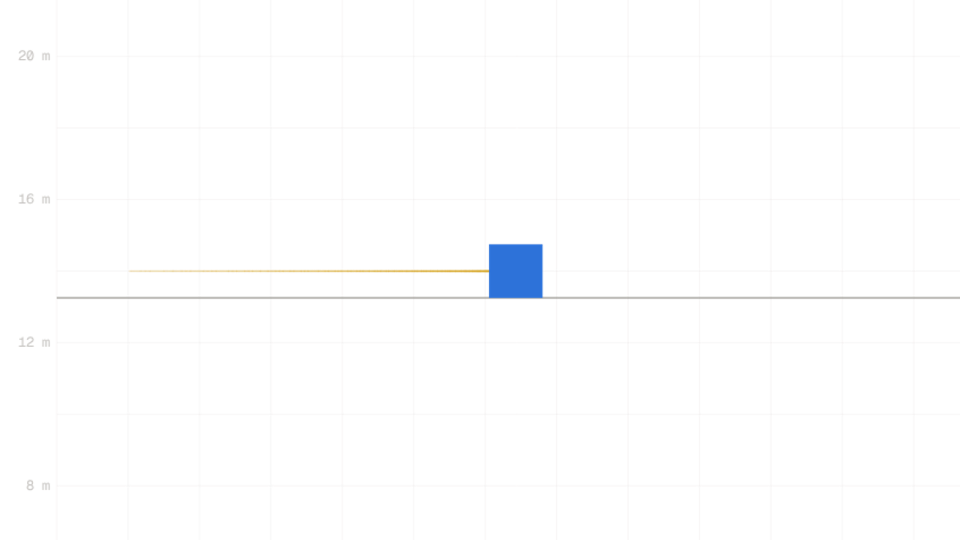
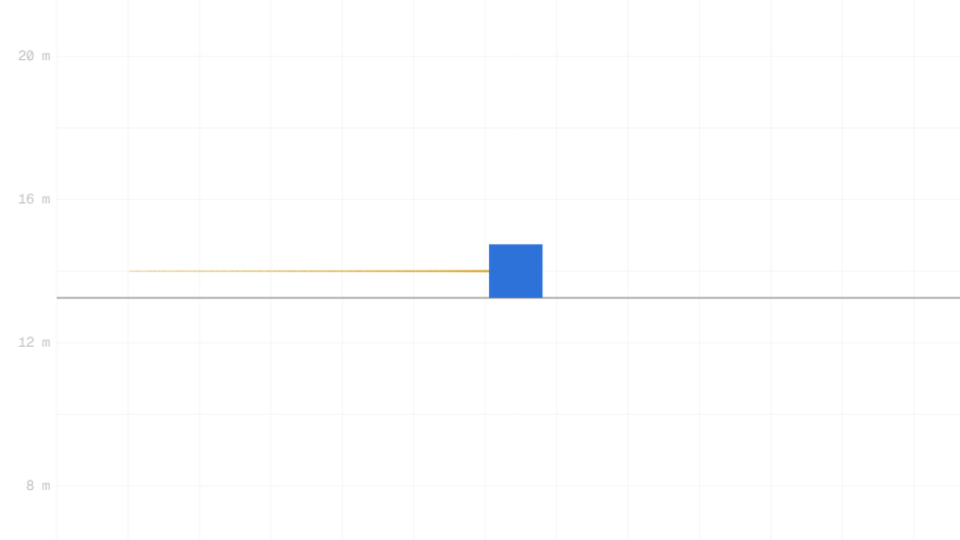
- Wait until the Speed readout reaches 0.00 m/s and the simulation halts. Record the final values shown for Friction and Slide distance; these are the numbers compared against the prediction.
Analytical Prediction
Once the pusher releases the block at v₀ = 8 m/s, kinetic friction is the only horizontal force on it. Newton's second law gives a constant deceleration a = −μk·g. The block stops after t_stop = v₀ / (μk·g) and travels d = v₀² / (2·μk·g). The kinetic friction force itself is f_k = μk·m·g and stays constant while the block moves. With v₀ = 8 m/s, μk = 0.30, m = 5 kg, g = 9.81 m/s²:
These four values (deceleration, slide time, slide distance, and friction force) describe the slide from the release point; the Slide distance and Friction readouts are the targets to verify.
Results Analysis
When the run halts, the readouts settle at fixed values that can be compared one by one to the prediction. With the default μk = 0.30 and v₀ = 8 m/s, the slide (from release to rest) lasts ≈ 2.72 s, the Slide distance readout lands at ≈ 10.87 m, and Friction at ≈ 14.72 N (= 0.30 · 5 · 9.81); Speed reads 0.00 m/s at termination. (The Time readout also counts the push phase, whose length is set by μs.) Agreement within roughly 0.5% confirms that the simulated motion obeys a = −μk·g. A sharper test: press Reset and double μk to 0.60 while leaving everything else fixed. The prediction d = 64 / (2 · 0.60 · 9.81) ≈ 5.44 m is exactly half the default. The Friction readout doubles to ≈ 29.43 N, and the slide time halves to ≈ 1.36 s. Halving μk to 0.15 should instead double the distance to ≈ 21.75 m. These scaling checks demonstrate the inverse-linear dependence of d on μk that the formula encodes.
Source of Error
What this sim does NOT model: air drag, surface temperature variations, pressure-dependent friction, deformation of the block or the surface, or any rolling component (the block slides as a point mass). Static and kinetic friction coefficients are treated as constants independent of speed. The closed forms f_s ≤ μs·N and f_k = μk·m·g assume the same idealizations, so they cancel rather than contributing to the residual stopping distance or speed. When the μk slider is set above μs, the model waits until the ramped push also exceeds kinetic friction before the block leaves rest, rather than simulating stick-slip chatter. The remaining gap between prediction and readouts is therefore purely numerical, not physical, for this sim.
Further Exploration
- Run the experiment at μk = 0.10, 0.20, 0.30, 0.50, 0.80, and 1.00, recording the Slide distance readout at each. Plot d versus 1/μk on paper. Does the data fall on a straight line through the origin, as d = v₀² / (2·μk·g) predicts?
- The mass slider is fixed at 5 kg in this simulation. Using the formula, explain why doubling the mass would leave the stopping distance unchanged even though the friction force itself would double. Which two terms cancel?
- Set μs = 1.50 and μk = 0.10, the largest gap between static and kinetic friction the sliders allow. The push now takes far longer to break the block loose, yet the Slide distance readout still lands at ≈ 32.62 m. Why does μs set only WHEN the block releases, while the slide itself depends only on μk?
- Predict the slide time analytically for μk = 0.25: the formula t_stop = v₀ / (μk·g) gives ≈ 3.26 s. Run the sim and time the slide (the Time readout advances by that amount between release and stop). How close does it come, and which of the error sources in the previous section likely accounts for the gap?
- If the block were sliding on ice with μk ≈ 0.03, predict the stopping distance with v₀ = 8 m/s. The slider minimum is 0.10, so this value lies outside the experimental range, but the formula still gives an answer. What does d ≈ 108.7 m tell you about why winter braking distances grow so dramatically?