Friction and Forces PhysicsStopping-Distance Formula & μk
Introduction
Friction is the contact force that resists relative sliding between two surfaces. On a flat horizontal track with no applied force after release, kinetic friction is the only horizontal force on a moving block, and it always points opposite to the velocity. The block decelerates uniformly until it stops, and the distance it covers is set entirely by the release speed and the kinetic friction coefficient.
The closed-form result d = v₀² / (2·μk·g) sits at the foundation of every braking-distance calculation engineers write. The same expression governs how far a hockey puck glides across the ice, how much runway an airliner needs after touchdown, and how far a parked car will roll on a wet street before friction at the tyres dissipates its kinetic energy. Once the block-on-surface case is locked in, every variation reduces to the same balance.
It seems natural to assume that a heavier block should slide farther, carrying more momentum into the surface. The Slide distance readout refuses to budge: with v₀ = 8 m/s and μk = 0.30, it settles near 10.87 m regardless of mass, because the friction force scales with mass at exactly the rate needed to keep the deceleration μk·g independent of m.
The Physics Explained
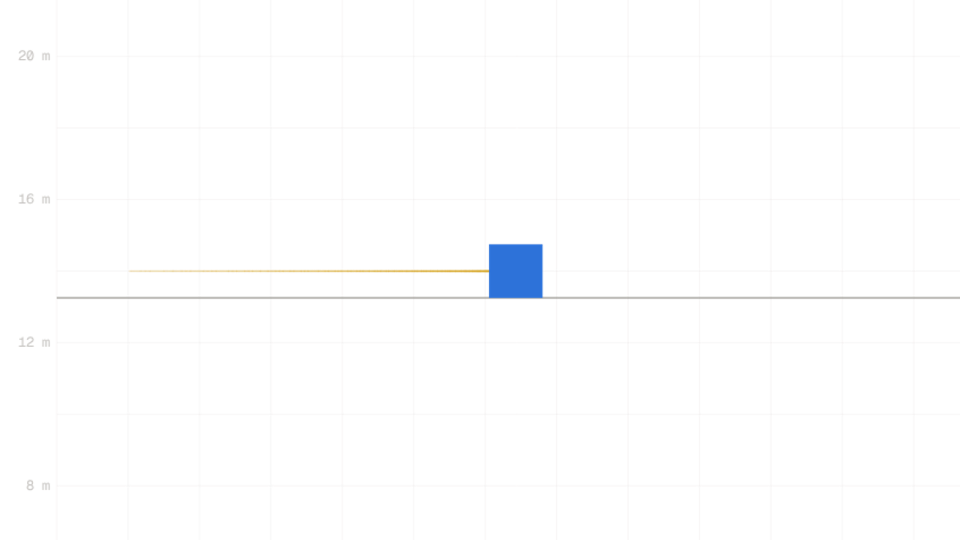
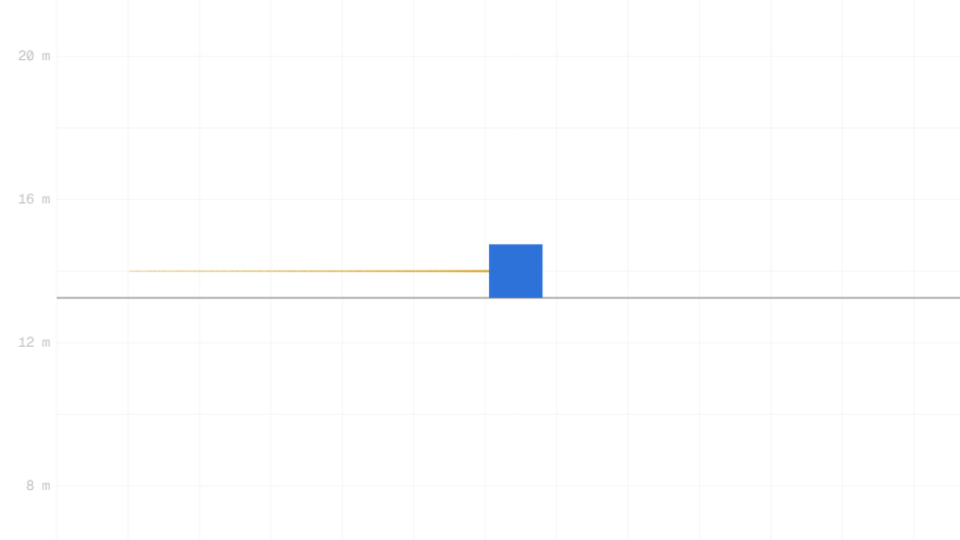
The block in this experiment is pushed by a steadily growing applied force until static friction gives way; the pusher accelerates it and releases it at a fixed v₀ = 8 m/s, and it slides rightward across a uniform horizontal surface. Once released, no external horizontal force pushes or pulls; only kinetic friction acts in the direction of motion. The friction force has magnitude fk = μk·m·g, where m = 5 kg is the block's mass, μk is the kinetic friction coefficient set by the slider, and g = 9.81 m/s². With the default μk = 0.30, the Friction readout settles at 0.30 · 5 · 9.81 ≈ 14.72 N for the entire slide.
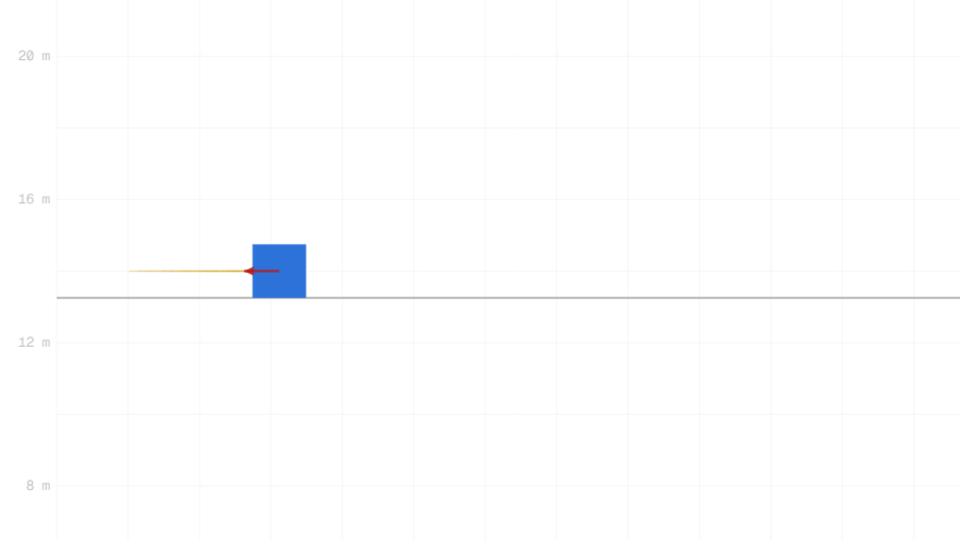
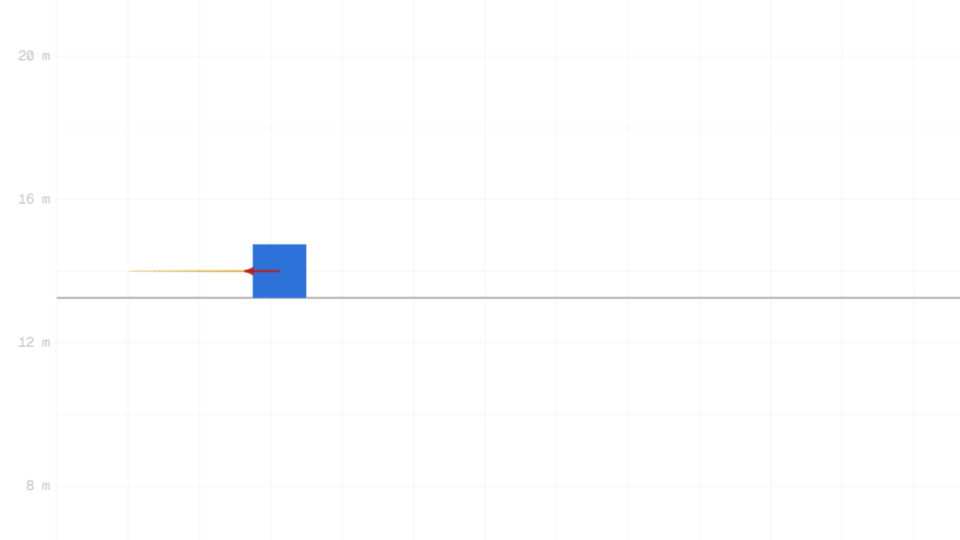
Newton's second law converts that friction force into a deceleration: a = −μk·g, with the mass cancelling out. For the default μk = 0.30 the deceleration is −0.30 · 9.81 ≈ −2.943 m/s². This constant value is what makes the Speed readout drop linearly toward zero. The simulator's red arrow on the block points opposite to the velocity at every frame, visually anchoring the fact that friction continuously removes momentum at a steady rate while the block moves.
Because the deceleration is constant, the kinematic relations for uniformly decelerated motion apply exactly. The stopping time is tstop = v₀ / (μk·g), and the stopping distance is d = v₀² / (2·μk·g). With the defaults v₀ = 8 m/s and μk = 0.30, these give tstop ≈ 2.72 s and d ≈ 10.87 m. The slide lasts tstop after release, and the simulator's Slide distance readout at termination matches d within roughly 0.5 %, the residual coming from the fixed 1/240 s integration substep and the two-decimal display truncation.
The static friction coefficient μs governs the opening act of the run. The simulator pushes on the stationary block with a gradually increasing horizontal force, and static friction balances that push exactly, up to its ceiling μs·m·g. With the slider at its default μs = 0.50 that ceiling is 24.53 N: the moment the push exceeds it the block breaks away, kinetic friction takes over, and the pusher lets go at 8 m/s. Drag μs higher and the breakaway comes visibly later; the slide that follows is unchanged, because the release speed and μk alone set it.
Key Equations
With the simulator's defaults μk = 0.30, m = 5 kg, and g = 9.81 m/s²: fk = 0.30 · 5 · 9.81 ≈ 14.72 N. The Friction readout shows 14.72 N for the full duration of the slide and is independent of the block's instantaneous speed.
Dividing the friction force by the mass eliminates m from the answer: a = −0.30 · 9.81 ≈ −2.943 m/s². This is why doubling the mass slider would leave the stopping distance unchanged: the friction force grows in lockstep with m, holding the deceleration fixed.
For v₀ = 8 m/s and μk = 0.30: tstop = 8 / (0.30 · 9.81) ≈ 2.72 s. The Time readout halts at 2.72 s when the Speed readout reads 0.00 m/s, confirming the linear-deceleration prediction.
For the same defaults: d = 64 / (2 · 0.30 · 9.81) = 64 / 5.886 ≈ 10.87 m. The Slide distance readout reports 10.87 m at termination, matching the closed-form result within 0.5 %. Doubling μk to 0.60 cuts the predicted distance in half to 5.44 m; halving it to 0.15 doubles the predicted distance to 21.75 m. The inverse-linear scaling between μk and d is the cleanest experimental signature of the formula and the property the simulator's slider sweep exposes most directly.
Key Variables
| Symbol | Name | Unit | Meaning |
|---|---|---|---|
| v₀ | Release speed | m/s | Speed of the block when the pusher lets go (8 m/s in this sim) |
| μk | Kinetic friction coefficient | dimensionless | Sets the friction force while the block slides |
| μs | Static friction coefficient | dimensionless | Breakaway threshold before sliding begins |
| m | Mass | kg | Mass of the block (5 kg, fixed) |
| g | Gravitational acceleration | m/s² | 9.81 m/s² near Earth's surface |
| fk | Kinetic friction force | N | μk · m · g, opposite to velocity |
| a | Deceleration | m/s² | −μk · g, independent of mass |
| d | Stopping distance | m | v₀² / (2 · μk · g) on a flat surface |
Real World Examples
How long does an airliner need to stop on a wet runway?
A landing airliner touches down near 70 m/s, and its brakes plus reverse thrust must dissipate that kinetic energy in under two kilometres of runway. On dry concrete the effective μk between rubber and pavement is roughly 0.50; on a wet runway it can drop to 0.20 or lower. Using the same closed form the simulator validates, d = v₀² / (2·μk·g), the dry case predicts 4900 / (2·0.50·9.81) ≈ 499 m of pure-friction stopping distance, while the wet case extends to 1248 m, a 2.5× increase from the same touchdown speed.
The block-on-surface simulator anchors the scaling exactly. Holding v₀ = 8 m/s and μk = 0.30, the Slide distance readout settles at 10.87 m. Halving μk to 0.15 doubles the readout to 21.75 m, and dropping it to 0.10 triples the readout to 32.62 m. A pilot landing in rain reads the same inverse-linear trend on every approach: every factor of two lost in μk costs a factor of two in runway needed before the wheels come to rest.
Why is winter braking distance so much longer than summer?
Tyre-on-asphalt μk sits around 0.70 in dry summer conditions. Snow drops it to roughly 0.20, and packed ice can fall as low as 0.03. A car decelerating from 30 m/s (about 108 km/h) would need v₀² / (2·μk·g) ≈ 65 m on dry asphalt, 229 m on snow, and a staggering 1529 m on ice. The same launch speed produces a fifteen-fold increase in stopping distance between dry asphalt and pure ice, all driven by the kinetic friction coefficient in the denominator.
The simulator confirms the trend by sweeping the μk slider through its range. With v₀ = 8 m/s held fixed, μk = 1.00 stops the block in d ≈ 3.26 m, while μk = 0.10 stretches the slide to ≈ 32.62 m. The closed form even extrapolates beyond the slider minimum: setting μk = 0.03 in the formula gives d ≈ 108.7 m at v₀ = 8 m/s, which is why winter highway authorities multiply posted following distances by four to ten in icy conditions.
How do brake engineers size a friction pad?
A disc brake converts the rotational kinetic energy of a wheel into heat through the friction between a stationary pad and a spinning rotor. The contact behaves as a μk-and-normal-force problem identical in structure to the block on the simulator's surface: the friction force on the pad is μk·N, where N is the clamping force the brake calliper applies. Engineers pick pad materials whose μk stays in the 0.35 to 0.45 range across a wide temperature window, because a coefficient that fades with heat (known as brake fade) produces unpredictable stopping distance.
The simulator illustrates the failure mode. With v₀ = 8 m/s and μk reduced from 0.30 to 0.15, the Slide distance readout doubles from 10.87 m to 21.75 m and the Friction readout halves from 14.72 N to 7.36 N. A real brake pad whose μk drops by half mid-stop produces exactly that doubling on the second half of the deceleration, which is why race teams instrument pad temperature so carefully and engineers specify high-temperature carbon-ceramic compounds for performance vehicles.
Further Reading
- Inclined plane with friction: how the same kinetic friction force resolves into components along and perpendicular to a tilted surface, modifying both the normal force and the deceleration.
- Motion on an inclined ramp: gravity split into slope-aligned and normal components, the natural next step once the flat-surface case is solid.
- Projectile motion: the frictionless contrast case where horizontal speed never decays because no force acts along the direction of motion.