Inclined Plane PhysicsAcceleration a = g(sin θ − μ cos θ)
Introduction
An inclined plane is a flat surface tilted relative to the horizontal, and it is the simplest setting in which gravity, the surface's normal reaction, and friction all act on a single object at once. The simulator drops a block at the top of an 8 m ramp, draws the three force vectors around it as it moves, and reports four readouts (Time, Velocity, Accel, and Angle) as the block slides toward the foot. The closed-form acceleration along the slope, a = g·(sin θ − μ·cos θ), governs every run.
The setup matters because the same decomposition trick, splitting gravity into a piece along the slope and a piece into the surface, recurs across mechanical engineering, civil works, and sports. Highway grades, rooftop pitches, conveyor belts, ski runs, ramps for accessibility, and the threads of every screw in a hardware store are all sized using the inclined-plane equations. Once the angle and the friction coefficient are known, the slide time, exit speed, and stationary threshold all follow without any further measurement.
Almost everyone expects a heavier block to accelerate faster down the same ramp, since gravity pulls on it harder. The Accel readout refuses to cooperate: with θ = 30°, μk = 0.20, and Mass set to 2.0 kg it settles near 3.21 m/s²; raising Mass to 10 kg or dropping it to 0.5 kg leaves that same 3.21 m/s² on screen. Mass appears in the gravitational pull and in the normal force in equal measure, so it cancels out of the acceleration formula entirely.
The Physics Explained
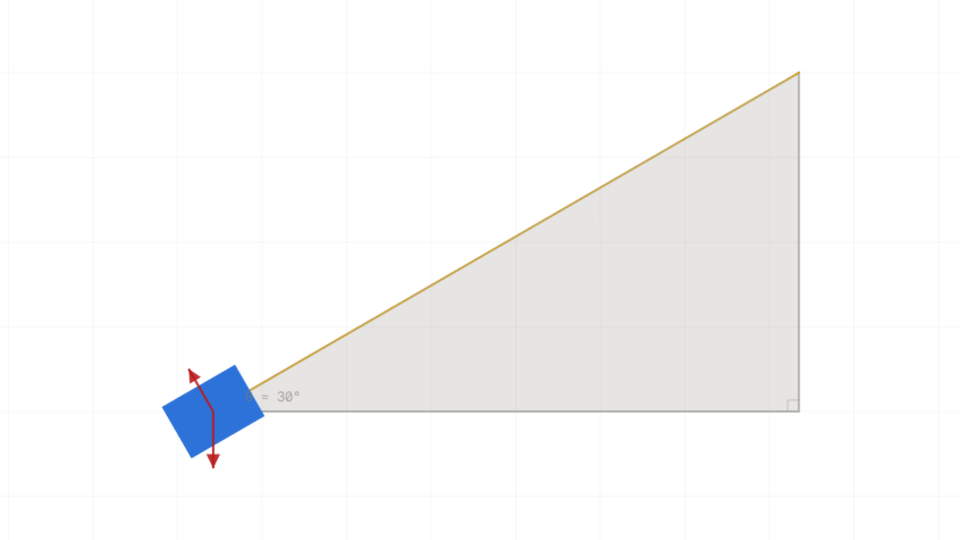
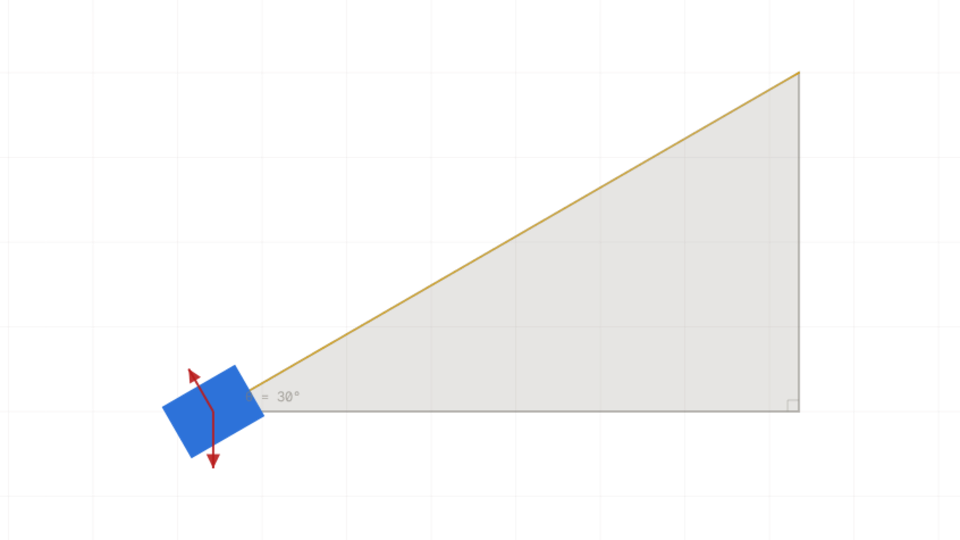
The block on the ramp feels three forces. Gravity acts straight down with magnitude m·g. The ramp pushes back perpendicular to its surface with the normal force N. Kinetic friction acts along the surface, opposing the direction of sliding, with magnitude μk·N. Splitting gravity into a component along the slope (m·g·sin θ) and one perpendicular to it (m·g·cos θ) lets the perpendicular component cancel against N, leaving the along-slope balance Fnet = m·g·sin θ − μk·m·g·cos θ. Dividing by m gives a = g·(sin θ − μk·cos θ), with mass absent on both sides.
With the simulation defaults θ = 30°, μk = 0.20, and Mass = 2.0 kg, the arithmetic is direct. The along-slope pull is g·sin 30° = 9.81·0.500 ≈ 4.91 m/s². The friction term subtracts μk·g·cos 30° = 0.20·9.81·0.8660 ≈ 1.70 m/s². The net acceleration is 4.91 − 1.70 ≈ 3.21 m/s², which is exactly what the simulator's Accel readout displays from the moment the block starts moving until it reaches the foot of the 8 m ramp.
Because the acceleration is constant throughout the slide, the block obeys uniform-acceleration kinematics from rest. Over the ramp length L = 8 m, the predicted slide time is t = sqrt(2·L/a) = sqrt(16/3.21) ≈ 2.23 s, and the exit speed is v = sqrt(2·a·L) = sqrt(51.3) ≈ 7.16 m/s. The simulator's Time readout stops near 2.23 s and the Velocity readout climbs linearly from 0.00 to roughly 7.16 m/s while Accel holds steady. Angle stays pinned at 30° because the slider does not move during a run.
Whether the block moves at all depends on the static-friction threshold. If tan θ ≤ μ, the gravitational pull along the slope is less than the maximum static friction the surface can supply, and the block stays put. With μ = 0.20, the critical angle is arctan(0.20) ≈ 11.31°. Setting the slider to 11° produces a predicted a ≈ −0.05 m/s², clamped to zero, so pressing Start leaves the block stationary. Bumping the slider to 12° gives tan 12° ≈ 0.213 > 0.20 and a small positive a ≈ 0.12 m/s², and the block creeps slowly down the slope.
Key Equations
For the default run with m = 2.0 kg, g = 9.81 m/s², and θ = 30°: N = 2.0·9.81·cos 30° = 2.0·9.81·0.8660 ≈ 16.99 N. This value sets the maximum friction the surface can supply and rescales the red normal-force vector that the simulator draws perpendicular to the slope around the block.
For the same defaults with μk = 0.20: fk = 0.20·16.99 ≈ 3.40 N. The friction vector renders along the slope pointing up the ramp, opposing the direction of sliding. Its magnitude scales linearly with mass and with cos θ: at θ = 60° the same mass and μ give only fk ≈ 1.96 N because the surface presses back less firmly.
For θ = 30° and μk = 0.20: a = 9.81·(0.500 − 0.20·0.8660) = 9.81·0.32679 ≈ 3.21 m/s². Mass has dropped out entirely. The simulator's Accel readout stays fixed at 3.21 m/s² for the whole slide because neither θ nor μ changes during a run, no matter what value the Mass slider holds.
With L = 8 m and a ≈ 3.21 m/s²: t = sqrt(16 / 3.21) = sqrt(4.99) ≈ 2.23 s. The Time readout stops at roughly 2.23 s the moment the block's distance along the slope first exceeds 8 m, which is when the simulator halts the run.
For the same defaults: v = sqrt(2·3.21·8) = sqrt(51.3) ≈ 7.16 m/s. The Velocity readout climbs linearly from 0.00 m/s at Start and lands near 7.16 m/s at the moment the block reaches the foot of the 8 m ramp.
With μ = 0.20: θc = arctan(0.20) ≈ 11.31°. At any θ ≤ 11.31° with that μ, the simulator predicts a ≤ 0 and the block stays at rest when Start is pressed. At θ = 12° the predicted a ≈ 0.12 m/s² and the block creeps down the 8 m slope over many seconds.
Key Variables
| Symbol | Name | Unit | Meaning |
|---|---|---|---|
| θ | Ramp angle | degrees (°) | Tilt of the slope above the horizontal |
| μ | Kinetic friction coefficient | dimensionless | Ratio of kinetic friction to normal force |
| m | Block mass | kg | Cancels out of the along-slope acceleration |
| g | Gravitational acceleration | m/s² | 9.81 m/s² downward at Earth's surface |
| L | Ramp length | m | Fixed at 8 m for every run in this simulator |
| N | Normal force | N | Surface reaction perpendicular to the slope |
| fk | Kinetic friction force | N | Force opposing the block's motion along the slope |
| a | Acceleration along slope | m/s² | Net acceleration once the block starts sliding |
| t | Slide time | s | Time from Start until the block reaches the foot |
| v | Exit speed | m/s | Velocity at the foot of the 8 m ramp |
Real World Examples
Why are wheelchair ramps required to stay below about 5 degrees?
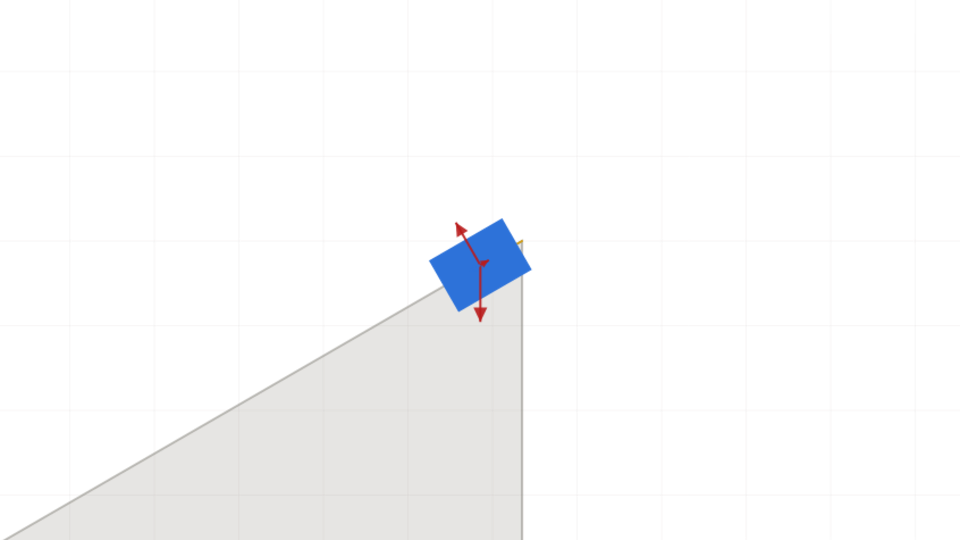
The Americans with Disabilities Act caps accessible ramp slopes at a 1:12 rise-to-run ratio, which corresponds to roughly 4.76°. The reason is straight Newtonian: at very small θ, sin θ ≈ tan θ, so the gravitational pull along the slope grows almost linearly with the angle. A user in a wheelchair must overcome m·g·sin θ at every push, and pushing more than a few percent of body weight uphill, for the length of a ramp run, exhausts the shoulder muscles within seconds. Doubling the slope from 5° to 10° doubles the per-push effort.
The simulator brackets the regime cleanly. Holding μk = 0.20 and Mass = 2.0 kg, dropping the Angle slider from 30° down to 5° cuts the gravitational along-slope component from m·g·sin 30° = 9.81 N to m·g·sin 5° ≈ 1.71 N, about a sixfold reduction in the force the user has to fight. Tan 5° ≈ 0.0875 is well below μk = 0.20, which is also why the Accel readout pins to zero on a 5° slope at that friction; on real wheelchairs, the wheel-bearing friction coefficient is much smaller, which is what allows motion at all in this regime.
How steep can a loaded gravel pile or hillside be before it collapses?
Loose granular materials (gravel, dry sand, soil, snow) have a natural angle of repose, the steepest stable slope angle, set by tan θrepose = μs between grains. Dry sand sits near μs ≈ 0.7, giving θrepose ≈ 35°; gravel runs slightly steeper, near 38°; wet snow on a roof can fail by sliding once the angle of the roof exceeds arctan of the snow-shingle friction coefficient, which is why ski resorts trigger controlled avalanches on slopes above about 30°.
The simulator's stationary-block behavior maps directly onto this idea. With μk = 0.20, the predicted critical angle is arctan(0.20) ≈ 11.31°: setting the Angle slider to 11° leaves the Accel readout at zero and the block does not move when Start is pressed, while moving the slider to 12° produces a predicted a ≈ 0.12 m/s² and the block begins to creep down the 8 m ramp. The same threshold logic, with μs in place of μk, governs whether a slope of dirt, snow, or sand stays in place or fails.
Why do skis with fresh wax glide so much faster than ones that have not been waxed?
A racing ski's base is hot-waxed to drop the ski-on-snow kinetic friction coefficient from roughly 0.10 down to 0.04 or lower. On a 30° slope, the along-slope acceleration jumps from g·(sin 30° − 0.10·cos 30°) ≈ 4.06 m/s² with stock skis to g·(sin 30° − 0.04·cos 30°) ≈ 4.57 m/s² with race wax. Over a 100 m course that is reached from rest, the exit speed grows from sqrt(2·4.06·100) ≈ 28.5 m/s to sqrt(2·4.57·100) ≈ 30.2 m/s, a difference of about 1.7 m/s; at race pace, that is hundredths of a second across the finish line.
The simulator confirms the friction-acceleration linkage on a controlled ramp. Holding θ = 30° and Mass = 2.0 kg, lowering the Friction μk slider from 0.20 down to 0.05 raises the Accel readout from about 3.21 m/s² to about 4.48 m/s², and the Time readout drops from 2.23 s to roughly 1.89 s on the same 8 m ramp. The exit-speed Velocity readout grows from 7.16 m/s to about 8.47 m/s. The race-wax effect is the same friction-coefficient lever, applied on a much longer slope.
Further Reading
- Projectile motion: the same vector-decomposition trick applied to a launched object that splits velocity into independent horizontal and vertical components.
- Block on a horizontal surface with friction: the inclined-plane friction model evaluated at θ = 0°, where the normal force equals m·g and only an applied force can produce motion.