Inclined Plane · SimulatorGravity Split on a Slope
An object sliding down an adjustable incline with friction and normal force vectors.
Published: April 26, 2026 · Updated: May 29, 2026
Objective
Confirm that a block sliding down an incline with kinetic friction obeys the closed-form acceleration a = g·(sin θ − μ·cos θ), where θ is the ramp angle and μ is the kinetic friction coefficient. Measure how the slide time and final velocity at the foot of the 8 m ramp depend on these two parameters, and verify the static-friction threshold tan θ_c = μ that separates sliding motion from a stationary block. The simulation assumes a rigid block, uniform surface, constant μ, and no air drag.
Setup
- Press Reset so the block returns to the top of the 8 m ramp and the Time, Velocity, Accel, and Angle readouts all show 0.00 (Angle reverts to the slider value).
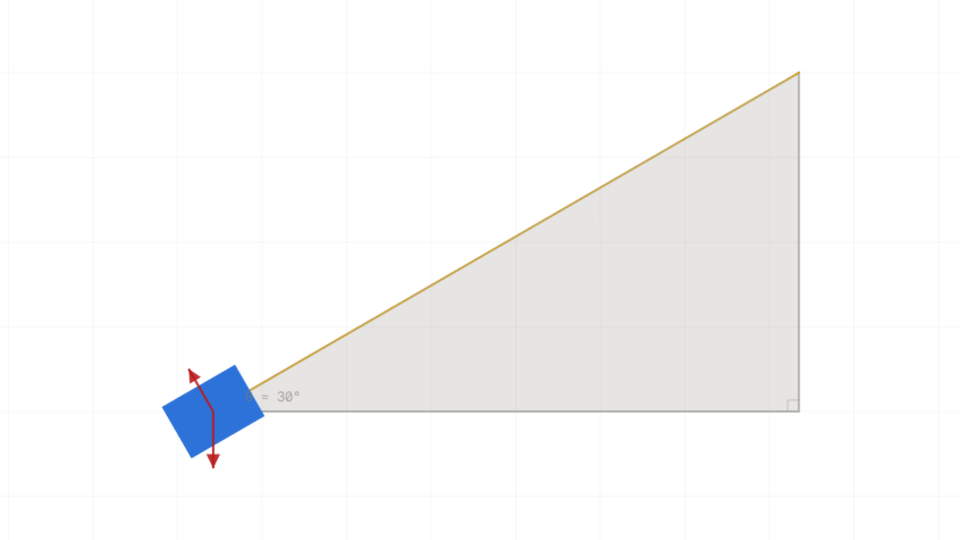
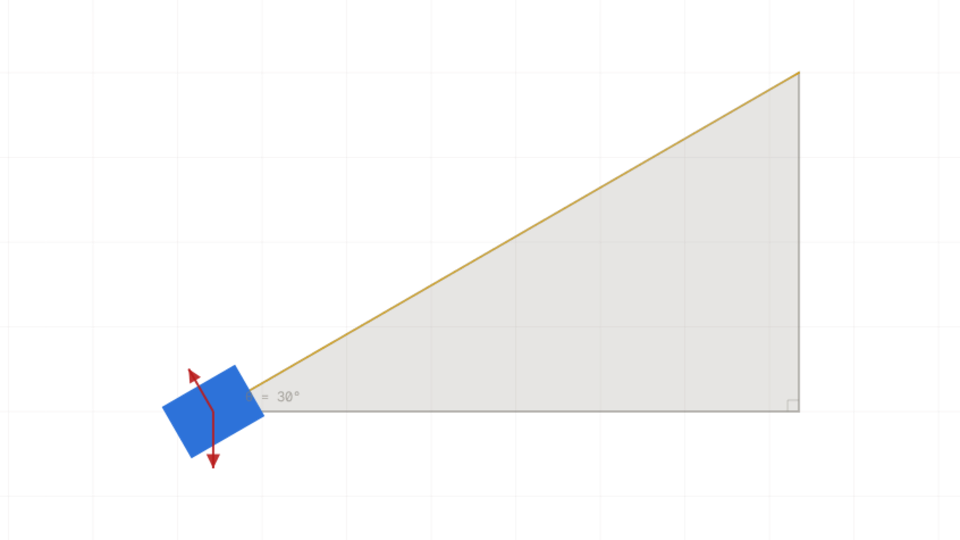
- Set the Angle slider to 30°. The angleVal readout updates to 30, and the on-canvas θ label and ramp triangle redraw to match the new inclination.
- Set the Friction μk slider to 0.20. The frictionVal readout shows 0.20, the kinetic-friction coefficient used by the acceleration formula a = g·(sin θ − μ·cos θ).
- Set the Mass slider to 2.0 kg. Mass cancels out of the acceleration but rescales the red weight, normal, and friction force vectors that render around the block during motion.
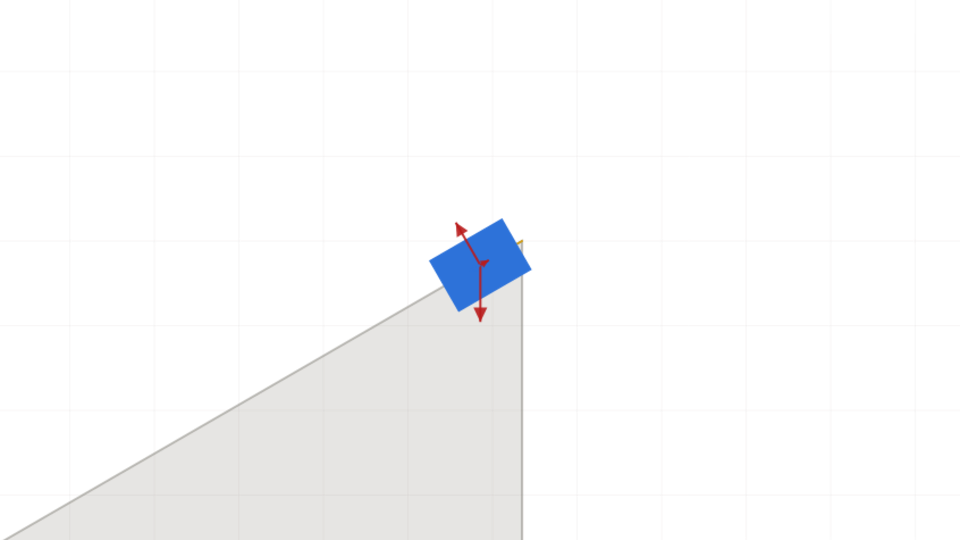
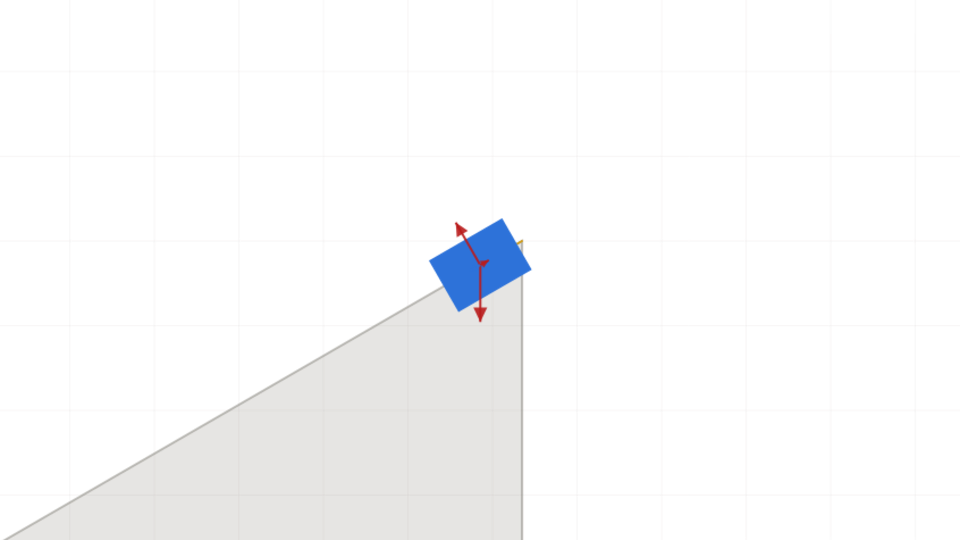
- Press Start. The block accelerates down the slope; watch the blue dotted velocity arrow grow and the Velocity and Accel readouts update each frame until the block reaches the foot of the ramp.
Analytical Prediction
For a block sliding from rest down a ramp with kinetic friction, Newton's second law along the slope gives a = g·(sin θ − μ·cos θ). The block stays at rest if tan θ ≤ μ; otherwise it accelerates uniformly. From rest over distance d, the kinematic relations are t = √(2·d/a) and v = √(2·a·d). With θ = 30°, μ = 0.20, d = L = 8 m, g = 9.81 m/s²:
Mass m = 2.0 kg sets the normal force N = m·g·cos θ ≈ 16.99 N and friction f_k = μ·N ≈ 3.40 N but does not affect a, t, or v.
Results Analysis
While the block slides, the Accel readout should hold steady at about 3.21 m/s² (the formula gives a constant value because θ and μ do not change during a run). The Velocity readout climbs linearly from 0.00 toward roughly 7.16 m/s, and the Time readout reaches about 2.23 s when the block reaches the foot of the ramp and the loop stops. The Angle readout stays pinned at 30° throughout. To stress-test the formula, reset and lower the Angle slider to 11° while keeping μk at 0.20: tan 11° ≈ 0.194 < 0.20, so the predicted acceleration is essentially zero (a ≈ 9.81·(0.1908 − 0.1963) ≈ −0.05, clamped to 0 in the sim) and the block should not move when you press Start. Raising the angle to 12° flips this: tan 12° ≈ 0.213 > 0.20, so a ≈ 0.12 m/s² and the block creeps slowly down the 8 m slope.
Source of Error
What this sim does NOT model: air resistance, deformation of the block or the slope, rotational kinetic energy of the block (it slides as a point mass, no rolling), variations in g, or non-uniform friction along the slope. The kinetic friction coefficient μk is treated as a single constant. The closed-form a = g·(sin θ − μk·cos θ) and the normal-force expression N = m·g·cos θ assume the same idealizations, so they cancel rather than contributing to the residual. The remaining gap between prediction and readouts is therefore purely numerical, not physical.
Further Exploration
- Find the static-friction critical angle empirically. Hold μk = 0.20 and lower the Angle slider one degree at a time from 15° down to 5°, pressing Start each time. At what angle does the block first refuse to slide? Compare with θ_c = arctan(0.20) ≈ 11.31°.
- Confirm that mass does not affect the slide. Keep θ = 30° and μk = 0.20 and run the sim with Mass set to 0.5 kg, 2.0 kg, and 10 kg in turn. Do the Time and Velocity readouts at the foot of the ramp differ, or do they coincide as the formula predicts?
- Predict the slide time at θ = 45°, μk = 0.30. Compute a = 9.81·(sin 45° − 0.30·cos 45°) by hand, then t = √(16/a). Run the sim and compare your answer to the Time readout when the block stops.
- For what value of μk does a 60° ramp produce exactly half the frictionless acceleration? Solve g·(sin 60° − μ·cos 60°) = 0.5·g·sin 60° for μ, then dial in your answer on the Friction μk slider and verify the Accel readout matches your target.
- Why does the Accel readout stay constant during a single run while the Velocity readout grows? Relate this to the difference between a (which depends only on θ and μ) and v (which integrates a over time).