Circular Motion PhysicsCentripetal Force Formula a = v²/r
Introduction
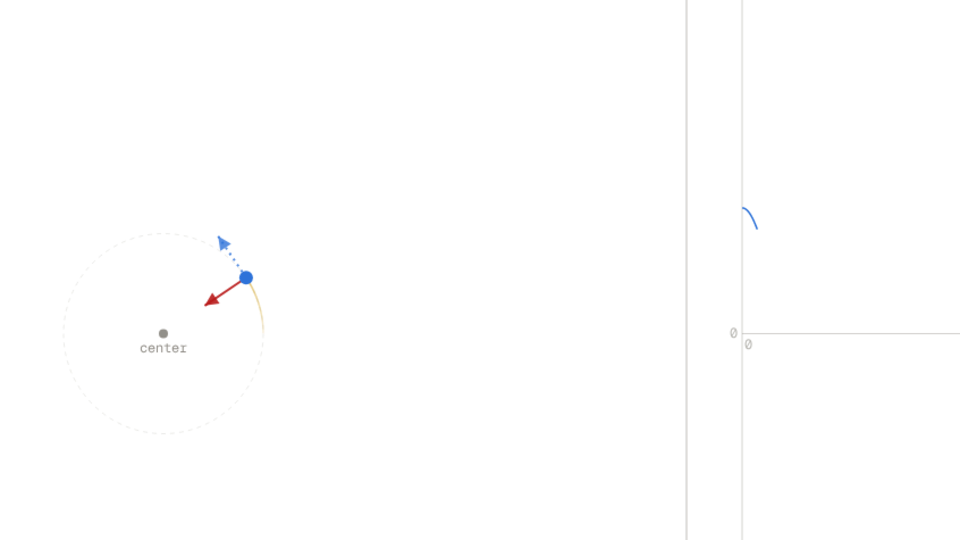
Circular motion describes an object travelling along a closed curved path at constant tangential speed while a steady inward force bends its trajectory away from the straight line inertia would otherwise produce. The speed is constant, but the velocity vector is not; it rotates at the rate physicists call the angular velocity. The simulator draws the orbit ring, the marker, the inward red centripetal-force arrow, and the tangent blue velocity arrow together.
The topic threads through every part of mechanics that involves rotation. Satellites stay in orbit because gravity supplies the inward pull the geometry requires; cars hold a curve because tyre friction supplies it; a centrifuge separates a sample because the rotating walls supply it. Knowing how acceleration scales with speed and radius lets engineers size that inward force before any specific application is chosen.
Riders on a spinning fairground ride step off certain the force pushed them outward, pressed as they were into the wall. The arrows on screen point the other way: with Radius = 5.0 m and Speed = 5.0 m/s, the red force arrow stays pinned toward the centre at every orbit angle while the blue velocity arrow stays tangent. The outward sensation is the rider's inertia trying to continue in a straight line; the actual force that keeps them on the circle points inward.
The Physics Explained
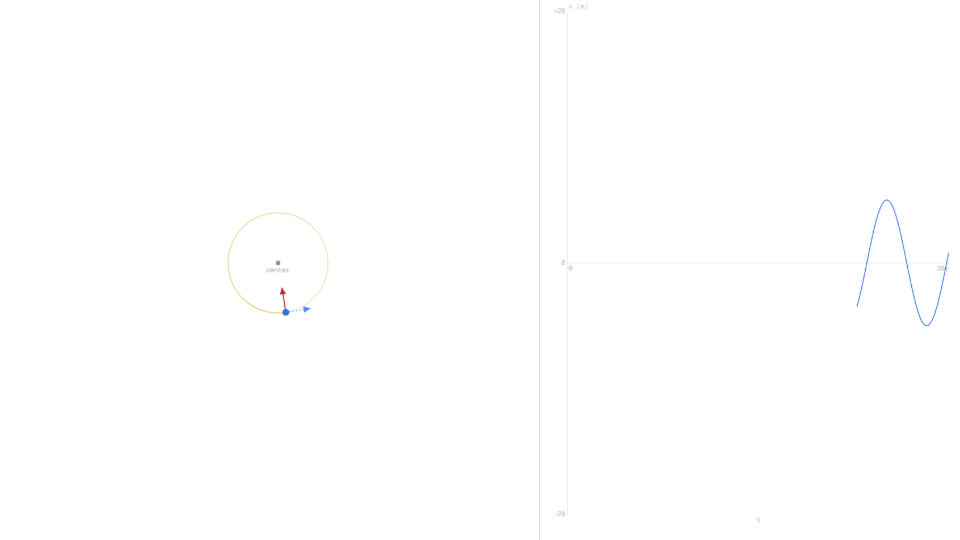
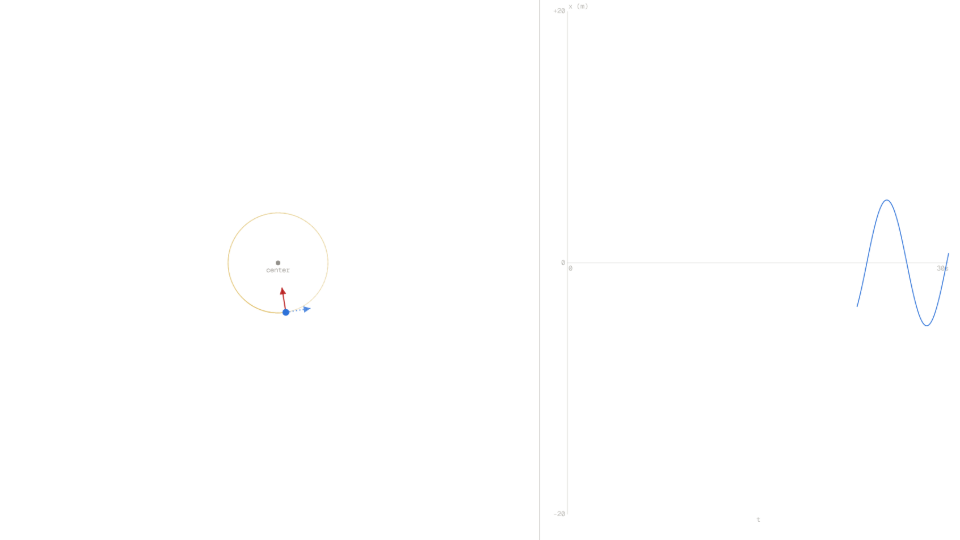
Uniform circular motion is the cleanest setting in which Newton's second law applies to a vector that changes direction without changing magnitude. The position of the orbiting marker is r · (cos θ, sin θ), where θ grows linearly with time at the angular rate ω = v / r. Differentiating that position twice gives an acceleration vector of magnitude v² / r that always points back toward the centre: the radial unit vector flipped in sign. The simulator's ac readout is the magnitude of that vector, and the red centripetal-force arrow is the same vector scaled by the mass slider.
At the as-loaded settings of Radius = 5.0 m, Speed = 5.0 m/s, and Mass = 1.0 kg, the readouts settle at ω = 1.00 rad/s, ac = 5.00 m/s², and Fc = 5.00 N. These three numbers are locked together by the formulas: ω · r reproduces v, ω² · r reproduces ac, and m · ac reproduces Fc. None of them drifts during the run because the simulator evaluates the closed-form relations directly rather than integrating force over time, so the readouts hold steady from t = 0 right through the auto-stop at t = 30 s.
The most useful thing to notice is how ac responds to the two geometric sliders. Doubling Speed from 5.0 to 10.0 m/s at fixed Radius = 5.0 m sends ac from 5.00 to 20.00 m/s², a factor of four, because v enters the formula squared. Doubling Radius from 5.0 to 10.0 m at v = 10.0 m/s drops ac back to 10.00 m/s², halving it. Speed and radius are not interchangeable knobs; the asymmetry is what makes high-speed tight turns the dangerous combination they are in driving and motorsport.
Mass behaves differently from the geometric sliders because it cancels out of the acceleration relation but survives in the force relation. Sliding Mass from 1.0 to 2.0 kg at fixed Radius = 5.0 m and Speed = 5.0 m/s leaves the ac readout pinned at 5.00 m/s² and the ω readout pinned at 1.00 rad/s, but doubles the Fc readout from 5.00 to 10.00 N. The geometry of the orbit is a property of the path; the inward force needed to enforce that geometry is a property of what is being moved along it.
Key Equations
For the default sliders Radius = 5.0 m and Speed = 5.0 m/s: ω = 5 / 5 = 1.00 rad/s. The simulator's ω readout reports 1.00 rad/s on the same configuration, and the marker completes one full sweep of the dashed orbit ring every 2π ≈ 6.28 s of simulated time.
For the defaults: ac = 25 / 5 = 5.00 m/s². The simulator's ac readout shows 5.00 m/s² for the entire 30-second run because both v and r are held fixed by the sim. The same number falls out of ω² · r = 1² · 5 = 5.00 m/s², confirming the two algebraic forms agree.
With the defaults plus Mass = 1.0 kg: Fc = 1 · 25 / 5 = 5.00 N. The simulator's Fc readout reports 5.00 N. Sliding Mass to 2.0 kg with Radius and Speed unchanged sends Fc to 10.00 N, while ac and ω both stay locked at their previous values; the linear-in-mass dependence is visible directly in the HUD.
For the defaults: T = 2π · 5 / 5 = 2π ≈ 6.28 s. Across the full 30-second run the marker completes 30 / 6.28 ≈ 4.77 revolutions, which matches the visible orbit trail and the Time readout's progression past each return to θ = 0.
Key Variables
| Symbol | Name | Unit | Meaning |
|---|---|---|---|
| r | Radius | m | Distance from centre to orbiting object |
| v | Tangential speed | m/s | Speed along the circle, constant in uniform motion |
| m | Mass | kg | Mass of the orbiting object |
| ω | Angular velocity | rad/s | Rate of angular sweep around the centre |
| ac | Centripetal acceleration | m/s² | Inward acceleration, magnitude v² / r |
| Fc | Centripetal force | N | Net inward force, magnitude m · v² / r |
| T | Orbital period | s | Time for one complete revolution |
Real World Examples
How tight a turn can a car safely take at highway speed?
The friction force between tyres and dry asphalt has an upper limit set by the coefficient of static friction, typically μ ≈ 0.9 for good rubber on clean pavement. The maximum centripetal acceleration a tyre can deliver is therefore ac,max = μ · g ≈ 0.9 · 9.81 ≈ 8.83 m/s². Rearranging ac = v² / r for the minimum safe radius gives rmin = v² / ac,max. At a highway speed of 30 m/s (about 108 km/h), the minimum unbanked turn radius works out to rmin = 900 / 8.83 ≈ 102 m: a wide, gentle sweep, not a city block.
Halving the speed quarters the required centripetal acceleration and therefore quarters the minimum radius, which is why slow turns feel forgiving and fast turns suddenly do not. The simulator demonstrates the v² scaling directly: with Mass = 1.0 kg and Radius = 5.0 m, raising Speed from 5.0 to 10.0 m/s sends the ac readout from 5.00 to 20.00 m/s². Wet pavement collapses μ to 0.3 or below, tripling rmin and explaining why posted curve speeds drop sharply in the rain.
Why does a satellite's orbit speed depend only on its altitude?
For a satellite in circular orbit, gravity supplies the centripetal force. Equating the gravitational pull G · ME · m / r² with the centripetal requirement m · v² / r and cancelling m gives v = sqrt(G · ME / r). The mass of the satellite drops out completely: a 100 kg cubesat and a 400-tonne space station at the same altitude orbit at exactly the same speed and exactly the same period. Only the orbit radius matters. At low Earth orbit (r ≈ 6.78 × 10⁶ m, about 400 km altitude) the formula gives v ≈ 7.67 km/s and a period near 92 minutes.
The simulator captures the mass-cancellation property in miniature. With Radius = 5.0 m and Speed = 5.0 m/s, sliding Mass from 1.0 to 5.0 kg leaves the ω readout pinned at 1.00 rad/s and the ac readout pinned at 5.00 m/s²; only Fc scales, from 5.00 to 25.00 N. Geometry alone determines how fast you must go to stay on the circle; the mass of what you put on it just sets how hard the rope, the gravity, or the rocket has to pull.
The same logic produces geostationary orbit. A satellite that takes exactly one sidereal day to complete a revolution must sit at the radius for which sqrt(G · ME / r) gives v = 2π · r / Tday, which solves to r ≈ 4.22 × 10⁷ m, about 35,786 km above Earth's surface. Every geostationary satellite, regardless of mass, sits in that same ring.
How fast must a centrifuge spin to simulate Earth gravity?
A rotating habitat or laboratory centrifuge produces an apparent gravity equal to the centripetal acceleration its walls deliver. Setting ac = g = 9.81 m/s² and solving v² / r = 9.81 gives the speed–radius pairings that produce Earth-equivalent g. A 1-metre arm needs a tip speed of v = sqrt(9.81) ≈ 3.13 m/s, which is ω = 3.13 rad/s ≈ 30 RPM. A 100-metre orbital ring needs the same ac at v = sqrt(981) ≈ 31.3 m/s, but only ω = 0.313 rad/s ≈ 3 RPM.
The simulator confirms the family of solutions. Setting Radius = 5.0 m and Speed = 7.0 m/s gives ac = 49 / 5 = 9.80 m/s² on the readout, Earth-equivalent g. Setting Radius = 10.0 m and Speed = 9.9 m/s gives ac = 98.01 / 10 ≈ 9.80 m/s². Both configurations produce one g, but the larger ring rotates noticeably more slowly. This is why proposed rotating space stations grow rather than spin faster: small radii at one g require uncomfortably high rotation rates that the inner ear interprets as constant motion sickness.
Further Reading
- Orbital motion: when the inward force is gravity rather than tension, and how the same ac = v² / r relation determines orbital speed at a given radius.
- Simple pendulum: a circular-arc swing in which the inward radial force changes during the motion and the tangential component is what restores the bob.
- Spring-mass oscillator: a one-dimensional restoring-force system whose period formula T = 2π · sqrt(m / k) shares the 2π · sqrt-of-something structure with the orbital period.