Orbital Motion PhysicsKepler's Third Law & Orbit Speed
Introduction
Orbital motion is the closed, repeating path a small body traces around a much larger one when gravity supplies all the sideways turning the small body needs. The simulator pins a star at the centre of the canvas and launches a planet from a chosen radius at the exact tangential speed required for a circular orbit, so the path that draws itself is the simplest case Newton's law of gravitation predicts.
The topic underpins every satellite, every space probe, and every prediction about where Jupiter or Mars will sit on the sky next month. Mission planners who choose a launch window for a Mars rover use the same Kepler period formula the simulator displays in its readouts, and a geostationary communication satellite sits at exactly the radius where the orbital period matches one Earth day.
Heavier planets, the reasoning often goes, must orbit faster because gravity pulls them harder. Yet the planet's own mass never enters the circular-orbit speed: with Orbit Radius = 100 m and Star Mass = 50, the Speed readout settles at 22.36 m/s no matter what the planet weighs, because the gravitational pull and the required centripetal force scale together with that mass.
The Physics Explained
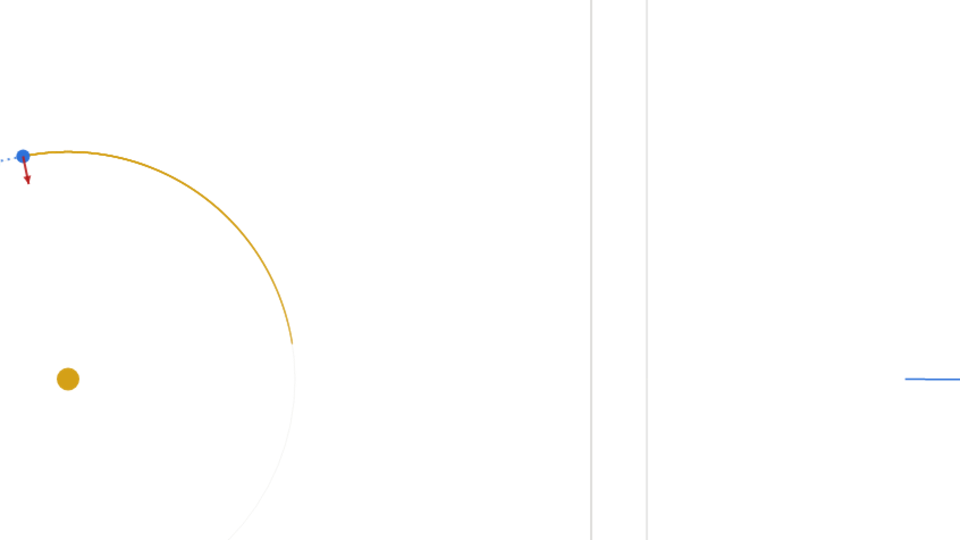
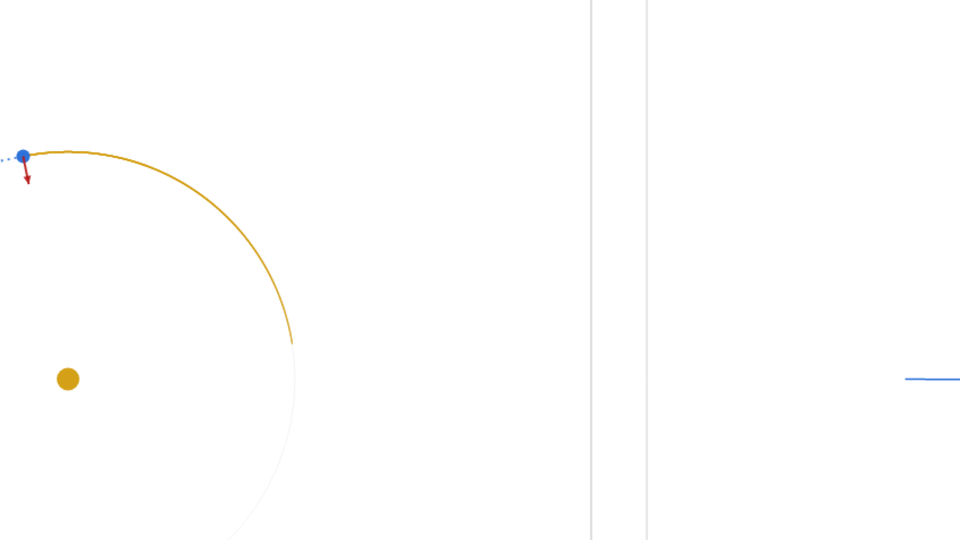
For a planet to hold a circular path around the central star, the inward gravitational pull G·M·m/r² must exactly equal the centripetal demand m·v²/r. The orbiting mass m cancels from both sides, leaving v² = G·M/r and therefore v = sqrt(G·M/r). The simulator works in scaled units where the Star Mass slider value s represents G·M = s · 10³ m³/s². At the default Orbit Radius = 100 m and Star Mass = 50, that gives G·M = 50000 m³/s² and a circular speed of sqrt(50000/100) = sqrt(500) ≈ 22.36 m/s, which is exactly what the Speed readout reports throughout the run.
Closing the orbit takes time. One revolution covers a circumference of 2π·r, so the period is T = 2π·r/v = 2π·sqrt(r³/(G·M)): Kepler's third law in its Newtonian form. For the defaults, T = 2π·sqrt(100³/50000) = 2π·sqrt(20) ≈ 28.10 s. The simulator runs for up to 85 s, so the Angle readout sweeps from 0° back through 360° about three times before the time cap stops the loop, and the Time readout at each return to 0° matches the predicted period within integration noise.
The radius and the central mass tug the period in opposite directions. Doubling the radius from 100 m to 200 m at Star Mass = 50 multiplies T by 2^1.5 ≈ 2.83, so the period grows from 28.10 s to about 79.48 s and only one full orbit fits inside the 85 s cap. Doubling Star Mass from 50 to 100 at Orbit Radius = 100 m raises G·M to 100000 m³/s², shrinking T to 2π·sqrt(100³/100000) ≈ 19.87 s. The orbit is the same circle, traversed faster because the central pull is stronger.
Gravity also sets a ceiling on bound motion. The escape speed at radius r is vesc = sqrt(2·G·M/r), which is exactly sqrt(2) ≈ 1.414 times the circular speed at the same radius. With the defaults that is sqrt(1000) ≈ 31.62 m/s, so the 22.36 m/s the Speed readout shows leaves the planet comfortably bound, with about 71 % of the speed it would need to break free.
Key Equations
This is the inward force the central star exerts on the planet at separation r. With G·M = 50000 m³/s² and r = 100 m, the force per unit planet mass is 50000 / 100² = 5 m/s², the centripetal acceleration the simulator sustains for the entire 85 s run, and the source of the inward red arrow drawn at the planet on every frame.
Setting the gravitational pull equal to the centripetal demand m·v²/r and cancelling the planet mass gives this expression. At the default Orbit Radius = 100 m and Star Mass = 50 (so G·M = 50000 m³/s²), v = sqrt(50000 / 100) = sqrt(500) ≈ 22.36 m/s. The Speed readout holds within a few hundredths of that value for every revolution, since the symplectic-Euler integrator preserves energy on closed Kepler orbits.
One full revolution traces a circumference 2π·r at constant speed v, so the period is T = 2π·r / v, which simplifies to this radius-cubed form. For the defaults, T = 2π · sqrt(100³ / 50000) = 2π · sqrt(20) ≈ 28.10 s. The Angle readout returns to its starting 0° on roughly that cadence, and the Time readout when it does so confirms the prediction within the integrator's drift budget.
This is the launch speed at radius r above which total mechanical energy turns positive and the orbit no longer closes. At the defaults, vesc = sqrt(2 · 50000 / 100) = sqrt(1000) ≈ 31.62 m/s, exactly sqrt(2) ≈ 1.414 times the 22.36 m/s circular speed shown by the Speed readout. Any launch above vesc would escape on a hyperbolic path instead of closing into an orbit.
Key Variables
| Symbol | Name | Unit | Meaning |
|---|---|---|---|
| G | Gravitational constant | m³/(kg·s²) | Universal constant 6.674·10⁻¹¹ in SI |
| M | Central mass | kg | Mass of the star at the canvas centre |
| G·M | Gravitational parameter | m³/s² | Star Mass slider value × 10³ |
| r | Orbit radius | m | Planet-to-star centre-to-centre distance |
| v | Orbital speed | m/s | Tangential speed shown by the Speed readout |
| T | Orbital period | s | Time for one revolution back to Angle = 0° |
| vesc | Escape speed | m/s | Unbound-trajectory threshold at radius r |
Real World Examples
How is the radius of a geostationary satellite chosen?
A geostationary satellite must complete exactly one orbit per sidereal day, 86164 s, so its angular position above the equator never changes relative to the ground. Solving Kepler's third law for r at that period and Earth's G·M ≈ 3.986·10¹⁴ m³/s² gives r ≈ 42164 km from Earth's centre, or about 35786 km above the equator. Pick a different altitude and the satellite drifts east or west across the sky every day.
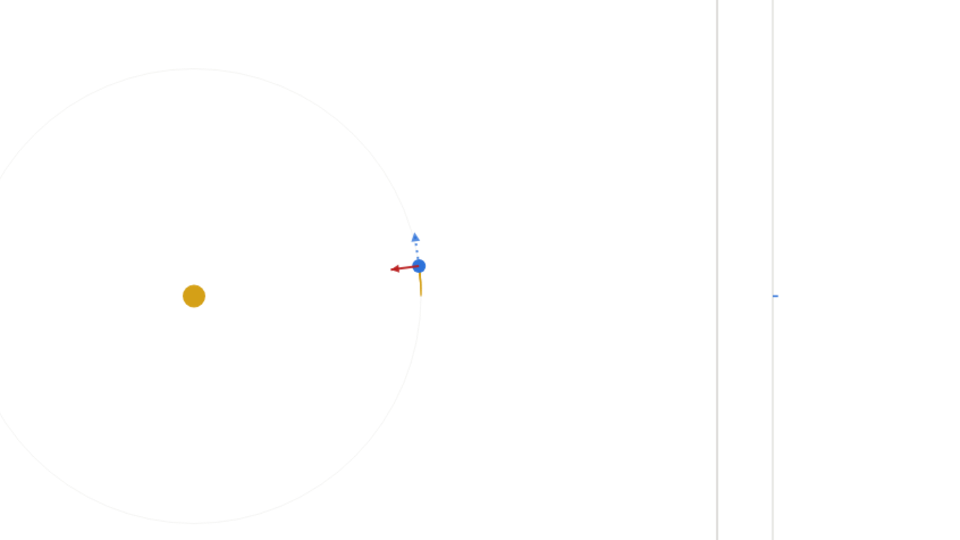
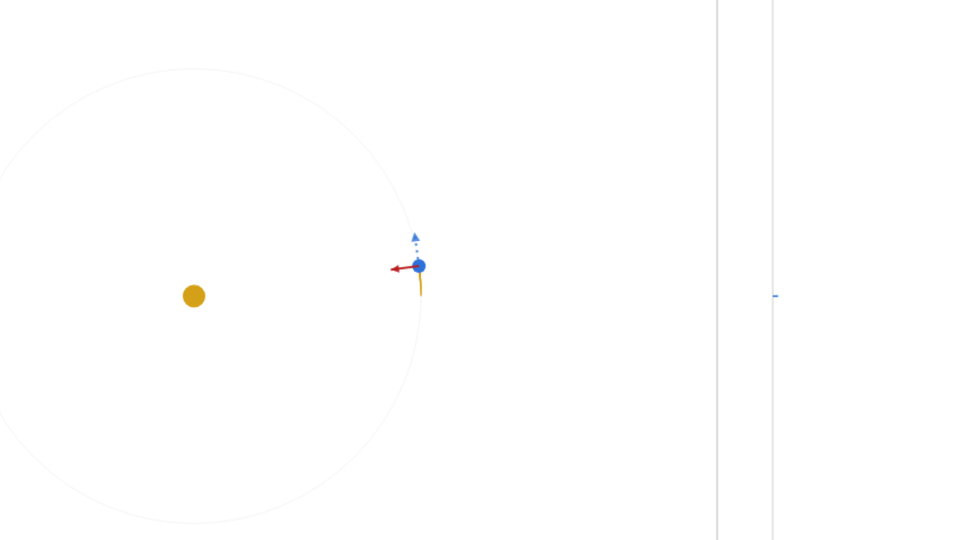
The simulator captures the same one-way coupling between radius and period in scaled units. Holding Star Mass = 50 and stepping Orbit Radius from 100 m to 159 m raises the predicted period from 28.10 s to 2π·sqrt(159³/50000) ≈ 56.20 s, exactly twice as long. The radius is not a free parameter once the operator commits to a stationary footprint, and the same v = sqrt(G·M/r) law the Speed readout obeys at 22.36 m/s for the default 100 m orbit forces a unique speed near 3.07 km/s on every geostationary bird.
Why does the International Space Station orbit so quickly?
The ISS sits roughly 400 km above Earth's surface, at r ≈ 6771 km from Earth's centre. The circular-orbit formula gives v = sqrt(G·M/r) ≈ 7.66 km/s and a period near 92 min, which is why crews see roughly sixteen sunrises and sunsets a day. Astronauts inside are not weightless because gravity has switched off (at that altitude, surface gravity is still about 89 % of its sea-level value) but because the station and everything in it are in continuous free fall around the planet.
The simulator illustrates the same radius-speed coupling at a more comfortable scale. Pulling Orbit Radius from 200 m down to 50 m at Star Mass = 50 raises the predicted Speed from 15.81 m/s to sqrt(50000/50) ≈ 31.62 m/s, exactly twice as fast at one-quarter the radius, and shrinks the period from 79.48 s to about 9.93 s. The closer the orbit, the more curvature gravity must impose per second, and the faster the orbiting body has to travel to keep up. Real low orbits also wear out: the thin upper atmosphere at 400 km exerts enough drag that the ISS needs periodic reboosts, while the simulator's drag-free Distance readout holds near 100.00 m for the entire 85 s run.
How do mission planners send a probe to Mars?
The cheapest transfer from Earth to Mars is a Hohmann ellipse whose perihelion sits at Earth's orbit and whose aphelion just touches Mars's orbit. The semi-major axis is the average of the two radii, about 1.262 AU, and Kepler's third law fixes the half-orbit travel time at roughly 8.5 months. Launch windows open every 26 months, when Earth and Mars line up so the probe arrives at the same place Mars happens to be.
The same period-radius scaling appears in the simulator. With Star Mass = 50 fixed, raising Orbit Radius from 100 m to 200 m grows T from 28.10 s to about 79.48 s (a factor of 2^1.5), exactly the slope of 1.5 that planetary astronomers see when they plot log T against log r for the Solar System's planets. The Speed readout drops correspondingly from 22.36 m/s to 15.81 m/s, the same v ∝ 1/sqrt(r) law that governs every transfer-orbit calculation, and the simulator's escape-speed prediction of vesc ≈ 31.62 m/s at the defaults is the same threshold an interplanetary probe has to cross, scaled, when it leaves Earth's gravity well on the way to Mars.
Further Reading
- Escape velocity: the speed threshold sqrt(2)·vcirc at which a bound orbit becomes a hyperbolic trajectory and the orbiting body departs to infinity.
- Circular motion: the general centripetal-force framework that gravity satisfies in the orbital case, with worked examples for any inward force law.
- Simple pendulum: another small-amplitude periodic system whose period depends on geometry rather than on the mass of the swinging body, paralleling the m-cancellation in the orbital-speed derivation.