Escape Velocity PhysicsEscape-Speed Formula v = √(2GM/r)
Introduction
Escape velocity is the threshold launch speed at which an unpowered projectile, fired straight up from the surface of a massive body, is just barely fast enough to climb away forever instead of returning. The number depends on only two things: how massive the body is and how compact it is. The simulator fixes the planet at Earth's mass and lets the radius vary, displaying the resulting threshold as a live readout labelled vesc beside the launch-speed slider.
The threshold matters because it sorts every unpowered trajectory into one of two qualitative regimes. Below it the projectile is bound, traces a finite arc, and falls back to the surface; at or above it the projectile escapes and continues outward indefinitely. Mission planners use the same number to decide how much delta-v an upper stage needs to leave a planet, and astronomers use it to decide which gases a planet can hold onto over geological time.
Intuition insists that only piling on more mass can make a body harder to leave, and that shrinking the radius at fixed mass merely rearranges the same pull. The readouts say the opposite. With Planet Radius set to 6371 km the vesc readout sits at 11186 m/s; lowering the slider to 3000 km, at the same Earth mass, pushes vesc above 16 000 m/s. Compactness, not bulk mass alone, drives the escape threshold.
The Physics Explained
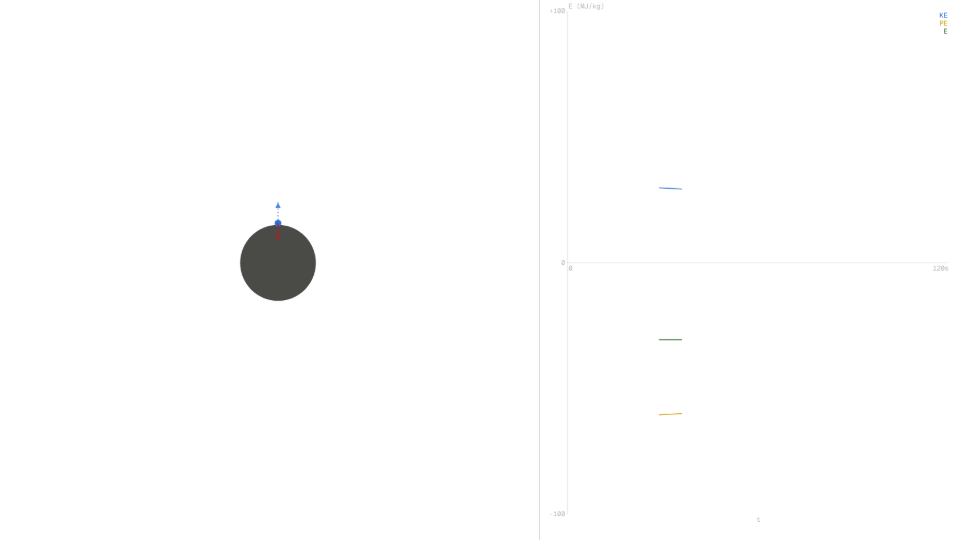
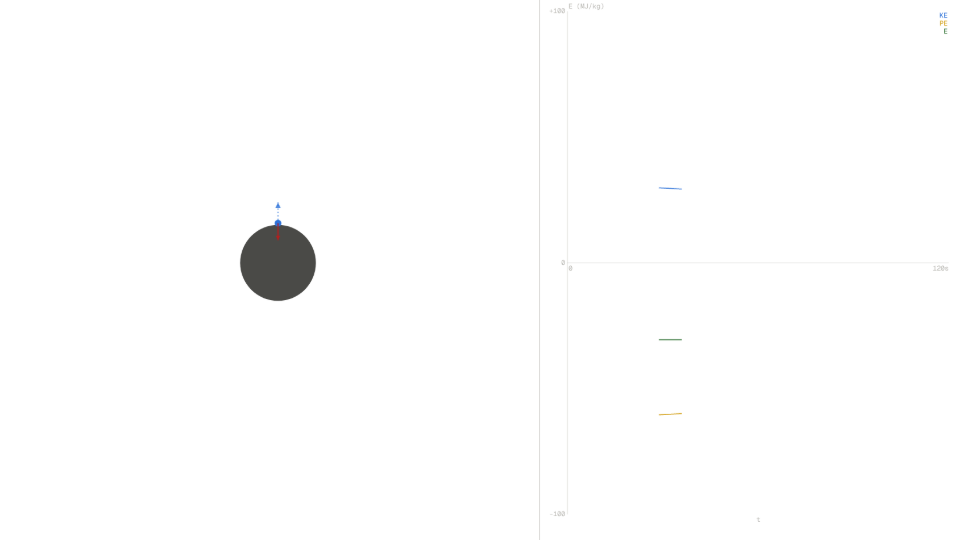
Escape from a planet is a question about the sign of the projectile's total mechanical energy at launch, not about its speed in isolation. Total energy per unit mass at the surface is E/m = ½·v² − G·M/R, the sum of a positive kinetic term and a negative gravitational potential term. If E is negative the projectile is bound: its kinetic energy will run out somewhere short of infinity and the object will fall back. If E is zero or positive the projectile reaches arbitrarily large distances with non-negative residual speed, never reversing.
The simulator makes this dichotomy directly observable. With Planet Radius at 6371 km, the vesc readout shows 11186 m/s, the launch speed at which E equals exactly zero. Setting Launch Speed to 8000 m/s makes E negative; the Speed readout falls steadily as the projectile climbs, the Height readout peaks near 6670 km, and the projectile reverses and re-impacts the surface. Raising Launch Speed to 11200 m/s, just above the threshold, flips the sign of E. The same Speed readout still falls, but it never reaches zero before the 120 s simulation cap, and Height climbs past 13 000 km without any sign of a turnaround.
Algebraically, setting E = 0 at launch and solving for v gives the closed-form escape velocity vesc = sqrt(2·G·M/R). Two features stand out. First, the projectile mass m cancels out of the energy equation entirely, so a 1 kg pebble and a 1000 kg satellite share the same threshold; the simulator's prediction is independent of any payload mass. Second, the formula scales with sqrt(M/R), so cutting R in half at fixed M raises vesc by sqrt(2) ≈ 1.41. That is exactly what the slider does: dragging Planet Radius down from 6371 km to 3000 km roughly doubles the M/R ratio and pushes the vesc readout above 16 000 m/s.
Key Equations
For the default run with Planet Radius R = 6.371 × 10⁶ m, Earth mass M = 5.972 × 10²⁴ kg, and Launch Speed v₀ = 8000 m/s: E/m = ½·(8000)² − 6.674 × 10⁻¹¹ · 5.972 × 10²⁴ / 6.371 × 10⁶ ≈ 3.20 × 10⁷ − 6.26 × 10⁷ ≈ −3.06 × 10⁷ J/kg. Negative E predicts a bound trajectory, matching the simulator's bound-and-return behaviour.
Plugging in the same R and M: vesc = sqrt(2 · 6.674 × 10⁻¹¹ · 5.972 × 10²⁴ / 6.371 × 10⁶) ≈ 11186 m/s. The simulator's vesc readout reports exactly 11186 m/s for these slider positions, matching the closed-form prediction to the displayed precision.
Using E/m = −3.06 × 10⁷ J/kg from the 8000 m/s run: rmax = 3.986 × 10¹⁴ / 3.06 × 10⁷ ≈ 1.304 × 10⁷ m. Subtracting the planet's radius gives an apogee height hmax ≈ 6670 km above the surface, which the simulator's Height readout climbs to before the projectile reverses.
With g = G·M/R² ≈ 9.82 m/s² for the default Earth-mass and 6371 km radius: vesc = sqrt(2 · 9.82 · 6.371 × 10⁶) ≈ 11186 m/s, identical to the formula above. This rewrite shows why halving R at fixed M raises vesc: both g (which scales as 1/R²) and R itself appear inside the square root.
Key Variables
| Symbol | Name | Unit | Meaning |
|---|---|---|---|
| vesc | Escape velocity | m/s | Threshold launch speed at which total energy E equals zero |
| v | Launch speed | m/s | Initial radial speed of the projectile at the surface |
| M | Planet mass | kg | Mass of the central body; held at Earth mass in this simulator |
| R | Planet radius | m | Distance from the planet centre to the launch point |
| r | Radial distance | m | Distance from the planet centre at any point in the flight |
| G | Gravitational constant | N·m²/kg² | Universal constant; G ≈ 6.674 × 10⁻¹¹ N·m²/kg² |
| E | Total mechanical energy | J | Sum of kinetic and gravitational potential energy |
| g | Surface gravity | m/s² | Gravitational acceleration at r = R |
Real World Examples
Why does an upper stage need 11.2 km/s to leave Earth, while a Saturn V launches from rest?
Escape velocity is defined for an unpowered projectile released at the surface: a cannonball, a kicked rock, or a spent upper stage after engine cutoff. A Saturn V on the pad does not need to reach 11.2 km/s before it lifts off because its first-stage engines keep adding energy throughout the climb. Total mechanical energy keeps rising while thrust acts; the rocket only has to be at or above escape speed at the moment its engines stop firing.
The simulator illustrates the unpowered-launch case directly. With Planet Radius at 6371 km the vesc readout shows 11186 m/s, and a Launch Speed of 8000 m/s (well below threshold) produces a bound trajectory whose Height readout peaks near 6670 km and falls back. Raising Launch Speed to 11200 m/s, just above the readout, produces an escape trajectory whose Height climbs past 13 000 km and is still rising at the 120 s time cap. Mission planners size each stage's delta-v so the residual speed at engine cutoff sits above this threshold by a comfortable margin.
How can the Moon retain rocks while losing almost all of its gases?
Atmospheric escape is the same energy criterion applied to individual gas molecules. A molecule moving faster than the local escape velocity at the top of the atmosphere has a real chance of leaving over many collisions; one moving much slower is bound. The Moon's escape velocity is around 2380 m/s, low enough that hydrogen and helium at any plausible temperature have thermal speeds well above it, so the Moon never accumulated a significant atmosphere. Solid rocks, with effectively zero thermal speed at the macroscopic scale, stay put.
The simulator clarifies why the Moon's threshold is so low. Earth and Moon differ in both mass and radius, but vesc = sqrt(2·G·M/R) is more sensitive to the M/R ratio than to either factor alone. With Planet Radius at 6371 km and Earth mass, the vesc readout is 11186 m/s; raising Planet Radius to its 12 000 km maximum at fixed Earth mass drops vesc below 8200 m/s, even though the larger body is less dense. Lower density at fixed mass means a more spread-out gravitational well that is easier to climb out of.
Why does a black hole's event horizon sit exactly where escape velocity equals the speed of light?
Substituting vesc = c into the Newtonian formula and solving for R gives Rs = 2·G·M/c², the Schwarzschild radius. For one solar mass this comes out near 3000 m. The full general-relativistic derivation gives the same expression, a happy coincidence of the Newtonian approximation that makes the Schwarzschild radius a useful intuition pump for what an event horizon actually is, even though the real geometry beyond the horizon needs general relativity to describe.
The simulator's compactness sweep makes the limit tangible inside Newtonian physics. With Earth mass and Planet Radius at the default 6371 km, the vesc readout is 11186 m/s, far below the speed of light. Lowering Planet Radius toward its 3000 km minimum more than doubles M/R and pushes vesc above 16 000 m/s. Extrapolating the same trend down to a 9 mm radius for an Earth-mass body would raise vesc all the way to c: the radius at which Earth, if compressed to that point, would become a black hole.
Further Reading
- Projectile motion: the constant-gravity limit of the same energy framework, valid when the launch speed is small compared to vesc.