Escape Velocity · SimulatorReach Orbit or Escape
A projectile launched from a planet surface showing the threshold speed to escape gravity.
Published: April 29, 2026 · Updated: May 28, 2026
Objective
Confirm that escape from a planet's gravity depends on the sign of total mechanical energy E = ½·m·v² − G·M·m/r at launch, and verify that the threshold launch speed matches the closed-form escape-velocity formula v_esc = √(2·G·M/R). Using Earth-mass parameters (M ≈ 5.972 × 10²⁴ kg, R = 6371 km), test that a launch at 8000 m/s is bound and returns, while a launch at 11200 m/s escapes. Examine how shrinking the Planet Radius slider raises v_esc, illustrating that compactness, not mass alone, drives the escape threshold.
Setup
- Press Reset to clear any previous trail and return the projectile to the surface. The Time readout shows 0.00 and the Height readout shows 0.
- Set the Planet Radius slider to 6371 km. This is Earth's mean radius and the default reference for the prediction in the next section.
- Set the Launch Speed slider to 8000 m/s. Confirm the v_esc readout reads 11186 m/s: this is the escape threshold for the current radius and the fixed Earth mass.
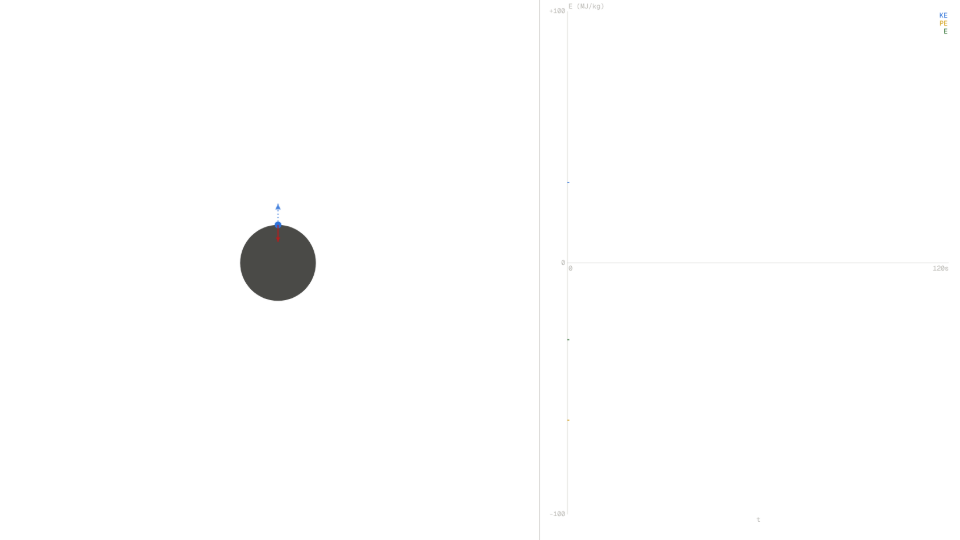
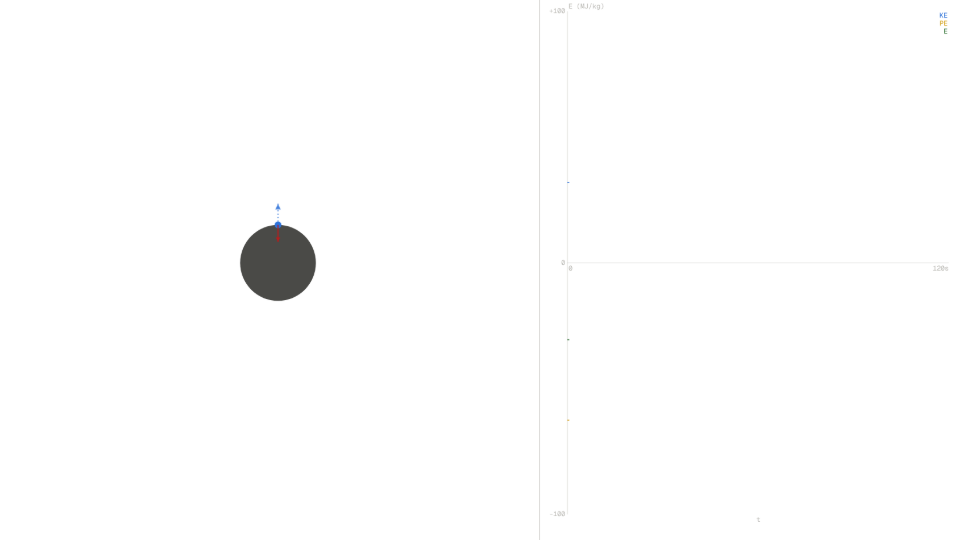
- Press Start. The projectile rises along the planet's vertical axis, slowing as gravity decelerates it, while the Speed readout falls and the Height readout climbs.
- Wait for the projectile to reach apogee (Speed approaches 0) and fall back. The simulation stops when the projectile re-impacts the surface (Height returns to 0).
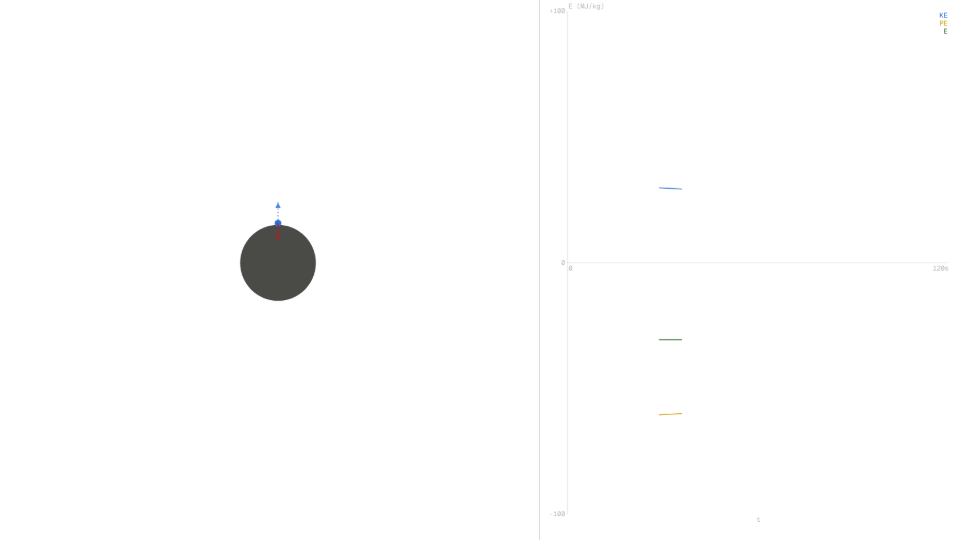
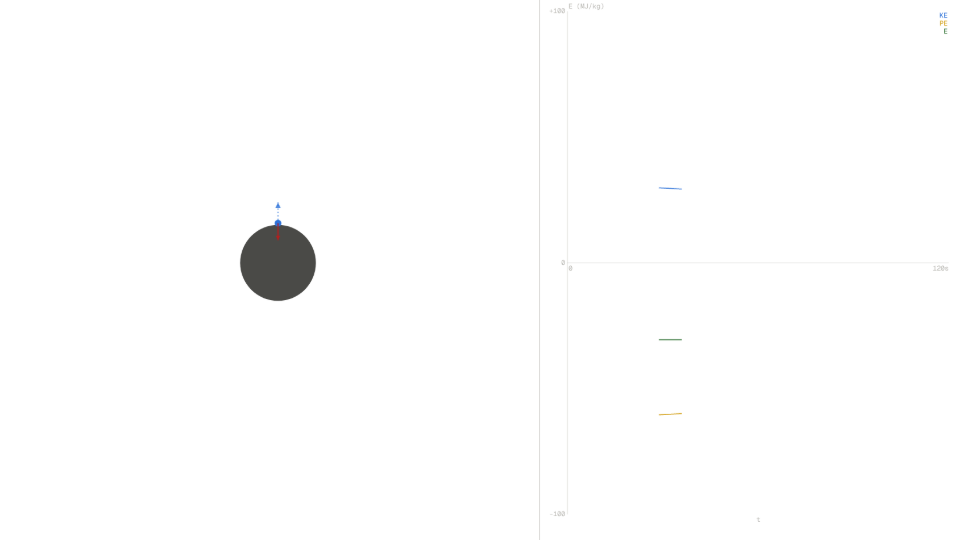
- Without resetting, raise the Launch Speed slider to 11200 m/s and press Start. The projectile now climbs without reversing, and the run ends at the 120 s time cap.
Analytical Prediction
With Planet Radius R = 6.371 × 10⁶ m and Earth mass M = 5.972 × 10²⁴ kg, the escape velocity is:
matching the v_esc readout. At Launch Speed v₀ = 8000 m/s, total mechanical energy per unit mass is:
Because E < 0 the projectile is bound. At apogee v = 0, so:
giving a maximum height h_max = r_max − R ≈ 6670 km. At Launch Speed v₀ = 11200 m/s, E/m ≈ ½·(11200)² − 6.26 × 10⁷ ≈ +1.5 × 10⁵ J/kg, just above zero: the projectile escapes and continues outward through the full 120 s simulation window.
Results Analysis
After the 8000 m/s run, watch the Height readout climb to a peak near 6670 km, then fall back to 0 as the projectile re-impacts the surface. The Speed readout drops from 8000 m/s toward 0 at apogee, then climbs back through 8000 m/s on impact: energy is conserved, so the impact speed equals the launch speed. The agreement between the predicted apogee (≈ 6670 km) and the observed peak Height confirms that the simulation conserves the mechanical energy E = ½·m·v² − G·M·m/r. After the 11200 m/s run, the Speed readout falls steadily but never reaches 0; the Height readout climbs past 6670 km, past 13 000 km, and is still rising at t = 120 s when the time cap stops the run. The qualitative split (return at 8000 m/s, indefinite climb at 11200 m/s) straddles the v_esc readout of 11186 m/s and matches the energy criterion: E < 0 binds, E ≥ 0 escapes.
Source of Error
What this sim does NOT model: atmospheric drag, planetary rotation, the projectile's own mass (it cancels in the energy equation), the Sun's or Moon's gravity, and tidal or relativistic corrections. The simulation treats the planet as a single non-rotating point mass with no atmosphere or third bodies. The closed-form v_esc = √(2·G·M/R) and the energy criterion E = ½·v² − G·M/r assume the same idealizations, so they cancel rather than contributing to the residual between predicted and observed apogees. The remaining gap is therefore purely numerical, not physical.
Further Exploration
- Hold Launch Speed at 8000 m/s and lower the Planet Radius slider from 6371 km to 3000 km. The v_esc readout rises sharply. Recompute v_esc = √(2·G·M/R) by hand and verify. At what radius does 8000 m/s become an escape trajectory?
- Set the Launch Speed slider to 11186 m/s, exactly the v_esc readout for Earth's radius. Press Start and watch the Speed readout. Does it fall to 0 before the 120 s cap, or does it asymptote toward 0? What does the energy criterion E = 0 predict?
- Compute the apogee for a 5000 m/s launch from R = 6371 km using E = ½·v² − G·M/r. Run the sim and compare your predicted Height peak with the readout. Repeat for 10 000 m/s. How does the predicted apogee scale as v₀ approaches v_esc?
- Raise the Planet Radius slider to its maximum (12 000 km) at fixed Earth mass. The v_esc readout falls below 8200 m/s. Explain why a larger radius (at constant M) lowers v_esc, even though the planet would be less dense.
- The formula v_esc = √(2·G·M/R) does not contain the projectile mass m. Argue from the energy equation E = ½·m·v² − G·M·m/r why m cancels, and predict whether a 1 kg pebble and a 1000 kg satellite launched at the same speed share the same fate in this simulation.