Inelastic Collision · SimulatorWhen Objects Stick Together
Two objects collide and stick together; watch momentum stay conserved while kinetic energy is lost to deformation.
Published: April 16, 2026 · Updated: May 28, 2026
Objective
Confirm that linear momentum is conserved across a perfectly inelastic collision while kinetic energy is not. Verify the closed-form final velocity v′ = (m₁v₁ + m₂v₂)/(m₁+m₂) for the stuck-together pair, and quantify the kinetic energy lost to deformation using the reduced-mass expression ΔKE = ½ μ v_rel², where μ = m₁m₂/(m₁+m₂). The contact is treated as instantaneous, the track as frictionless, and the objects as point particles with no rotation.
Setup
- Press Reset to clear any previous traces from the canvas. The pf, KEf, and ΔKE readouts show dashes until a collision completes; p₀ and KE₀ populate from the slider values.
- Set the Mass 1 slider to 2.0 kg and the Mass 2 slider to 2.0 kg. Equal masses give the cleanest analytical case: the merged pair leaves the impact at exactly half the incoming speed.
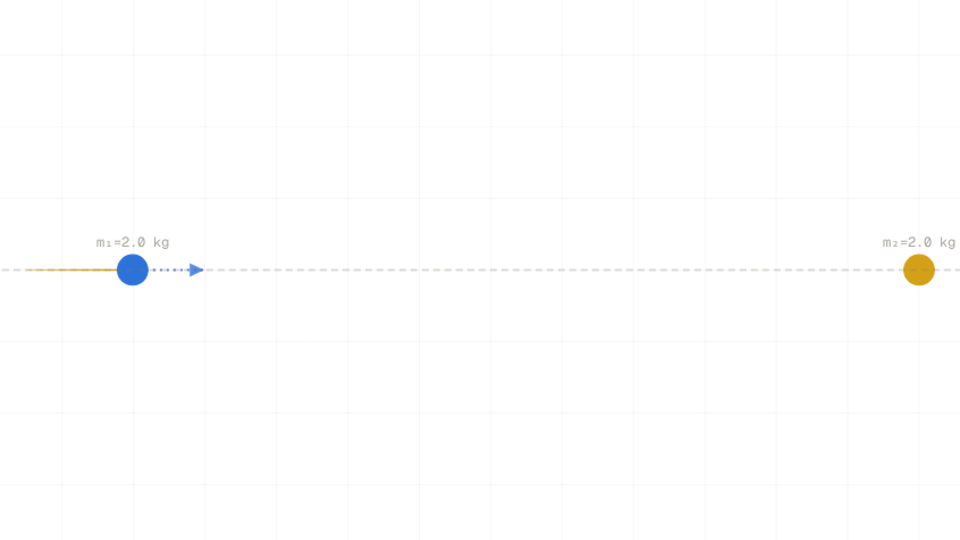
- Set the Speed 1 slider to 5.0 m/s. Object 2 is fixed at rest by the simulation, so the total initial momentum is carried entirely by object 1 across the dashed track.
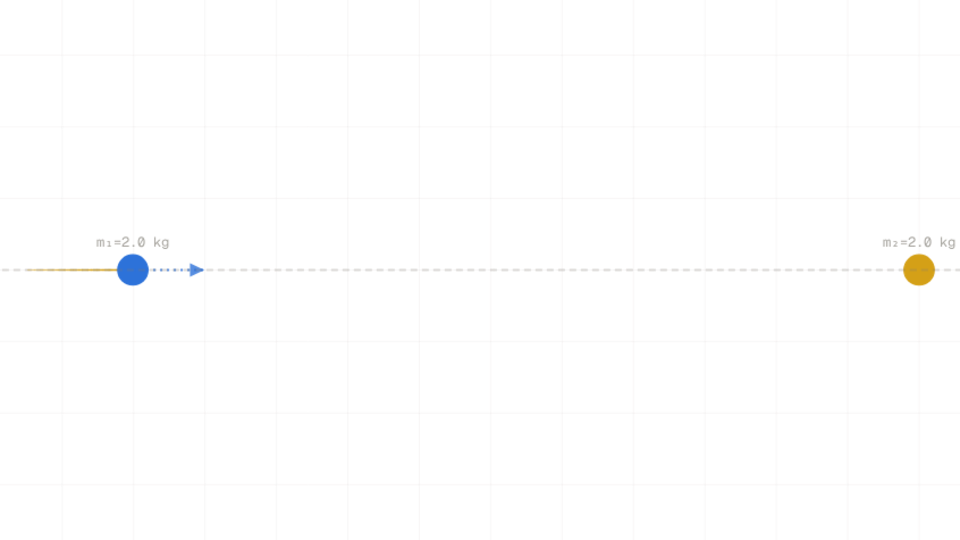
- Press Start. Object 1 (blue) drifts right at 5.0 m/s, contacts the stationary object 2 (white) near x = 30 m, and the two merge into a single combined-mass disc that continues rightward.
- Wait until the merged object passes x = 45 m and the loop stops. The HUD now displays the post-collision momentum pf, kinetic energy KEf, and the energy loss ΔKE for direct comparison with the prediction.
Analytical Prediction
For a perfectly inelastic 1D collision with object 2 initially at rest, momentum conservation gives v′ = (m₁v₁ + m₂v₂)/(m₁+m₂) = m₁v₁/(m₁+m₂). The energy lost equals ΔKE = ½ μ v_rel², where μ = m₁m₂/(m₁+m₂) is the reduced mass and v_rel = v₁ − v₂ is the approach speed. With m₁ = 2.0 kg, m₂ = 2.0 kg, v₁ = 5.0 m/s, v₂ = 0:
So pf = 4.0 · 2.50 = 10.00 kg·m/s (identical to p₀) and KEf = 25.00 − 12.50 = 12.50 J, exactly half the original. Verify against the readouts: p₀ = pf = 10.00 kg·m/s, KE₀ = 25.00 J, KEf = 12.50 J, ΔKE = 12.50 J.
Results Analysis
After the merged pair exits the track at x = 45 m, the readout grid shows p₀ = 10.00 kg·m/s, pf = 10.00 kg·m/s, KE₀ = 25.00 J, KEf = 12.50 J, and ΔKE = 12.50 J for the default configuration m₁ = m₂ = 2.0 kg, v₁ = 5.0 m/s. The exact agreement between p₀ and pf confirms that momentum is conserved across the collision to the precision of the displayed values. The 50% drop from KE₀ to KEf confirms the equal-mass result that half the incoming kinetic energy is converted to deformation when two equal masses stick. A more demanding check: change Mass 2 to 6.0 kg with the same v₁ = 5.0 m/s. The prediction gives v′ = (2.0 × 5.0)/(2.0 + 6.0) = 1.25 m/s, pf = 8.0 × 1.25 = 10.00 kg·m/s (still conserved), and ΔKE = ½ × (12/8) × 5.0² = 18.75 J, three-quarters of the initial 25.00 J. The readouts should track these values within a small numerical tolerance.
Source of Error
What this sim does NOT model: friction along the track, rotational kinetic energy of either object, the rebound that a real near-perfectly-inelastic collision would still produce, finite ball stiffness, air drag, or gravity (the track is horizontal). Both objects are point particles on a frictionless rail and the collision is resolved as a perfect stick-together by construction. The closed forms vf = (m₁v₁ + m₂v₂)/(m₁+m₂) and ΔKE = ½·μ·(v₁−v₂)² assume the same idealizations, so they cancel. The remaining gap between prediction and readouts is therefore purely numerical, not physical.
Further Exploration
- Run the equal-mass case at v₁ = 5.0 m/s and read off ΔKE. Now double the input speed to v₁ = 10.0 m/s with the same masses. The energy loss quadruples while the fractional loss stays at 50%. What does this reveal about the v² scaling of ΔKE = ½ μ v_rel²?
- Set Mass 1 to 0.5 kg and Mass 2 to 10.0 kg with v₁ = 5.0 m/s, a tiny object hitting a near-immovable wall. Compute v′ and the fractional energy loss before running. Why does almost all the kinetic energy vanish in this configuration?
- Reverse the previous case: Mass 1 = 10.0 kg, Mass 2 = 0.5 kg, v₁ = 5.0 m/s, a heavy object plowing into a light one. Predict the fractional KE loss, then verify. Which mass ratio loses the most energy, and why does the limit favour heavy-on-light?
- Find the mass ratio m₂/m₁ that loses exactly 25% of the initial kinetic energy at any v₁. Solve ½ μ v₁² / (½ m₁ v₁²) = 0.25 algebraically, then confirm by setting the sliders to the derived ratio and reading ΔKE/KE₀.
- Compare with the elastic-collision sim at identical default settings (m₁ = m₂ = 2.0 kg, v₁ = 5.0 m/s). The elastic case transfers all velocity to object 2 with zero KE loss; the inelastic case keeps the pair at v′ = 2.50 m/s and loses 12.50 J. What physical assumption distinguishes the two outcomes?