Gravitational PE on a Hill PhysicsPE = m·g·(h − href) & Reference Height
Introduction
Gravitational potential energy quantifies how much work gravity could do on an object if it were released from its current height. For an object of mass m at height h above a reference level href, the formula is PE = m·g·(h − href), where g = 9.81 m/s². PE and kinetic energy KE = ½·m·v² trade off continuously as the object moves, while their sum, the total mechanical energy, stays constant on a frictionless surface.
That conservation relationship underpins nearly every energy analysis in classical mechanics: roller-coaster safety margins, hydroelectric head calculations, ski-jump take-off speeds, and pendulum timing all reduce to the same PE + KE = constant identity. Understanding it thoroughly means understanding not just the formula but the role of the reference height, because every PE value depends on where you place href.
Most students treat PE = m·g·h as if h were absolute, expecting the PE readout to be fixed by position alone. The simulator contradicts that directly: with mass = 2 kg and the ball held at the 6 m hill peak, dragging refLevel from 0 to 3 m drops the PE readout from 117.7 J to 58.9 J without the ball moving a centimetre. The position is unchanged; only the reference line moved.
The Physics Explained
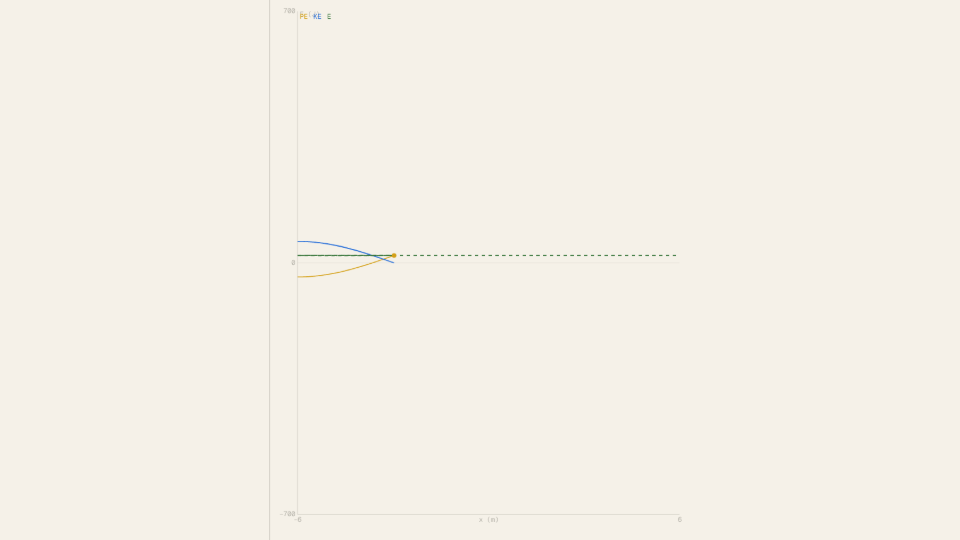
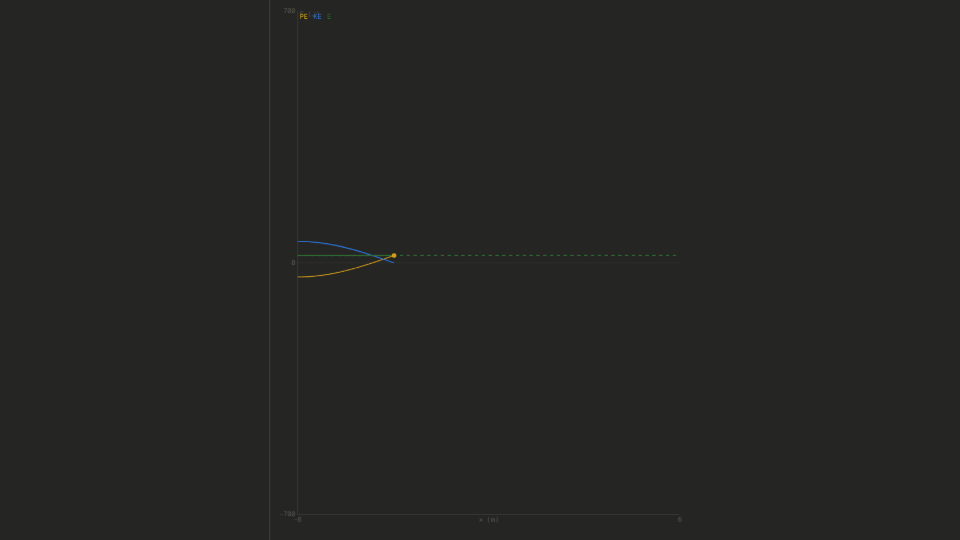
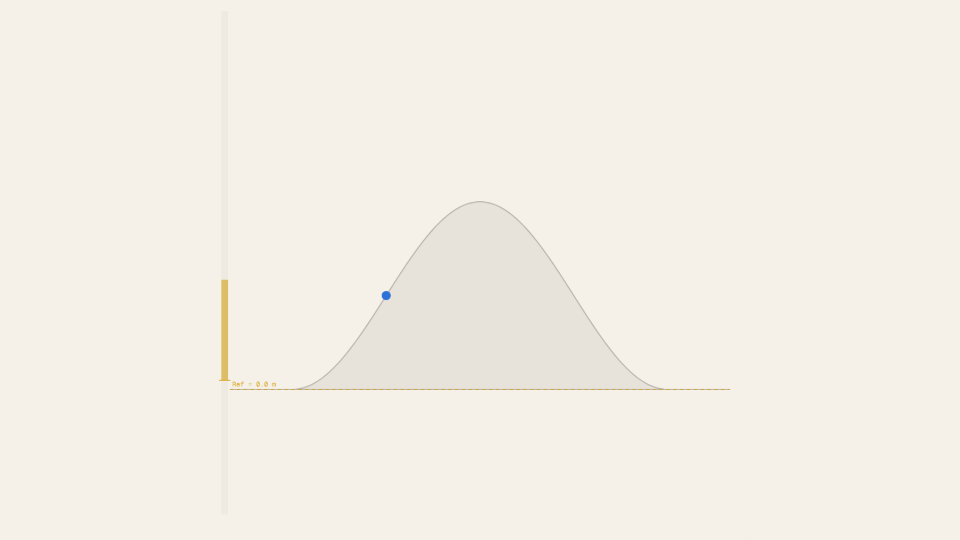
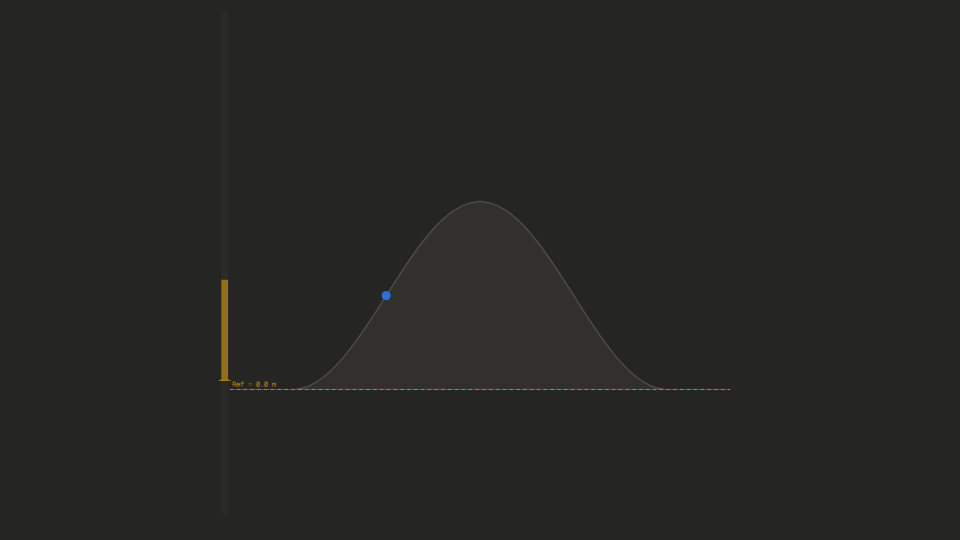
The hill profile in the simulator is a cosine bell: y(x) = H·½·(1 + cos(π·x / 6)), where H is the peak amplitude set by the Height slider and x ranges from −6 m to 6 m. At x = 0 the surface reaches exactly H; at x = ±6 m it meets the flat ground at y = 0. A ball with mass = 2 kg and Height = 6 m therefore sits at y = 6.00 m when positioned at the peak, y = 3.00 m at x = ±3 m, and y = 0 at the base, values the Height readout confirms as the ball rolls.
PE is computed at every physics step as PE = m·g·(yball − href). With refLevel = 0 and mass = 2 kg, the PE readout at the 6 m peak is 2 × 9.81 × 6 = 117.7 J. As the ball descends to y = 0 at the base, PE drops to 0 J. KE climbs by exactly the same amount: KE at the base = 59.86 J starting from x = −3 m (where the ball begins at y = 3 m with v ≈ 1 m/s, so Etotal = 2 × 9.81 × 3 + ½ × 2 × 1² = 59.86 J). The Total E readout stays locked throughout, confirming the conservation identity numerically.
Shifting refLevel to 3 m with the same mass = 2 kg and ball at the 6 m peak changes the PE readout to 2 × 9.81 × (6 − 3) = 58.9 J. The ball has not moved; no force has acted; yet PE is halved because the reference line rose. Setting refLevel to −3 m pushes the same peak position's PE to 2 × 9.81 × (6 − (−3)) = 176.6 J. These three readings for the identical physical configuration show that PE is relative, not absolute. The total energy changes with the reference choice, but the difference PEpeak − PEfoot stays constant regardless of where href sits, and that difference is what governs the ball's speed everywhere on the hill.
When refLevel exceeds the ball's current height, PE turns negative: the ball is below the reference line. With refLevel = 3 m and the ball at y = 0, the PE readout reports 2 × 9.81 × (0 − 3) = −58.86 J. The PE bar on the canvas extends downward from the dashed reference line rather than upward, rendered in red rather than amber. Total E, still conserved, is now negative relative to this reference, which is mathematically valid and physically meaningful: it simply means the ball cannot reach href = 3 m under its own energy budget.
Key Equations
With mass = 2 kg, g = 9.81 m/s², ball height h = 6 m, and refLevel = 0: PE = 2 × 9.81 × (6 − 0) = 117.72 J. The PE readout at the hill peak with those slider settings reports 117.7 J, matching to displayed precision. Raising refLevel to 3 m gives PE = 2 × 9.81 × (6 − 3) = 58.86 J; the readout updates to 58.9 J the instant the slider moves, with the ball stationary.
At the hill's base (y = 0) with refLevel = 0 and mass = 2 kg, all PE has converted to KE. The ball starts at x = −3 m, y = 3 m with v ≈ 1 m/s, so Etotal = 59.86 J. By the time it reaches the foot, KE = Etotal = 59.86 J, giving v = sqrt(2 × 59.86 / 2) = sqrt(59.86) ≈ 7.74 m/s. The Speed readout at the base confirms this value.
Because the hill is frictionless and the ball is constrained to the surface, no energy leaves the system. Etotal is set at the start by the ball's initial position and speed and never changes. The Total E readout verifies this: over the full 60-second run with mass = 2 kg and Height = 6 m, the value does not drift. Changing refLevel shifts PE and leaves KE unchanged because KE depends on speed, not on the reference convention, so Etotal shifts by the same amount as PE shifts, a consistent, reference-relative constant.
This rearrangement recovers speed at any height h without tracking the trajectory step by step. With Etotal = 59.86 J, mass = 2 kg, h = 0 m (foot), refLevel = 0: v = sqrt(2 × (59.86 − 0) / 2) = sqrt(59.86) ≈ 7.74 m/s. At h = 3 m (its starting height): v = sqrt(2 × (59.86 − 2 × 9.81 × 3) / 2) = sqrt(2 × (59.86 − 58.86) / 2) = 1 m/s: the ball passes its starting height with exactly its initial speed, as conservation demands.
Key Variables
| Symbol | Name | Unit | Meaning |
|---|---|---|---|
| m | Mass | kg | Inertial and gravitational mass of the ball (0.5–5.0 kg slider) |
| g | Gravitational acceleration | m/s² | Fixed at 9.81 m/s² throughout the simulation |
| h | Ball height | m | Current y-coordinate of the ball on the cosine hill surface |
| href | Reference level | m | Chosen zero-PE elevation; sets where the dashed line appears on the canvas (−3 to +3 m slider) |
| PE | Gravitational potential energy | J | m·g·(h − href); negative when ball is below the reference line |
| KE | Kinetic energy | J | ½·m·v²; always non-negative; peaks at the hill's lowest point |
| Etotal | Total mechanical energy | J | PE + KE; conserved exactly on the frictionless hill |
| v | Speed | m/s | Instantaneous speed of the ball along the hill surface |
Real World Examples
Why do structural engineers place the reference height at the lowest point of a building's foundation?
A building's gravitational PE budget spans every floor, every beam, and every occupant above ground. Setting href at the foundation's lowest point guarantees that every mass in the structure carries a non-negative PE value, which simplifies load calculations and prevents sign errors when summing energy terms across multiple storeys. If the reference were placed at the roof instead, every floor below would carry negative PE, and the sign convention would have to be tracked explicitly through every formula.
The same logic applies to dam-spillway engineering: the reference sits at the downstream riverbed so that every cubic metre of water in the reservoir carries positive PE equal to m·g·(hwater − hbed). With mass = 2 kg and refLevel = 0 in the simulator, the PE readout at hill height 6 m reports 117.7 J; shifting refLevel to −3 m pushes that same position's readout to 176.6 J. The ball has not moved, but the sign-safe convention adds a fixed m·g·|href| offset to every value in the system, exactly as an engineer's choice of datum shifts every floor's energy figure by a constant.
Neither the 117.7 J nor the 176.6 J figure is more correct than the other. Both describe the same physical state; only the accounting frame differs. The structural engineer picks the frame that keeps all terms positive to reduce the risk of a missed minus sign in a load table.
How do roller-coaster designers use reference-height reasoning to size the first drop?
A roller coaster converts the PE stored in its first hill into the KE that sustains every subsequent loop, bank, and brake section. The designer places the reference height at the lowest point of the track so that the first hill's PE equals m·g·hfirst, the maximum mechanical energy the car will ever carry. Every subsequent element must stay below that height (accounting for friction losses) or the car stalls. The reference choice is arbitrary physics, but a low reference level keeps all PE values positive throughout the ride profile, which simplifies the inequalities the designer checks at each element.
In the simulator with mass = 2 kg, Height = 6 m, and refLevel = 0, the Total E readout holds steady at 59.86 J as the ball rolls between its start height (PE = 58.86 J, KE = 1 J at y = 3 m) and the foot (PE = 0 J, KE = 59.86 J). A real coaster's energy audit is the same conservation argument scaled to a 1 000 kg car and a 30 m first hill: PEfirst = 1000 × 9.81 × 30 = 294 300 J, and every subsequent feature's entry speed follows from v = sqrt(2·(Etotal − m·g·hfeature) / m).
Raising the reference above the lowest track point would introduce negative PE terms for sections below it, without changing any speed prediction. The physics is identical; the bookkeeping is harder. That is why the design convention and the simulator's default (refLevel = 0 at ground level) agree.
Why can a skier's gravitational PE be negative, and does that violate energy conservation?
A skier descending into a terrain-park halfpipe can end up below the elevation a coach chose as the reference height, giving the skier a negative PE by the formula PE = m·g·(y − href). Negative PE is not a physical problem: it means the skier's height is below the reference line, and the total mechanical energy (PE + KE) remains constant throughout the run as long as friction is negligible. The total energy can itself be negative relative to an arbitrary reference, yet it is conserved perfectly.
The simulator reproduces this directly: with refLevel set to 3 m and mass = 2 kg rolling on a hill of Height = 6 m, the PE readout at the hill's foot (y = 0) reads 2 × 9.81 × (0 − 3) = −58.86 J while KE climbs to compensate, keeping the Total E readout unchanged from its value at the starting position. The PE bar on the canvas extends downward from the dashed amber line, rendered in red, which is the visual signal that the ball is below the reference.
For a halfpipe skier, the coach's reference might be the lip of the pipe. Every metre the skier drops below the lip adds m·g·1 = roughly 588 J of negative PE per kilogram, converted to speed. At the pipe's lowest point that speed peaks, and the skier rides it back up the far wall to near the original height, with small losses to friction and air drag. The conservation law holds throughout; the sign of PE simply tracks which side of the reference line the athlete occupies.
Further Reading
- Pendulum energy bars: gravitational PE and KE cycling in a swinging pendulum, with the same PE + KE = constant identity applied to circular-arc motion.
- Net work with friction: what happens to total mechanical energy when a non-conservative force is present and Etotal is no longer constant.
- Ramp: a ball accelerating down an inclined plane, where gravitational PE converts to KE along a straight slope rather than a curved hill profile.
- Escape velocity: the limiting case where gravitational PE extends to infinity and the reference level is placed at an infinite distance from a planet's centre.