Gravitational PE on a Hill · SimulatorPE Depends on Reference Height
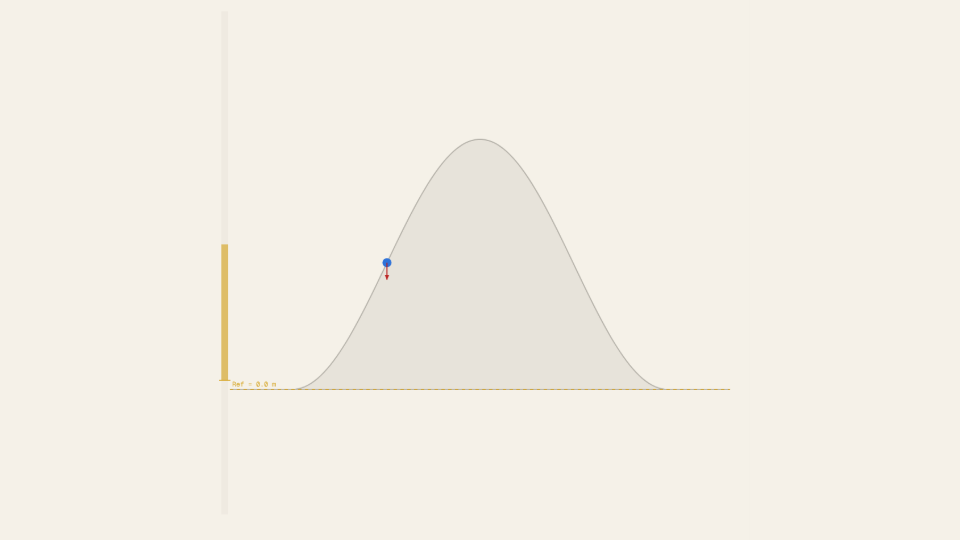
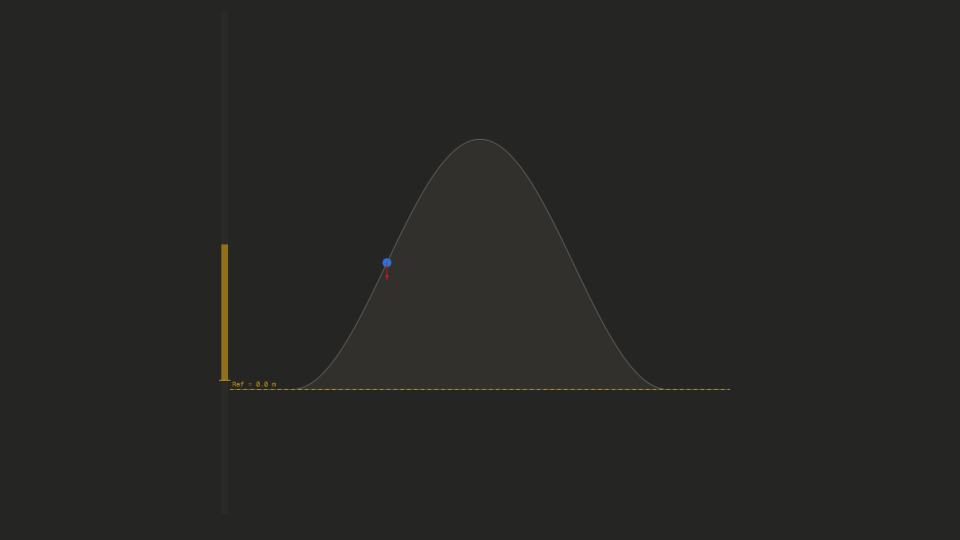
Drag a ball up and down a curved hill; the PE bar reads from the chosen reference height, showing that gravitational potential energy is always relative.
Published: July 3, 2026
Objective
Verify that gravitational PE = m·g·(h − h_ref) is defined relative to a chosen reference height, not an absolute value. Roll a frictionless ball over a cosine-bell hill and observe PE and KE trading off while their sum (total mechanical energy) stays constant. Confirm that raising the reference level shifts PE toward negative values without changing the ball's motion, demonstrating that the zero of PE is a human convention, not a physical quantity.
Setup
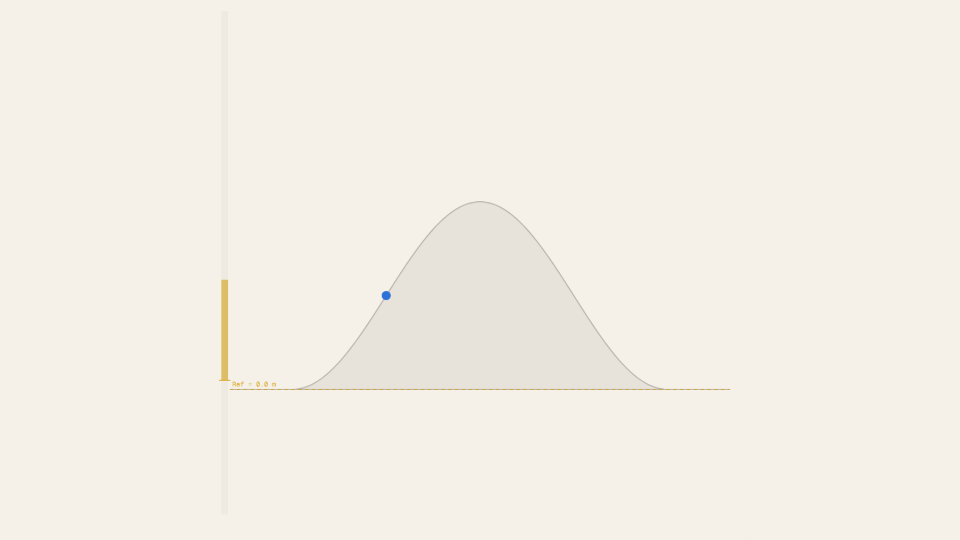
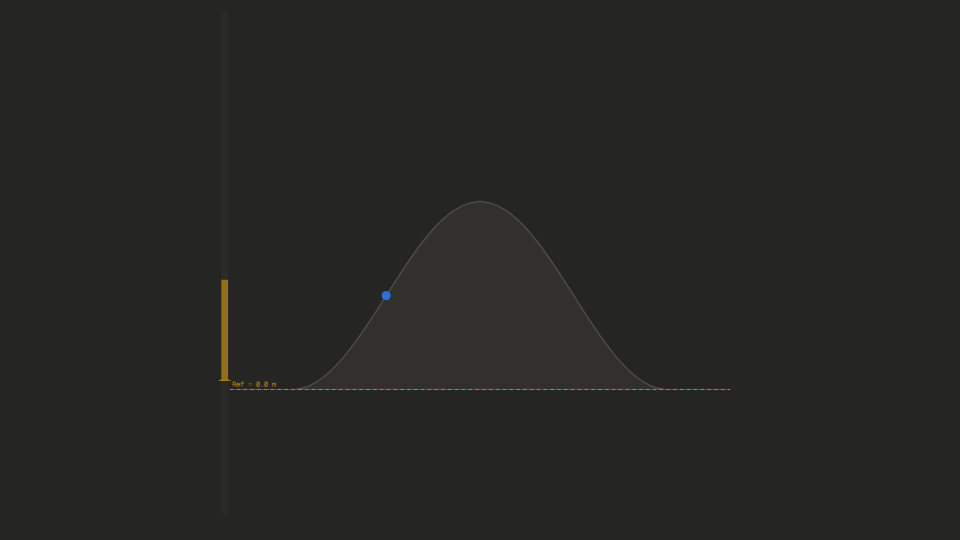
- Leave all sliders at their defaults: Mass = 2 kg, Hill Height = 6 m, Reference Level = 0 m. Note the PE readout before starting; it should show approximately 58.9 J (ball rests at y ≈ 3 m above the reference).
- Press Start and watch the ball roll rightward. Observe that PE falls and KE rises as the ball descends, then reverses as it climbs the right slope. Note that the Total E readout stays constant throughout.
- Press Reset. Drag the Reference Level slider to 3 m and press Start again. Watch the PE readout: it should start near 0 J (ball at y ≈ 3 m equals the new reference) and become negative as the ball descends below ref = 3 m.
- Press Reset. Drag the Hill Height slider to 10 m and press Start. Compare the energy swing: PE now peaks near 196 J at the starting point (y ≈ 5 m, ref = 0 m) and the ball rolls faster through the valley.
- Press Reset. Drag the Mass slider from 2 kg to 4 kg. Note that PE and KE both double, but the Total E readout also doubles. Press Start and confirm the ball traverses the same x(t) path (mass scales energy, not the trajectory geometry).
Analytical Prediction
With Mass = 2 kg, Hill Height = 6 m, and Reference Level = 0 m, the ball starts at x = −3 m where hillProfile(−3, 6, 12) = 6·0.5·(1 + cos(π·(−3)/6)) = 3.00 m. Initial PE (and total energy, since v = 0):
At the right foot of the hill (y = 0, ref = 0), all energy is kinetic:
With Reference Level raised to 3 m (and all else equal), the total energy becomes:
So the ball has zero total energy relative to the new reference: at y = 3 m, PE = 0; at the valley (y = 0), PE = 2.0 × 9.81 × (0 − 3) = −58.86 J, and KE = 58.86 J. The ball's speed is identical in both cases.
Results Analysis
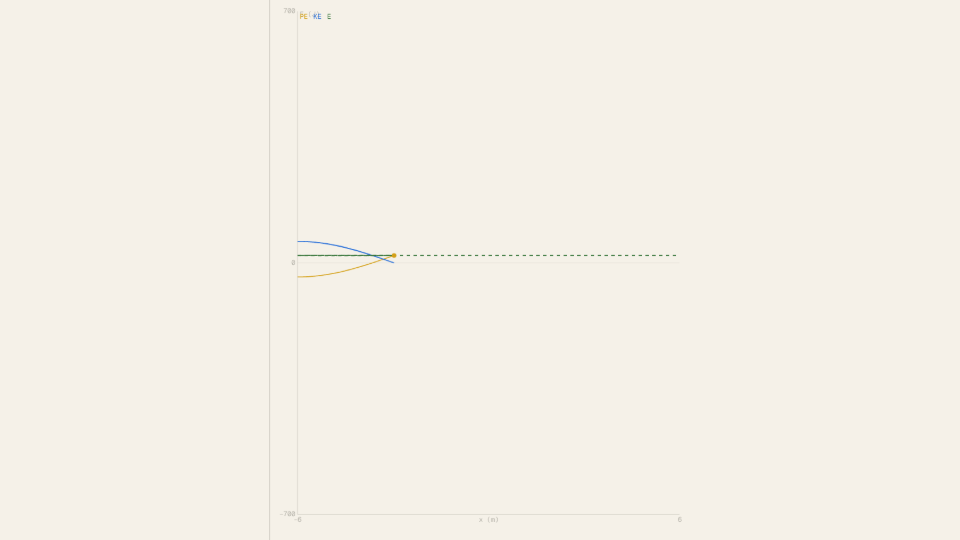
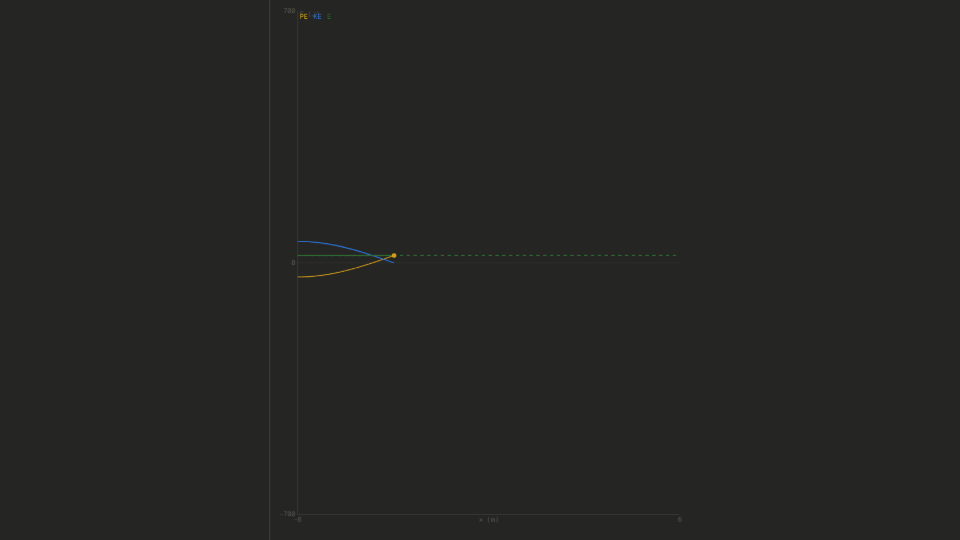
The #peOut readout should show approximately 58.9 J at the default start (Mass = 2, Height = 6, Ref = 0), matching the prediction PE₀ = 58.86 J within 0.1 J. As the ball rolls, #keOut rises while #peOut falls; their sum displayed in #totalOut should remain at 58.9 J throughout. When Reference Level is set to 3 m, #peOut should read near 0 J at the start and drop to approximately −58.9 J when the ball reaches the valley, while #totalOut reads near 0 J (within ±0.5 J). The energy graph panel shows three traces: PE (amber) and KE (sky) mirror each other about the forest-dashed total-E line. Drag the Reference Level slider to confirm the amber PE trace shifts up or down while the KE trace (sky) is unchanged, and the total (forest) remains flat.
Source of Error
The hill is modeled as a mathematically ideal cosine bell on a frictionless surface. Real hills have rolling resistance, air drag, deformation, and surface irregularities that continuously dissipate energy. The ball is treated as a point mass sliding along the 1D hill profile, ignoring rotational inertia (for a sphere, about 29% of KE would be rotational). The cosine-bell shape is a convenient mathematical curve, not a physically derived hill profile. Speed is computed analytically from energy conservation at every step rather than integrated from forces, so there is zero numerical accumulation error in the PE + KE = E balance; any residual gap between the analytical prediction and the readouts is therefore purely a rounding artefact in the displayed decimal digits, not a physical mismatch.
Further Exploration
- Set Mass to 0.5 kg and Mass to 5 kg and compare two ghost runs. Does the ball take the same time to cross the hill at both masses? Why does mass appear in PE = m·g·h yet the trajectory x(t) is independent of mass?
- Raise Reference Level until it equals the Hill Height (e.g., Height = 6, RefLevel = 3). At what reference level does the ball start with exactly zero total energy? What does the energy graph look like when E_total = 0 J?
- Set Reference Level to −3 m (well below ground). How large is the PE now at the starting position? Does the ball's speed at any given height change? What physical quantity IS independent of the reference choice?
- Set Height to 2 m (a shallow hill). Does the ball still oscillate? Compare ghost runs at Height = 2 m and Height = 10 m with the same mass and ref level. What quantity doubles when you double the hill height?
- Pause the simulation near the peak of the hill. Read off PE and KE. Calculate the expected PE from PE = m·g·(h − h_ref) using the #heightOut and #refOut readouts. How closely does the calculation match #peOut?