Feather and Hammer PhysicsWhy Mass Doesn't Affect Free Fall
Introduction
A feather and a hammer released side by side make a vivid test bench for one of the oldest claims in mechanics: that gravity accelerates every object at the same rate, regardless of mass. On a windy afternoon the claim looks false (the hammer thuds to the floor while the feather lingers), but in the absence of air the two arrive together. The simulator lets the air go away and come back at the touch of a slider, so the same release can be replayed in any atmosphere from pure vacuum to standard sea-level density.
The two objects in the sim share the same gravity g = 9.81 m/s² and the same release height, but they differ sharply in one place: their drag-to-mass ratio. The feather is modelled with a mass of 0.005 kg and a drag area product Cd · A of 0.05 m², while the hammer carries a mass of 0.5 kg and a drag area product of 0.002 m². Per unit mass, the feather presents about 25 times more drag surface to oncoming air than the hammer does, and that single number controls everything that follows.
The HUD reports four readouts during the fall: Time, Feather Height, Hammer Height, and Separation. Two sliders set the scenario: Air Density from 0 to 1.225 kg/m³ in steps of 0.05, and Drop Height from 10 to 50 m in steps of 5. The Separation readout is the educational keystone: it stays glued to 0.00 m in vacuum and grows visibly as soon as any air is admitted, isolating drag as the only physical cause of the familiar feather-versus-hammer gap.
The Physics Explained
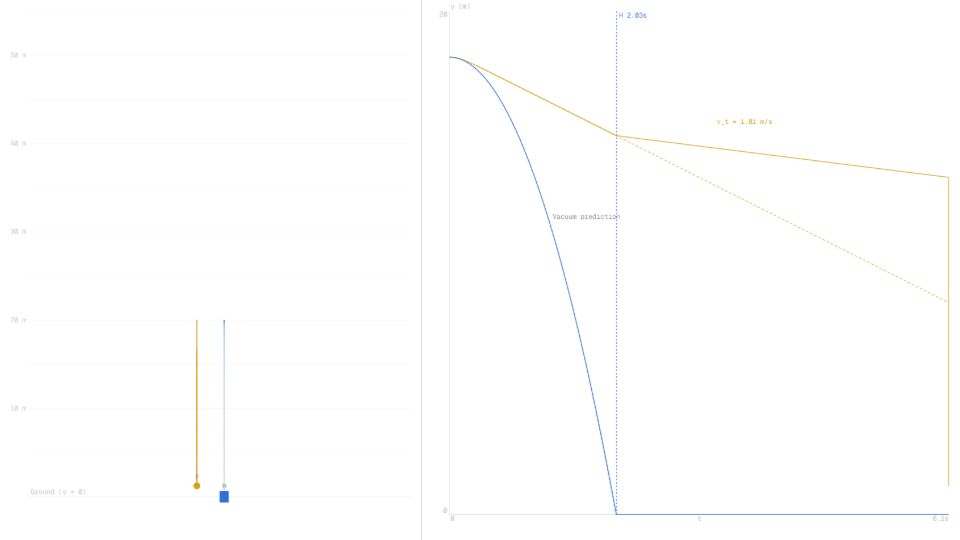
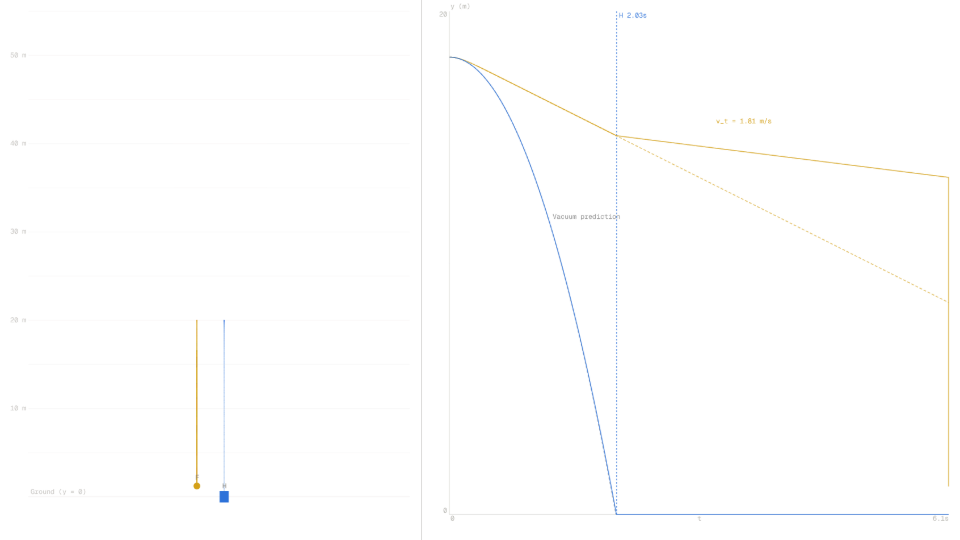
With Air Density set to 0.00 kg/m³, the simulator removes the drag term entirely and Newton's second law collapses to a = g for both objects. Mass appears on the left side as inertia and on the right side as gravitational pull, and the two cancel exactly. The feather and the hammer fall on the same trajectory y(t) = h₀ − ½ g t² and reach the ground at the same instant. Running the sim with Air Density = 0.00 and Drop Height = 20 m, the Feather Height and Hammer Height readouts decrease together and the Separation readout never leaves 0.00 m, confirming Galileo's claim numerically in less than three seconds.
Switching Air Density to 1.225 kg/m³ adds an upward quadratic drag force Fd = ½ · ρ · Cd · A · v² (a magnitude; the force vector points opposite to the velocity vector). The acceleration of each object becomes a = g − Fd / m, and now mass appears asymmetrically: the drag force depends on the object's geometry through Cd · A, while the inertia that resists it depends on mass m. For the feather, ρ · Cd · A / (2m) is 25 times larger than for the hammer, so the feather feels a much stronger upward push for every unit of forward speed it gains.
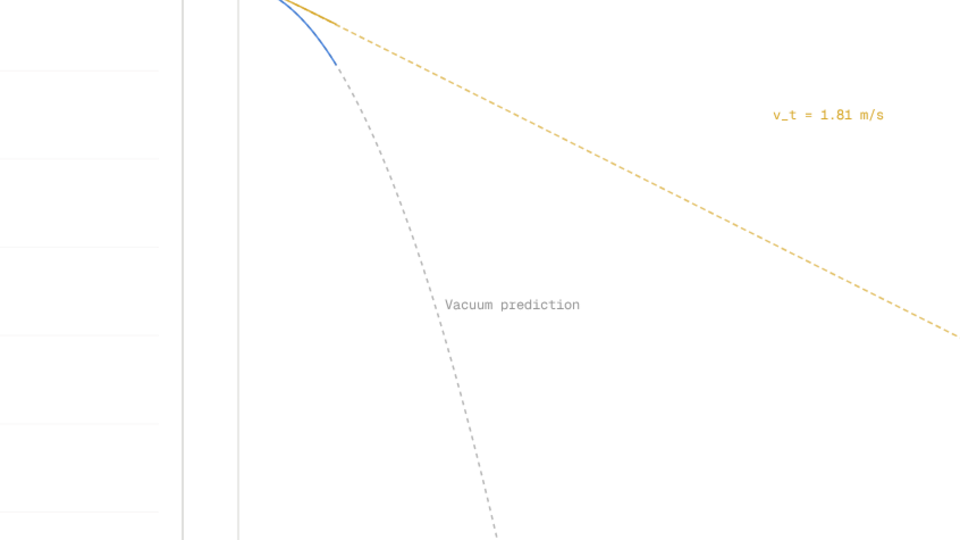
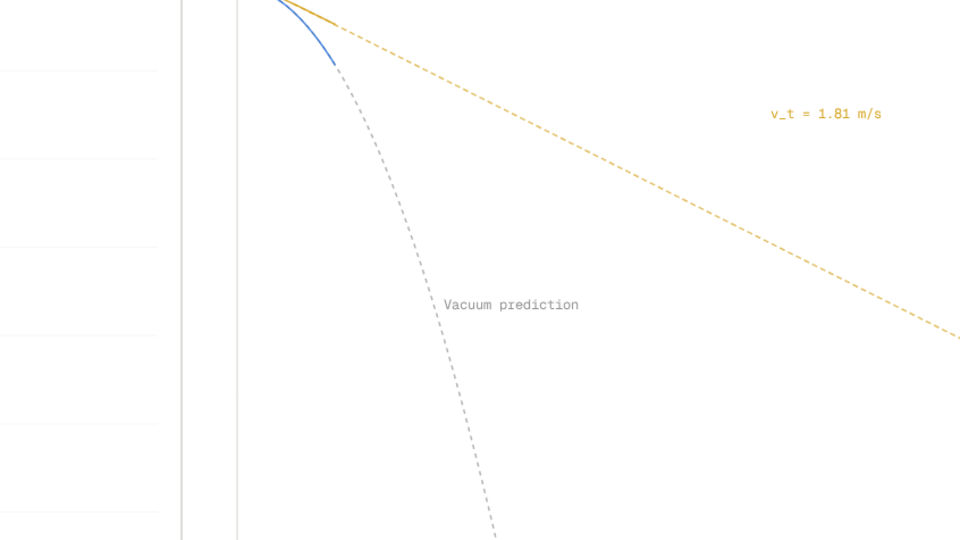
As each object accelerates, drag grows until it cancels weight. The speed at which that happens is the terminal velocity vt = √(2 m g / (ρ · Cd · A)). For the feather at ρ = 1.225 kg/m³, vt ≈ 1.27 m/s, a slow walking pace. For the hammer at the same density, vt ≈ 63 m/s, far above the speeds an object actually attains over the 20 m default drop. The feather hits its terminal value within the first half-metre and then descends at almost constant speed for the remainder of the fall, while the hammer keeps accelerating nearly as if no air were present.
The Separation readout collects all of this into one number. In vacuum it is identically zero. As Air Density rises, Separation at the moment the hammer lands grows with it: slowly at first while the air is thin, then more strongly once the feather's terminal regime is established. The right-panel graph shows the same story in altitude versus time: the hammer trace stays close to the vacuum parabola and the feather trace bends away into a near-straight slow descent, the bend tightening as Air Density is increased.
Key Equations
With Air Density set to 0.00 kg/m³ the simulator integrates plain free fall, and this closed-form expression sets the landing time of both objects. For the default Drop Height h₀ = 20 m and g = 9.81 m/s², t = √(2 · 20 / 9.81) ≈ 2.02 s, which is what the Time readout reports at the moment Feather Height and Hammer Height both reach 0.00 m.
Eliminating time from the kinematic equations gives the impact speed in terms of height alone. For Drop Height = 20 m, v = √(2 · 9.81 · 20) ≈ 19.81 m/s, independent of mass. This is the speed both objects reach in vacuum, and it is also the speed the hammer approaches very closely in atmosphere because its terminal velocity sits far above this value.
Above a few metres per second, air resistance for compact bluff objects scales with the square of speed. The expression above is the magnitude. The force vector points opposite to the velocity vector and so always acts to slow the object. For the feather at v = 1 m/s and ρ = 1.225 kg/m³ the drag force is roughly ½ · 1.225 · 0.05 · 1 ≈ 0.031 N, already comparable to its weight of 0.05 N, which is why the feather slows so quickly.
Setting the drag force equal to the weight m · g and solving for v gives this expression. For the feather at ρ = 1.225 kg/m³, vt ≈ √(2 · 0.005 · 9.81 / (1.225 · 0.05)) ≈ 1.27 m/s. For the hammer at the same density, vt ≈ √(2 · 0.5 · 9.81 / (1.225 · 0.002)) ≈ 63 m/s, high enough that the hammer never actually attains it during a 20 m drop.
The ratio (Cd · A) / m is what sets each object's susceptibility to drag at a given air density. For the feather, 0.05 / 0.005 = 10 m²/kg. For the hammer, 0.002 / 0.5 = 0.004 m²/kg. The feather's ratio is 2500 times larger, which when traced through the vt formula reduces the feather's terminal velocity by a factor of √2500 = 50, exactly the gap the simulator displays between the two objects in atmosphere.
Key Variables
| Symbol | Name | Unit | Meaning |
|---|---|---|---|
| h₀ | Drop height | m | Initial altitude of both objects above the ground line |
| y | Height | m | Current vertical position of either object |
| v | Velocity | m/s | Vertical speed, negative when descending |
| m | Mass | kg | Inertial and gravitational mass of the object |
| g | Gravitational acceleration | m/s² | 9.81 m/s² downward at Earth's surface |
| ρ | Air density | kg/m³ | Mass per unit volume of the surrounding fluid |
| Cd · A | Drag area product | m² | Drag coefficient times reference cross-section |
| t | Time | s | Elapsed time since release |
Real World Examples
Did Apollo 15 really drop a hammer and a feather on the Moon?
On 2 August 1971 Commander David Scott stood on the surface of the Moon at the end of the Apollo 15 mission, held a geology hammer in one gloved hand and a falcon feather in the other, and released both at chest height in front of a parked television camera. With the lunar atmosphere effectively a vacuum, the only force on each object was the Moon's gravity of 1.62 m/s², and both touched the regolith in the same instant after a fall of about 1.2 s from roughly 1.6 m.
The simulator reproduces the conditions of that demonstration directly. With Air Density set to 0.00 kg/m³ and Drop Height set to 20 m, the Feather Height and Hammer Height readouts decrease in lockstep and the Separation readout stays at 0.00 m all the way to ground contact at Time ≈ 2.02 s, the same prediction as t = √(2 · 20 / 9.81) for free fall from 20 m under Earth gravity.
Why does a feather drift down slowly in air while a hammer falls almost as if in vacuum?
The deciding number is the drag-to-mass ratio ρ · Cd · A / (2m), and the feather's exceeds the hammer's by about a factor of 25 in the simulation. Because terminal velocity follows vt = √(2 m g / (ρ · Cd · A)), a larger drag-to-mass ratio drops terminal velocity sharply. For the modelled feather at ρ = 1.225 kg/m³, vt ≈ 1.27 m/s, slow enough that the feather reaches it within the first half-metre and then drifts the rest of the way at near-constant rate.
The hammer's terminal velocity under the same air is about 63 m/s, well above any speed it actually attains over a 20 m drop, so its motion remains effectively free-fall. With Air Density = 1.225 kg/m³ and Drop Height = 20 m the simulator shows exactly this split: the Hammer Height readout reaches 0.00 m near Time ≈ 2.0 s while the Feather Height readout is still many metres above ground, and Separation grows to a large positive value at landing.
How does a flat-belly skydiver settle at a terminal speed that is fifty times the feather's?
A 75 kg skydiver in a stable belly-to-earth posture exposes about 0.7 m² of frontal area with a drag coefficient near 1.0, giving ρ · Cd · A ≈ 0.858 kg/m at sea level. Plugging into vt = √(2 m g / (ρ · Cd · A)) returns roughly 41 m/s on the conservative side and the commonly cited 55 m/s at higher altitudes where ρ drops. The simulator's feather has a drag-to-mass ratio that is far worse: with m = 0.005 kg and ρ · Cd · A = 0.05 kg/m, vt ≈ 1.27 m/s, barely a walking pace.
The difference is not gravity, which is identical for both objects, but the way drag scales with cross-section and the way it is divided by the very small feather mass. The simulator brings this contrast to a single screen: with Air Density = 1.225 kg/m³ and Drop Height = 50 m, the Feather Height readout shows a near-linear descent at about 1.27 m/s through most of the fall, while the Hammer Height readout traces a free-fall parabola and lands at Time ≈ 3.19 s.
Further Reading
- Vertical drop: the single-object precursor to this comparison, where the same quadratic-drag model is used to study one falling mass at a time.
- Variable acceleration: generalises away from constant g to time-varying accelerations, the broader category that drag-limited fall belongs to.
- Projectile motion with drag: extends the same drag physics to two-dimensional flight and shows how the optimum launch angle shifts below 45° in air.
- Projectile motion: the drag-free baseline, where horizontal and vertical components separate cleanly and the trajectory is a parabola.