Terminal Velocity PhysicsTerminal Speed v = √(2mg/ρCdA)
Introduction
Terminal velocity is the constant speed a falling object reaches when the upward drag force exactly balances the downward pull of gravity. At that instant the net force on the object is zero, acceleration vanishes, and the object continues at a fixed speed for as long as it remains in the fluid. The speed at which balance occurs is set by the terminal-velocity formula vt = sqrt(2mg / ρ·Cd·A), where m is mass, g is gravitational acceleration, ρ is fluid density, Cd is the drag coefficient, and A is the cross-sectional area. With default simulator settings (m = 1.0 kg, Cd·A = 0.047 m², ρ = 1.225 kg/m³ for air), the vt readout shows ≈ 18.46 m/s.
The concept opens the study of drag forces because it is the only point in a falling object's trajectory where every force is fully accounted for without solving a differential equation: the balance condition alone gives the answer. Engineers use the same formula to size parachutes, design rainwater drainage systems, calibrate wind-tunnel models, and predict the settling speed of particles in industrial separators. Biologists apply it to understand how insects and seeds exploit drag for controlled descent.
The expectation most students bring is that a heavier object falls faster, and therefore reaches a proportionally higher terminal velocity. The readouts grant only half of that: with m = 1.0 kg the vt readout shows ≈ 18.46 m/s, but doubling mass to 2.0 kg raises vt only to ≈ 26.1 m/s, a factor of √2, not 2. The square-root relationship between mass and terminal velocity is one of the most counterintuitive predictions of the drag model, and the HUD exposes it quantitatively.
The Physics Explained
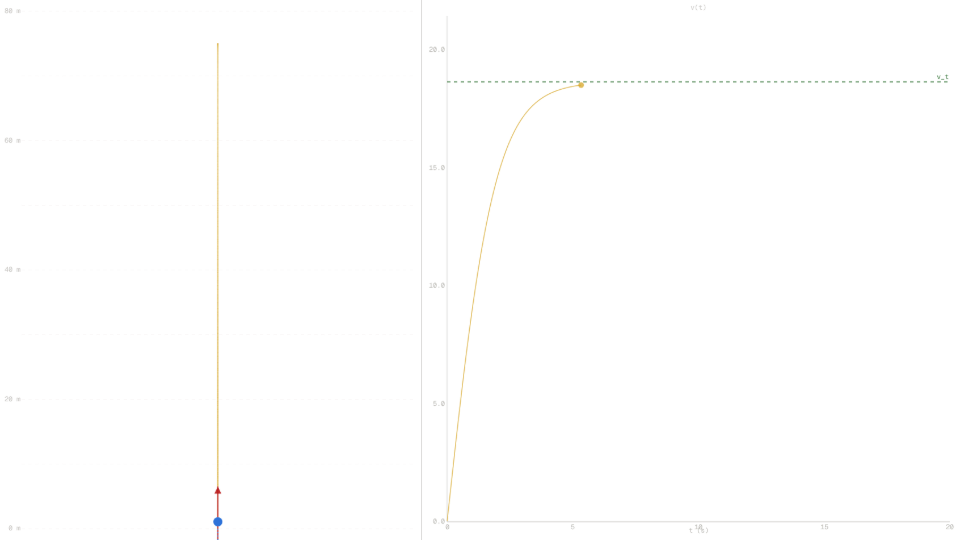
A falling object experiences two vertical forces: its weight W = mg acting downward, and a drag force Fd acting upward, opposing motion. For objects moving through air or water at everyday speeds, drag follows the quadratic law Fd = ½·ρ·Cd·A·v², where v is the instantaneous speed. At the moment of release the object is stationary, so drag is zero and the full weight accelerates it downward. As speed builds, drag grows as v², increasingly offsetting weight and reducing the net downward force (and therefore the acceleration).
The net force at any instant is Fnet = mg − ½·ρ·Cd·A·v². Setting Fnet = 0 and solving for v gives the terminal velocity: vt = sqrt(2mg / ρ·Cd·A). This is the speed at which the drag force exactly matches weight, leaving zero net force and zero acceleration. The simulator displays Fnet on the HUD; starting the run with default settings (m = 1.0 kg, CdA = 0.047 m², ρ = 1.225 kg/m³), the Fnet readout begins near 9.81 N (pure weight, no drag) and decays smoothly toward 0.00 N as the object approaches terminal velocity at ≈ 18.46 m/s.
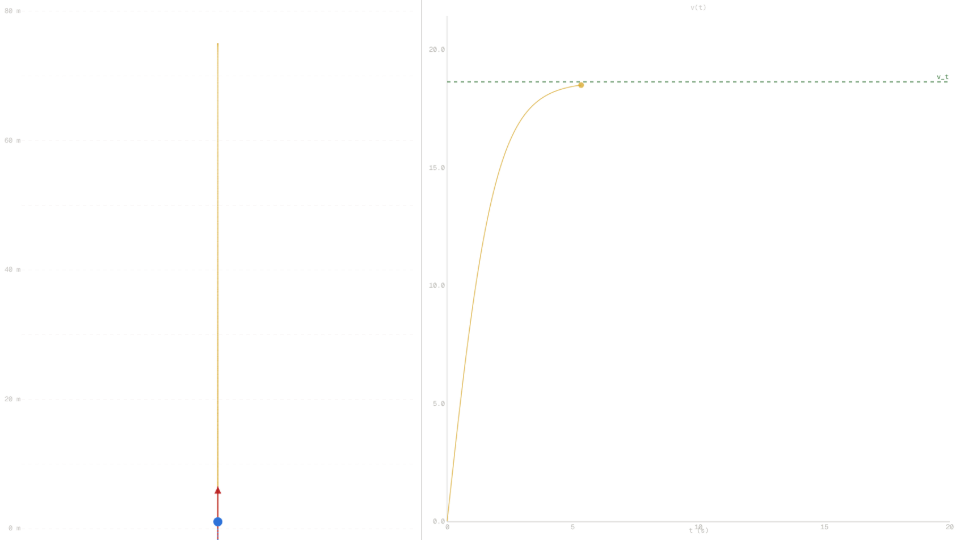
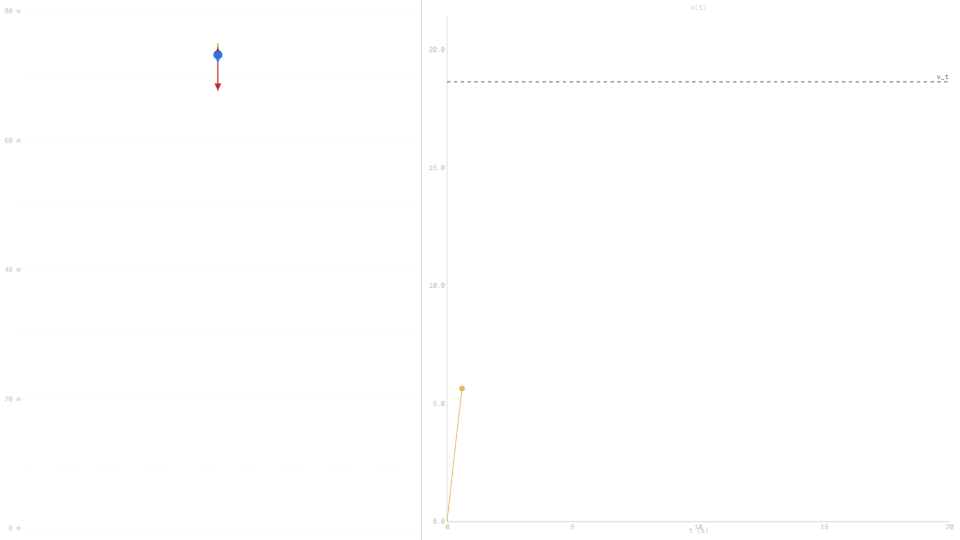
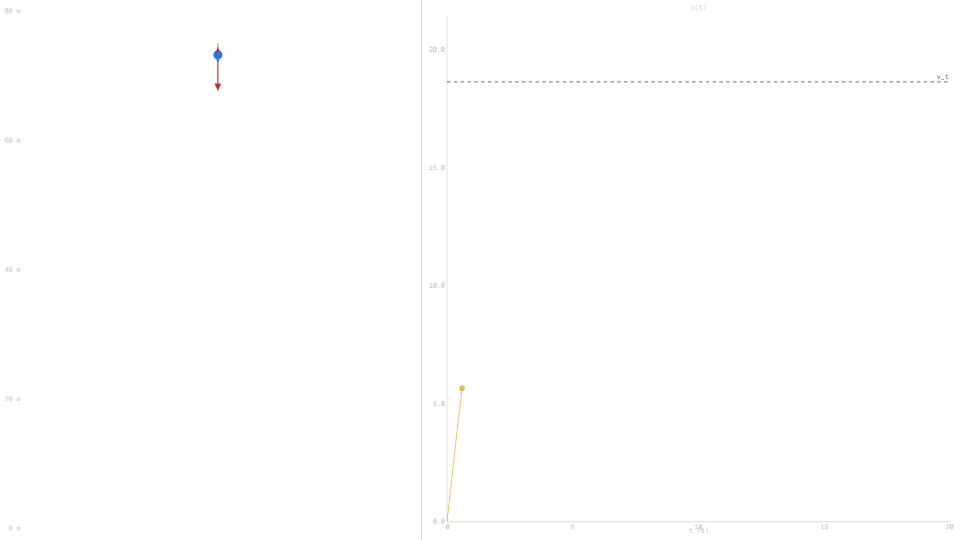
The right-panel v(t) graph reveals the asymptotic nature of the approach. The amber curve rises steeply early, when drag is small and acceleration is large, then flattens as drag grows, approaching the forest-green dashed vt reference line from below without ever crossing it (the Euler integrator clamps v at vt to prevent numerical overshoot). The approach is theoretically infinite: a freely falling body never reaches exactly vt in finite time, only arbitrarily close to it. The simulator stops automatically once v is within 0.1% of vt for two continuous seconds, which is operationally indistinguishable from balance.
The square-root dependence of vt on each parameter has important engineering consequences. Doubling mass raises vt by √2 ≈ 1.41, not 2; the simulator confirms this with the mass slider set to 2.0 kg, where the vt readout updates to ≈ 26.1 m/s. Doubling CdA (the drag area product) has the opposite effect: vt falls by 1/√2. Increasing fluid density has the same halving effect. The left panel's force arrows make the balance physical: the drag arrow (pointing upward, growing with v²) reaches the same visual length as the constant weight arrow (pointing downward) precisely when the object is at vt.
Key Equations
With ρ = 1.225 kg/m³ and CdA = 0.047 m² (their default values) and the object at v = 18.46 m/s: Fd = ½ × 1.225 × 0.047 × 18.46² = 0.5 × 1.225 × 0.047 × 340.8 ≈ 9.81 N. This equals mg = 1.0 × 9.81 N exactly, confirming the force-balance condition. The simulator's Fnet readout reads 0.00 N at this speed, matching the analytical result.
Substituting defaults (m = 1.0 kg, g = 9.81 m/s², ρ = 1.225 kg/m³, CdA = 0.047 m²): vt = sqrt(2 × 1.0 × 9.81 / (1.225 × 0.047)) = sqrt(19.62 / 0.057575) = sqrt(340.8) ≈ 18.46 m/s. The vt readout displays 18.46 m/s before the run begins (it is the analytical prediction, not a measured value), and the v readout converges to it by the time the simulation stops.
At the start of the run (v = 0): Fnet = 1.0 × 9.81 − 0 = 9.81 N, so acceleration = 9.81 m/s², identical to free fall. At v = 10 m/s: Fnet = 9.81 − ½ × 1.225 × 0.047 × 100 = 9.81 − 2.876 = 6.93 N. The Fnet readout at this point would show ≈ 6.93 N, consistent with the formula. By v = 18.46 m/s the readout reaches 0.00 N, completing the convergence the v(t) graph displays.
With m = 1.0 kg the vt readout shows ≈ 18.46 m/s. With m = 2.0 kg (all other sliders unchanged) the readout updates to ≈ 26.11 m/s. The ratio 26.11 / 18.46 ≈ 1.414, matching sqrt(2) to three significant figures. This scaling result, which follows directly from the formula, is the simulator's central quantitative prediction and is what distinguishes the drag model from naive intuition.
Key Variables
| Symbol | Name | Unit | Meaning |
|---|---|---|---|
| m | Mass | kg | Inertial and gravitational mass of the falling object |
| g | Gravitational acceleration | m/s² | Acceleration due to gravity; 9.81 m/s² at Earth's surface |
| ρ | Fluid density | kg/m³ | Density of the surrounding fluid (1.225 kg/m³ for air; 1000 kg/m³ for water) |
| Cd | Drag coefficient | dimensionless | Shape-dependent factor relating pressure drag to dynamic pressure |
| A | Cross-sectional area | m² | Projected frontal area of the object perpendicular to flow |
| vt | Terminal velocity | m/s | Speed at which drag force equals weight; displayed in the vt readout |
| Fd | Drag force | N | Upward resistive force = ½·ρ·Cd·A·v²; zero at rest, equals mg at vt |
| Fnet | Net force | N | mg − Fd; drives acceleration; shown in the Fnet readout; reaches 0 at vt |
Real World Examples
Why do skydivers reach about 55 m/s in a spread-eagle position but nearly 90 m/s head-down?
The terminal velocity formula vt = sqrt(2mg / ρ·Cd·A) shows that vt depends on the product Cd·A: the drag coefficient multiplied by the cross-sectional area the falling body presents to the airflow. A skydiver in the classic belly-to-earth spread-eagle posture exposes a large area (roughly 0.7 m²) and carries a high Cd near 1.0, giving a Cd·A product around 0.70 m². Head-down orientation reduces the presented area dramatically: the body's silhouette shrinks to roughly 0.1 m² with a lower Cd, cutting Cd·A to around 0.09 m².
Since vt scales as the reciprocal square root of Cd·A, this factor-of-8 reduction in Cd·A raises vt by roughly sqrt(8) ≈ 2.8×. The simulator demonstrates this directly: with m = 1.0 kg, ρ = 1.225 kg/m³, and CdA = 0.070 m² the vt readout shows ≈ 15.1 m/s; reducing CdA to 0.009 m² raises vt to ≈ 42.1 m/s, a factor-of-2.8 increase, exactly as the formula predicts. Skydivers exploit this to control fall rate and rendezvous with other jumpers during a formation dive.
Why do large raindrops fall faster than small ones despite both reaching terminal velocity?
A raindrop falling at terminal velocity satisfies ½·ρair·Cd·A·vt² = m·g. For a sphere, mass scales as radius³ (m ∝ r³) while cross-sectional area scales as radius² (A ∝ r²), so the ratio m/A ∝ r. Substituting into the terminal-velocity formula gives vt ∝ sqrt(r): larger drops fall faster. A 1 mm radius drop reaches roughly 4 m/s; a 2.5 mm drop reaches roughly 7 m/s.
The simulator captures this scaling through the mass and CdA sliders. Holding ρ = 1.225 kg/m³ and scaling CdA as r² while scaling m as r³ (so CdA/m ∝ 1/r) reproduces the sqrt(r) trend: with m = 0.5 kg and CdA = 0.100 m² the vt readout shows ≈ 8.95 m/s; doubling m to 1.0 kg while doubling CdA to 0.200 m² gives vt ≈ 8.95 m/s unchanged, confirming that equal m/CdA ratios give equal terminal velocities regardless of absolute size. Very large drops (r > 3 mm) flatten aerodynamically and eventually break apart, a regime outside the constant-Cd model this simulator uses.
How do badminton shuttle designers control the steep drop that makes the shuttlecock decelerate so sharply?
A shuttlecock is one of the highest-drag projectiles in sport: its feather cone presents a large Cd·A relative to its tiny mass (roughly 5 g), giving a terminal velocity in air of around 1.6 m/s. Smashed at up to 130 m/s, the shuttle decelerates to terminal velocity within the first few meters of flight, a deceleration rate far beyond any ball sport. Designers tune this by adjusting feather spread angle and cork mass: a wider cone raises Cd·A and lowers vt, producing a steeper drop; a heavier cork raises m and raises vt, flattening the trajectory slightly.
The terminal-velocity formula makes these trade-offs quantitative. With m = 0.005 kg, ρ = 1.225 kg/m³, and CdA = 0.030 m², the simulator's vt readout shows ≈ 1.63 m/s; increasing CdA to 0.060 m² reduces that to ≈ 1.15 m/s, a 29% drop for a 2× area increase, consistent with the 1/sqrt(2) factor the formula predicts. Tournament shuttles are manufactured to tight tolerances precisely because small deviations in feather geometry shift vt enough to change the shuttle's flight arc detectably.
Further Reading
- Projectile motion with drag: extends the terminal-velocity model to horizontal flight, showing how quadratic drag reshapes the symmetric vacuum parabola into an asymmetric arc that drops steeply on the descending side.
- Free fall: the drag-free baseline: an object falling under gravity alone, establishing the g = 9.81 m/s² acceleration that terminal velocity counteracts.
- Feather and hammer: the classic Apollo 15 demonstration of equal-time fall in vacuum, directly contrasting with the drag-dominated regime explored here.