Terminal Velocity · SimulatorDrag Balances Weight
An object falling through fluid with quadratic drag reaches terminal velocity that depends on mass and cross-section.
Published: June 2, 2026
Objective
Verify that a falling object subject to quadratic drag (F_d = ½·ρ·C_d·A·v²) asymptotically approaches the analytical terminal velocity v_t = sqrt(2mg / ρ·C_d·A), and that doubling mass raises v_t by only √2, confirming the square-root dependence. The model assumes a rigid sphere-like body, no buoyancy correction, and constant fluid density.
Setup
- Set Mass to 1.0 kg, Drag Area to 0.047 m², and Fluid Density to 1.225 kg/m³ (default air). Record the v_t readout: it should show ≈ 18.46 m/s.
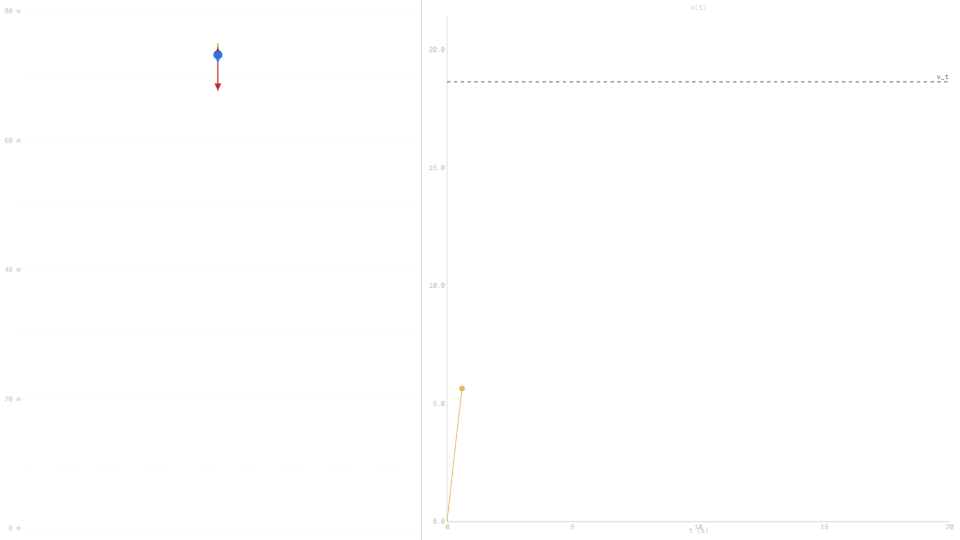
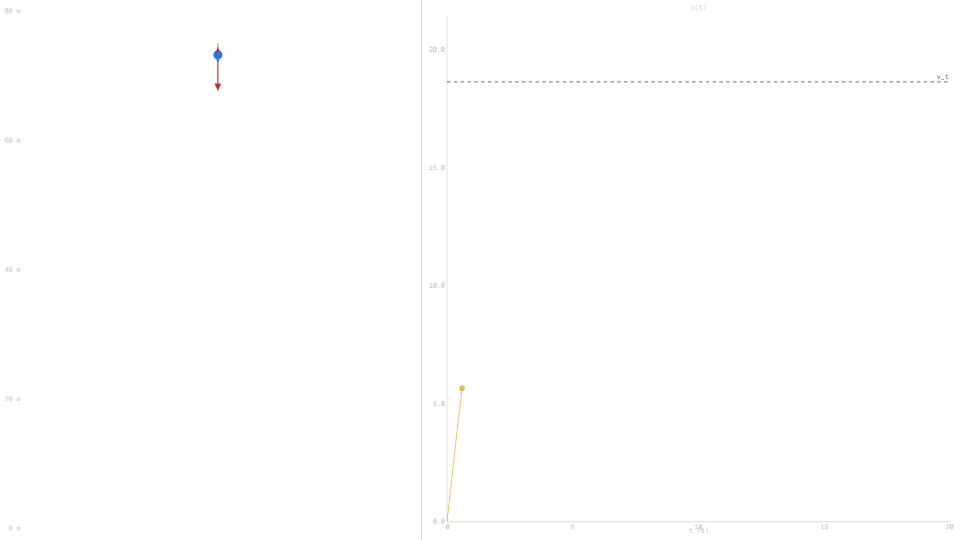
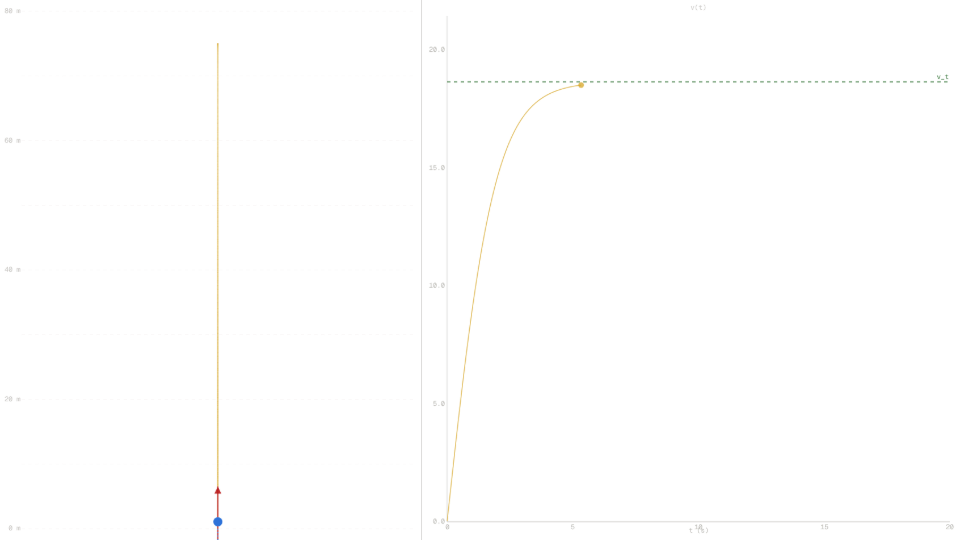
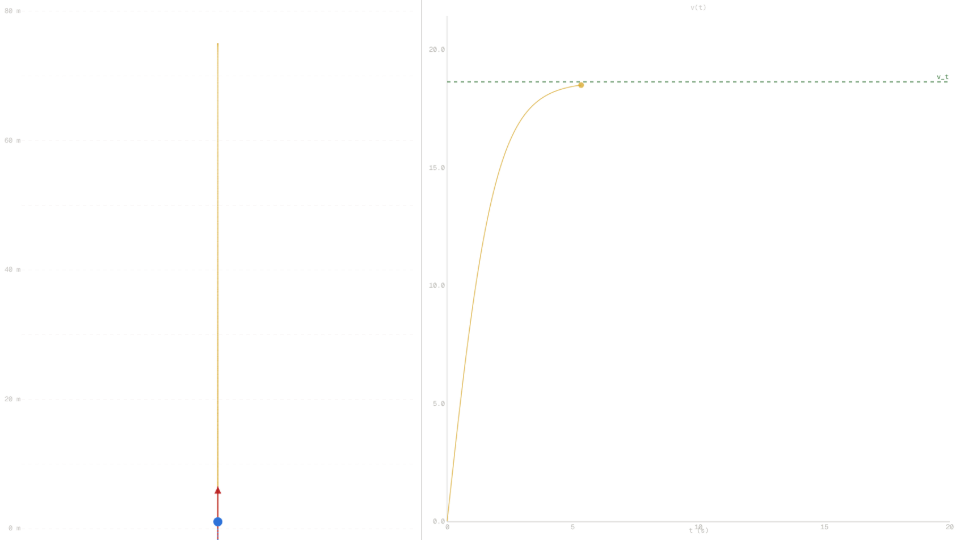
- Press Start and observe the v(t) amber curve in the right panel rising and flattening against the forest-green dashed v_t line. Note the time at which the curve visually touches the reference line.
- When the simulation stops automatically, check that the v readout ≈ v_t readout and that F_net ≈ 0.00 N, confirming force balance.
- Press Reset, then raise Mass to 2.0 kg. The v_t readout should update to ≈ 26.1 m/s (= 18.46 × √2). Run again and verify the curve settles at the new dashed line.
- Press Reset, set Fluid Density to 1000 kg/m³ (water). Observe that v_t drops to ≈ 0.646 m/s; the object reaches terminal velocity almost instantly.
Analytical Prediction
Terminal velocity is where drag equals weight: ½·ρ·C_d·A·v_t² = m·g, which gives v_t = sqrt(2·m·g / ρ·C_d·A). With the default settings (m = 1.0 kg, CdA = 0.047 m², ρ = 1.225 kg/m³):
After doubling mass to 2.0 kg:
At ρ = 1000 kg/m³ (water), m = 1.0 kg, CdA = 0.047 m²:
The v_t readout must match these values to within 0.05 m/s.
Results Analysis
Once the simulation stops, compare the v readout to the v_t readout; they should agree to within 0.01 m/s (the 0.1% near-terminal threshold). The F_net readout should display ≈ 0.00 N, confirming that weight and drag balance exactly. On the v(t) graph, observe that the amber curve's rate of rise decreases monotonically: early frames show steep acceleration (small drag), late frames show the curve barely moving (drag ≈ weight). The forest-green dashed v_t line is the analytical prediction; the curve must approach it from below without overshooting. For the water-density run (ρ = 1000 kg/m³), the curve flattens within the first second, and the v_t readout should show ≈ 0.646 m/s, a factor of ≈ 28 lower than the air-density case, consistent with the sqrt(1000/1.225) ≈ 28.6 density ratio.
Source of Error
This simulation models the drag force as purely quadratic (F_d = ½·ρ·C_d·A·v²), with a fixed scalar C_d; it omits the Reynolds-number dependence of C_d, which can vary significantly at low speeds (Stokes drag regime) and near the boundary layer transition. Buoyancy (Archimedes force) is not included, which is negligible in air but non-trivial in liquids. The fluid density ρ is held constant throughout the fall; pressure-density stratification of a real atmosphere is ignored. The body is treated as a point mass with no rotation or tumbling. The analytical prediction in the setup section assumes identical idealizations, so both the formula and the sim share the same simplifications; any residual gap between the v_t readout and the formula value is therefore purely numerical, not physical.
Further Exploration
- Set Fluid Density to 1000 kg/m³ (water) and run with mass = 1.0 kg and CdA = 0.047 m². The object reaches terminal velocity in well under a second. How does this compare to the air case? What does this reveal about why fish don't accelerate indefinitely?
- Keep mass = 1.0 kg and CdA = 0.047 m². Drag area models the product of drag coefficient and cross-sectional area. What CdA value gives v_t ≈ 50 m/s in air? Solve v_t = sqrt(2mg / ρ·CdA) for CdA and verify against the readout.
- Double the mass from 1.0 kg to 2.0 kg with all other sliders unchanged. Does v_t double? If not, what is the ratio, and why does the formula predict exactly that factor?
- Set mass to its maximum (5.0 kg) and CdA to its minimum (0.001 m²) in air (ρ = 1.225). The sim will hit the 60 s time cap before reaching terminal velocity. What does this imply about the speed of a dense, streamlined object in air?