Roller Coaster EnergyKE, PE, and Energy Conservation
Introduction
A roller coaster is a machine for trading potential energy against kinetic energy: every drop converts height into speed, every climb converts speed back into height, and without friction the sum of the two never changes. That sum, the total mechanical energy, is fixed the moment the cart leaves the first hill, and it silently constrains everything the track can do afterwards.
The intuition that fails here is thinking of speed as something the track gives and takes arbitrarily. It cannot: the simulator's Total E readout holds at 11.52 kJ through the entire frictionless run, no matter how violently the KE and PE readouts trade places beneath it. The cart is released just past the crest, at a launch height of 58.53 m with a small 2 m/s push, and from that instant its speed at any height is fully determined.
Add friction and the story gains a leak: the total energy declines in exact proportion to the distance travelled, which is why the friction run's cart may fail to climb a loop the frictionless cart clears easily.
The Physics Explained
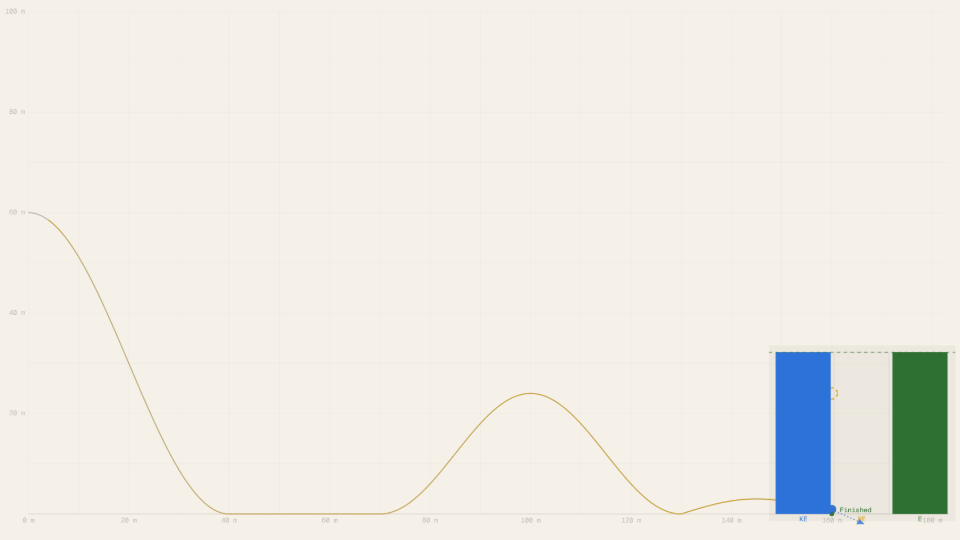
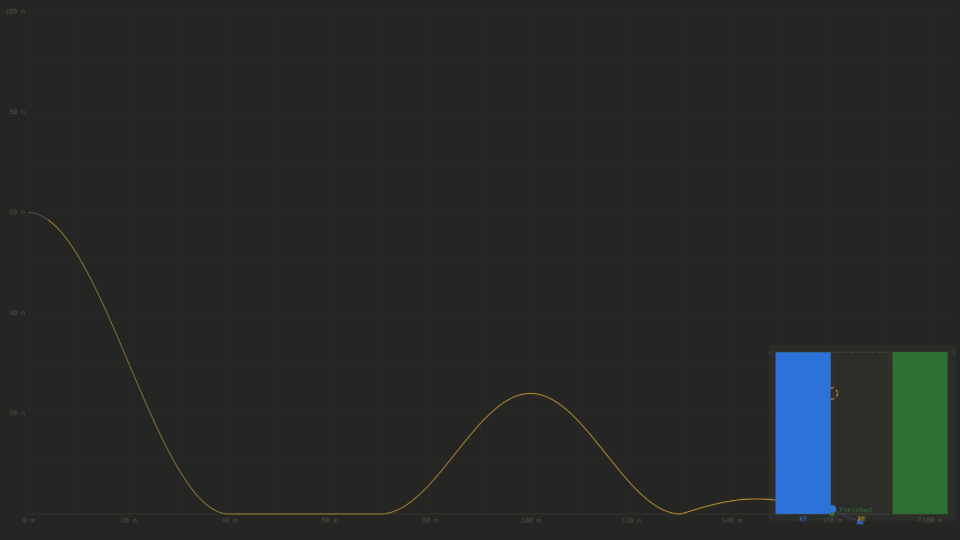
The track has three acts: a cosine launch hill descending from the launch height, a flat valley at ground level, and a circular vertical loop. The cart is treated as a point mass, and the simulator advances it by deriving speed from energy at every step: v = sqrt(2·(E₀/m − g·h)). That construction makes conservation exact by design in the frictionless case, so the Total E readout is not merely measured to be constant, it is constant.
With the default settings (launch height 60 m, mass 20 kg, loop radius 12 m, friction 0), the launch point at 58.53 m plus the 2 m/s release push give E₀ ≈ 11523.9 J, displayed as 11.52 kJ. At the valley floor every joule is kinetic: v = sqrt(2 · 11523.9 / 20) ≈ 33.95 m/s, which the Speed readout confirms. Climbing into the loop, the cart pays g·h per kilogram back to gravity, crossing the 24 m apex at about 26.11 m/s.
The loop is where energy conservation meets circular motion. Staying on the rails at the apex requires the centripetal condition v² ≥ g·R, and chaining it through the energy budget gives the famous design rule h₀ ≥ 2.5·R: a 12 m loop demands at least 30 m of launch hill. Set the launch height slider to 25 m and the cart stalls on the loop's rising arc, precisely where its energy account runs dry.
Friction turns the equality into an audit. Each metre of track at friction coefficient μ costs μ·m·g joules on gentle grades, so at μ = 0.05 the 20 kg cart sheds 981 J over 100 m of track. The Total E readout visibly slopes downward as the Distance readout grows, and the two are locked in ratio: energy lost per metre is constant.
Key Equations
The total mechanical energy is set at launch: E₀ = m·g·h₀ + ½·m·v₀². At the defaults this is 20 · 9.81 · 58.53 + 0.5 · 20 · 2² ≈ 11523.9 J. Every readout pair (KE, PE) in a frictionless run sums to this number.
Mass divides out of the frictionless version: E₀/m depends only on h₀ and v₀, so a 5 kg cart and a 50 kg cart reach the valley at the same 33.95 m/s. The mass slider changes the energy numbers but not the motion, a fact the simulator lets you verify directly.
At the top of the loop, gravity must not exceed the centripetal force demand, giving a minimum apex speed of sqrt(g·R) ≈ 10.85 m/s for R = 12 m. Working that requirement back down the energy ledger, the launch hill must be at least 2.5 · 12 = 30 m tall. The apex sits at 2·R = 24 m; the extra half-radius of height is the kinetic energy the cart must still carry while upside down.
Key Variables
| Symbol | Name | Unit | Meaning |
|---|---|---|---|
| h₀ | Launch height | m | Height of the release point on the first hill; sets the energy budget |
| E₀ | Total mechanical energy | J | KE + PE at launch; constant without friction |
| m | Cart mass | kg | Scales all energies but cancels out of frictionless motion |
| R | Loop radius | m | Radius of the vertical loop; apex at height 2·R |
| μ | Friction coefficient | dimensionless | Fraction of weight acting as drag; energy loss is μ·m·g per metre |
| v | Speed | m/s | Derived from the energy budget at the cart's current height |
Real World Examples
Why do real roller coasters always start with the tallest hill?
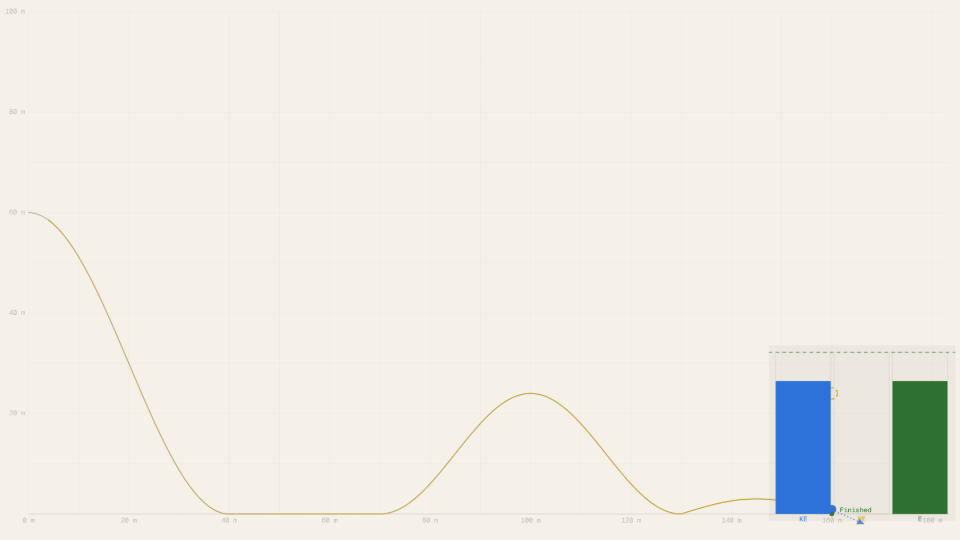
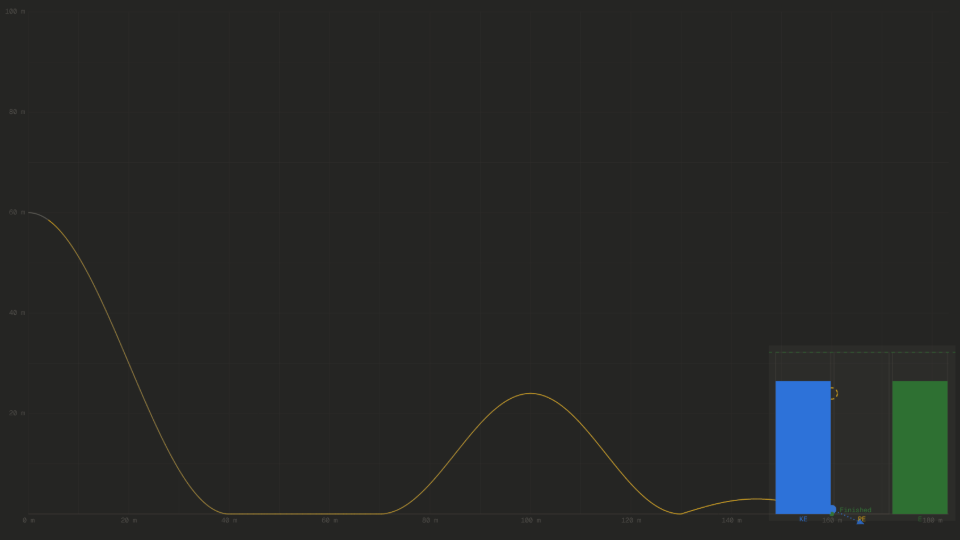
The first hill is the coaster's energy bank: everything the cars do afterwards is spent from the account filled at the top. Without a motor on the track, total mechanical energy can only stay constant or shrink, so no later hill or loop can be taller than the energy budget the first drop provides, and friction makes each successive feature effectively shorter.
In the simulator this is the launch height slider: with the default 60 m hill the cart carries about 11.52 kJ down the track, and every loop it can clear must fit inside that budget.
Designers add a margin on top of the bare minimum, which is why the 2.5R loop rule in practice becomes closer to 3R once air drag, wheel friction, and passenger comfort limits are counted.
Why does a coaster cart not fall off at the top of a vertical loop?
At the apex the cart is upside down, and gravity plus the track's normal force together supply the centripetal force that curves its path. The cart stays pressed to the rails as long as the required centripetal acceleration v²/R is at least g: that gives the apex condition v² ≥ g·R. Combining it with energy conservation from the launch hill yields the minimum launch height h₀ ≥ 2.5·R.
In the simulator the default 12 m loop demands 30 m of launch height; releasing the cart from 25 m makes it stall partway up the loop, exactly as the inequality predicts.
Real coasters use clothoid loops, narrower at the top than a circle, which lower the required speed at the apex and soften the g-forces at the bottom.
Where does the energy go when friction slows a coaster down?
Friction converts ordered kinetic energy into disordered thermal energy in the wheels, rails, and air. The bookkeeping is exact: the mechanical energy lost equals the friction force times the distance travelled, W = μ·m·g·d on gentle grades.
In the simulator, raising the friction slider to 0.05 drains the total energy readout in direct proportion to the distance readout: over 100 m of track the cart sheds 981 J.
Real parks fight this with polished steel rails and polyurethane wheels, but they also exploit it: brake runs at the end of the circuit are deliberately high-friction sections that dump the remaining kinetic energy as heat before the station.
Further Reading
- Gravitational PE on a hill: the same energy-derived motion on a single hill, with a movable reference level that makes the meaning of potential energy explicit.
- Net work with friction: the flat-track version of the friction audit used here, where each force's work is tabulated separately.
- Circular motion: the centripetal acceleration v²/R that sets the loop apex condition, studied on its own without the energy bookkeeping.