Ramp into Spring PhysicsGravitational PE, KE & Spring Compression
Introduction
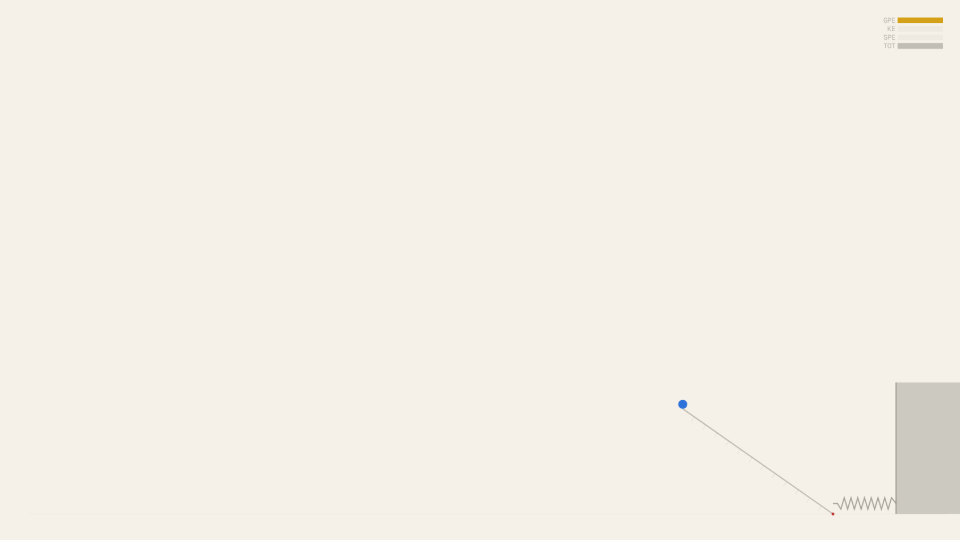
When a ball rolls down a frictionless ramp and compresses a spring at the bottom, three forms of mechanical energy take turns holding the system's total. Gravitational potential energy (GPE) converts entirely to kinetic energy (KE) as the ball descends; then KE transfers entirely into elastic potential energy stored in the spring at maximum compression. At that instant the ball is momentarily at rest and every joule that started as GPE now lives in the coiled spring. The energy bar display in the simulator tracks this three-way handoff in real time: the amber GPE bar drains as the sky-blue KE bar rises, then the KE bar drains as the green spring PE bar fills.
This scenario appears throughout engineering precisely because it isolates the conversion chain cleanly. No friction, no air resistance: every variable in the conservation equation is directly readable from the simulator's sliders and readouts. The formula xmax = sqrt(2mgh/k) links height, mass, and spring stiffness to maximum compression, and it underpins the design of crash buffers, shock absorbers, and landing-gear struts.
Most people expect that a steeper ramp produces a larger spring compression, reasoning that a steeper slope means faster acceleration. The Compression x readout contradicts this: with m = 0.5 kg, h = 2.0 m, and k = 80 N/m, sweeping the Ramp Angle from 15° to 75° leaves the Compression x readout pinned at approximately 0.495 m regardless of slope. Ramp angle changes how quickly the ball accelerates but cannot change the height dropped, so it cannot change the energy budget or the final compression.
The Physics Explained


Energy conservation on a frictionless ramp means the total mechanical energy of the ball-spring system stays constant. At the top, all energy is gravitational PE: Etotal = mgh. At the moment the ball reaches ground level and first touches the spring, that full budget has become KE: ½mv² = mgh, giving v = sqrt(2gh). With m = 0.5 kg and h = 2.0 m, the KE readout reports approximately 9.81 J at that instant, matching m·g·h = 0.5 · 9.81 · 2.0 = 9.81 J.
Once the ball contacts the spring, force F = −kx decelerates it. KE flows into spring PE as compression x grows. At maximum compression velocity reaches zero, so ½kxmax² = mgh, which rearranges to xmax = sqrt(2mgh/k). For m = 0.5 kg, h = 2.0 m, k = 80 N/m: xmax = sqrt(2 · 0.5 · 9.81 · 2.0 / 80) = sqrt(0.24525) ≈ 0.495 m. The Compression x readout confirms this value, and throughout compression the spring PE and KE readouts sum to 9.81 J.
The angle-independence result follows directly: theta does not appear in xmax = sqrt(2mgh/k). A 35° ramp with h = 2.0 m has length 2.0/sin(35°) ≈ 3.49 m; a 65° ramp with the same height has length 2.0/sin(65°) ≈ 2.21 m. The shallower ramp takes longer to traverse, but the energy delivered to the spring is identical because both balls fall the same vertical distance. Setting Ramp Angle to 65° while keeping m = 0.5 kg, h = 2.0 m, k = 80 N/m leaves the Compression x readout at approximately 0.495 m, identical to the 35° result.
Mass enters because a heavier ball carries more GPE at a given height yet also requires more spring force to stop. These effects partially cancel: xmax scales as sqrt(m). With m = 1.0 kg, h = 2.0 m, k = 80 N/m, the predicted compression is sqrt(2 · 1.0 · 9.81 · 2.0 / 80) ≈ 0.700 m, and the Compression x readout reaches approximately 0.700 m, confirming the square-root scaling.
Key Equations
At the top of the ramp with m = 0.5 kg, g = 9.81 m/s², h = 2.0 m: GPE = 0.5 · 9.81 · 2.0 = 9.810 J. This is the total mechanical energy budget for the entire run. The Total Energy readout in the simulator holds at 9.81 J throughout the motion, confirming that no energy is lost on the frictionless surface.
At the instant the ball reaches ground level, all GPE has become KE. Solving for speed: v = sqrt(2gh) = sqrt(2 · 9.81 · 2.0) = sqrt(39.24) ≈ 6.264 m/s. The KE readout in the simulator peaks at approximately 9.81 J at this moment, consistent with the full GPE having transferred to kinetic form.
At any compression x with velocity v, the initial gravitational PE equals the sum of remaining KE and stored spring PE. With x = 0.300 m and k = 80 N/m: spring PE = ½ · 80 · 0.300² = 3.600 J; remaining KE = 9.810 − 3.600 = 6.210 J. Setting Spring PE to 3.60 J on the green bar and KE to 6.21 J on the blue bar reproduces what the simulator readouts show at mid-compression.
At maximum compression v = 0 and all energy is in the spring. For the default configuration m = 0.5 kg, h = 2.0 m, k = 80 N/m: xmax = sqrt(2 · 0.5 · 9.81 · 2.0 / 80) = sqrt(0.24525) ≈ 0.495 m. The Compression x readout reaches 0.495 m when the simulation stops, and the dashed red reference line on the canvas marks that position. Increasing k to 200 N/m while keeping m and h fixed gives xmax = sqrt(2 · 0.5 · 9.81 · 2.0 / 200) ≈ 0.313 m, a stiffer spring that compresses less.
Key Variables
| Symbol | Name | Unit | Meaning |
|---|---|---|---|
| m | Ball mass | kg | Inertial and gravitational mass of the rolling ball |
| g | Gravitational acceleration | m/s² | Acceleration due to gravity; 9.81 m/s² in the simulator |
| h | Release height | m | Vertical height of the ball above the spring contact line at rest |
| k | Spring stiffness | N/m | Spring constant in Hooke's law; larger k means stiffer spring |
| v | Ball speed | m/s | Speed of the ball at any point along the ramp or during compression |
| x | Spring compression | m | Distance the spring is compressed from its natural length |
| xmax | Maximum compression | m | Compression at maximum spring PE, when ball velocity reaches zero |
| GPE | Gravitational potential energy | J | Energy stored by height: mgh |
| KE | Kinetic energy | J | Energy of motion: ½mv² |
| SPE | Spring potential energy | J | Elastic energy stored in the spring: ½kx² |
Real World Examples

How do automotive crash buffers absorb impact energy?
Highway crash attenuators and buffer stops in rail yards function as engineered springs: a vehicle or railcar arrives with kinetic energy and the buffer converts that KE into elastic (or plastic) deformation work. The governing relationship is the same as for the ramp scenario: KE at contact equals the energy stored in the buffer at maximum compression, ½mv² = ½kx². A rail buffer rated to stop a 20,000 kg car moving at 2 m/s must absorb 40,000 J; with a stiffness of 200,000 N/m the maximum stroke works out to sqrt(2 · 40000 / 200000) ≈ 0.632 m. Engineers size the stroke clearance to that value with a safety margin.
In the simulator, setting m = 2.0 kg, h = 4.0 m, k = 20 N/m reproduces a high-compression scenario: the Compression x readout reaches approximately 2.801 m, matching the analytical xmax = sqrt(2 · 2.0 · 9.81 · 4.0 / 20) ≈ 2.801 m. The buffer designer solves the same equation; the scale is different but the physics is identical. Note that the Ramp Angle slider plays no role in that final 2.801 m figure: only height, mass, and stiffness appear in the compression formula.
Why does the slope of a ski jump ramp not change where a skier lands on the flat?
In competitions where a skier descends from a fixed starting height to a flat runout zone containing a spring-loaded timing gate, the speed at the base depends only on the vertical drop h, not on how steep or gentle the slope is. This is the angle-independence result built directly into the simulation: xmax = sqrt(2mgh/k) contains no trigonometric term. Two ramp configurations set to h = 2.0 m but at 35° and 65° produce the same Compression x readout of approximately 0.495 m. The steeper ramp accelerates the ball faster along the slope, while the shallower ramp is longer with a smaller gravitational component along it; both effects cancel exactly, leaving the same speed at the base.
Course designers can therefore choose slope angle for safety and terrain fit without altering the gate activation force. A gentler beginner slope and a steeper expert slope that share the same vertical drop from start gate to timing gate will trigger the same spring compression at the bottom. The simulator makes this verifiable: fix m = 0.5 kg, h = 2.0 m, k = 80 N/m, then run two separate attempts at 20° and 70°. Both attempts archive a ghost trail of different lengths, but the Compression x readout lands at approximately 0.495 m each time.
How do engineers select spring stiffness for a pogo stick or shock absorber?
A pogo stick rider drops through a height h each bounce cycle, and the spring must compress enough to store all the gravitational PE before rebounding. The required maximum compression xmax = sqrt(2mgh/k) sets a direct constraint: if the physical spring can only compress 0.15 m before bottoming out, and the rider has mass 60 kg dropping h = 0.05 m each cycle, then k must satisfy 0.15 ≥ sqrt(2 · 60 · 9.81 · 0.05 / k), giving k ≥ 2 · 60 · 9.81 · 0.05 / 0.15² ≈ 2614 N/m. The same sizing logic governs automotive shock absorbers and landing-gear struts, where available stroke is fixed by packaging constraints and spring rate is chosen to keep compression within that stroke at the design load.
The simulator makes this trade-off tangible at a smaller scale: with m = 0.5 kg and h = 2.0 m, reducing k from 80 N/m to 20 N/m pushes the Compression x readout from approximately 0.495 m to approximately 0.990 m, doubling the required stroke as stiffness is quartered. The square-root relationship means halving the stiffness increases compression by sqrt(2) ≈ 1.41, not by 2, a subtlety that catches many designers who apply linear intuition to what is fundamentally a square-root problem.
Further Reading
- Spring potential energy: Hooke's law and the elastic PE stored in a compressed or stretched spring, with worked examples of force and energy as functions of displacement.
- Gravitational PE on a hill: how height converts to speed on a slope, covering the same GPE-to-KE conversion that drives the ramp phase of this simulation.
- Roller coaster energy: energy conservation across a full loop-and-hill track, extending the ramp-into-spring chain to multiple PE-KE transitions in sequence.
- Damped spring: what happens when friction is reintroduced so that the spring-mass system loses energy on each cycle instead of conserving it perfectly.