Projectile in Wind PhysicsHow Wind Shifts a Throw via Airspeed
Introduction
Throw a ball into a stiff head-wind and it falls disappointingly short; throw it with a tail-wind at your back and it sails. The wind has not changed gravity, and it has not changed how hard you threw; what it changes is the air the ball pushes through on its way. Drag, the resistive force of that air, does not care how fast the ball moves over the ground; it cares how fast the ball moves relative to the air itself.
One idea is the whole story of this simulation: drag depends on the velocity relative to the air, v − w. A head-wind adds to the airspeed the projectile feels, so drag bites harder and the range collapses. A tail-wind subtracts from it, so drag eases and the range grows. The simulator reports an Airspeed readout, the relative airspeed |v − w|, right next to the Range, so you can watch the cause and the effect side by side.
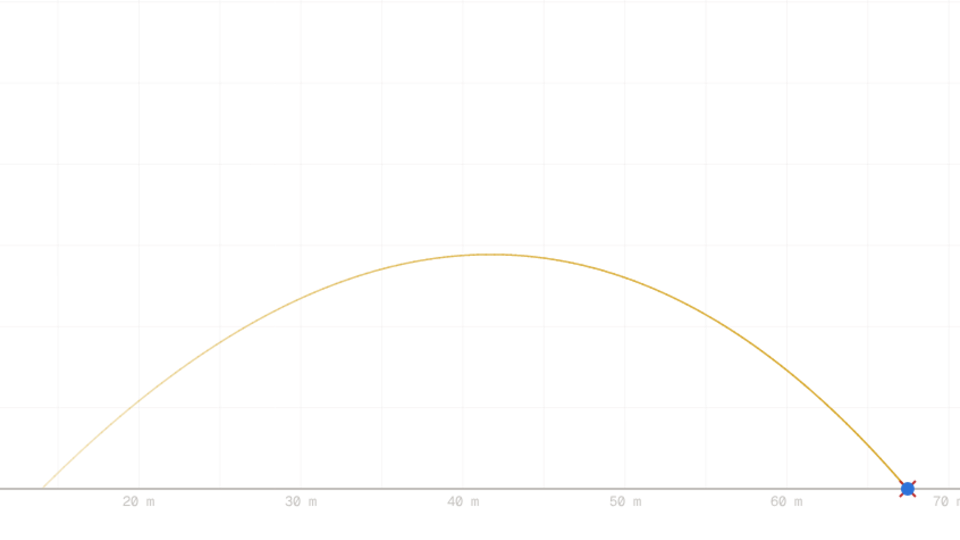
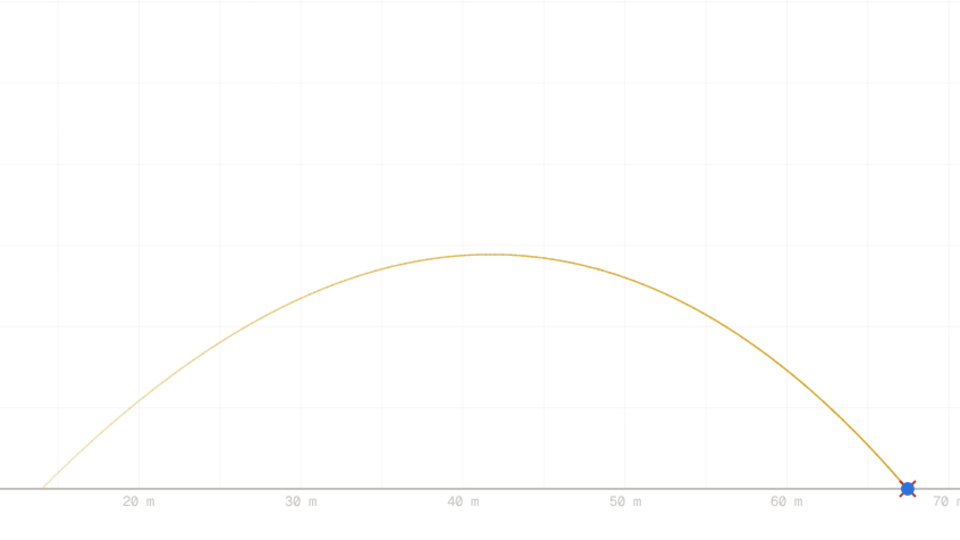
There is a sharp twist that makes the principle unmistakable: turn the drag off and the wind stops mattering entirely. With no air resistance there is nothing for the wind to act through, so every wind produces the same vacuum range of about 64 m. Wind is not a force on its own; it is a change in the medium that only shows up as a change in drag.
The Physics Explained
Start from the relative velocity. If the projectile moves at velocity v over the ground and the air moves at the wind velocity w, then the projectile's velocity through the air is the difference, v − w. Aerodynamic drag at these speeds is quadratic: its magnitude scales with the square of the relative airspeed |v − w|, and it points opposite to v − w. For a horizontal wind w = (w, 0), the relative airspeed is |v − w| = √((vₓ − w)² + vy²).
Splitting the drag into components and adding gravity gives the accelerations the simulator integrates: aₓ = −(k/m)·(vₓ − w)·|v − w| horizontally, and ay = −g − (k/m)·vy·|v − w| vertically. The wind appears only in the horizontal relative velocity (vₓ − w); the vertical equation carries it indirectly, through the shared |v − w| factor, because faster air past the projectile increases drag in every direction at once.
Because the equations are quadratic and coupled, there is no tidy formula for the range; the simulator steps the motion forward in small time slices. Launching at 25 m/s and 45° with drag 0.0040 kg/m, the calm-air range comes out near 53 m. An 8 m/s head-wind raises the launch airspeed and drives the range down to about 47 m; an 8 m/s tail-wind lowers the airspeed and lifts the range to about 59 m. The Airspeed readout tells you why: it reads about 24 m/s into the head-wind and about 18 m/s down the tail-wind, against about 21 m/s in calm air.
The limiting case nails the mechanism. Set k = 0 and the drag terms vanish, leaving aₓ = 0 and ay = −g, ordinary vacuum projectile motion, with a range of about 64 m no matter what w is. The wind only ever entered through the drag, so removing the drag removes the wind. Everything between calm air and a vacuum is just the same v − w law dialled up or down by the drag coefficient.
Key Equations
This is the speed the projectile feels through the air. A head-wind (w < 0 against the motion) raises it; a tail-wind (w > 0) lowers it. The simulator's Airspeed readout displays exactly this quantity, so you can see it climb into a head-wind and fall down a tail-wind.
Drag opposes the horizontal relative velocity (vₓ − w). Notice the sign can flip: if a tail-wind is faster than the projectile, vₓ − w becomes negative and the drag actually pushes the projectile forward, nudging it toward the wind's speed rather than braking it.
Gravity always pulls down; the drag term opposes the vertical velocity, adding to gravity on the way up and resisting it on the way down. The wind reaches this equation only through the shared |v − w| factor, so a stronger head-wind steepens the vertical braking too.
With no drag the wind drops out completely. Every wind then gives the identical range (about 64 m for the default launch), which is the clearest possible proof that the wind acts only through the air resistance.
Key Variables
| Symbol | Name | Unit | Meaning |
|---|---|---|---|
| v₀ | Launch speed | m/s | Initial speed of the projectile relative to the ground |
| θ | Launch angle | ° | Angle of launch above the horizontal |
| w | Wind speed | m/s | Horizontal air velocity; negative is a head-wind, positive a tail-wind |
| k | Drag coefficient | kg/m | Strength of the quadratic drag; zero means no air resistance |
| m | Mass | kg | Mass of the projectile (1 kg in the simulator) |
| |v − w| | Relative airspeed | m/s | Projectile speed through the air; what drag depends on |
| g | Gravitational acceleration | m/s² | Downward acceleration due to gravity; 9.81 m/s² at Earth's surface |
Real World Examples
Why does a head-wind shorten a throw while a tail-wind lengthens it?
Air drag depends on how fast the projectile moves through the air, not over the ground. A head-wind blows toward the projectile, so the air rushes past it faster than its ground speed alone; the relative airspeed rises, drag grows, and the projectile is braked harder and falls short. A tail-wind blows the same way the projectile travels, so the air slips past more slowly, drag shrinks, and the projectile carries farther.
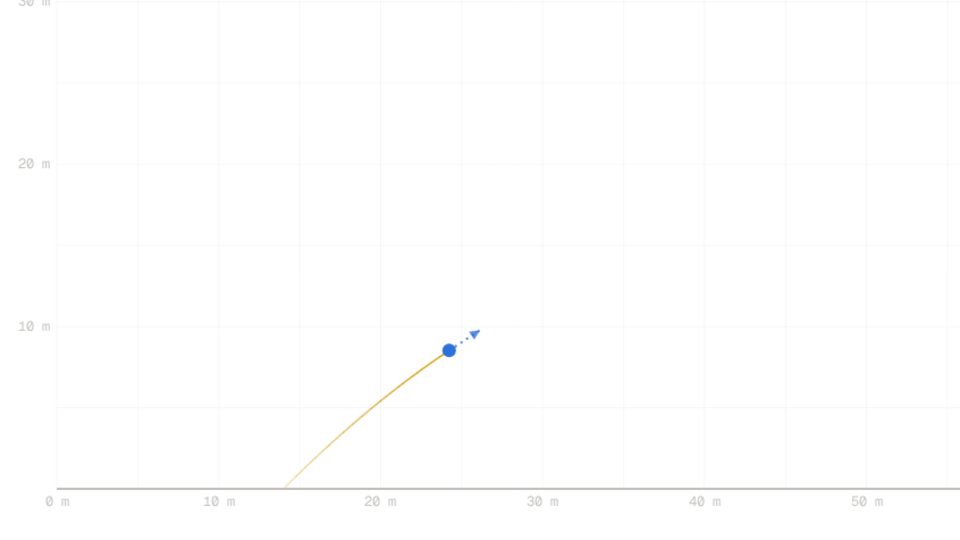
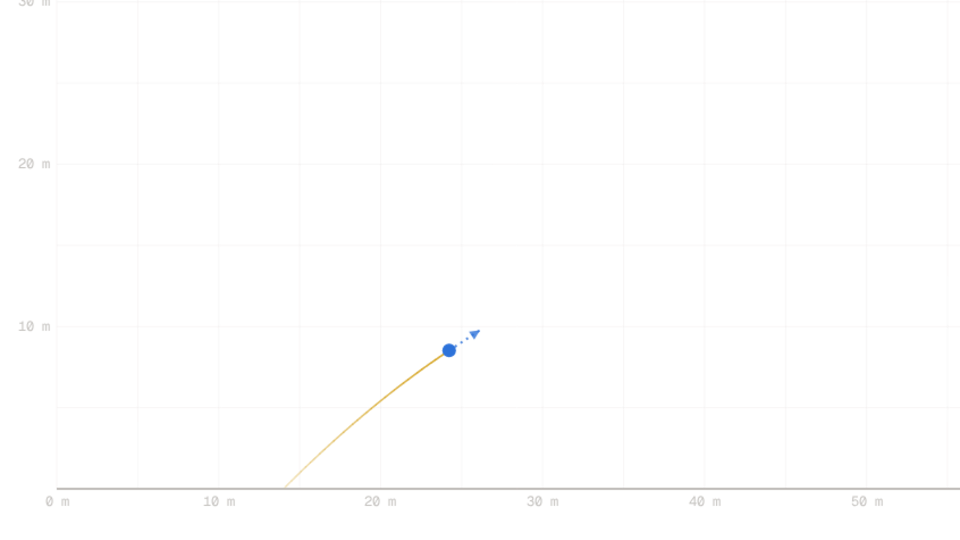
The simulator measures this directly. At launch speed 25 m/s, 45°, and drag 0.0040 kg/m, the calm-air range is about 53 m. Switch on an 8 m/s head-wind and the Airspeed readout climbs from about 21 to about 24 m/s, and the range drops to roughly 47 m. Flip to an 8 m/s tail-wind and the Airspeed falls to about 18 m/s while the range stretches to roughly 59 m.
The ground motion still decides where the projectile is at each instant, but it is the air motion that sets how hard the drag pushes. That is why a baseball outfielder, a javelin thrower, and a long-drive golfer all read the flags before they commit: the same swing buys very different distance depending on which way the air is moving.
Why does wind have no effect on a projectile in a vacuum?
Wind can only reach a projectile through the air, and the only force the air exerts is drag. If there is no drag (no air to speak of, or a drag coefficient of zero), there is simply no channel through which the wind can act, so the trajectory is the same whether the wind blows or not.
The simulator makes this concrete: set the drag coefficient to off and fire at any wind you like, and the arc lands near 64 m every single time, while the Wind slider does nothing to the path. Turn the drag back on and the wind immediately starts shifting the landing point again. This is why moving air is irrelevant on the Moon or in a vacuum chamber: a feather and a hammer dropped together land together regardless of any 'wind', because without air there is no aerodynamic force at all.
Wind, in other words, is not a force in its own right. It is a change in the velocity of the medium that produces drag, and with the drag switched off the medium has effectively been removed from the problem, leaving only gravity, which the wind never touched.
How do golfers and archers actually correct for the wind?
Skilled players treat the wind as a change to the airspeed their projectile feels, and they manage it mostly by changing how long the projectile stays exposed to it. Into a head-wind a golfer hits a lower, flatter, faster shot: less time aloft and a smaller vertical profile mean the head-wind has fewer seconds to bleed off range. Down a tail-wind they can loft the ball higher to let the wind carry it.
The simulator shows why the launch angle matters so much. Hold an 8 m/s head-wind fixed and compare a steep 60° shot with a flat 30° one at the same speed: the steep shot, which hangs in the air far longer, gives up a larger fraction of its calm-air range, because drag has more time to act. Time aloft, not just airspeed, is what the wind taxes.
Archers and rifle shooters apply the same logic with windage corrections, aiming off to compensate for the steady push, and they care most in slow, looping shots where the projectile spends long enough in the moving air for the effect to accumulate. The common thread is the relative-airspeed law: anything that raises the airspeed, or the time spent at high airspeed, costs range, and players spend their skill minimising both.
Further Reading
- Projectile with drag: the same quadratic drag with still air, the calm-wind baseline this sim builds on.
- Projectile motion: the drag-free, wind-free parabola that the vacuum limit (k = 0) returns to.
- Terminal velocity: what quadratic drag does to vertical motion alone, the balance the drag term here is pushing toward.