Projectile in Wind · SimulatorHead-Wind vs Tail-Wind Range
Launch a projectile through moving air and watch quadratic drag act on its speed relative to the wind: a head-wind shortens the range, a tail-wind extends it, and with drag off the wind stops mattering.
Published: June 8, 2026
Objective
Show that aerodynamic drag depends on a projectile's speed relative to the air, not relative to the ground. A horizontal wind w shifts the drag so it acts along the relative velocity v − w: a head-wind raises the relative airspeed and shortens the range, a tail-wind lowers it and extends the range, and with drag switched off the wind has no effect at all. Confirm that flipping the wind from a head-wind to an equal tail-wind moves the landing point markedly downrange, that the Airspeed readout (|v − w|) is larger into a head-wind than down a tail-wind, and that setting the drag coefficient to off collapses every wind to the same vacuum range. The projectile is a point mass and drag follows the quadratic law F = k·|v − w|·(v − w).
Setup
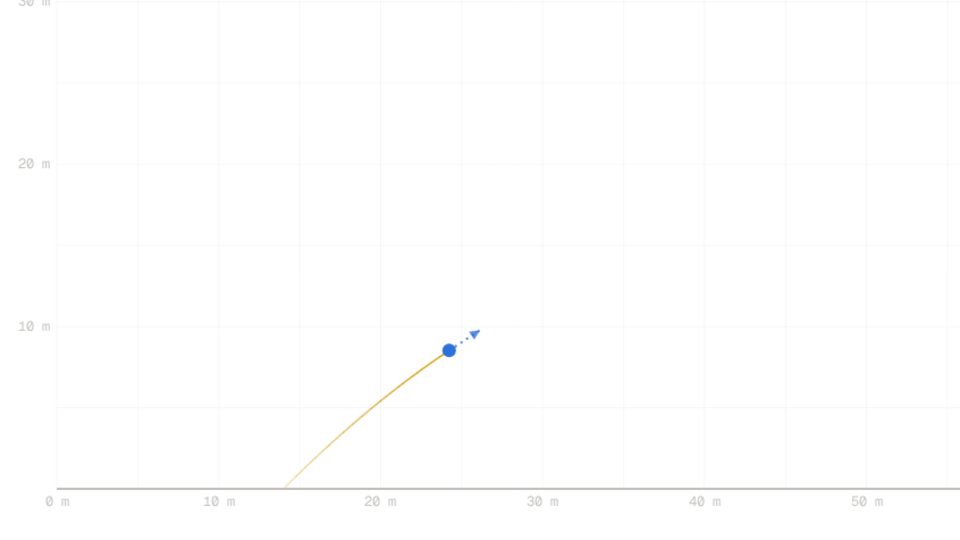
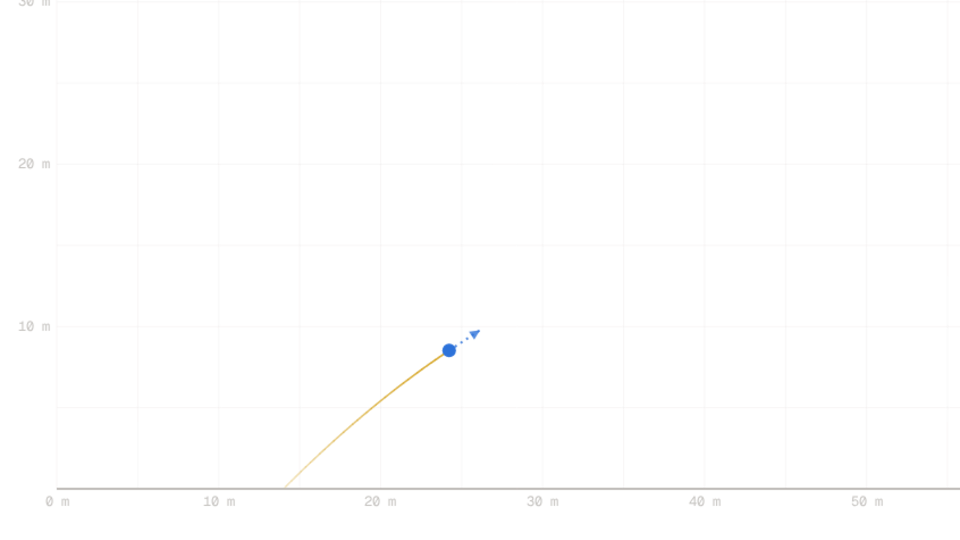
- On a fresh canvas the third button reads Reset; if earlier arcs are on screen it reads Clear; press Clear to wipe them. Leave the defaults (launch speed 25 m/s, angle 45°, drag 0.0040 kg/m, wind 0) and press Start. With no wind the projectile lands near 53 m.
- Press Reset: the arc stays as a faded grey ghost. Drag the Wind slider to −8 m/s (a head-wind) and press Start. The new arc falls short, landing near 47 m, and the Airspeed readout runs higher than before because the projectile meets the air faster.
- Press Reset again, set the Wind to +8 m/s (a tail-wind), and press Start. This arc overshoots both ghosts, landing near 59 m, with a lower Airspeed reading. The three overlaid arcs fan out: head-wind shortest, calm in the middle, tail-wind longest.
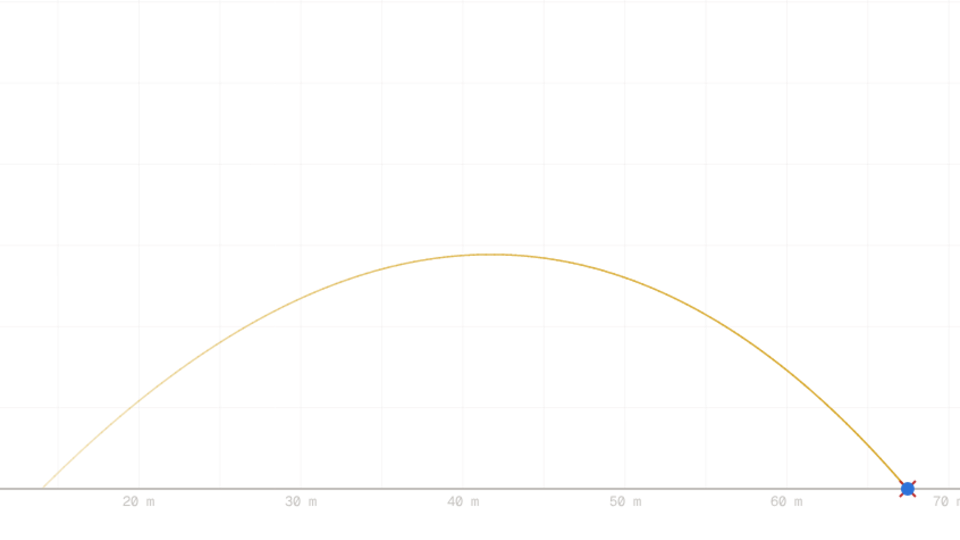
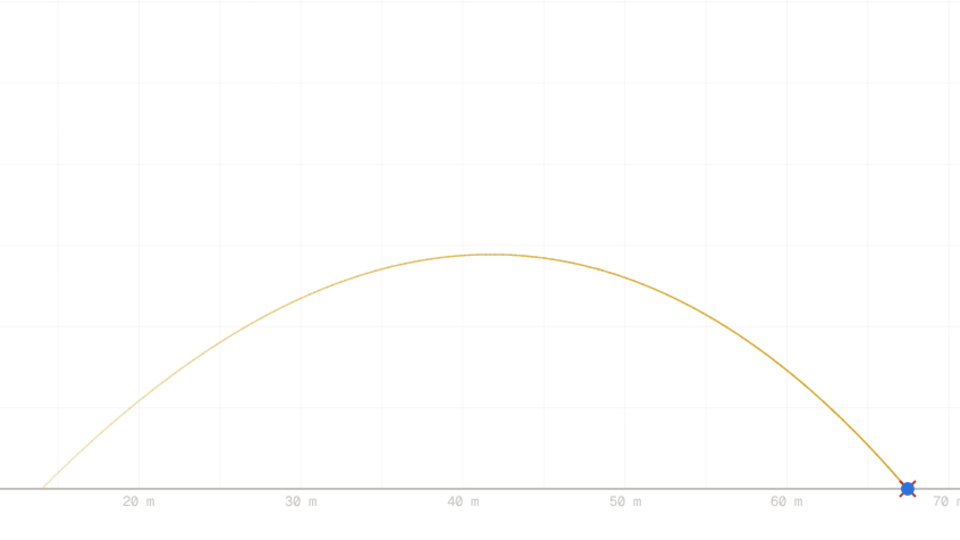
- Press Reset and set the Drag coefficient to off (0). Fire at any wind: the arc now reaches about 64 m and does not change when you move the Wind slider, because with no drag there is no airspeed for the wind to push against.
- Press Clear to wipe the board. Restore the drag to 0.0040 and compare a steep, slow shot with a flat, fast one in the same head-wind: the slower, higher arc lingers in the wind longer and loses more of its range.
Analytical Prediction
Drag acts along the velocity of the projectile relative to the air, v − w, where w is the wind. Its strength grows with the square of that relative airspeed, so the wind enters only through the relative velocity:
There is no closed form for the range, so the simulator integrates the motion. With the defaults (launch 25 m/s, 45°, k = 0.0040 kg/m) the calm-air range is about 53 m. A head-wind of 8 m/s raises the relative airspeed (the Airspeed readout climbs from about 21 to about 24 m/s) and shortens the range to roughly 47 m. An equal tail-wind lowers the airspeed to about 18 m/s and stretches the range to roughly 59 m. Switch the drag off and the relative airspeed no longer matters: the range returns to its vacuum value of about 64 m for every wind.
Results Analysis
Watch the Range and Airspeed readouts together. The Airspeed readout shows |v − w|, the speed the projectile feels through the air; it reads higher into a head-wind and lower down a tail-wind than it does in calm air at the same ground speed, and that difference is exactly what shifts the range. With Reset keeping each arc as a ghost, fire the same launch into a −8 m/s head-wind, then calm air, then a +8 m/s tail-wind: the three landing points spread out in order, near 47 m, 53 m, and 59 m. Now set the drag coefficient to off and repeat: the arcs land on top of one another near 64 m no matter what the wind is, because drag is the only channel through which the wind can act. The clean way to read the sim is that ground motion sets where the projectile is, but air motion sets how hard the drag pushes.
Source of Error
The model is a point-mass projectile in a steady, uniform, horizontal wind, with quadratic drag of fixed coefficient k and no lift. Real wind gusts, shears with altitude, and carries a vertical and a cross component that a side view cannot show; a real drag coefficient drifts with speed (Reynolds and Mach effects); and a real ball with spin would also feel lift. Because the prediction and the simulation use the same idealisations, the head-wind/tail-wind asymmetry shown here is exactly the v − w law and any residual is numerical, not physical. The one exact statement that survives every idealisation is the limiting case: with the drag coefficient at zero the wind cannot couple to the projectile at all, so every wind gives the identical vacuum range.
Further Exploration
- Set the drag to off and sweep the Wind slider across its whole range. Why does the landing point refuse to move, and what does that tell you about how the wind reaches the projectile?
- Fire the same launch into a −8 m/s head-wind and a +8 m/s tail-wind, using Reset to keep both arcs. Is the range you lose to the head-wind equal to the range you gain from the tail-wind, or is the response lopsided?
- Hold the wind at −8 m/s and compare a 60° launch with a 30° launch at the same speed. Which one loses a larger fraction of its calm-air range to the head-wind, and why does time in the air matter?
- Turn the drag up to its maximum and watch the Airspeed readout through a tail-wind launch. Can the projectile ever end up moving slower than the wind, and what happens to the horizontal drag force when it does?