Projectile on an Incline PhysicsOptimal Angle Shifts to 45° + φ/2
Introduction
A projectile launched up a hillside follows the same parabolic arc as one fired over flat ground. Gravity still pulls straight down at 9.81 m/s² and the horizontal velocity still stays constant. What changes is where the arc ends. Instead of returning to its launch height, the projectile lands on ground that has risen beneath it. That single change reshapes the relationship between launch angle and distance, and it shifts the angle that throws the projectile furthest away from the familiar 45°.
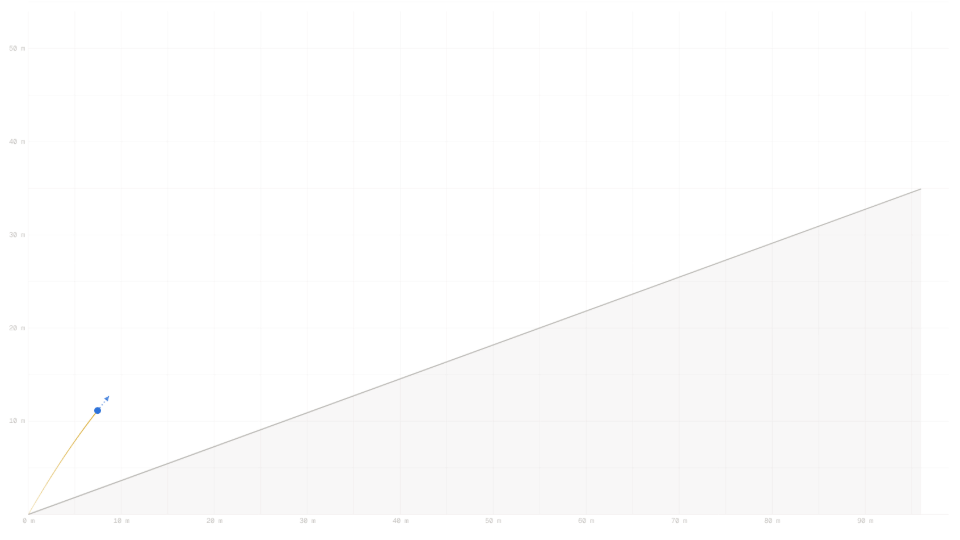
The governing quantity is the slope angle φ, the steepness of the rising ground measured from the horizontal. The range is now measured along the incline surface rather than across level ground, and the launch angle that maximises it generalises to θ = 45° + φ/2, an angle that bisects the slope and the vertical. The simulator draws the slope, fires the projectile up it, and reports the Range up slope, the Flight time, and the Optimum θ for the current slope, so the dependence on φ can be traced one shot at a time.
Intuition trained on level ground insists that 45° stays optimal no matter the terrain ahead. A single uphill run undermines that: set the incline to 20° and launch at v = 25 m/s, and a 45° shot reaches only 43.1 m up the slope, while the 55° shot the Optimum θ readout recommends reaches 47.5 m. The hill rewards a steeper launch.
The Physics Explained
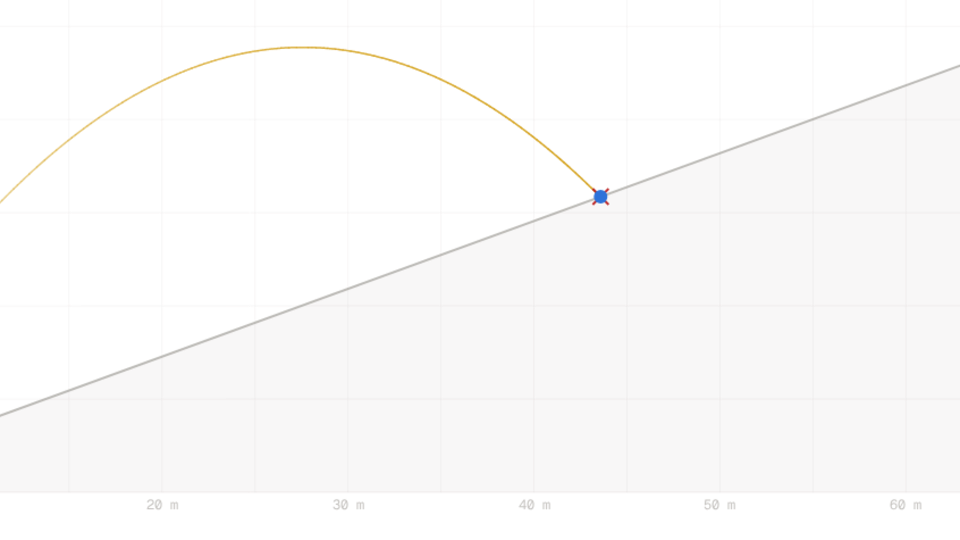
The motion is ordinary projectile motion: the launch velocity v splits into a constant horizontal component vₓ = v·cos(θ) and a vertical component vy = v·sin(θ) that decelerates under gravity. What makes the incline distinct is the landing condition. The projectile lands not at y = 0 but on the slope line y = x·tan(φ), the straight surface rising from the launch point at the base.
Solving for the time at which the parabolic path meets that line gives the flight time T = 2·v·sin(θ − φ)/(g·cos φ). The combination θ − φ (the launch angle measured relative to the slope rather than the horizontal) controls how long the projectile stays above the rising ground. With v = 25 m/s, θ = 60°, and φ = 20°, θ − φ = 40° and T = 2·25·sin(40°)/(9.81·cos(20°)) ≈ 3.49 s. The simulator's Flight time readout shows 3.49 s at those settings.
Multiplying the speed along the slope by the flight time and simplifying yields the range up the incline: R = 2·v²·cos(θ)·sin(θ − φ)/(g·cos²φ). With v = 25 m/s, θ = 60°, φ = 20°, this gives R ≈ 46.4 m, and the simulator's Range up slope readout confirms 46.4 m. Setting φ = 0 collapses cos²φ to 1 and turns 2·cos(θ)·sin(θ) back into sin(2θ), recovering the flat-ground R = v²·sin(2θ)/g exactly.
Maximising R over θ, by differentiating the cos(θ)·sin(θ − φ) factor, gives the optimum launch angle θ* = 45° + φ/2. This angle bisects the slope direction and the upward vertical, the incline analogue of the way 45° bisects flat ground and the vertical. At v = 25 m/s on a 20° slope, θ* = 55° and the range reaches its maximum value Rmax = v²/(g·(1 + sin φ)) ≈ 47.5 m. The simulator's Optimum θ readout reports 55° whenever φ = 20°, and sweeping the launch slider confirms the range peaks there.
Key Equations
With v = 25 m/s and θ = 60°: vₓ = 25·cos(60°) = 25·0.5 = 12.5 m/s. As on flat ground, this stays constant throughout the flight; the slope changes where the projectile lands, not the horizontal force on it (there is none in a vacuum).
With φ = 20°: θ* = 45° + 10° = 55°. With φ = 40°: θ* = 65°. With φ = 0° the formula returns 45°, the flat-ground optimum. The simulator's Optimum θ readout evaluates this expression for the current slope, so it updates the instant the incline slider moves.
With v = 25 m/s, θ = 60°, φ = 20°, g = 9.81 m/s²: T = 2·25·sin(40°)/(9.81·cos(20°)) = 50·0.6428/(9.81·0.9397) ≈ 3.49 s. The simulator's Flight time readout shows 3.49 s. Launching at the optimum 55° shortens the flight to about 3.11 s, because a shot tuned for maximum range up the slope spends less time climbing straight up.
With v = 25 m/s, θ = 60°, φ = 20°: R = 2·625·0.5·0.6428/(9.81·0.8830) ≈ 46.4 m, matching the Range up slope readout. At the optimum θ = 55° the range rises to about 47.5 m; dropping to θ = 45° lowers it to 43.1 m. When θ ≤ φ the factor sin(θ − φ) is zero or negative and the range collapses to zero: the shot no longer travels up the slope.
With v = 25 m/s and φ = 20°: Rmax = 625/(9.81·(1 + 0.342)) = 625/13.17 ≈ 47.5 m, achieved at θ = 55°. A steeper slope reduces the maximum: at φ = 30° the same speed reaches only Rmax = 625/(9.81·1.5) ≈ 42.5 m at its optimum of 60°, because more of the launch energy is spent gaining height rather than distance along the ground.
Key Variables
| Symbol | Name | Unit | Meaning |
|---|---|---|---|
| v | Initial speed | m/s | Magnitude of the launch velocity vector |
| θ | Launch angle | ° | Angle of the launch velocity above the horizontal |
| φ | Incline angle | ° | Steepness of the rising ground, measured from the horizontal |
| θ* | Optimum launch angle | ° | Launch angle giving maximum range up the slope; 45° + φ/2 |
| g | Gravitational acceleration | m/s² | Downward acceleration due to gravity; 9.81 m/s² at Earth's surface |
| T | Flight time | s | Time from launch until the projectile returns to the slope |
| R | Range up slope | m | Distance from the launch point to the landing point, measured along the incline |
| Rmax | Maximum range | m | Greatest range up the slope, reached at θ = θ* |
Real World Examples
Why is the best launch angle up a hill steeper than 45°?
On flat ground the range-maximising launch angle is 45°, the angle that bisects the ground and the vertical. On an upward slope of angle φ the landing surface itself has tilted up, so the angle that bisects the slope and the vertical is θ* = 45° + φ/2. The launch must lean toward the steeper side to keep the projectile aloft long enough to reach further up the rising ground.
The simulator reports this directly: set the incline angle φ to 20° and the Optimum θ readout shows 55°. Sweeping the launch angle at v = 25 m/s, the Range up slope readout peaks at θ = 55° with about 47.5 m, beating the 46.4 m at 60° and the 43.1 m at 45°.
A steeper slope wants a steeper launch: at φ = 40° the Optimum θ readout reads 65°. Setting φ = 0° returns the optimum to 45°, recovering the familiar flat-ground result as the special case of the same rule.
How does an uphill shot in golf or soccer differ from a flat-ground shot?
Playing uphill, the ball has to climb to a landing point that is higher than the launch point, so the trajectory must be steeper than it would be on the level. A player who aims as though the ground were flat (around 45°) leaves range on the table.
The simulator quantifies the penalty: with v = 25 m/s on a 20° slope, a 45° launch carries the ball 43.1 m up the slope, while the optimum 55° launch reaches 47.5 m, about 10% further for the same speed. The effect grows with the gradient. On a gentle 10° rise the optimum is only 50°, but on a steep 40° rise it climbs to 65°.
Real golf and soccer add air resistance and spin, which shift the practical optimum, but the geometric lesson is unchanged: aim uphill steeper than you would on the flat.
Why do complementary angles stop giving equal range on a slope?
On flat ground the range depends on sin(2θ), and because sin(2θ) is symmetric about 45°, complementary angles that sum to 90°, such as 30° and 60°, give exactly equal range. The simulator confirms this with the incline set to 0°: at v = 25 m/s both 30° and 60° produce a Range up slope of about 55.2 m.
The moment the slope tilts, that symmetry is broken. The incline range depends on cos(θ)·sin(θ − φ), which is no longer symmetric about a single angle once φ is non-zero. With the incline at 20° and v = 25 m/s, a 30° launch reaches only about 21.7 m up the slope while a 60° launch reaches 46.4 m, more than double, even though the two angles are still complementary.
The slope picks a side: launches above the new optimum of 55° lose range gently, while launches well below it fall short badly because they drive the projectile into the rising ground early.
Further Reading
- Projectile motion: the flat-ground baseline, where the optimum launch angle sits at exactly 45° and complementary angles give equal range.
- Projectile from a cliff: the complementary case where the launch point is higher than the landing point rather than lower.
- Projectile with drag: how air resistance breaks the vacuum symmetry and lowers the optimal angle, a separate effect from the slope geometry studied here.
- Free fall: the vertical motion in isolation, establishing the g = 9.81 m/s² relationship that sets flight time and height.