Projectile on an Incline · SimulatorLaunch Up a Slope
Launch a projectile up an adjustable slope and discover the angle that maximises range: the optimum generalises to θ = 45° + φ/2.
Published: May 11, 2026 · Updated: June 8, 2026
Objective
Investigate how the launch angle θ, initial speed v₀, and slope angle φ set the range of a projectile fired up an inclined plane. Confirm that the range up the slope follows R = 2·v₀²·cos(θ)·sin(θ − φ) / (g·cos²φ), and that the launch angle giving maximum range generalises from the flat-ground 45° to θ = 45° + φ/2, the angle that bisects the slope and the vertical. The projectile is a point mass launched from the base of the slope with no air resistance.
Setup
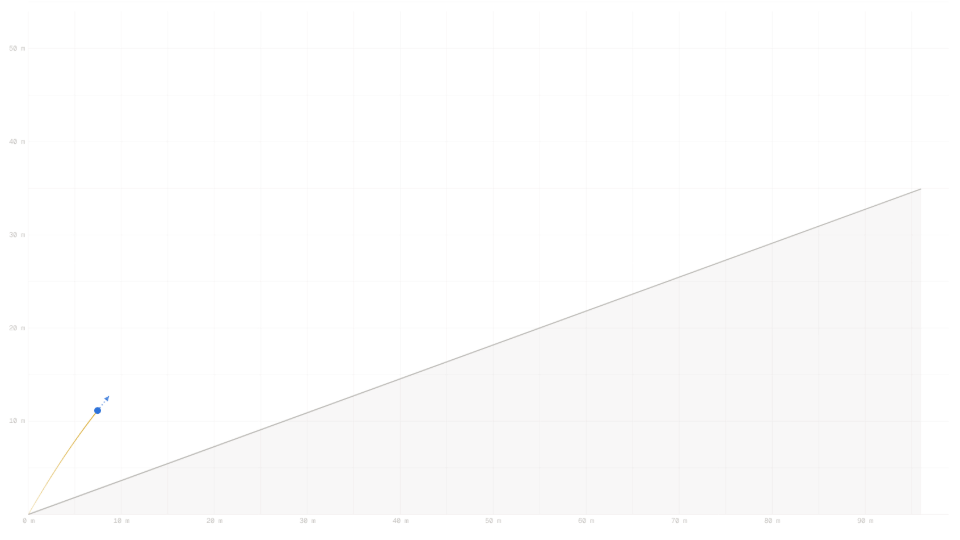
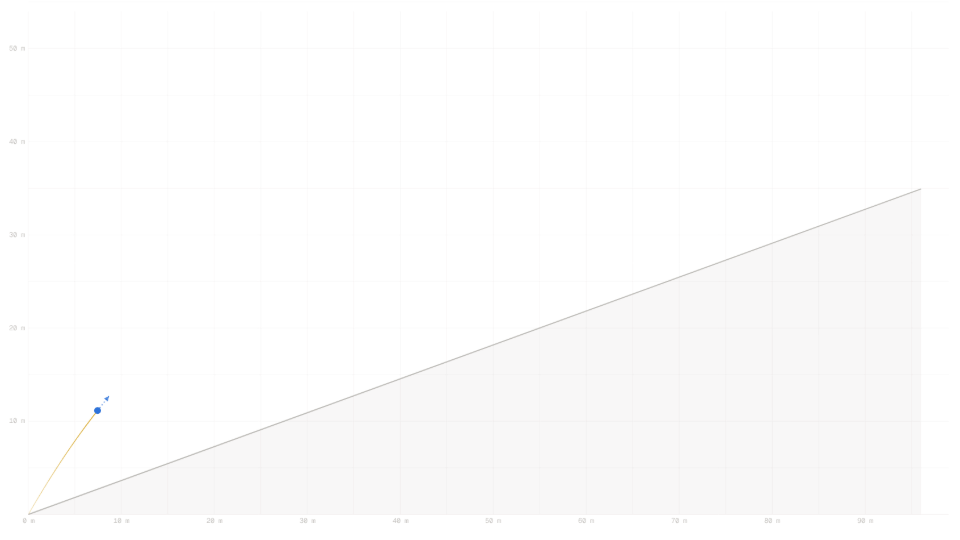
- On a fresh canvas the third button reads Reset; if earlier arcs are on screen it reads Clear; press Clear to wipe them. Set the slope angle φ to 20°, the initial speed v₀ to 25 m/s, and the launch angle θ to 60° (the defaults). The Optimum θ readout shows 55°.
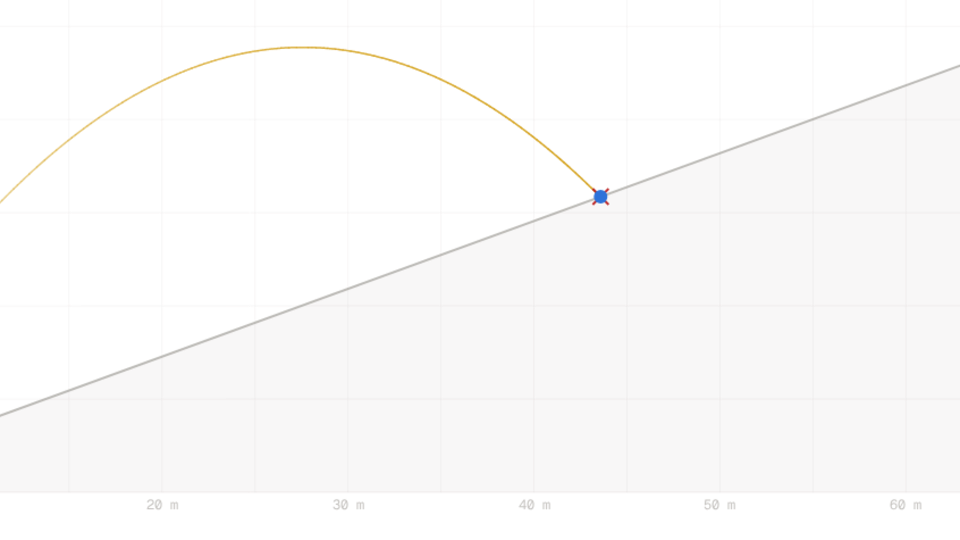
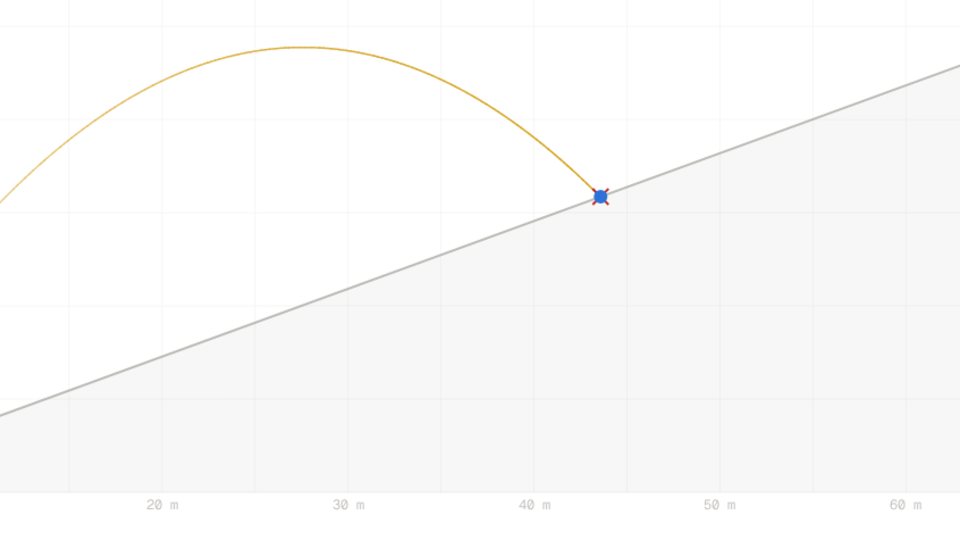
- Press Start. The projectile arcs up and lands back on the slope; the × marks the landing point. Record the Range up slope (≈ 46.4 m) and the Flight time (≈ 3.49 s).
- Press Reset: the first arc stays on the canvas as a faded grey ghost. Set the launch angle to 55° (the value the Optimum θ readout reported) and press Start. The new arc overlays the first, and the Range up slope now reads its maximum (≈ 47.5 m), beating the 60° shot.
- Press Reset, then set the slope angle φ to 0° (flat ground). The Optimum θ readout drops to 45°, recovering the ordinary projectile-range result. Press Start to confirm, then press Clear to wipe the board.
Analytical Prediction
The range measured along an upward slope of angle φ is R = 2·v₀²·cos(θ)·sin(θ − φ) / (g·cos²φ). With v₀ = 25 m/s, θ = 60°, and φ = 20° (so θ − φ = 40°):
The flight time T = 2·v₀·sin(θ − φ) / (g·cos φ):
The range-maximising launch angle is θ* = 45° + φ/2 = 45° + 10° = 55°, which bisects the slope and the vertical. At that angle the range reaches its maximum, R_max = v₀² / (g·(1 + sin φ)) ≈ 47.5 m, slightly more than the 46.4 m at 60°. Setting φ = 0 returns θ* to 45° and R to the flat-ground v₀²·sin(2θ)/g.
Results Analysis
After each run, compare the Range up slope readout to the prediction. At θ = 60°, v₀ = 25 m/s, φ = 20° it should read ≈ 46.4 m and the Flight time ≈ 3.49 s. Re-run at θ = 55° (the optimum the readout reports): the range climbs to its maximum ≈ 47.5 m, confirming θ* = 45° + φ/2. Overlay several launch angles with Reset and watch the landing × march up and back down the slope; the arc that reaches furthest is the one launched at θ*. Now set φ = 0: the Optimum θ readout returns to 45° and the whole picture collapses to ordinary level-ground projectile range, the φ = 0 special case of the same formula.
Source of Error
This model omits air resistance, the finite size of the projectile (point-mass idealisation), Earth's curvature, and any spin or Magnus effect. Both the closed-form prediction and the simulation assume the same idealisations (a point mass, uniform gravity g = 9.81 m/s², and a perfectly straight slope), so those assumptions cancel when you compare the predicted value to the readout rather than adding to the residual. Any small gap between prediction and readout is therefore numerical (discrete time step, rounding), not physical. When θ ≤ φ the shot does not travel up the slope and the range collapses to zero.
Further Exploration
- Hold φ = 20° and v₀ = 25 m/s and sweep the launch angle from 30° to 80°, watching the Range up slope readout. At what angle is the range greatest? Does it match the 55° that the Optimum θ readout predicts?
- Change the slope angle φ and watch the Optimum θ readout. Confirm the relationship θ* = 45° + φ/2: at φ = 0° it reads 45°, at φ = 30° it reads 60°. Why does a steeper slope want a steeper launch?
- Set φ = 0° and compare the behaviour to the flat-ground case: is the optimum back at 45°, and do complementary angles (e.g. 30° and 60°) give equal range again? What breaks that symmetry once φ > 0?
- With Reset keeping each arc as a ghost, overlay launches at 45°, 55°, and 65° on a 20° slope at fixed speed. Which two bracket the optimum, and how much range do you lose by missing θ* by 10°?