Full Projectile Sandbox PhysicsAll Four Forces on One Projectile
Introduction
This is the capstone of the projectile family. Every earlier simulation isolated one new idea (a launch off a cliff, a moving platform, air drag, a head-wind, back-spin) so it could be understood on its own. Here they all run at once. A single ball flies under gravity, quadratic drag relative to a moving air mass, and the Magnus lift of its own spin, with five sliders to set the launch, the air, and the spin.
The point of the sandbox is twofold. First, it shows that the earlier sims were never separate physics: each is this one model with some of its terms switched off. Turn the spin and wind to zero and you are back to the plain drag sim; leave the wind at zero and you have the Magnus sim; leave the spin at zero and you have the wind sim. Second, it reveals what only appears when the forces share a stage: the way they couple through the velocity they all act on.
That coupling produces the sandbox's most surprising result. A tail-wind, which lengthens an ordinary drag shot, can actually shorten a heavily back-spun one, because the tail-wind lowers the speed the ball feels through the air and the Magnus lift fades with it. Forces in the real world are not a stack of independent effects; they feed back on one another through the motion they jointly produce, and the full model is where that becomes visible.
The Physics Explained
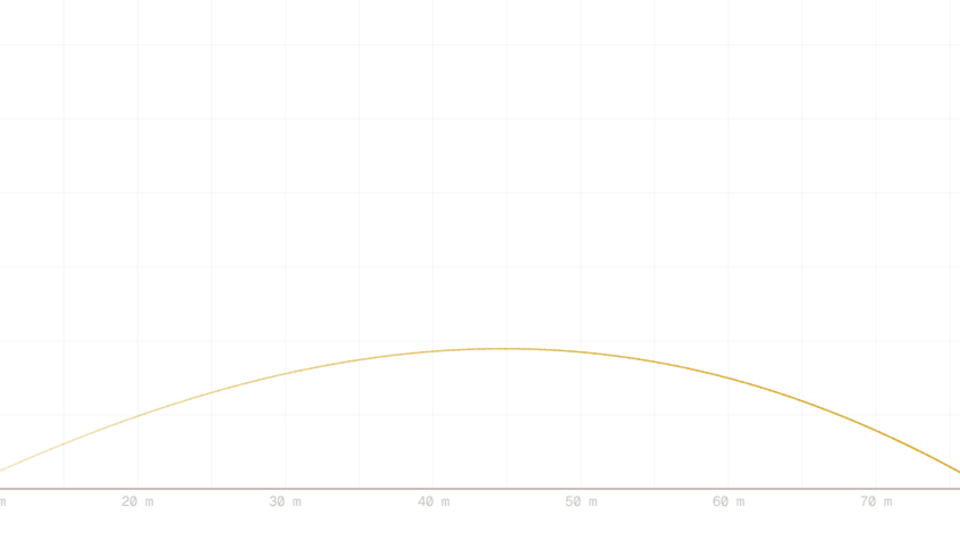
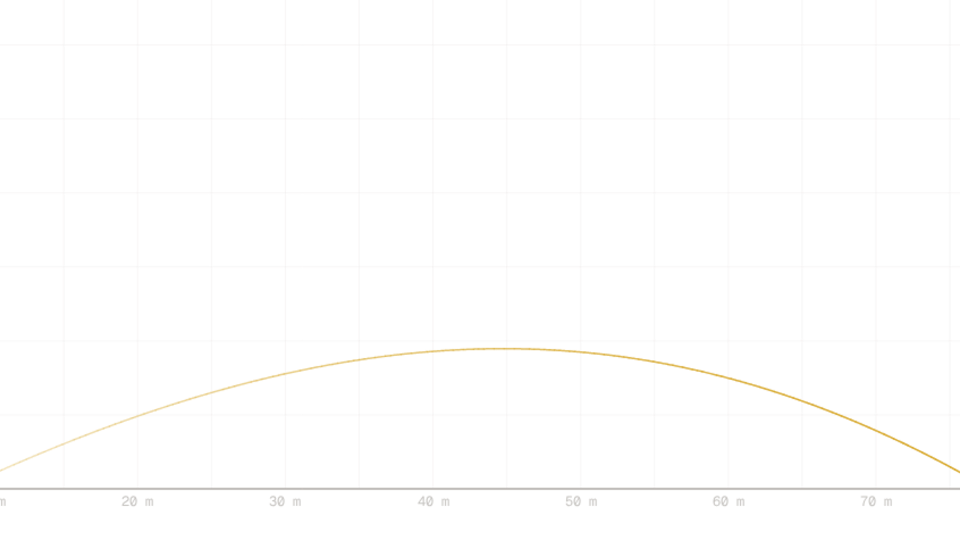
The whole flight is governed by one acceleration with three contributions. Gravity pulls straight down at g. Quadratic drag opposes the velocity relative to the air, v − w, with a magnitude that scales as the square of the relative airspeed. The Magnus force, set by the spin, acts perpendicular to that same relative velocity, with magnitude C·ω·|v − w|. Crucially, both the aerodynamic forces read the relative airspeed |v − w|, not the ground speed.
Resolved into components, the accelerations are aₓ = −(k/m)·(vₓ − w)·|v − w| − C·ω·vy and ay = −g − (k/m)·vy·|v − w| + C·ω·(vₓ − w). The lift lives in the +C·ω·(vₓ − w) term: for back-spin on a forward-moving ball it points up, opposing gravity. Notice that the wind speed w sits inside both the drag factor and the Magnus factor; that shared appearance is the coupling that makes the forces interact.
Because the equations are nonlinear and coupled, there is no closed-form range; the simulator integrates them in small steps. With the defaults (28 m/s at 25°, drag 0.0040, no wind, back-spin 120) the ball carries about 69 m. Switch the spin off and it carries about 53 m; that arc is exactly the projectile-with-drag sim. Raise the spin to 200 and the carry grows to about 83 m as the lift holds the ball up; that is the Magnus sim. Leave the spin off and add an 8 m/s tail-wind for about 56 m, or a head-wind for about 48 m: the wind sim.
The synthesis is the interesting part. Pair the back-spin of 200 with the 8 m/s tail-wind and the carry is about 77 m, less than the 83 m the same spin gives in calm air. The tail-wind lowered the relative airspeed, and since the Magnus lift is proportional to that airspeed, the lift weakened. For the spinless shot the tail-wind only cut the drag and so helped; for the spinning shot it also cut the lift, and here the lost lift wins. One slider, two coupled consequences.
Key Equations
This single quantity drives both aerodynamic forces. Anything that changes it (the wind, the launch speed, the spin's effect on the path) changes the drag and the Magnus lift together, which is the root of every coupling the sandbox shows.
The first term is drag relative to the air; the second is the horizontal part of the Magnus force, which curves the path backward as the ball rises and forward as it falls. Set the spin to zero and only the drag-and-wind term is left, which is the wind sim.
Gravity and vertical drag pull down; the +C·ω·(vₓ − w) lift fights them for a back-spinning, forward-moving ball. Because that lift carries (vₓ − w), the wind reaches straight into it: a tail-wind shrinks the term and softens the lift.
With spin and wind off, the model collapses to plain quadratic-drag projectile motion, the shared trunk of the whole family, whose optimum range sits just below 45°. Every other sim grows from here by switching a term back on.
Key Variables
| Symbol | Name | Unit | Meaning |
|---|---|---|---|
| v₀ | Launch speed | m/s | Initial speed of the ball relative to the ground |
| θ | Launch angle | ° | Angle of launch above the horizontal |
| k | Drag coefficient | kg/m | Strength of the quadratic drag |
| w | Wind speed | m/s | Horizontal air velocity; negative is a head-wind, positive a tail-wind |
| ω | Spin | rad/s | Spin rate; positive is back-spin (lift), negative is top-spin (dive) |
| C | Magnus coefficient | 1/s per unit spin | Strength of the lift per unit spin and relative airspeed |
| |v − w| | Relative airspeed | m/s | Speed through the air; drives both drag and lift |
| g | Gravitational acceleration | m/s² | Downward acceleration due to gravity; 9.81 m/s² at Earth's surface |
Real World Examples
How is every other projectile simulation a special case of this one?
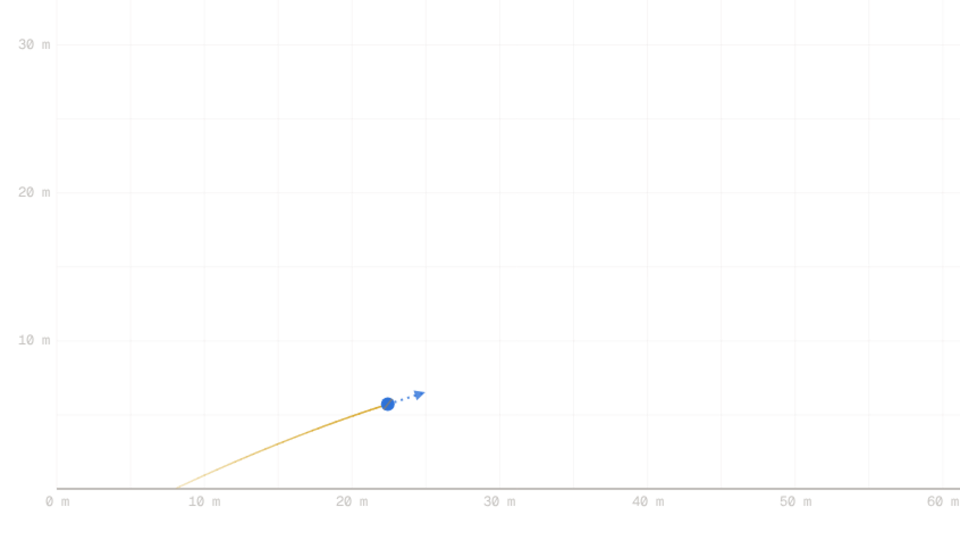
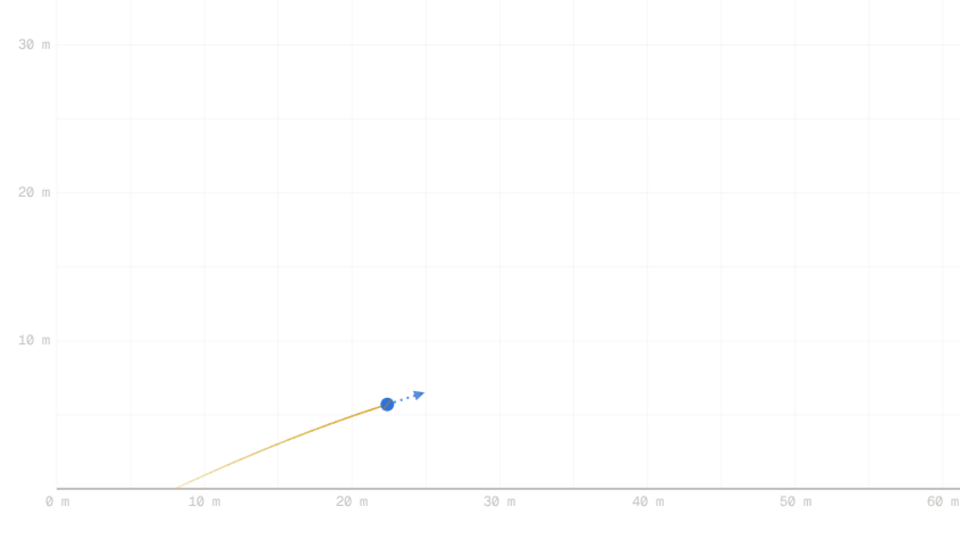
This sandbox runs the full equation of motion (gravity, quadratic drag relative to the moving air, and the Magnus lift of spin), so every simpler projectile is just this model with one or more terms switched off. Set the spin and the wind to zero and only gravity and drag remain: that is the projectile-with-drag sim, carrying about 53 m at the defaults.
Leave the wind at zero but turn the spin up to 200 and you have the Magnus sim, carrying about 83 m as lift holds the ball aloft. Leave the spin at zero but add an 8 m/s tail-wind and you have the wind sim at about 56 m, or a head-wind for about 48 m. Even the ideal vacuum parabola is the limit of dialling the drag toward zero with spin and wind off.
Building the family this way shows that the 'different' simulations were never really different physics: they were one set of forces with various pieces hidden. The sandbox simply turns them all on at once, and the earlier sims reappear, one at a time, as you switch the extra forces back off.
Why can a tail-wind make a heavily back-spun ball travel less far?
Because drag and the Magnus lift both depend on the ball's speed through the air, not over the ground, the wind quietly controls how much lift the spin produces. A tail-wind lowers the relative airspeed |v − w|, and since the Magnus lift is proportional to that airspeed, the lift weakens.
For a spinless shot a tail-wind helps, because it only reduces the drag; there is no lift to lose. But for a heavily back-spun shot the lost lift can outweigh the reduced drag, so the ball comes down sooner. The sandbox shows it directly: at the defaults with a spin of 200, calm air gives about 83 m, while adding an 8 m/s tail-wind drops the carry to about 77 m.
The same tail-wind that lengthens a spinless drag shot shortens the spinning one. It is a clean reminder that the forces on a real projectile are coupled: you cannot change the wind without also changing the lift, because both read the same relative airspeed.
Why don't real projectile forces simply add up independently?
They do add as vectors at any instant, but they are not independent inputs, because several of them depend on the same changing quantities, chiefly the velocity relative to the air. Drag depends on the relative airspeed; the Magnus lift depends on it too, and on the direction of the velocity; and the velocity is itself changing under all of the forces together.
So adjusting one force shifts the velocity, which changes what the other forces produce on the next instant. The sandbox makes this feedback visible: switch the spin on and the ball flies flatter and faster, which means more airspeed, which means even more lift and more drag; the forces feed back on each other through the shared trajectory.
This is why there is no neat closed-form range once drag and lift are present: the equations are coupled and must be integrated step by step, exactly as the simulator does. The lesson of the capstone is that real-world motion is a system of interacting forces, not a stack of independent effects you can reason about one at a time.
Further Reading
- Projectile with drag: the family's baseline, recovered here by switching spin and wind off.
- Terminal velocity: the same quadratic drag in pure vertical motion, the balance the drag term pushes toward.
- Projectile motion: the force-free parabola at the very root of the family, the drag-free limit of this model.