Full Projectile Sandbox · SimulatorGravity, Drag, Wind & Spin
The capstone projectile sandbox: gravity, drag relative to moving air, and Magnus spin lift all at once. Every earlier sim in the family is this model with one or more knobs turned off.
Published: June 8, 2026
Objective
Bring every projectile force together in one sandbox (gravity, quadratic drag relative to a moving air mass, and the Magnus lift of a spinning ball) and watch how they combine and interact. Each earlier simulation in the family is this model with knobs turned off: set spin and wind to zero for plain drag, leave wind at zero for the Magnus sim, leave spin at zero for the wind sim. Confirm that back-spin lengthens the carry while top-spin shortens it, that a head-wind shortens and a tail-wind lengthens a spinless shot, and (the key synthesis) that because both drag and lift act on the speed through the air, a tail-wind paired with strong back-spin can actually cut the range by softening the lift. The ball is a point mass and C is a fixed Magnus coupling.
Setup
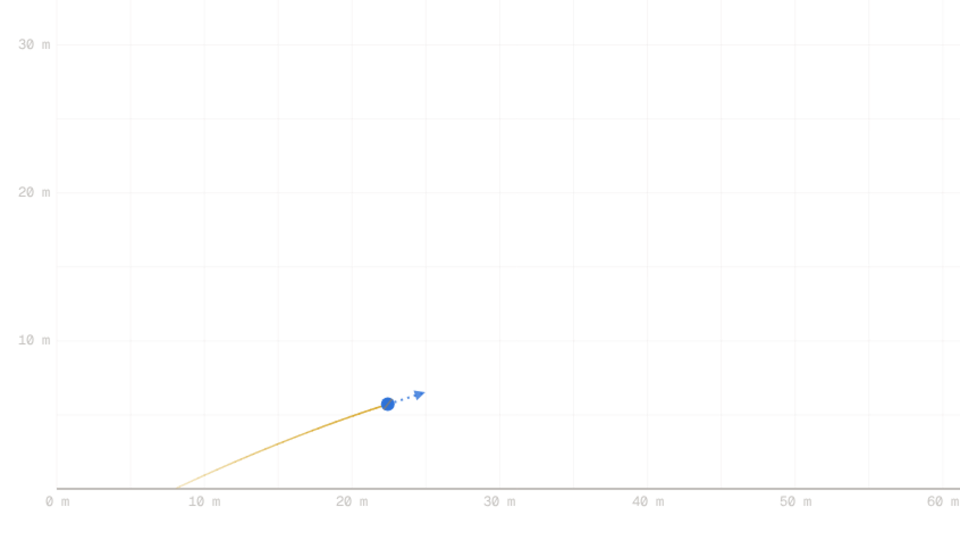
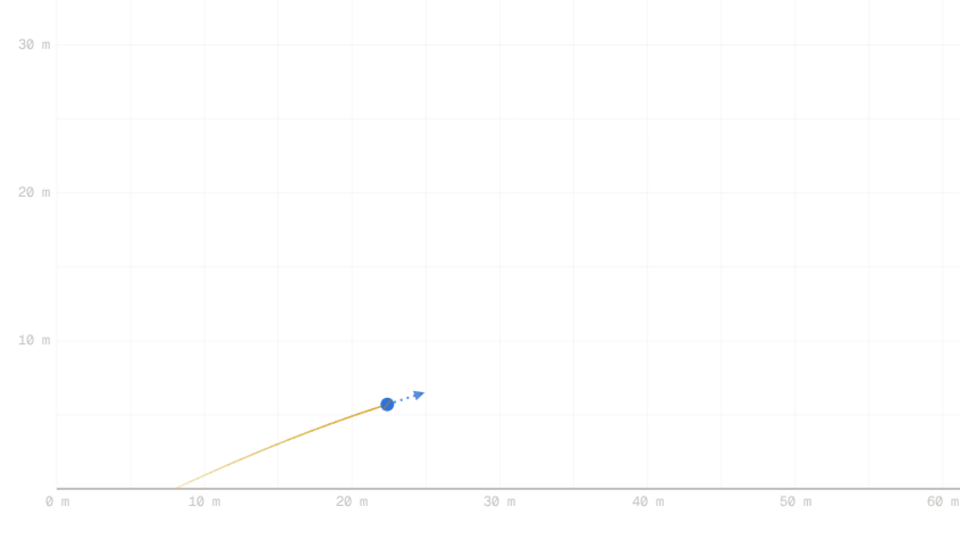
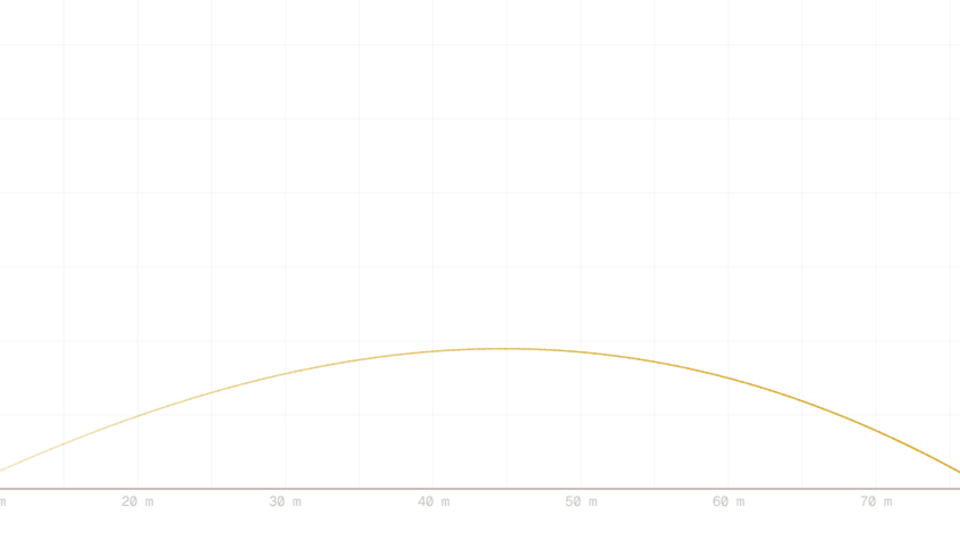
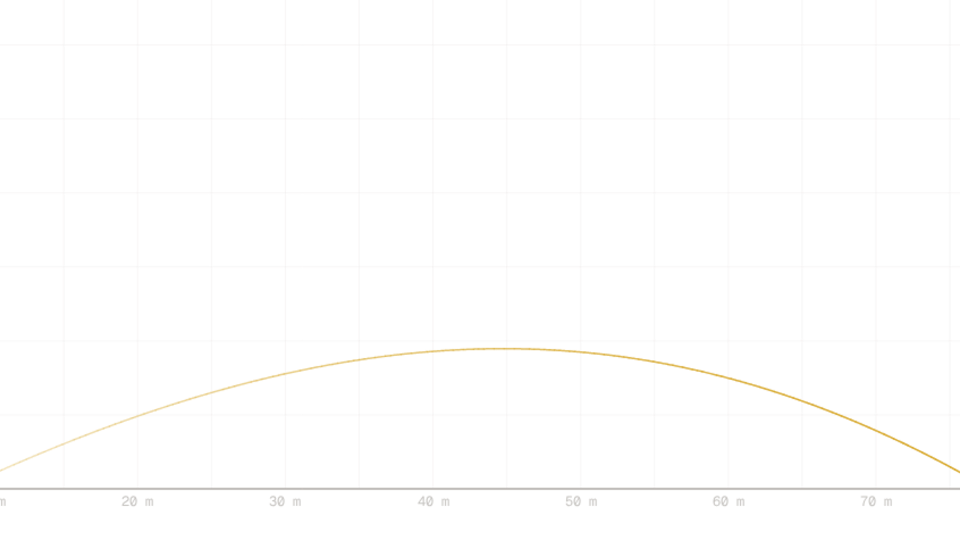
- On a fresh canvas the third button reads Reset; if earlier arcs are on screen it reads Clear; press Clear to wipe them. Leave the defaults (launch 28 m/s, 25°, drag 0.0040 kg/m, wind 0, spin 120 back-spin) and press Start. The ball carries about 69 m and tops out near 9 m.
- Press Reset: the arc stays as a faded ghost. Set the Spin to 0: the carry drops to about 53 m, and that arc is exactly the plain drag sim. Press Reset and raise the Spin to 200: the carry grows to about 83 m with an apex near 12 m, the Magnus sim.
- Press Reset, set the Spin back to 0 and the Wind to +8 (a tail-wind): about 56 m. Press Reset and set the Wind to −8 (a head-wind): about 48 m. Those two are the wind sim, with spin switched off.
- Now the synthesis. Press Reset and set the Spin to 200 and the Wind to +8 together. The carry comes out near 77 m, shorter than the 83 m of back-spin in calm air, because the tail-wind lowers the airspeed and a slower ball gets less Magnus lift.
- Press Reset and set the Spin to −150 (top-spin): the ball dives and lands short, near 40 m. Use Reset to overlay top-spin, no spin, and back-spin, then press Clear when you have compared them.
Analytical Prediction
All the forces act through one acceleration. Drag and the Magnus lift both depend on the speed relative to the air, v − w, so the wind couples into the spin lift as well as the drag:
There is no closed form, so the motion is integrated. With the defaults (28 m/s, 25°, k = 0.0040, wind 0, spin 120) the carry is about 69 m. Switch the spin off and it falls to about 53 m, the plain drag sim. Raise the spin to 200 and it grows to about 83 m, the Magnus sim. The synthesis appears when you combine them: a tail-wind of 8 with that spin of 200 gives only about 77 m, not more, because the Magnus term carries (vₓ − w) and the tail-wind has shrunk it, weakening the lift.
Results Analysis
Read the Range and Apex while you switch knobs. Each earlier family member is hiding inside this one: spin 0 and wind 0 is the drag sim (about 53 m at the defaults); wind 0 with spin is the Magnus sim (about 83 m at spin 200); spin 0 with wind is the wind sim (about 56 m with an 8 m/s tail-wind, 48 m into a head-wind). The deeper lesson is that the forces are not independent. Drag and lift both scale with the relative airspeed |v − w|, so anything that changes that airspeed changes both at once. That is why a tail-wind, which lengthens a spinless shot, can shorten a heavily back-spun one: it lowers the airspeed, and the lift falls with it. With Reset keeping every arc as a ghost, build up the family one knob at a time and watch the single full model reproduce each special case.
Source of Error
The model is a point-mass ball under gravity, quadratic drag of fixed coefficient k, a steady uniform horizontal wind, and a Magnus lift C·ω·|v − w| with a constant coupling C and a constant spin. It leaves out gusting and sheared wind, spin decay in flight, drag and lift coefficients that drift with the Reynolds number, and the sideways curve of a ball spinning about a vertical axis. Because every arc in this sandbox uses the same idealisations, the way the special cases nest inside the full model, and the airspeed coupling between wind and spin, are exact consequences of the equations above, not artefacts. The honest limit is the same as for the pieces: set spin and wind to zero and only quadratic-drag projectile motion remains, the shared baseline of the whole family.
Further Exploration
- Turn the knobs off one at a time to recover each earlier sim. Which exact combination reproduces the plain drag parabola, and which adds only the wind?
- Set a strong back-spin and compare calm air, a tail-wind, and a head-wind. Which wind helps the spun ball most, and why is the tail-wind's effect the opposite of what it does to a spinless shot?
- Tune the angle and spin together to find the longest carry. With every force switched on, where does the best launch angle settle compared with the drag-free 45°?
- Set top-spin and a head-wind at the same time. How short can you make the flight, and which of the two forces is doing more of the work?