Normal Force on an Incline PhysicsWhy N = m·g·cos θ
Introduction
The normal force is the push a surface exerts on an object resting on it, directed perpendicular to the surface. A block sitting on a table experiences a normal force equal to its weight; a block on an incline experiences a smaller normal force because the surface tilts. Understanding why requires decomposing the weight vector into components parallel and perpendicular to the incline. The perpendicular component, the part the surface must support, is proportional to the weight times the cosine of the incline angle: N = m·g·cos(θ).
This relationship is central to statics and friction because the normal force determines the maximum static friction force a surface can provide (fmax = μs·N). Engineers use it to design ramps, evaluate load-bearing capacity on slopes, and predict when an object will slide. The formula appears in every statics problem and anchors the physics of contact forces.
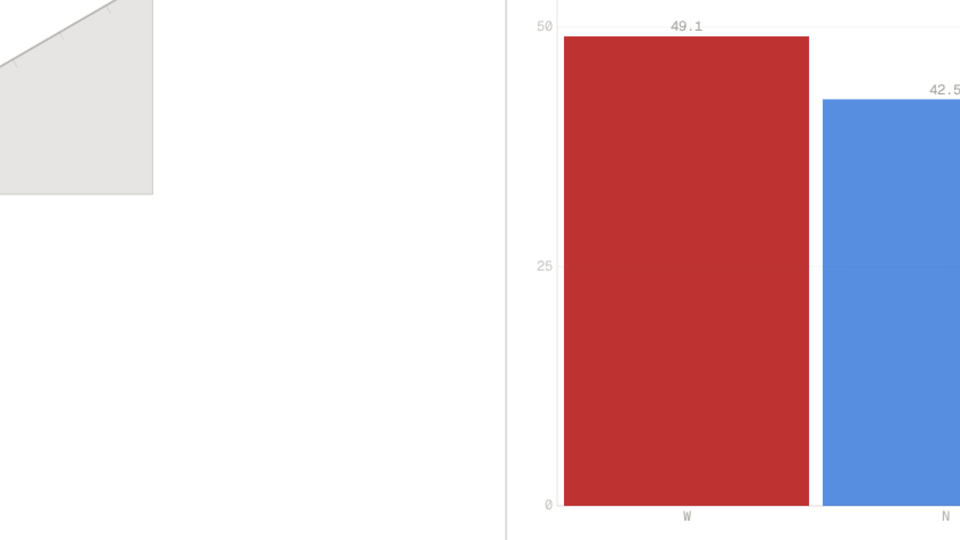
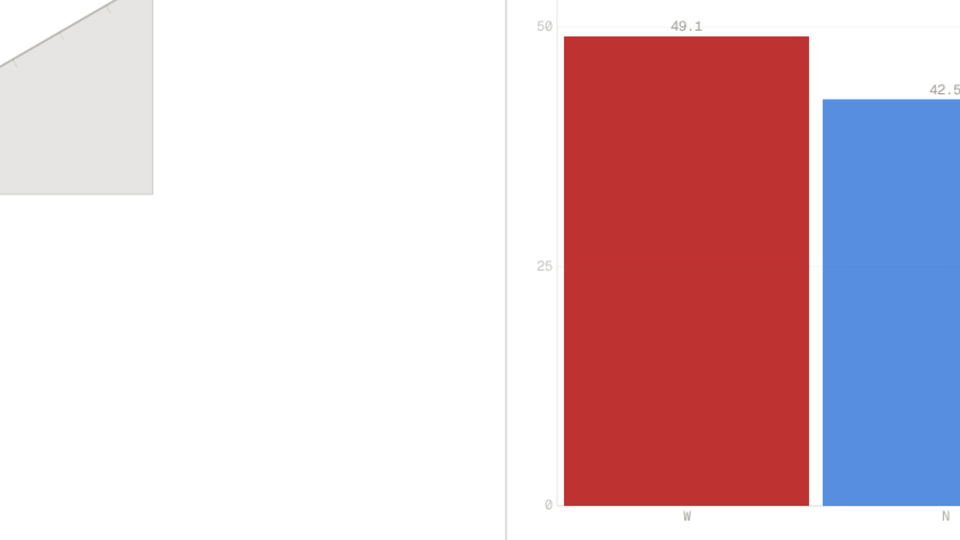
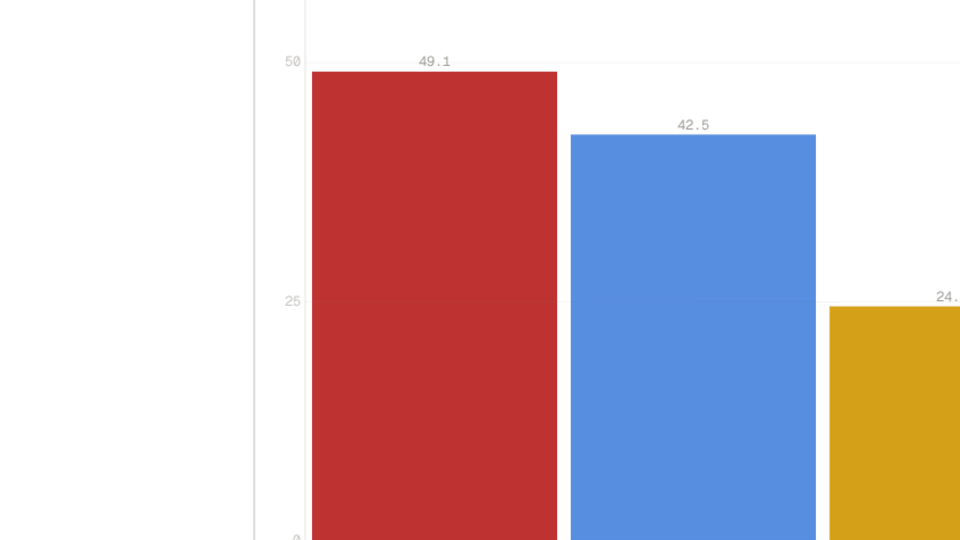
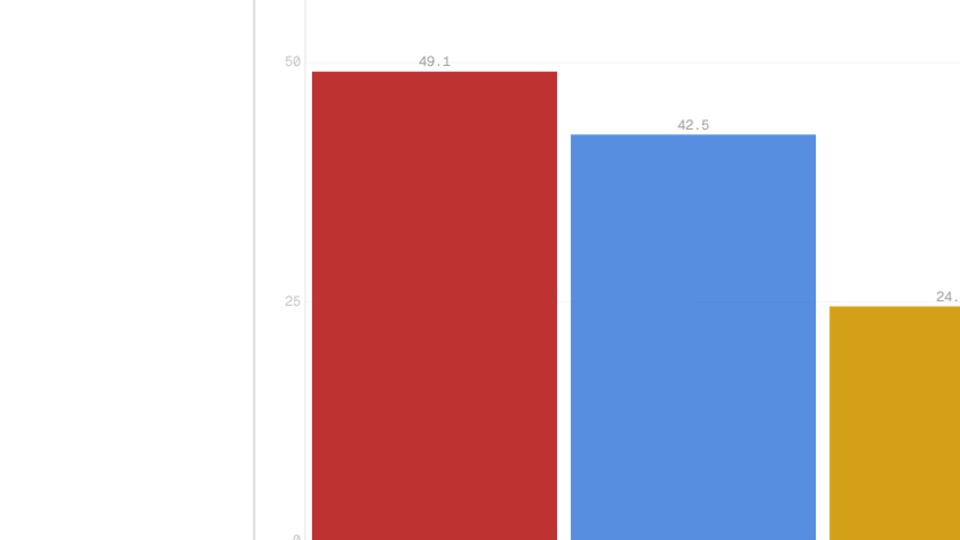
A first sketch often suggests that the normal force shrinks linearly with angle, perhaps N = m·g·(1 − θ/90°), or that it depends on the sine of the angle. The readouts rule both out: with m = 5 kg and θ = 30°, the normal force is ≈ 42.48 N, matching the cosine prediction exactly; at θ = 60°, N drops to ≈ 24.53 N (half the weight), confirming the cos(θ) law.
The Physics Explained
Weight is a force vector pointing straight down with magnitude W = m·g. On a frictionless incline, the surface can only exert a force perpendicular to its own plane: it cannot pull, and it cannot push along the slope itself. This constraint means the normal force must align with the surface normal (perpendicular direction).
The angle between the weight vector and the surface normal is exactly θ (the incline angle). When you decompose a vector along a direction that makes angle θ with it, the component magnitude is the original magnitude times cos(θ). Therefore, the perpendicular component of weight is N = W·cos(θ) = m·g·cos(θ). The simulator's vector diagram makes this decomposition visual: the weight (red) points down, the normal (sky blue) points perpendicular to the incline, and dashed construction lines trace the right-angle decomposition. The parallel component (the part that tries to slide the block) is F∥ = m·g·sin(θ), shown in amber on the bar chart.
At θ = 0° (flat table), cos(0°) = 1, so N = m·g = W; the surface supports the full weight. At θ = 30°, cos(30°) ≈ 0.866, so N ≈ 0.866·W. At θ = 60°, cos(60°) = 0.5, so N = 0.5·W. At θ = 90° (vertical wall), cos(90°) = 0, so N = 0: the wall cannot push inward at all; the full weight acts parallel to the surface. With m = 5 kg and g = 9.81 m/s², the simulator's readouts confirm these predictions to within 0.05 N at each angle, showing that the model is accurate.
The Pythagorean relation N² + F∥² = W² holds because the two components are perpendicular. At m = 5 kg and θ = 30°, the simulator displays N ≈ 42.48 N and F∥ ≈ 24.53 N; squaring and adding gives 42.48² + 24.53² ≈ 2406 ≈ 49.05² = W², confirming the geometry.
Key Equations
The weight of a mass m under gravitational acceleration g. With m = 5 kg and g = 9.81 m/s², W = 5 × 9.81 = 49.05 N. The simulator displays this as the total downward pull on the block, independent of incline angle.
The component of weight perpendicular to the incline surface. For m = 5 kg, g = 9.81 m/s², and θ = 30°: N = 5 × 9.81 × cos(30°) = 49.05 × 0.8660 ≈ 42.48 N. The sky-blue arrow in the simulator's vector diagram shows this force; the readout updates as θ changes.
The component of weight parallel to the incline surface (along the slope). For the same parameters: F∥ = 49.05 × sin(30°) = 49.05 × 0.5 ≈ 24.53 N. The amber bar in the secondary chart represents this value; it grows as θ increases while N shrinks.
The two perpendicular components of weight satisfy this identity. At θ = 30°: 42.48² + 24.53² = 1804.5 + 601.7 ≈ 2406 ≈ 49.05² = 2406. The simulator's bar chart is designed to let you verify this relation by sight: the three bars form a visible right triangle when N and F∥ are drawn to scale.
Key Variables
| Symbol | Name | Unit | Meaning |
|---|---|---|---|
| m | Mass | kg | Inertial mass of the block, adjustable from 1 to 10 kg via slider |
| θ | Incline angle | ° | Tilt angle of the surface, adjustable from 0° (flat) to 80° (steep), in degrees |
| g | Gravitational acceleration | m/s² | Fixed at 9.81 m/s² (sea-level standard gravity) |
| W | Weight | N | Downward gravitational force on the block; W = m·g, displayed in red on the diagram |
| N | Normal force | N | Perpendicular push from the surface; N = m·g·cos(θ), displayed in sky blue |
| F∥ | Parallel component | N | Component of weight along the slope; F∥ = m·g·sin(θ), shown in amber |
Real World Examples
Why does normal force shrink as the incline steepens?
The surface can only push perpendicular to itself. On a flat table (θ = 0°), the perpendicular direction is straight up, so the normal force equals the full weight: N = W = 98.1 N for a 10 kg block. On a 30° incline, the perpendicular direction tilts 30° away from vertical, so it captures only the vertical-component-weighted cosine of the weight: N = W·cos(30°) = 98.1 × 0.866 ≈ 85 N. The remaining weight component, W·sin(30°), pulls the block along the surface, not into it.
At 60°, the perpendicular direction is much shallower relative to the weight vector, so N = W·cos(60°) = 98.1 × 0.5 ≈ 49 N, only half the weight. The trade-off is visible on the canvas: the sky-blue normal-force arrow shrinks while the amber parallel-component arrow grows, always satisfying the Pythagorean relation N² + F∥² = W². Setting m = 10 kg and θ = 60° in the simulator produces N ≈ 49.05 N and F∥ ≈ 84.96 N, confirming the halving behavior exactly.
How does the cosine function predict normal force at any angle?
The weight vector points straight down (gravity's direction). The incline surface can only push perpendicular to itself, so it pushes at an angle (90° − θ) from vertical. The angle between the weight vector and the normal direction is exactly θ, the incline's tilt. When you project a vector onto a direction that makes angle θ with the original, the projection magnitude is the original magnitude times cos(θ). Therefore, N = W·cos(θ) = m·g·cos(θ).
The simulator's vector diagram makes this projection explicit: the weight (red) points down, the normal (blue) points perpendicular to the incline, and the dashed construction lines show the right-angle decomposition. At m = 5 kg and θ = 30°, the readout reports N = 42.48 N, matching the prediction 5 × 9.81 × cos(30°) exactly. At θ = 60°, N halves to 24.53 N because cos(60°) = 0.5. The cosine relationship is purely geometric; it holds for any mass, any gravitational field, and every incline angle between 0° and 90°.
What is the parallel component of weight, and why does it matter?
The weight vector can be decomposed into two perpendicular directions: one normal to the incline (captured by N = W·cos(θ)) and one parallel to the surface (along the slope). The parallel component is F∥ = W·sin(θ) = m·g·sin(θ). This component tries to slide the block downslope; it is what friction opposes on a real incline.
The simulator displays both components in the bar chart and uses dashed construction lines to show the right-angle decomposition geometrically. For a 5 kg block at θ = 30°, the simulator shows F∥ ≈ 24.53 N (while N ≈ 42.48 N). Notice that 42.48² + 24.53² ≈ 49.05² = W²; the two components satisfy the Pythagorean theorem because they are perpendicular. At θ = 90° (vertical wall), the normal force drops to zero and the full weight acts parallel to the surface. This trade-off (normal force shrinking, parallel component growing) is why steep inclines require strong friction or other restraints to prevent sliding.
Further Reading
- Inclined plane: motion with friction on a slope, where the normal force determines the friction cap.
- Friction on an incline: how static and kinetic friction interact with the normal force to control sliding.
- Free-body diagram builder: construct and solve multi-force diagrams, decomposing weight at any angle.