Normal Force on an Incline · SimulatorNormal Force vs Slope Angle
Block on an incline with adjustable angle; normal force decreases as cosine of the angle
Published: June 2, 2026
Objective
Verify that the normal force on an inclined surface equals N = m·g·cosθ, not the full weight, by reading it as a function of angle. On a frictionless incline the block slides down under the unbalanced along-slope component F∥ = m·g·sinθ (acceleration a = g·sinθ, independent of mass), while the normal force stays equal to the perpendicular projection of weight, N = m·g·cosθ, unchanged by the motion. The block is idealized as a point mass.
Setup
- Set the angle slider to θ = 0° and the mass slider to m = 5 kg. Press Start and note the Normal Force N readout: it should equal the Weight W readout (both ≈ 49.05 N). This is the flat-surface baseline.
- Press Reset. Drag the angle slider to θ = 30° (leave mass at 5 kg). Before pressing Start, read the N readout: it should show ≈ 42.48 N. Record this as your prediction, then press Start to confirm the animated result.
- Press Reset. Drag the angle slider to θ = 60°. Predict N = m·g·cos60° ≈ 24.53 N. Press Start; the block slides down and the N readout holds at this value.
- Press Reset. Drag the angle slider to θ = 80° and mass to m = 10 kg. Predict N ≈ 17.03 N, W = 98.10 N. Press Start and verify the readouts match the analytic values within 0.1 N.
- Sweep the mass slider from 1 kg to 10 kg at a fixed angle (e.g. θ = 45°) without pressing Start; watch W and N both scale while the ratio N/W stays constant at cos45° ≈ 0.707. This confirms that the cosine relationship is mass-independent.
Analytical Prediction
The normal force is the component of weight perpendicular to the incline surface: N = m·g·cosθ. Weight is W = m·g regardless of angle. With m = 5 kg, g = 9.81 m/s², and θ = 30°:
At θ = 60°:
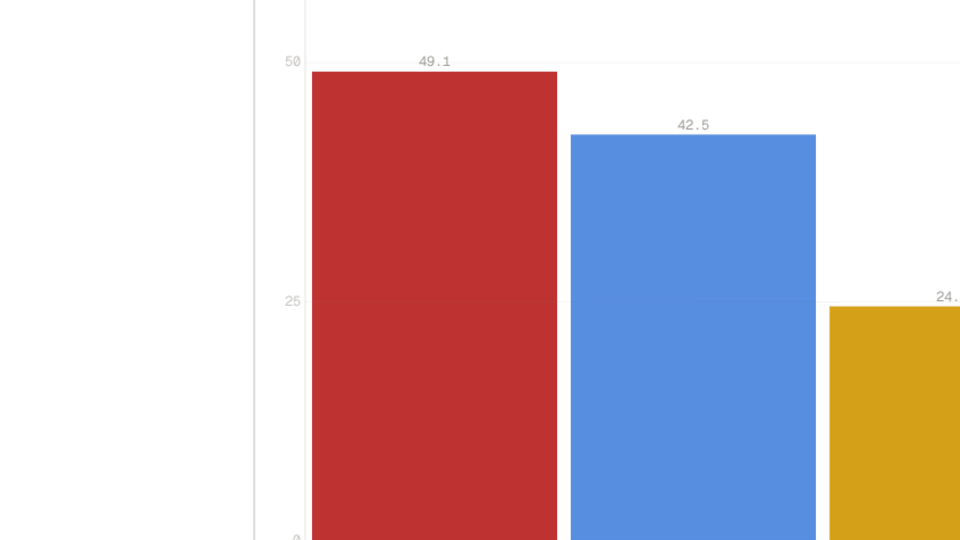
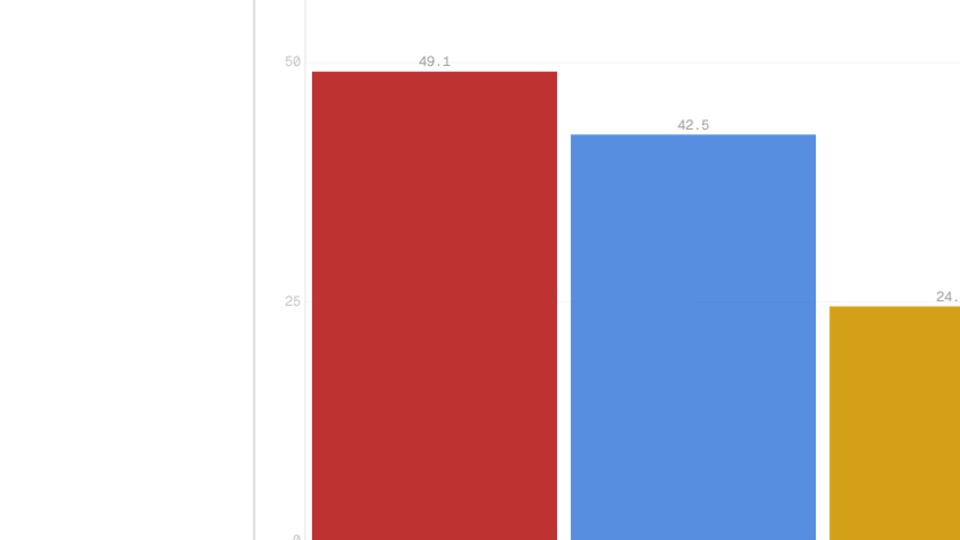
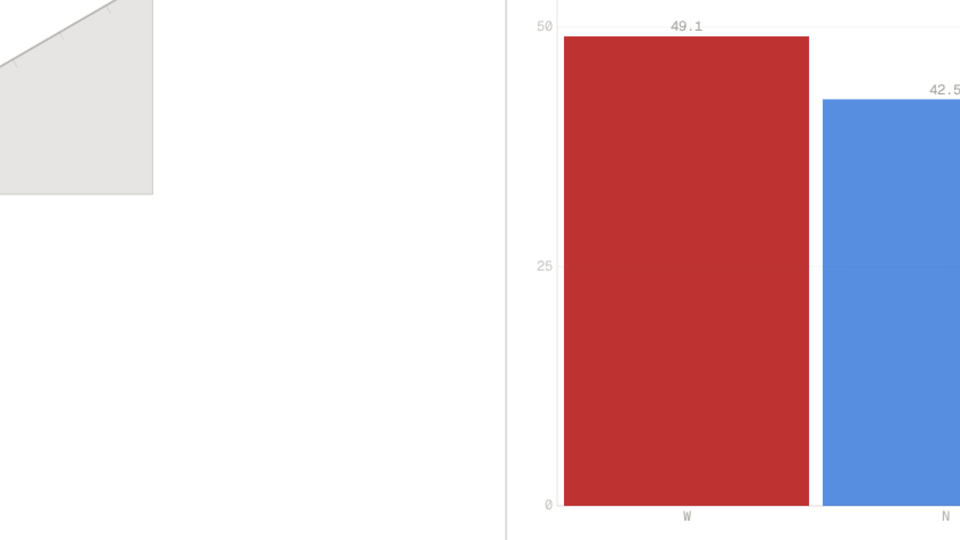
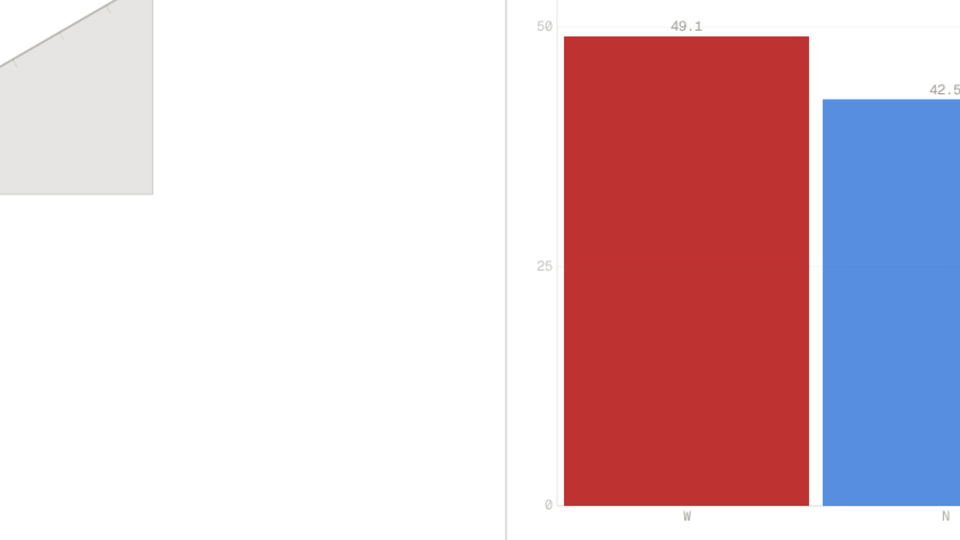
The ratio N(30°)/N(60°) = cos30°/cos60° = 0.866/0.500 ≈ 1.73, so the 30° case carries 73% more normal force than the 60° case, a large difference the bar chart makes immediate. The Pythagorean identity N² + F∥² = W² always holds: at 30°, 42.48² + 24.53² ≈ 2406 ≈ 49.05².
Results Analysis
After pressing Start at each test angle, the block slides down the frictionless incline while the Normal Force N readout stays constant (N does not depend on position). Compare the N readout to the analytic prediction. At θ = 30°, m = 5 kg, N reads 42.48 N (tolerance ± 0.05 N). At θ = 60°, it reads ≈ 24.53 N. The Weight W readout remains 49.05 N throughout, confirming W is angle-independent while N is not. The bar chart secondary view makes the trade-off visual: as θ increases, the sky-blue N bar shrinks and the amber F∥ bar grows, always satisfying N² + F∥² = W². The amber F∥ vector is the unbalanced net force that drives the slide.
Source of Error
This simulation models the block as a rigid point mass on a perfectly smooth, rigid incline with no friction, no air drag, and no rotational degrees of freedom. The analytical prediction N = m·g·cosθ assumes the same idealizations: a point mass on a frictionless incline under uniform gravity. The block slides under the unbalanced along-slope component F∥ = m·g·sinθ, but the normal force N is the geometric perpendicular projection of weight, computed directly from the angle rather than integrated, so it equals m·g·cosθ exactly throughout the slide, independent of any integration drift in the block's position. Any gap between the N readout and the analytic value is purely decimal rounding.
Further Exploration
- Set θ = 0° and m = 5 kg. Does N equal W exactly? Now slowly drag θ toward 90°. At what angle does N drop below half of W? (Hint: cos θ = 0.5 at θ = 60°.) Does the bar chart confirm this?
- Fix θ = 45° and sweep mass from 1 kg to 10 kg. Does the ratio N/W stay constant? What does this tell you about the mass-independence of the cosine relationship?
- Compare θ = 30° and θ = 60°. The angles differ by 30°, but N at 30° is about 1.73 times N at 60°, not 1.5 times. Why? (Hint: the cosine function is not linear; equal angle steps produce unequal normal-force steps.)
- Set θ = 80° and m = 10 kg. The normal force N ≈ 17 N while W ≈ 98 N. If you placed a book on this near-vertical ramp, what force would need to hold it in place along the surface, and why is it so much larger than N?