Puck on Ice PhysicsNewton's First Law & Stopping Distance
Introduction
Puck on Ice simulates a hockey puck sliding across ice with a logarithmic friction slider spanning three decades, from μk = 0.0001 (idealized frictionless) through μk = 0.01 (real hockey-puck-on-ice) up to μk = 0.1 (rough or worn ice). The simulator tracks Speed, Distance, and Kinetic Energy in real time; a speed-versus-time plot to the right of the puck shows the deceleration profile alongside the live motion. At the low end of the slider the puck slides at near-constant speed for the full 30-second run; near the high end the friction force is strong enough to bring the puck to rest within seconds at a predictable stopping distance.
Newton's First Law, the law of inertia, states that an object in uniform motion continues at that velocity unless a net external force acts on it. Engineers apply this principle when designing curling stones, hockey rinks, and any low-friction surface where motion needs to persist with minimal input. The friction model used here, fk = μk · m · g, is the standard kinetic-friction approximation that underlies all of those calculations.
A persistent misconception is that a moving object requires a continuous force to keep moving. The simulator contradicts this directly: with Friction (μk) at its slider minimum (0.0001) and Initial Speed set to 10 m/s, the Speed readout remains essentially at 10.00 m/s for the entire 30-second run. No force is applied after launch, yet no observable deceleration occurs; the puck moves at constant velocity because the net force on it is negligible.
The Physics Explained
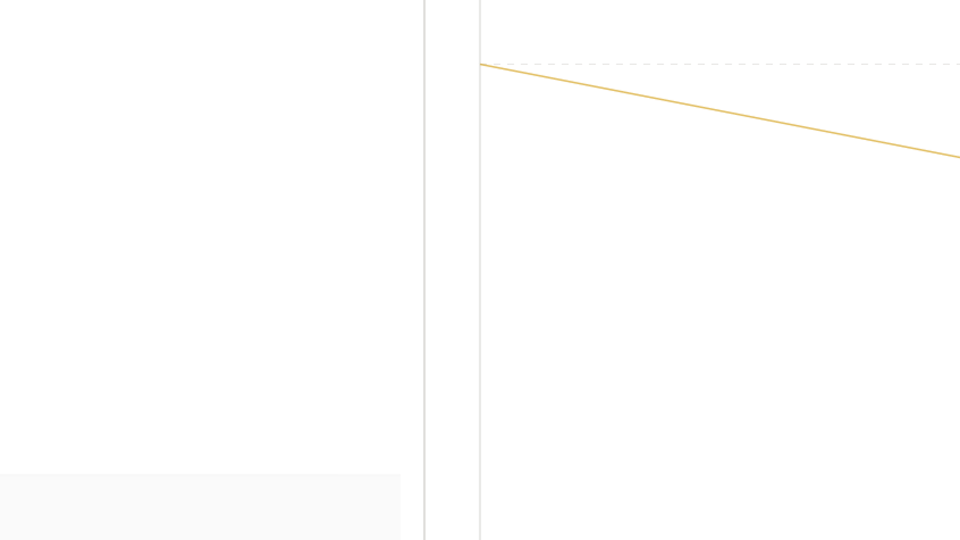
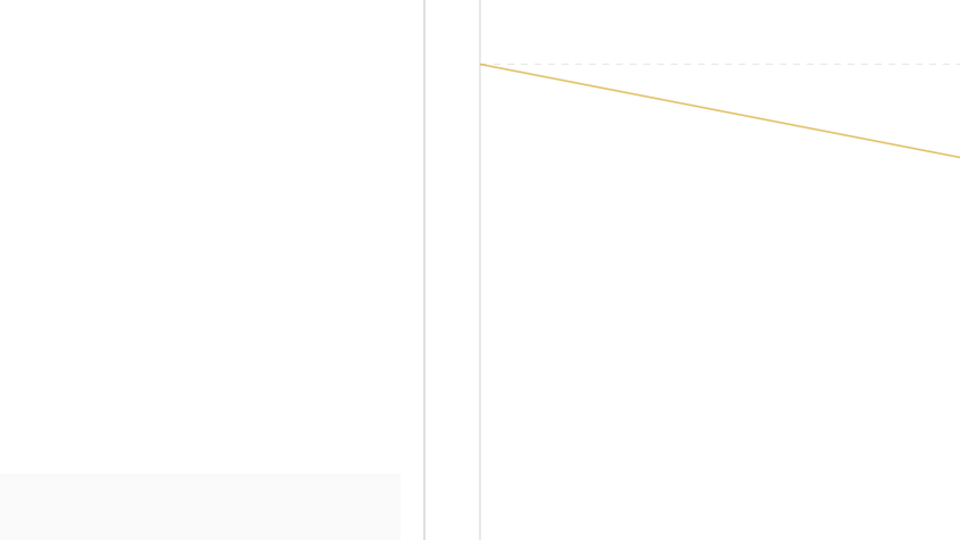
Newton's First Law draws a sharp distinction between rest and uniform motion on one side, and accelerated motion on the other. An object at rest stays at rest; an object moving at constant velocity continues at that velocity. Both states share the same cause: zero net force. In the simulator the puck is launched horizontally, so gravity is balanced by the normal force from the surface and contributes nothing to horizontal acceleration. The only horizontal force available is kinetic friction, and its magnitude is fk = μk · m · g, directed opposite to the direction of motion.
When μk is near zero (slider minimum, 0.0001), fk evaluates to essentially zero regardless of mass or gravity. The net horizontal force on the puck is therefore negligible, and Newton's First Law requires that the velocity remain constant. The Speed readout reflects exactly that. With Initial Speed set to 10 m/s and Friction (μk) at 0.0001, the readout holds at 10.00 m/s from the first frame to the 30-second time cap, and the speed-versus-time plot to the right shows a perfectly horizontal trace. The Distance readout climbs linearly: at t = 5 s it reads 50.0 m, at t = 10 s it reads 100.0 m, advancing at 10 m per second with no observable drift.
Raising μk introduces a constant deceleration a = μk · g acting against the motion. At μk = 0.1 (slider maximum), the deceleration is 0.981 m/s². The speed-versus-time trace changes from horizontal to a downward-sloping straight line, and the Speed readout decreases at a steady rate until it reaches 0.00. The puck then halts and the simulation stops. The Distance readout at that moment should read approximately 51.0 m, matching the analytical stopping-distance formula. At the slider's default μk = 0.01 (real hockey-puck-on-ice) the deceleration is only 0.0981 m/s²: the puck would need over 500 m to come to rest, well beyond the 30 s time cap, so the run ends with the puck still moving: Distance readout near 256 m and Speed readout near 7 m/s.
The Kinetic Energy readout mirrors the square of the speed, so it declines faster than the speed itself: at μk = 0.1, during the first second speed drops from 10.00 to 9.02 m/s while kinetic energy falls from 50.0 J to approximately 40.7 J. At the slider minimum, kinetic energy is essentially conserved for the full run because no significant force does work on the puck. This pairing of constant speed and constant kinetic energy is the signature of Newton's First Law operating without interference.
Key Equations
When the vector sum of all forces on the puck is essentially zero, velocity does not change. With Friction (μk) at the slider minimum (0.0001) and Initial Speed = 10 m/s, the simulator's Speed readout stays at 10.00 m/s for the entire 30-second run, confirming the left-hand side equals zero (within the slider's resolution) and the right-hand side holds exactly.
The simulator uses m = 1 kg and g = 9.81 m/s². At μk = 0.1 (slider maximum), fk = 0.1 × 1 × 9.81 = 0.981 N. The red arrow on the canvas represents this force; its length scales with fk and shrinks toward invisibility as μk approaches the slider minimum (0.0001), where fk = 0.000981 N.
Because m cancels from Newton's Second Law (fk = m · a → a = fk / m = μk · g), the deceleration is independent of the puck's mass. At μk = 0.1, a = −0.1 × 9.81 = −0.981 m/s². At μk = 0.01, a = −0.0981 m/s². At μk = 0.001, a = −0.00981 m/s². The speed-versus-time plot to the right shows a steeper downward slope at higher μk, and the simulator's numerical integration reproduces this slope to within the sub-step accuracy of the physics engine. The logarithmic slider means that moving from 0.001 to 0.01 to 0.1 multiplies the slope by 10 each step.
This formula follows from setting v = 0 in the kinematic equation v² = v₀² − 2 · a · d. With v₀ = 10 m/s and μk = 0.1: d = 100 / (2 × 0.981) = 100 / 1.962 ≈ 51.0 m. The simulator's Distance readout at halt should match this value to within 0.5 m. Setting v₀ = 20 m/s with μk = 0.1 quadruples the stopping distance to approximately 204 m, because d scales with v₀², not v₀; a doubling of speed requires four times the stopping distance. At μk = 0.01 (slider default), the formula gives d = 100 / 0.1962 ≈ 510 m, longer than the puck can travel within the 30 s time cap, so the run ends before the puck stops, and the Distance readout instead settles near 256 m at t = 30 s.
Key Variables
| Symbol | Name | Unit | Meaning |
|---|---|---|---|
| v | Velocity | m/s | Current speed of the puck; shown in the Speed readout |
| v₀ | Initial speed | m/s | Speed at the moment the puck is launched; set by the Initial Speed slider |
| m | Mass | kg | Puck mass; fixed at 1 kg in the simulator |
| μk | Kinetic friction coefficient | dimensionless | Ratio of friction force to normal force; set by the Friction slider |
| fk | Kinetic friction force | N | Retarding force equal to μk · m · g; shown as the red arrow on canvas |
| a | Deceleration | m/s² | Magnitude of the friction-induced acceleration; equals μk · g |
| d | Stopping distance | m | Total distance traveled before the puck halts; shown in the Distance readout |
| g | Gravitational acceleration | m/s² | Surface gravity; fixed at 9.81 m/s² in the simulator |
Real World Examples
How does ice skating demonstrate Newton's First Law?
A skater who stops pushing glides across the ice for a long distance before slowing to a halt. The ice surface provides an exceptionally low kinetic friction coefficient (typical values for steel blades on ice hover near μk = 0.01 to 0.02), so the net horizontal force acting on the skater is nearly zero. Newton's First Law states that an object experiencing zero net force maintains its velocity unchanged, and the skater's long coast is the practical result of that law operating under near-frictionless conditions.
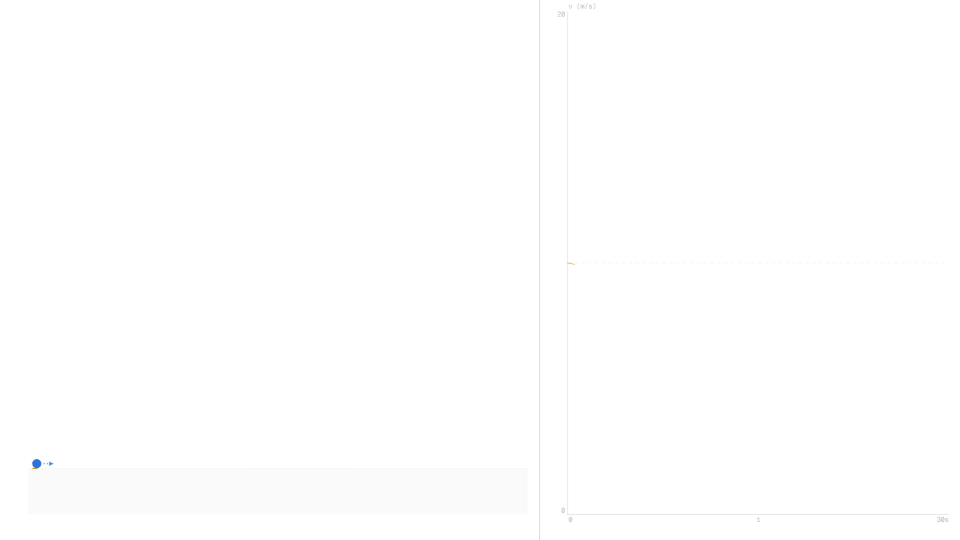
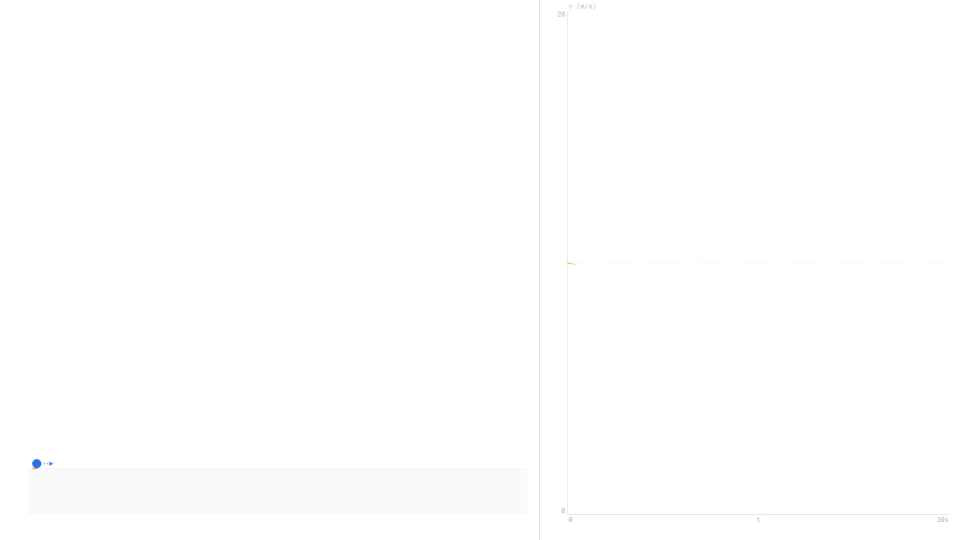
The simulator makes this relationship concrete. Setting Friction (μk) to the slider minimum (0.0001) and Initial Speed to 10 m/s, the Speed readout holds at 10.00 m/s for the full 30-second run; the puck doesn't measurably decelerate because the friction force is negligible. Raising μk to 0.1 (slider maximum) introduces a deceleration of 0.981 m/s² and the puck halts after approximately 51 m, illustrating how even modest friction is enough to drain all kinetic energy from a moving object given sufficient distance.
Speed skaters exploit this by crouching low to reduce aerodynamic drag, the dominant residual force on real ice, and by keeping blade angles shallow to minimise friction from lateral cutting. The physics is entirely captured by the same zero-net-force principle: any force that remains, however small, will eventually bring the skater to rest. The question is only how far they travel before it does.
How does curling demonstrate Newton's First Law on ice?
Curling is one of the clearest sports demonstrations of inertia. A 20 kg granite stone, given a single push, slides across pebbled ice for thirty meters or more before stopping. The kinetic friction coefficient between the stone's polished running surface and the textured ice is roughly μk = 0.015 to 0.02, comparable to a hockey puck on freshly resurfaced ice. With such low friction, the stone retains most of its initial speed throughout the slide, and even small differences in friction (from sweeping or temperature variations) noticeably shift the stopping point. This is Newton's First Law operating in its natural element: net force minimized, motion preserved.
Setting Friction (μk) to 0.02 and Initial Speed to 10 m/s in the simulator approximates the stone's behavior. The Speed readout starts at 10.00 m/s and decays slowly; over the full 30 s run the puck slows to roughly 4 m/s and the Distance readout reaches approximately 212 m. Compare this to setting μk to 0.1 (slider maximum, modeling much rougher ice): the puck stops at just 51 m in about 10 seconds. The factor-of-five increase in friction yields a factor-of-four shorter run, a dramatic demonstration of how sensitively distance depends on a small change in surface conditions.
Curlers strategize around this exact principle by sweeping in front of the stone, a transient action that locally melts a thin layer of ice, reducing μk and letting the stone travel just a bit farther. The simulator's logarithmic slider captures this sensitivity: dragging it by one tick (a factor of about 1.26 in μk) corresponds to a real-world adjustment in ice quality that competitive curlers can detect and exploit. The pedagogy is the same as Newton's: the smaller the net force, the more inertia governs the motion.
How do air hockey tables use near-zero friction to show inertia?
An air hockey table pumps a thin layer of pressurised air through thousands of tiny holes in the playing surface. The puck rides on this air cushion with virtually no solid-to-solid contact, reducing the effective friction coefficient to values below 0.01. Under these conditions the puck travels at nearly constant speed after a push, with only the surrounding air offering any meaningful resistance; even that drag is small at the low speeds involved. Newton's First Law predicts exactly this behaviour: with net horizontal force at zero, velocity stays constant.
Setting Friction (μk) to its slider minimum (0.0001) and Initial Speed to any value confirms the prediction: the Speed readout barely changes across the full 30-second run, and the amber trail shows the puck advancing at essentially the same rate throughout. The air hockey table is a controlled physical realisation of that frictionless limit, making Newton's First Law directly observable in an everyday game rather than an abstract law written in a textbook.
The same principle appears in high-precision laboratory settings. Linear air tracks used in undergraduate physics labs float a glider on a cushion of air to achieve μk values near 0.001 or lower, allowing students to measure constant-velocity motion and confirm inertia to within a fraction of a percent. The simulator's minimum-friction setting (μk = 0.0001) reproduces this ideal: d ≈ v₀ · t, linear and uninterrupted, for as long as the 30 s time cap allows.
Further Reading
These articles extend the friction and inertia concepts demonstrated by the puck simulation into related territory.
- Friction block: static and kinetic friction on a horizontal surface, including how μk and μs differ and how the slip transition occurs.
- Inclined plane: the same friction model on a tilted surface, where the gravitational component along the slope competes with friction.
- Constant acceleration cart: uniform deceleration from a kinematics perspective, with position, velocity, and acceleration readouts.
- Feather and hammer: inertia and gravity without air resistance, showing Newton's First Law applied to free fall.