Elevator Apparent Weight PhysicsApparent Weight N = m(g + a)
Introduction
Elevator Apparent Weight is one of the most familiar demonstrations of Newton's second law, because nearly everyone has felt it: the brief heaviness as a lift starts upward, the floating lightness as it begins to descend. The simulator puts a person on a bathroom scale inside an elevator car and lets you dial the car's acceleration up or down. The number the scale reports, the apparent weight, is not the person's true weight at all, but the normal force the scale must push up with.
That distinction is the whole lesson. Gravity pulls on the person with the same force no matter what the elevator does; the scale reading changes only because the floor, acting through the scale, has to push harder or softer to accelerate the person along with the car. When the elevator accelerates upward the scale reads more than the true weight; when it accelerates downward it reads less; and in free-fall it reads zero.
Reading that change correctly turns a vague bodily sensation into a precise statement about forces, and it is the same statement that governs roller coasters, launching rockets, and orbiting spacecraft.
The Physics Explained
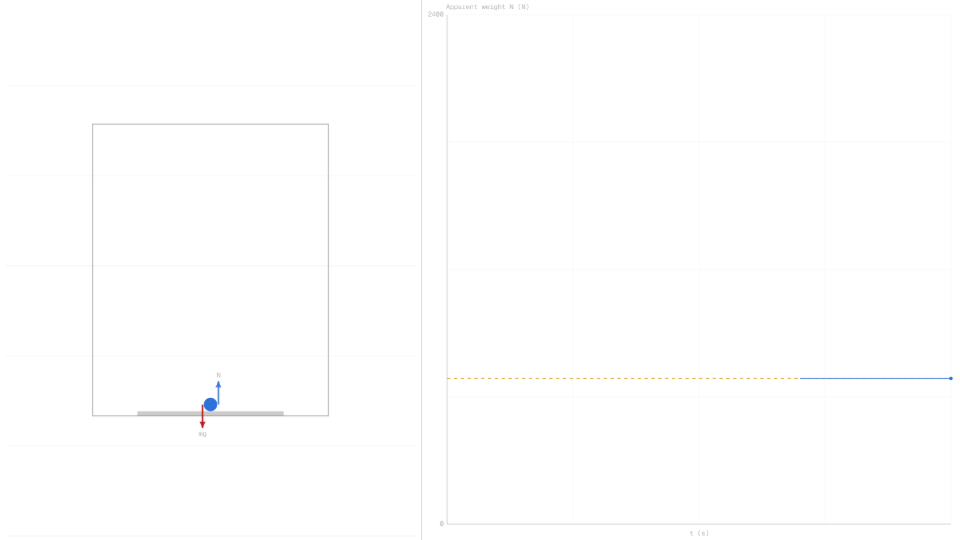
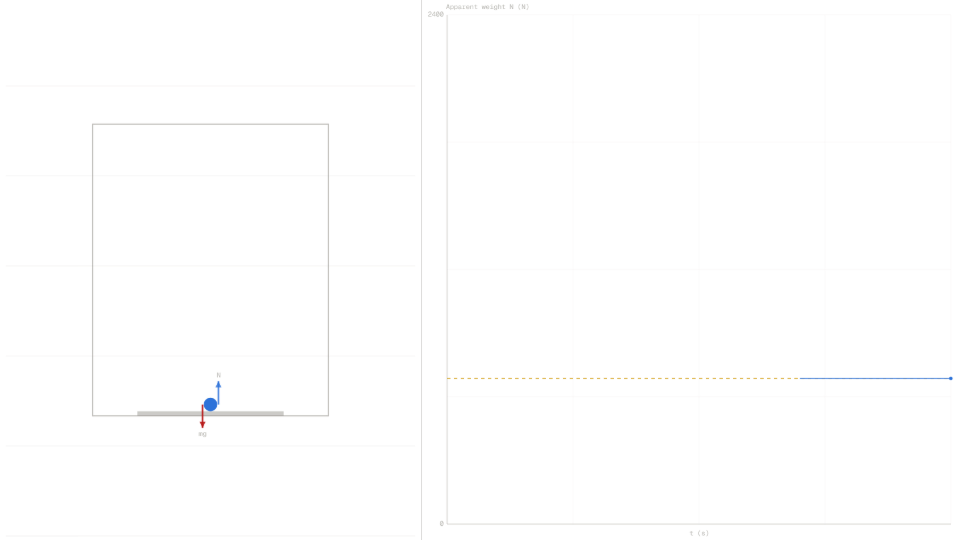
Start with the forces acting on the person alone. Gravity pulls straight down with magnitude m·g, the true weight. The scale pushes straight up with the normal force N. Those are the only two vertical forces, so Newton's second law along the vertical axis (taking up as positive) reads N − m·g = m·a, where a is the elevator's acceleration. Solving for the quantity the scale actually reports gives the apparent weight, N = m(g + a).
When the elevator is at rest or moving at constant speed, a = 0, and the equation collapses to N = m·g: the scale reads the true weight. For a 70 kg person that is 70 × 9.81 = 687 N, and the simulator's apparent-weight and true-weight readouts agree exactly in this case. Constant velocity feels identical to standing still, because only acceleration, not speed, changes the normal force.
Accelerate the car upward and the scale must do extra work. At a = 2 m/s² the apparent weight rises to 70 × (9.81 + 2) = 827 N. The 140 N difference from the true weight is precisely the net inertial force m·a, the part of the normal force that goes into accelerating the person rather than merely holding them up. Accelerate downward and the opposite happens: at a = −2 m/s² the apparent weight falls to 70 × 7.81 = 547 N, because gravity now supplies part of the downward acceleration and the scale can relax.
Push the downward acceleration all the way to a = −g = −9.81 m/s² and the apparent weight reaches 0 N: the scale reads nothing, the condition we call weightlessness or free-fall. The formula also shows that mass and acceleration act independently: doubling the mass doubles the reading at any fixed acceleration, while changing the acceleration shifts the reading up or down without touching the true weight.
Key Equations
The two vertical forces on the person are the upward normal force N and the downward weight m·g; their sum equals mass times the elevator's acceleration. Everything else follows from rearranging this single statement.
Solving for the normal force gives the apparent weight directly. With m = 70 kg and a = 0 the reading is 687 N; at a = 2 m/s² it is 827 N; at a = −2 m/s² it is 547 N. The reading exceeds the true weight whenever the car accelerates upward and drops below it whenever the car accelerates downward.
The true weight depends only on mass and gravity, never on the elevator's motion. It stays fixed at 687 N for a 70 kg person no matter what acceleration you select, which is why the simulator shows it as a constant baseline to compare the apparent weight against.
The gap between apparent and true weight is the net force m·a: it is 140 N at a = 2 m/s² and reverses sign for downward acceleration. Drive the acceleration to −9.81 m/s² and the apparent weight vanishes, the free-fall condition that produces weightlessness.
Key Variables
| Symbol | Name | Unit | Meaning |
|---|---|---|---|
| m | Mass | kg | Mass of the person on the scale |
| g | Gravity | m/s² | Gravitational acceleration, 9.81 m/s² |
| a | Acceleration | m/s² | Elevator acceleration, positive upward |
| N | Apparent weight | N | Normal force the scale reads, m(g + a) |
| W | True weight | N | Gravitational force m·g, independent of a |
Real World Examples
Why do you feel heavier the instant an elevator starts going up?
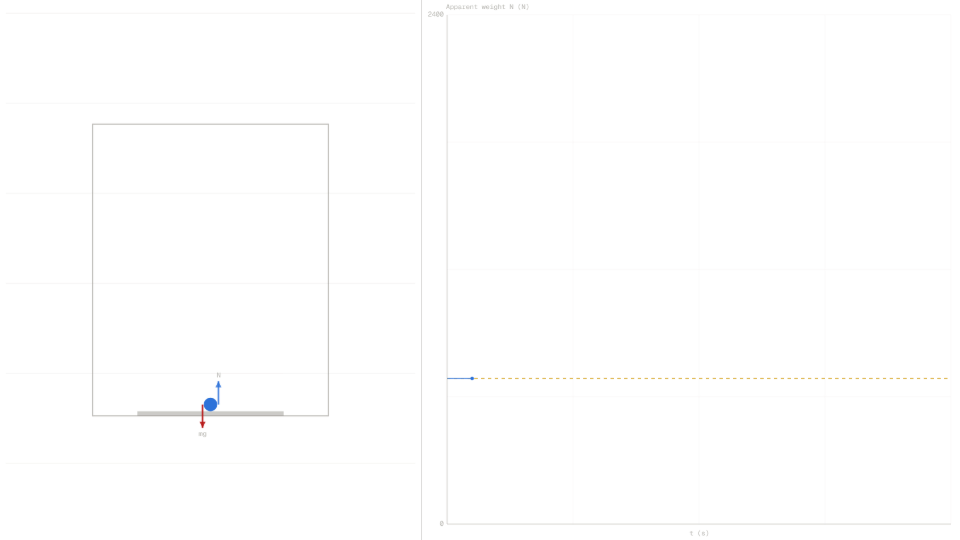
At the moment an upward trip begins, the elevator accelerates upward, and the floor, through the scale, has to do two jobs at once: hold you up against gravity and accelerate you upward with the car. Both jobs are paid for by the normal force, so the force pushing up on your feet rises above your true weight, and that larger push is exactly what you feel as heaviness.
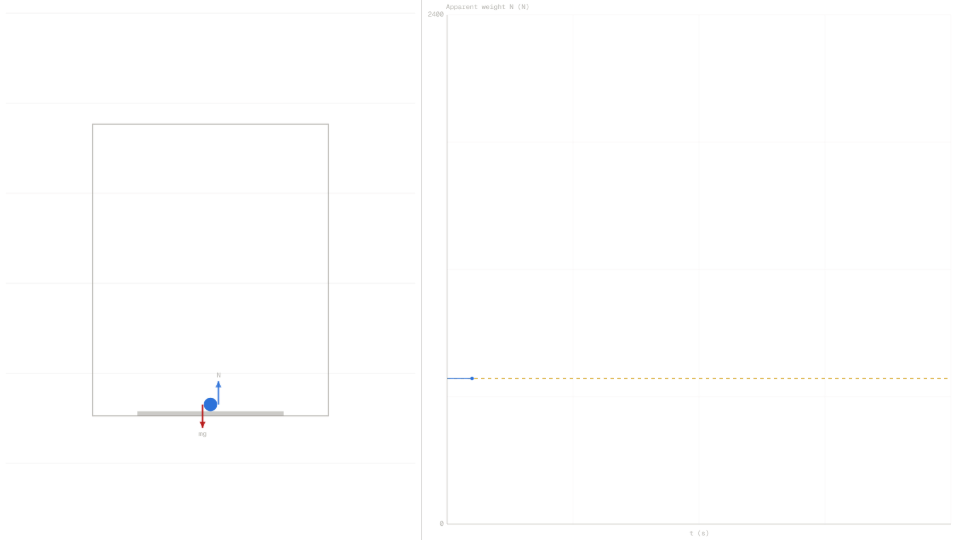
In the simulator, a 70 kg person at rest reads 687 N, their true weight of 70 × 9.81. Dial the acceleration to 2 m/s² and the apparent weight readout climbs to 827 N; the extra 140 N is the net inertial force m·a needed to speed you up. The sensation fades once the elevator reaches cruising speed, because at constant velocity the acceleration is zero and the scale falls back to 687 N. You feel the change only while the speed is changing, not while the car is moving fast.
What is really happening when astronauts float 'weightless' in orbit?
Orbiting astronauts are not beyond gravity; at the height of the space station gravity is still nearly as strong as at the ground. They float because their spacecraft is in continuous free-fall, accelerating downward at very nearly g while racing sideways fast enough to keep missing the Earth.
The elevator simulator reproduces the same condition: set the acceleration to −9.81 m/s², the free-fall value a = −g, and the apparent weight readout drops to 0 N. With nothing pushing up on the scale there is no normal force, and a person inside feels weightless even though gravity pulls on them exactly as before. True weight in the simulator stays fixed at 687 N the whole time; only the normal force vanishes. This is why 'zero gravity' is a misleading phrase: the honest description is zero normal force, and it is the absence of a supporting push, not the absence of gravity, that makes things float.
Why does a fast-launching amusement-park ride press riders into their seats?
A launch coaster or a rocket-sled ride accelerates its seats hard, and the seat behind a rider plays exactly the role the elevator floor plays in the simulator: it must supply enough normal force to accelerate the rider along with the vehicle. The faster the acceleration, the larger that supporting force, and riders register it as being crushed back into the cushion.
Push the simulator to its upward limit, acceleration 5 m/s² with a 70 kg rider, and the apparent weight reads 1037 N, about one and a half times the 687 N true weight, a 1.5 g load. The same formula explains the opposite drop at the crest of a hill, where the track briefly stops supporting the car and the apparent weight falls toward zero, producing the airtime that makes coasters thrilling. Designers tune these normal-force swings deliberately, keeping them within the range the human body tolerates.
Further Reading
- Free-body diagram builder: isolate the person and label the normal force and weight that set N = m(g + a).
- Friction on an incline: how the normal force changes on a slope and why friction scales with it.
- Atwood machine: two masses on a rope, where the same N = m(g ± a) logic sets the cord tension.
- Free fall on different planets: what changes when g itself changes, and why free-fall makes the scale read zero.