Elevator Apparent Weight · SimulatorFeel Heavier or Lighter
A person on a scale inside an accelerating elevator; the scale reading changes with elevator acceleration
Published: June 2, 2026
Objective
Understand that apparent weight (scale reading) is the normal force, which depends on both mass and elevator acceleration via the formula N = m(g + a). Observe how acceleration changes the scale reading while gravitational force remains constant, and how mass and acceleration are independent variables that both affect the normal force.
Setup
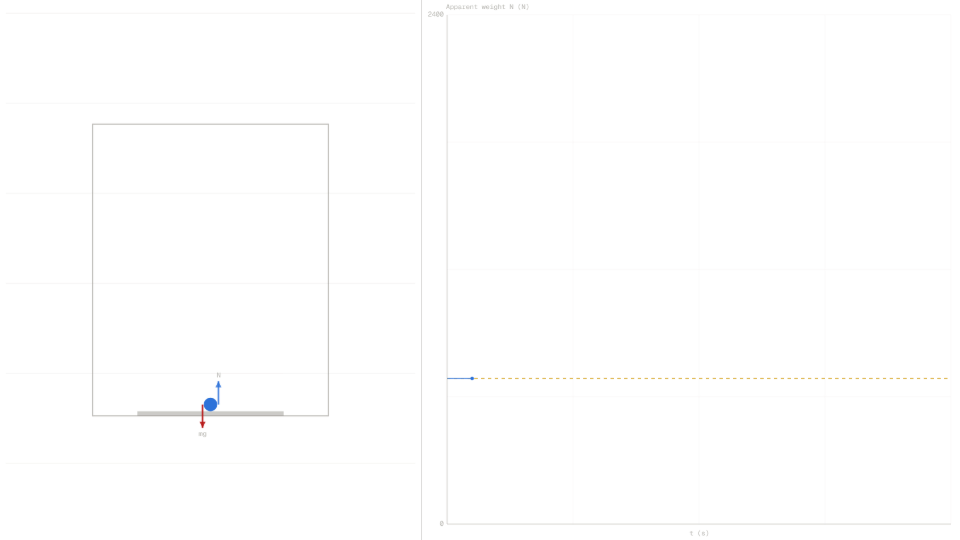
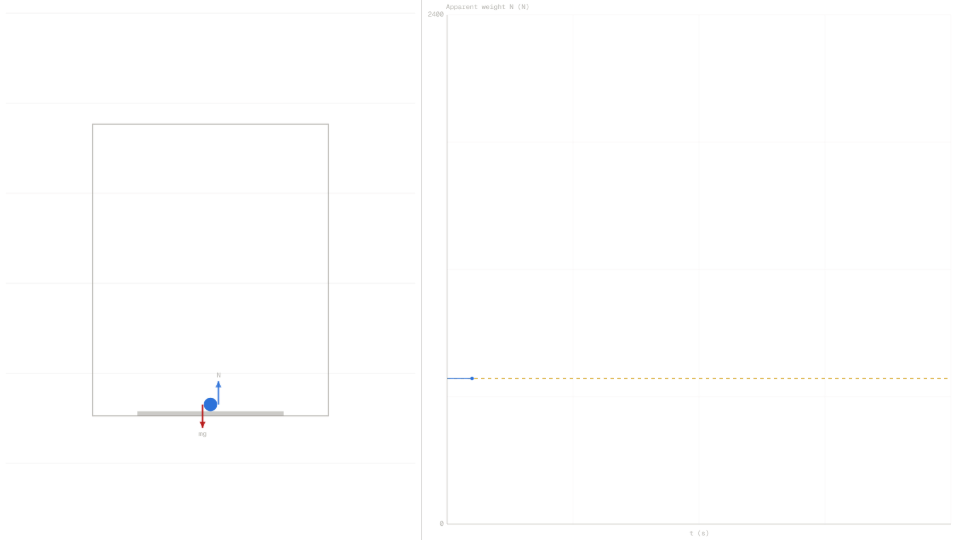
- Press Start with the default settings (acceleration = 0 m/s², mass = 70 kg). Observe the apparent weight readout and the upward (blue) and downward (red) force arrows on the person. Record the apparent weight value.
- Reset and set elevator acceleration to 2 m/s² (upward). Press Start and observe for a few seconds. Record the new apparent weight and compare it to the value at rest.
- Reset and set acceleration to −2 m/s² (downward). Press Start and observe. Record the apparent weight and note how it compares to acceleration = +2 m/s².
- Reset to acceleration = 0 and change the person's mass to 150 kg. Press Start and record the apparent weight. Compare to the default mass of 70 kg at the same acceleration.
- Reset and try extreme values: acceleration = 5 m/s² (maximum upward) with mass = 70 kg. Record the apparent weight and observe the scale reading ratio to true weight.
- Reset and try acceleration = −5 m/s² (maximum downward) with mass = 70 kg. Record the apparent weight and discuss what would happen at a = −g (free-fall).
Analytical Prediction
The apparent weight (normal force) is N = m(g + a), where m is mass in kg, g = 9.81 m/s² is gravitational acceleration, and a is elevator acceleration (positive upward). At rest the scale reads the true weight m·g; upward acceleration raises the reading and downward acceleration lowers it. With m = 70 kg:
Mass and acceleration are independent: doubling mass doubles N at any fixed a, and changing a shifts N linearly.
Results Analysis
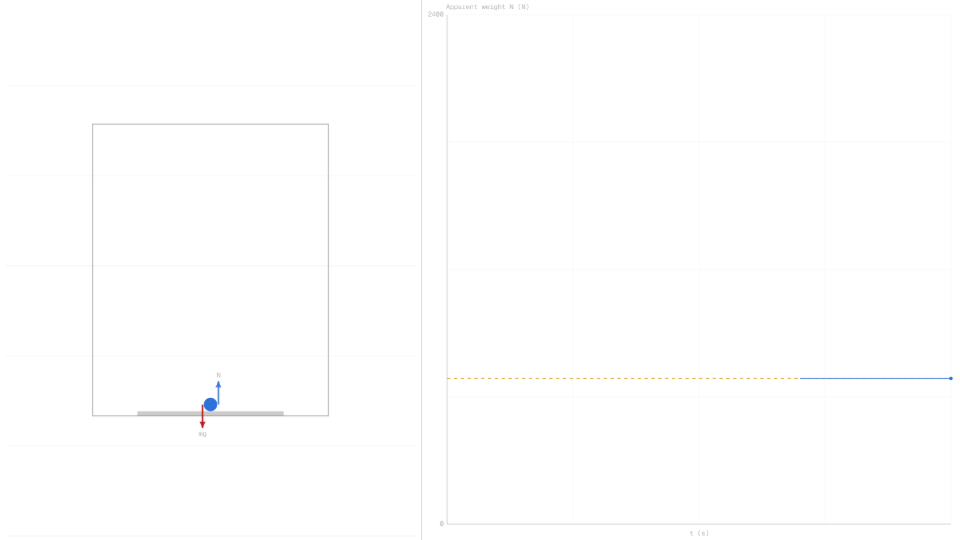
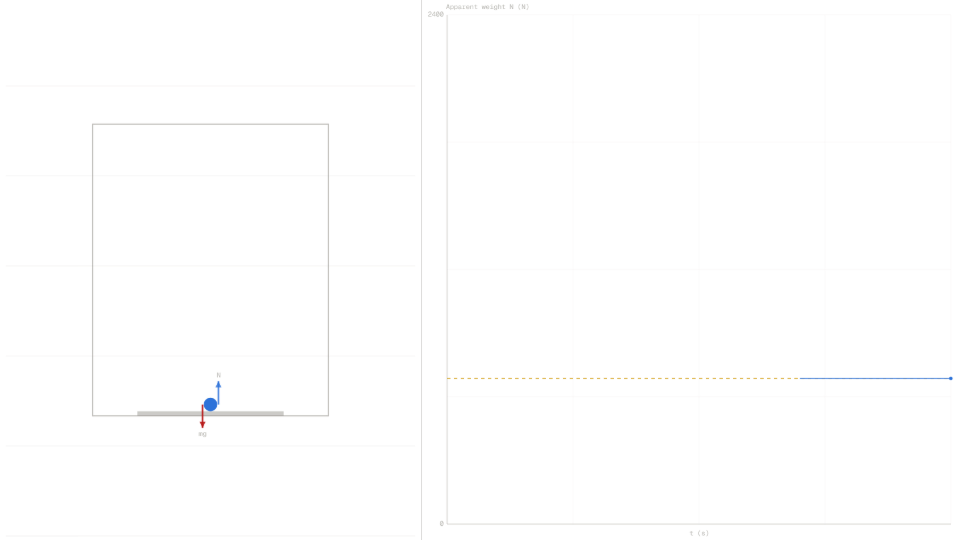
Run each of the six setup steps and compare your recorded values with the predictions above. Each run plays a full elevator trip: the car accelerates, cruises at steady speed, then decelerates to a stop. Watch the apparent weight readout rise above the true weight while accelerating upward, settle back to the true weight while cruising, and dip below it while decelerating; the graph on the right traces this curve against the constant true-weight line. The true weight readout shows m·g and never changes as you adjust acceleration; gravity is constant. The net inertial force readout shows m·a, the extra force the scale provides beyond supporting the person against gravity. The peak apparent weight equals m(g + a) at the acceleration you set.
Source of Error
This sim idealizes the person as a point mass and ignores air resistance, cable elasticity, and the time it takes the elevator to change acceleration. The sim assumes constant gravitational acceleration (g = 9.81 m/s²) and does not account for variation over Earth’s surface or in other gravitational fields. The scale’s mechanical response (needle damping, friction) is not modeled; the readout is instantaneous. The person is pinned to the elevator car, so the displayed apparent weight follows N = m(g + a) directly and the only residual gap from the prediction is slider rounding and readout decimal truncation.
Further Exploration
- What would the apparent weight be if the elevator accelerated downward at exactly −9.81 m/s² (free-fall)? Why does the scale read zero at this value? (Hint: what is this condition called in physics?)
- Compare the scale reading when you increase mass from 70 kg to 140 kg at fixed acceleration (e.g., a = 1 m/s²). By what factor does the apparent weight change? Does this match the formula?
- At a = 0 (elevator at rest), is the apparent weight equal to the true weight? Does the blue (normal force) arrow point straight up in this case? What does this tell you about the relationship between acceleration and force?
- If you want the scale to read *exactly twice* the person's true weight, what acceleration should you use? (Hint: solve N = 2·m·g for a.) Test your prediction in the sim.
- Experiment with rapid toggling between a = 3 m/s² and a = −3 m/s² by resetting and changing sliders. Does the elevator's position (height) change noticeably between these two runs? Why or why not?