Connected Carts on a Rope PhysicsShared Acceleration & Rope Tension
Introduction
Connected Carts on a Rope is one of the cleanest illustrations of Newton's second law applied to a system of more than one body. Two carts sit on a frictionless track, joined by a rope; a single external force pulls the front cart, and the rope drags the second along behind it. Because the rope is inextensible, both carts must move with the same acceleration. The question the simulator answers is how much force the rope itself has to carry to make that happen.
The setup is everywhere a single pull moves a chain of objects: a car towing a trailer, a locomotive hauling a string of wagons, a tugboat with a barge, even a hand pulling a train of toy carts. In every case one force enters the system, but each connecting link carries only part of it. Reading that split correctly is the difference between a hitch that holds and one that snaps.
Many learners expect the rope to carry the full applied force, since the rope is what drags the second cart. The Tension readout says no: the tension is always less than the applied force. It is a fixed fraction of that force, set by how the mass is split between the two carts: T = m₂·a, which at the default masses is three fifths of F.
The Physics Explained
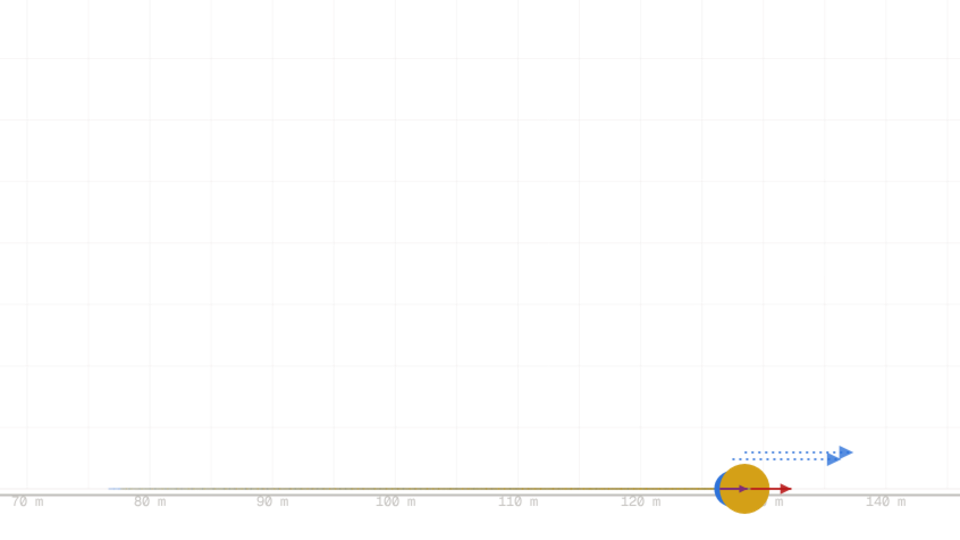
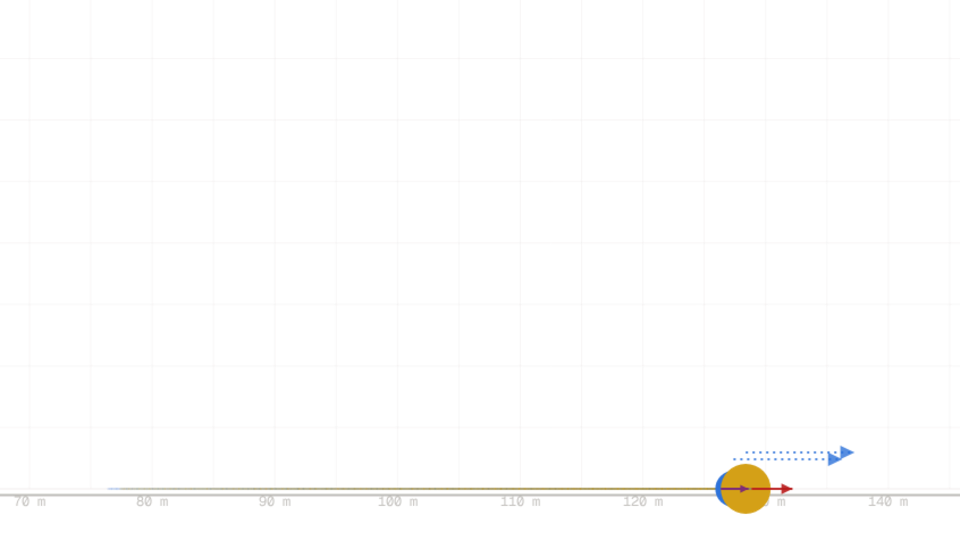
Treat the two carts as one system first. The only external horizontal force on that system is the applied force F (the rope's pull is internal: it acts equally and oppositely on the two carts and cancels within the system). Newton's second law for the whole system is therefore F = (m₁ + m₂)·a, which rearranges to a = F ⁄ (m₁ + m₂). Both carts share this single acceleration because the rope holds them at a fixed separation. On the canvas, cart 1 is the sky disc in front and cart 2 the gold disc behind it; the crimson arrow on cart 1 is the applied force F and the plum arrow along the rope on cart 2 is the tension T, both drawn to the same scale.
Now isolate the second cart, the one the rope drags. The only horizontal force on it is the rope tension T, so Newton's second law for that cart alone reads T = m₂·a. The rope's entire job is to give cart 2 exactly the acceleration the system has, no more. Substituting the system acceleration gives the combined form T = m₂·F ⁄ (m₁ + m₂).
That combined expression carries the key lesson. The factor m₂ ⁄ (m₁ + m₂) is always less than one, so the tension is always a fraction of the applied force; the rope never transmits the full push. At the default settings F = 20 N, m₁ = 2 kg, m₂ = 3 kg, the system accelerates at a = 20 ⁄ 5 = 4.00 m/s² and the rope carries T = 3 × 4.00 = 12.0 N, comfortably below the 20 N applied. The simulator's Acceleration and Tension readouts show exactly these values, and both carts move with identical velocity vectors.
The counterintuitive part appears when you change the masses. Cart 1's mass never enters T = m₂·a except through the shared acceleration, so making cart 1 heavier lowers the tension (by lowering a). Making cart 2 heavier does the opposite: even though acceleration drops, the larger m₂ multiplies it to a bigger tension. Raise cart 2 to 10 kg and the acceleration falls to 20 ⁄ 12 ≈ 1.67 m/s² while the tension rises to 10 × 1.67 ≈ 16.7 N. Tension scales with the mass being pulled as well as with the force applied: double F at fixed masses and T doubles too, but the ratio T ⁄ F is fixed by the masses alone.
Key Equations
Treating both carts as one body, the applied force divided by the total mass gives the shared acceleration. At F = 20 N, m₁ = 2 kg, m₂ = 3 kg: a = 20 ⁄ 5 = 4.00 m/s². Raising the force to 50 N (same masses) gives a = 50 ⁄ 5 = 10.0 m/s² and lifts the tension to T = 3 × 10.0 = 30.0 N, still three fifths of the applied force.
Isolating the second cart, the rope must supply exactly the force needed to accelerate cart 2 at the system rate. At a = 4.00 m/s² and m₂ = 3 kg the tension is T = 3 × 4.00 = 12.0 N, less than the 20 N applied force.
Substituting the acceleration into the tension shows the split directly: the rope carries the fraction m₂ ⁄ (m₁ + m₂) of the applied force. Since that fraction is always below one, T < F for any masses; the rope can never feel the whole push.
With F = 20 N and m₁ = 2 kg, raising m₂ from 3 kg to 10 kg drops a to 20 ⁄ 12 ≈ 1.67 m/s² yet lifts T to 10 × 1.67 ≈ 16.7 N. Tension scales with m₂ directly but acceleration only falls as 1 ⁄ (m₁ + m₂), so the mass term wins.
Key Variables
| Symbol | Name | Unit | Meaning |
|---|---|---|---|
| F | Applied force | N | External force pulling the front cart |
| m₁ | Cart 1 mass | kg | Mass of the front (pulled) cart |
| m₂ | Cart 2 mass | kg | Mass of the rear cart the rope drags |
| a | Acceleration | m/s² | Shared acceleration of both carts, F ⁄ (m₁ + m₂) |
| T | Rope tension | N | Force the rope carries, equal to m₂·a |
Real World Examples
Why does a tow rope between two vehicles carry less force than the towing engine produces?
When one vehicle tows another, the engine's drive force acts on the whole train but the rope only has to accelerate the towed vehicle. That is exactly the connected-carts setup: the applied force F speeds up both masses together at a = F ⁄ (m₁ + m₂), while the rope carries only T = m₂ · a.
With F = 20 N, m₁ = 2 kg and m₂ = 3 kg the simulator reads a = 4.00 m/s² and T = 12.0 N: the rope feels 12.0 N even though the engine pushed with 20 N. The tension is always a fraction m₂ ⁄ (m₁ + m₂) of the applied force, so it can never exceed it. A tow strap works the same way in this ideal picture: it carries only the share needed to accelerate the trailer, not the full engine force. Real straps see much more than that share, though: rolling resistance, hills, slack being taken up and shock loads all add tension the frictionless model leaves out, so this fraction is a starting point for understanding, not a rating rule.
How does the tension in a train's couplers change from the locomotive to the last car?
A train is a chain of connected carts, and each coupler is a rope in the connected-carts sense: it must accelerate everything behind it. In the idealised frictionless model the whole consist shares one acceleration a = F ⁄ (total mass), so the coupler just behind the locomotive carries the most tension (it pulls every car), and each coupler further back carries less, until the last coupler pulls only the final car.
The simulator captures the two-car version: with F = 20 N on the lead cart, m₁ = 2 kg and m₂ = 3 kg, the single coupler carries T = m₂ · a = 12.0 N. Add more cars and the same logic stacks: tension at any link equals the mass behind it times the shared acceleration. Railway engineers size the front couplers and draw gear for the largest of these loads.
Why does a heavier trailer raise the rope tension even though it accelerates more slowly?
It feels backwards that making the towed cart heavier (which slows everything down) should increase the rope tension, but the two effects do not cancel. Acceleration falls because the total mass in a = F ⁄ (m₁ + m₂) grows, yet tension T = m₂ · a multiplies that smaller acceleration by the larger m₂.
In the simulator, raising cart 2 from 3 kg to 10 kg (with F = 20 N and m₁ = 2 kg held fixed) drops the acceleration to a = 20 ⁄ 12 ≈ 1.67 m/s² but raises the tension to T = 10 × 1.67 ≈ 16.7 N, up from 12.0 N. The mass term wins because tension scales with m₂ directly while acceleration only falls as 1 ⁄ (m₁ + m₂). Trailer hitches and tow ropes must therefore be rated for the heaviest load, not the fastest acceleration.
Further Reading
- Two-rope tension: how a single load splits its weight into tension along two ropes at adjustable angles.
- Atwood machine: two masses linked by a rope over a pulley, where gravity sets the system acceleration.
- Newton's third law carts: how the rope's pull acts equally and oppositely on the two carts it connects.
- Free-body diagram builder: isolate one cart at a time to see why the rope tension equals m₂·a.