Conical Pendulum PhysicsTension, Angle & Circular Speed
Introduction
A conical pendulum is a ball on a string that traces a horizontal circle, so the string sweeps out the surface of a cone rather than swinging back and forth in a plane. The ball never speeds up or slows down once it settles into the circle: it orbits at a constant angular velocity set entirely by the string length L and the half-angle θ the string makes with the vertical. That rate is ω = sqrt(g / (L·cosθ)), where g is gravitational acceleration. With the default simulator settings (L = 0.8 m, θ = 30°), the ω readout shows ≈ 3.76 rad/s and the Period readout P shows ≈ 1.67 s.
The system is a clean illustration of how a single force can do two jobs at once. The string tension points along the string, so it has a vertical component that holds the ball up against gravity and a horizontal component that pulls the ball inward, the centripetal force that bends its path into a circle. Engineers meet the same geometry in amusement-park swing rides, flyball engine governors, and tetherball ropes, where the cone angle and the tension it demands are the quantities that matter for design and safety.
Almost everyone expects a heavier ball to orbit differently, slower perhaps, or at a shallower angle. The ω readout never budges, because ω carries no mass term at all. Drag the mass slider from m = 0.5 kg to m = 2.0 kg in the Fresh state and the ω readout stays fixed at ≈ 3.76 rad/s; only the Tension readout responds, climbing from ≈ 5.66 N to ≈ 22.66 N. The orbital rate is mass-independent while the tension scales linearly with mass; that contrast is the central insight this simulation makes quantitative.
The Physics Explained
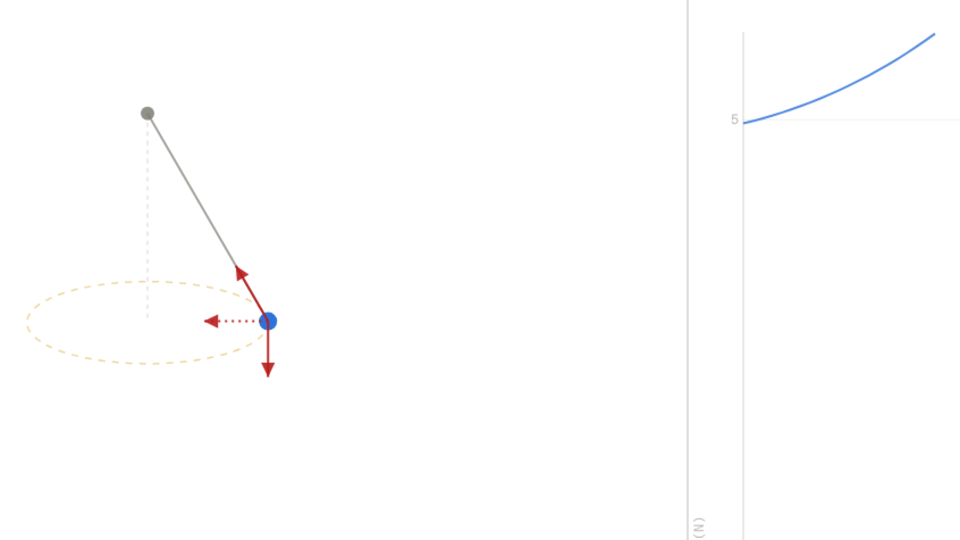
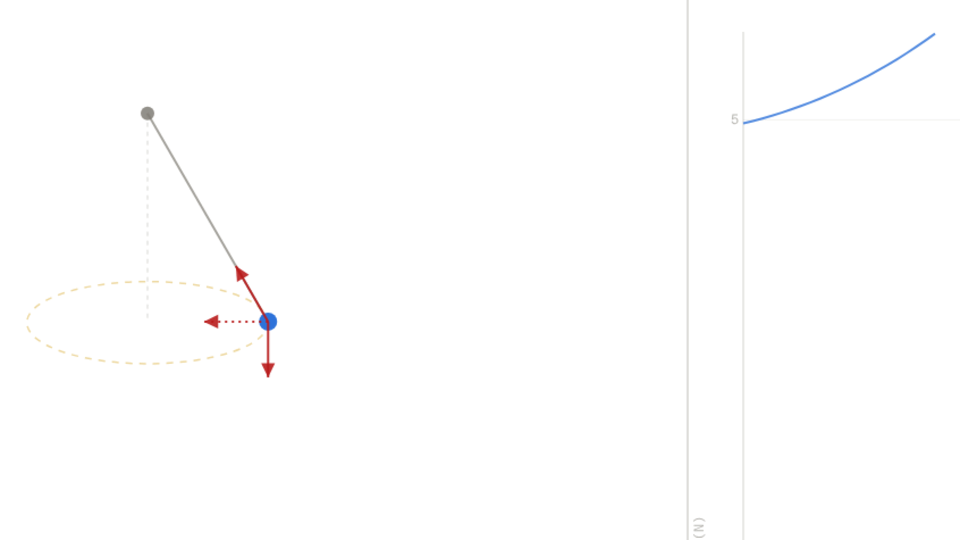
Two forces act on the orbiting ball: its weight W = mg pulling straight down, and the string tension T pulling along the string toward the pivot. Because the string is tilted by the half-angle θ from the vertical, the tension resolves into two perpendicular components: a vertical part T·cosθ and a horizontal part T·sinθ. The vertical part is the only thing available to balance gravity, and the horizontal part is the only thing available to curve the path, so each component is locked to a separate physical requirement.
Vertical balance requires T·cosθ = mg, which immediately gives the tension T = mg / cosθ. Horizontally, the inward component must supply the centripetal force for circular motion: T·sinθ = m·ω²·r, where the orbit radius is r = L·sinθ. Dividing the horizontal equation by the vertical one cancels both T and m and leaves tanθ = ω²·L·sinθ / (g) rearranged to ω² = g / (L·cosθ). Taking the square root gives ω = sqrt(g / (L·cosθ)); the mass has vanished entirely.
That cancellation is why the orbital rate depends only on geometry. With the defaults L = 0.8 m and θ = 30°, the formula gives ω = sqrt(9.81 / (0.8 · 0.8660)) ≈ 3.76 rad/s, and the period follows as P = 2π / ω ≈ 1.67 s, both shown on the HUD before the run even starts, because they are analytic predictions rather than measured outputs. The right-panel T–θ curve plots tension against angle and drops a live marker at the current state, so you can watch where the present settings sit on the whole family of solutions.
Tension behaves very differently from the rate. Because T = mg / cosθ, it grows as the reciprocal of cosθ: gentle at small angles, then steeply as the orbit flattens toward horizontal. At θ = 30° the Tension readout shows ≈ 5.66 N for m = 0.5 kg; at θ = 60° it reaches exactly ≈ 9.81 N (twice the ball's weight) and it would diverge to infinity at 90°, where no finite tension could hold the ball up. The simulator clamps the angle just below 90° (about 74.5°) so the readouts stay finite, mirroring the physical reality that a real string would snap long before then.
Key Equations
Substituting the defaults (g = 9.81 m/s², L = 0.8 m, θ = 30°): ω = sqrt(9.81 / (0.8 · cos 30°)) = sqrt(9.81 / 0.6928) = sqrt(14.16) ≈ 3.76 rad/s. The ω readout shows 3.76 rad/s, and because no mass term appears, dragging the mass slider leaves this value untouched, the defining feature of the system.
With m = 0.5 kg and θ = 30°: T = 0.5 · 9.81 / cos 30° = 4.905 / 0.8660 ≈ 5.66 N. Tension scales linearly with mass, so doubling the mass to 1.0 kg doubles the readout to ≈ 11.33 N while ω stays at 3.76 rad/s; no comparison makes it plainer that mass moves tension but not rate.
From the default ω ≈ 3.76 rad/s: P = 2π / 3.76 ≈ 1.67 s, matching the Period readout. Because P depends on sqrt(L·cosθ), a longer string orbits more slowly: doubling L from 0.6 m to 1.2 m at fixed angle multiplies the period by sqrt(2) ≈ 1.41, which you can confirm by reading P at both settings.
At the defaults: Fc = m·g·tanθ = 0.5 · 9.81 · tan 30° = 0.5 · 9.81 · 0.5774 ≈ 2.83 N. The same value comes from the horizontal tension component, T·sinθ = 5.66 · 0.5 ≈ 2.83 N, confirming that the inward pull of the string is exactly what curves the path. The Fc readout reads ≈ 2.83 N to match.
Key Variables
| Symbol | Name | Unit | Meaning |
|---|---|---|---|
| L | String length | m | Distance from the pivot to the ball along the string |
| θ | Half-angle | degrees | Angle the string makes with the vertical; sets the cone's width |
| m | Ball mass | kg | Mass of the orbiting ball; affects tension but not the orbital rate |
| g | Gravitational acceleration | m/s² | Acceleration due to gravity; 9.81 m/s² at Earth's surface |
| ω | Angular velocity | rad/s | Orbital rate = sqrt(g / L·cosθ); mass-independent; shown in the ω readout |
| T | String tension | N | Force along the string = mg / cosθ; shown in the Tension readout |
| r | Orbit radius | m | Radius of the horizontal circle = L·sinθ |
| v | Orbital speed | m/s | Tangential speed = ω·r |
| P | Period | s | Time for one orbit = 2π / ω; shown in the Period readout |
| Fc | Centripetal force | N | Inward force = m·ω²·r = T·sinθ; shown in the Fc readout |
Real World Examples
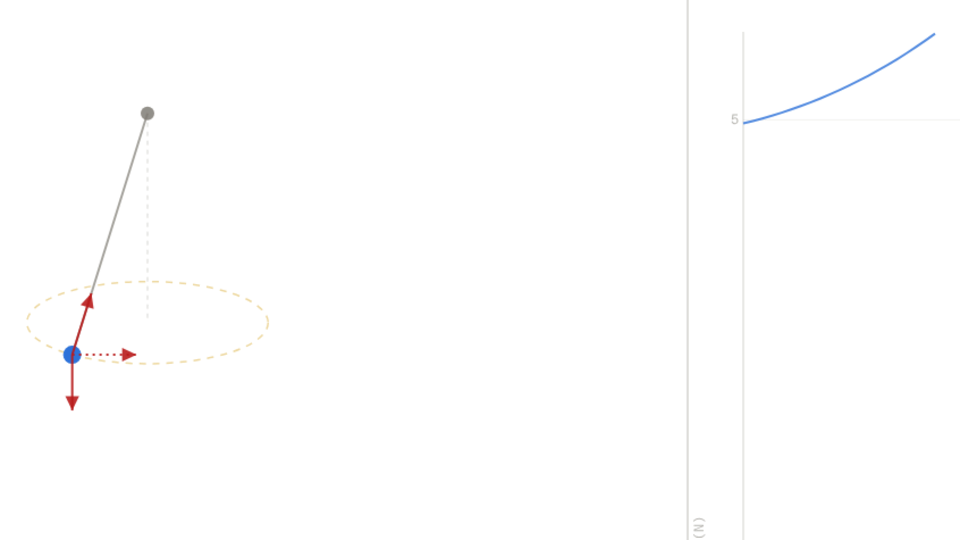
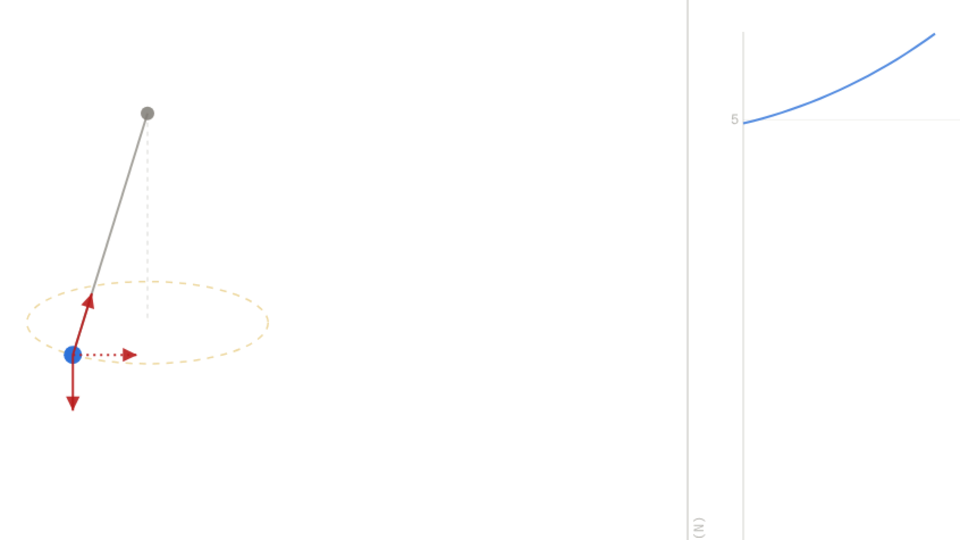
Why do all the chairs on a swing-carousel ride fly out to the same angle, no matter how heavy the rider is?
Each chain-and-chair is a conical pendulum, and the angle it settles at depends only on the rotation rate and chain length, not the rider's mass. The governing relation ω = sqrt(g / (L·cosθ)) contains no mass term, so for a fixed spin rate every chair (whether it holds a child or a heavy adult) hangs at the same cone angle.
The simulator shows this directly: with L = 0.8 m and θ = 30°, the angular-velocity readout ω reads ≈ 3.76 rad/s whether the mass slider is set to m = 0.5 kg or m = 2.0 kg; only the Tension readout changes, climbing from ≈ 5.66 N to ≈ 22.66 N. Ride designers rely on this mass-independence: they set the arm length and motor speed once, and every seat traces the same circle regardless of who sits in it. What the heavier rider does demand is a stronger chain: exactly the larger tension the readout reports.
How does a flyball (centrifugal) governor use a spinning pendulum to regulate an engine's speed?
A flyball governor is a conical pendulum geared to an engine, and because the cone angle rises with spin rate it converts speed into a mechanical position that throttles the engine. As ω increases the balls swing outward to a steeper angle; a linkage tied to that angle closes the steam or fuel valve, slowing the engine until it settles at a target speed.
The simulator captures the angle-to-speed coupling: holding L = 0.8 m and m = 0.5 kg, raising the angle slider from θ = 30° to θ = 60° drives the ω readout from ≈ 3.76 rad/s up to ≈ 4.95 rad/s while the Period readout P drops from ≈ 1.67 s to ≈ 1.27 s. James Watt's 1788 governor used exactly this feedback to hold textile-mill engines at constant speed, and the same principle still stabilizes turbines and music-box mechanisms today.
Why does a tetherball's rope pull harder as the ball circles faster and more horizontally?
The rope must both hold up the ball's weight and supply its centripetal force, and as the orbit flattens toward horizontal the tension needed for the vertical balance grows without bound. Tension follows T = m·g / cosθ, so as θ approaches 90° the cosθ in the denominator shrinks toward zero and T climbs steeply.
The simulator makes the growth concrete: with m = 0.5 kg, the Tension readout reads ≈ 5.66 N at θ = 30°, rises to exactly ≈ 9.81 N (twice the ball's weight) at θ = 60°, and continues to climb as the angle steepens; that is why the model clamps the angle just below 90° to keep the value finite. A real tetherball rope or a chain on a fairground ride is sized for this peak tension; spin the ball too fast and flat, and a rope rated only for the ball's static weight would snap.
Further Reading
- Normal force on an incline: the same trick of resolving one force into perpendicular components, applied to a block on a slope where the normal force splits against gravity.
- Friction on an incline: continues the force-decomposition theme, adding a friction term to the component balance along and across a tilted surface.
- Terminal velocity: another dynamics problem solved by a force-balance condition, where drag rather than tension grows until it offsets weight.